What Voltage Should a Car Alternator Produce?
Below about 13.2 volts or above about 15.0 volts can indicate a problem. Bad charging can leave you with a dead battery, dim lights, warning lamps, or electrical damage. This guide shows what each voltage reading means and how RPM and load change the diagnosis.
Normal alternator charging voltage and when to retest
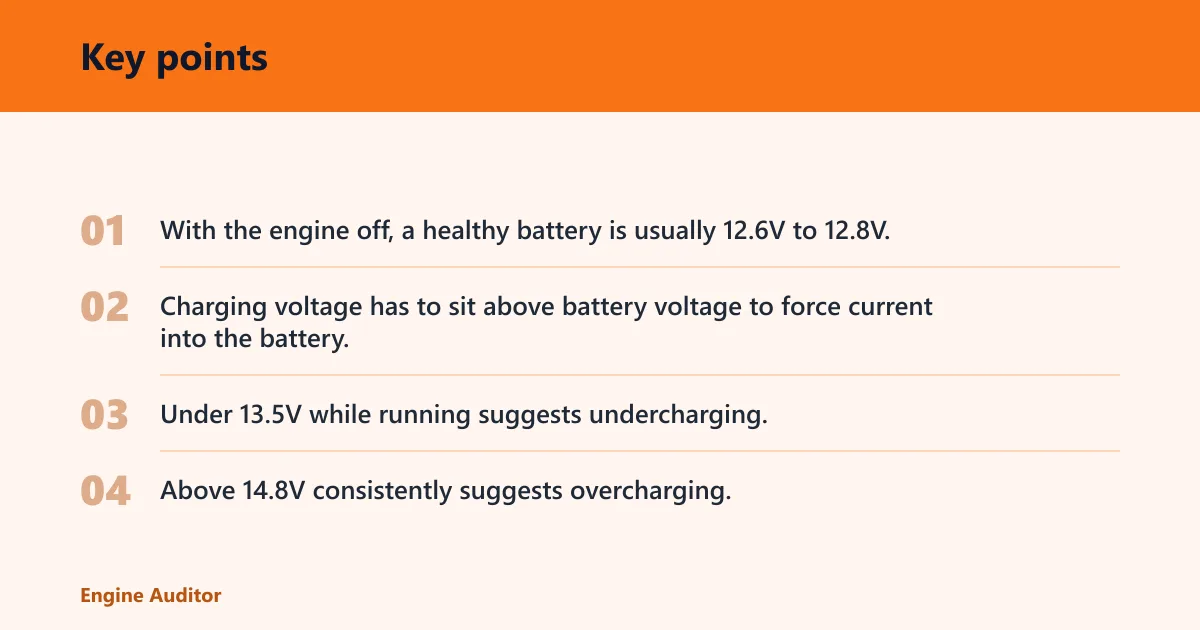


A normal alternator usually charges in the 13.5V to 15V range, but judge the reading against the battery and the test condition. With the engine off, a healthy battery is usually 12.6V to 12.8V. With the engine running, normal charging voltage is about 13.7V to 14.7V, and a steady reading above 14.8V points to overcharging.
What the baseline tells you
Charging voltage has to sit above battery voltage to force current into the battery. That means a running engine should read higher than the engine-off baseline. If the battery is already weak, a low charging system can look worse because the alternator has to feed vehicle loads and recharge the battery at the same time.
When a reading is suspicious
Under 13.5V while running suggests undercharging. Above 14.8V consistently suggests overcharging. Either reading deserves a second check with the same meter at idle, at about 2,000 RPM, and with electrical load applied so you can separate an alternator problem from belt slip, wiring loss, or a battery that is dragging the system down.
Alternator voltage decision table
Use this table as a reading-first guide. Match the engine-off battery voltage, the idle reading, the 2,000 RPM reading, and the loaded reading before you point to the alternator.
| Engine-off battery voltage | Idle charging voltage | 2,000 RPM charging voltage | Accessory-load voltage | Likely fault |
|---|---|---|---|---|
| 12.6V to 12.8V | 13.7V to 14.7V | 13.7V to 14.8V | Stays above 13.5V | Normal charging system |
| 12.6V to 12.8V | Below 13.5V | Rises into the normal range | May dip under load | Weak output at idle, belt slip, or wiring loss |
| Below 12.4V | Below 13.5V | Stays low | Stays low | Battery is weak, alternator output is low, or both |
| 12.6V to 12.8V | Above 14.8V | Above 14.8V | Above 14.8V | Voltage regulator fault, often built into the alternator |
| 12.6V to 12.8V | Normal at idle | Normal at 2,000 RPM | Drops below 13.5V with headlights and blower on | Alternator may be short on amperage under load |
Say your battery reads 12.7V with the engine off, then the running voltage sits at 13.3V at idle and 13.9V at 2,000 RPM. That pattern points away from a dead battery and toward low alternator output at idle, a slipping belt, or voltage loss in the charging wire.
Suppose the same battery reads 12.7V off, but the running voltage climbs to 15.2V and stays there with the headlights on. That is not a weak battery problem. It points much more strongly to a bad voltage regulator, because the regulator is supposed to keep alternator output from climbing into the overcharge range.
What does engine speed change?
Alternator output rises with RPM, so idle voltage can be lower than higher-speed voltage. A reading that looks borderline at idle may become normal at about 2,000 RPM. That is why a good diagnosis uses more than one engine speed instead of one quick glance at the meter.
Idle versus 2,000 RPM
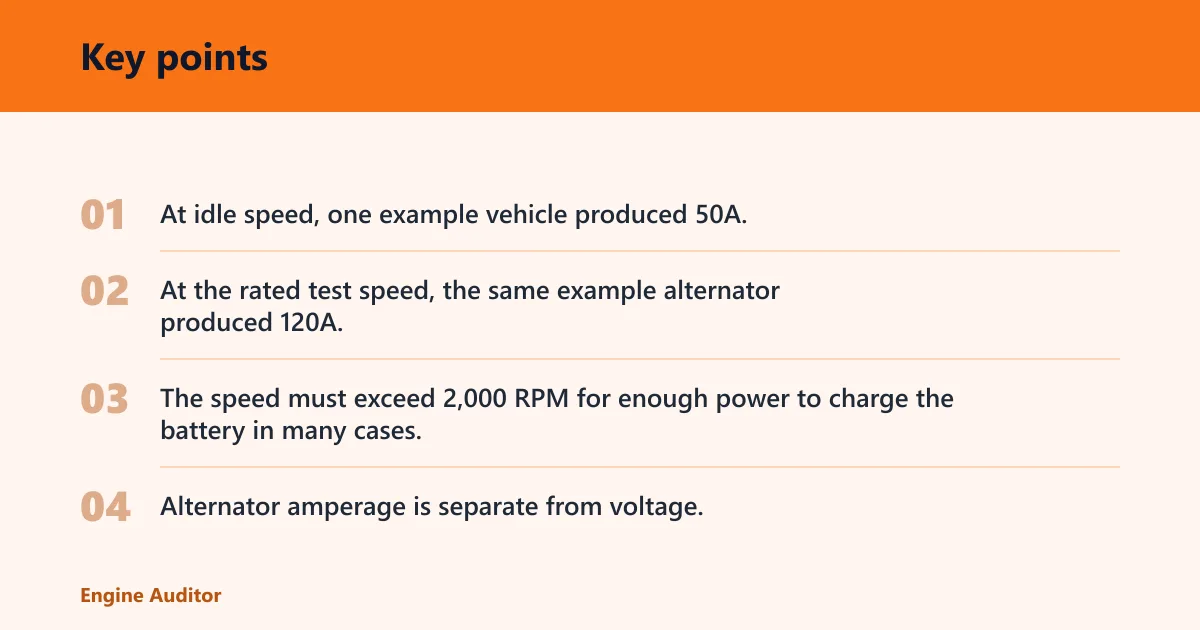
At idle speed, one example vehicle produced 50A. At the rated test speed, the same example alternator produced 120A. The point is not the exact vehicle model. The point is that output climbs with speed, and a slow idle can leave less current available for charging and accessories.
Why the rated speed matters
The speed must exceed 2,000 RPM for enough power to charge the battery in many cases. That does not mean every alternator is useless at idle. It means the alternator may not make full output until speed rises, especially if the battery is low or the electrical system is carrying a heavy load.
Alternator amperage is separate from voltage. A system can show a fair voltage reading and still fail under heavy demand because the alternator cannot supply enough current. Car alternator amperage is often between 40 and 120 amps, while higher-output units for trucks and buses can be rated as high as 430 amps.
What does electrical load do to voltage?
Higher load means more current demand, and that can pull system voltage down if the alternator or wiring is weak. Headlights, the blower fan, heated seats, and the rear defroster all add demand. A healthy system should hold near normal charging voltage under these loads, though a small dip is common.
Headlights and blower fan
Turn on the headlights and the blower fan, then watch the meter at idle and at about 2,000 RPM. If voltage falls below 13.5V and does not recover with engine speed, the charging system may be weak. If the reading only drops a little and then stays in range, that is usually acceptable.
Heated seats and defroster
Heated seats and the rear defroster can push the system harder than many drivers expect. A weak alternator may keep voltage near normal with light loads, then sag when these accessories switch on. That is a clue to inspect current output, belt condition, and charging cable loss rather than blaming the battery alone.
A common first-timer mistake is to treat one low idle reading as proof of failure. If the battery is partly discharged, the alternator has to supply the car and recharge the battery at the same time. The load can make a marginal system look worse at idle than it does at 2,000 RPM.
How does the voltage regulator affect charging?
The voltage regulator controls alternator output and prevents overcharging. Many regulators are built into the alternator assembly, so a failed regulator often means replacing or rebuilding the alternator rather than servicing a separate box. If voltage stays high across engine speeds, the regulator is a prime suspect.
High voltage fault clues
Over 14.8V consistently suggests overcharging, and the battery should not exceed 14.5 volts for long. That range can damage the battery and electronics. A regulator fault is more likely when the voltage is high at idle, high at 2,000 RPM, and still high with accessories on.
AC ripple and diode faults
Alternators should produce very little AC voltage at the battery. Meaningful AC voltage or noticeable ripple usually points to a failing alternator diode or rectifier, not a normal charging condition. If your meter has an AC mode, a rising AC reading alongside charging problems is a warning sign worth checking.
How do you confirm undercharge or overcharge?
Use a multimeter and compare engine-off voltage to running voltage. A good battery baseline is 12.6V to 12.8V engine off. With the engine running, normal voltage is 13.7V to 14.7V. Below 13.5V suggests undercharging, and above 14.8V consistently suggests overcharging.
-
Check the battery first.
Measure battery voltage with the engine off after the car has sat long enough to settle. A healthy battery should read 12.6V to 12.8V. If it is far below that, the charging test still matters, but the battery may already be part of the problem. -
Start the engine and measure again.
Place the meter leads on the battery posts and note the running voltage at idle. A reading in the 13.7V to 14.7V range is normal. If it is below 13.5V, the system may be undercharging. -
Raise engine speed to 2,000 RPM.
Hold a steady fast idle and watch whether voltage climbs or stabilizes. Alternator output rises with RPM, so a weak idle reading that improves here can point to a low-output alternator, belt slip, or a wiring loss that shows up only under load. -
Add electrical load.
Switch on the headlights, blower fan, rear defroster, and heated seats if fitted. A healthy system should stay near normal charging voltage. If voltage drops and stays low, the alternator may not have enough amperage for the demand. -
Recheck for high voltage.
If the running voltage is above 14.8V at more than one speed, suspect the regulator. If it stays high while the battery is already charging hard, overcharging can damage the battery and electronics quickly.
Check the battery during cranking if you need more context. Above 9.6V while cranking is considered normal battery behavior. A battery that collapses well below that may be weak enough to distort the rest of the diagnosis, especially if the alternator is also under stress.
If the charging voltage is low but rises with RPM, look at the belt, tensioner, and charging cables before replacing parts. If the voltage stays low at every speed and under load, the alternator itself is more suspect. If the voltage is high at every speed, think regulator first.
Frequently asked questions
What voltage should a car alternator produce?
A car alternator should usually produce about 13.5V to 15V while the engine is running. For a more useful check, expect about 13.7V to 14.7V at the battery with the engine on. Below 13.5V suggests undercharging. Above 14.8V consistently suggests overcharging.
What voltage does a car alternator produce?
Most passenger cars charge in the mid-13s to mid-14s volts once the engine is running. The exact reading changes with battery state, engine speed, and electrical load. A healthy battery at rest should read 12.6V to 12.8V, so the alternator must charge above that level to be doing useful work.
What ac voltage does a car alternator produce?
A good alternator should produce very little AC voltage at the battery. If the meter shows meaningful AC ripple, that often points to a bad diode or rectifier inside the alternator. Small residual AC is normal, but a noticeable rise alongside charging trouble is not.
How much voltage can a car alternator produce?
For normal charging, do not think in terms of very high voltage. The useful range is usually about 13.5V to 15V, and the battery should not exceed 14.5 volts for long. If the system sits above 14.8V, treat that as an overcharge fault rather than a benefit.
How many volts does an alternator produce?
In normal use, an alternator usually produces a charging voltage in the 13.5V to 15V range. The actual reading depends on engine RPM, load, and regulator control. If the voltage stays near battery resting voltage, the alternator is not charging properly.
Products related to this article
Sponsored / affiliate links. As an Amazon Associate I earn from qualifying purchases. I may earn additional commission from eligible campaigns.