Chevy Models to Avoid: Years with the Most Common Problems
Skip Chevy model years with repeated transmission, timing-chain, or oil-consumption complaints in owner reports and service bulletins, because those years are the ones most likely to bring expensive repairs or unsafe failures. Ignoring them can mean stalled drivability, sudden warning lights, or a repair bill that wipes out the used-car discount. This guide ranks the worst Chevy years by failure type and labels each problem as safety-critical, drivability-killing, or expensive-to-fix.
Chevy years at a glance
Think in failure types, not brand loyalty. A steering defect can make a car unsafe immediately, while an A/C compressor or suspension repair may be costly but still manageable if the rest of the truck or SUV is clean. The risk map below separates those cases so you can decide fast.
For used Chevy shopping, the biggest red flags are repeated engine oil use, timing-chain noise, transmission failure, electric power steering faults, and recall-heavy early production years. Start with the VIN, compare complaint patterns, and treat hard shifts, warning lights, or startup rattle as negotiation points or walk-away signs.
Methodology: Years were labeled avoid, inspect, or consider based on complaint concentration, recall severity, repeat failure type, drivability impact, and repair-cost exposure. A year moves toward avoid when the same symptom appears repeatedly, especially when it overlaps with a recall or a failure that can affect safety, engine health, or transmission function. Years move toward inspect when the pattern is narrower, more condition-dependent, or more likely to be manageable with documented repairs.
Chevy risk matrix
| Model | Year range | Dominant failure type | Typical symptom | Rough repair severity | Buy stance |
|---|---|---|---|---|---|
| Trax | 2015-2017 | Turbocharger, A/C compressor, lower control arm weld recall | Lack of boost, weak cooling, clunks or recall work | High | Avoid |
| Equinox | 2005-2008 | Early first-generation reliability issues | Mixed electrical, drivability, and repair history problems | High | Avoid |
| Equinox | 2010-2015 | Oil consumption, timing chain, transmission, fuel system, electrical | Cold-start rattle, low oil, shudder, warning lights | High | Avoid or inspect carefully |
| Traverse | 2009-2012 | Transmission failure | Slipping, delayed engagement, harsh shifts | High | Avoid |
| Traverse | 2013-2017 | Timing chain issues, 6-speed automatic problems | Rattle at startup, shifting flare, limp mode | High | Inspect carefully |
| Silverado | 2007-2013 | AFM lifter failure, transmission issues | Ticking, misfire, power loss, check-engine light | High | Avoid or inspect carefully |
| Silverado | 2014-2015 | Vibration, early 8-speed transmission bugs | Shudder, hesitating shifts, highway vibration | Medium to high | Inspect carefully |
| Silverado | 2020-2023 | Transmission complaints | Shift flare, rough downshifts, hesitation | Medium to high | Consider with records |
| Malibu | 2013-2016 | Steering and electrical problems | Power steering warning, heavy wheel, dead electronics | High | Avoid or inspect carefully |
Which Chevy model years are the riskiest?
General rule: the riskiest years are the ones with repeated complaints in the same failure category, plus a recall history that matches the symptom. The worst years often sit in the first or early-middle years of a redesign, where engine, transmission, or steering hardware had not settled down yet.
Chevrolet Trax
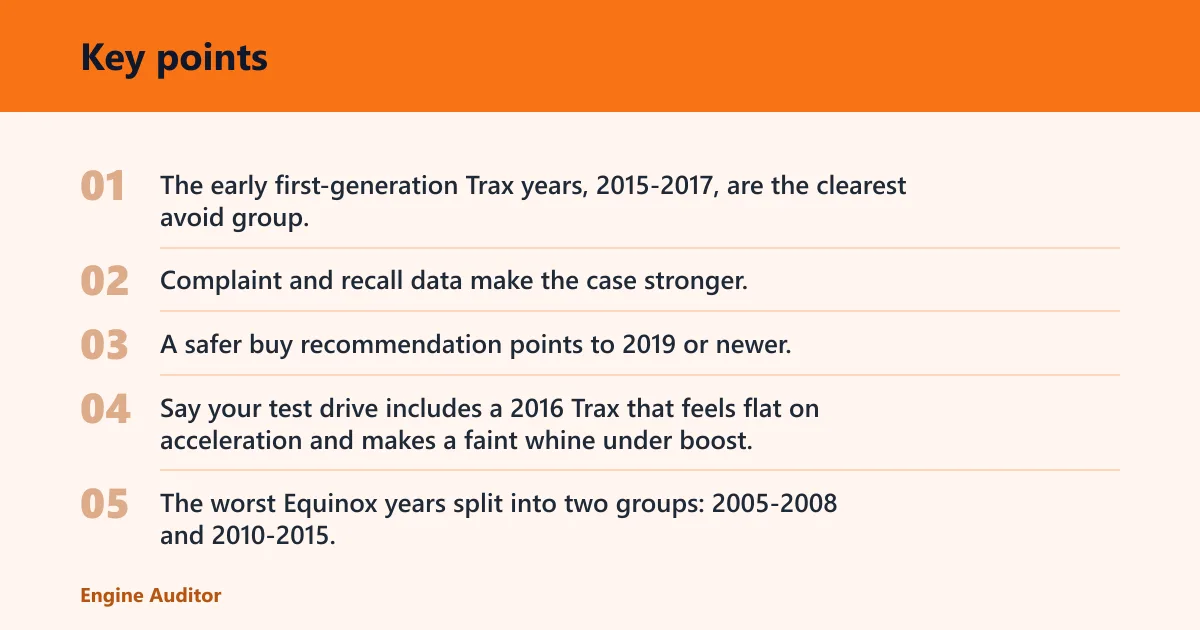
The early first-generation Trax years, 2015-2017, are the clearest avoid group. Those years have well-documented reliability problems, with turbocharger failures, A/C compressor failure, and a lower control arm weld recall that turns a shopping list problem into a safety check.
Complaint and recall data make the case stronger. According to NHTSA complaint and recall records, the 2015 model year is listed with seven recalls, 2016 with five recalls, and 2017 with three recalls. A safer buy recommendation points to 2019 or newer.
Say your test drive includes a 2016 Trax that feels flat on acceleration and makes a faint whine under boost. That combination is not a cosmetic issue. It can point to turbo trouble, which is far more expensive than a simple sensor swap.
Chevrolet Equinox
The worst Equinox years split into two groups: 2005-2008 and 2010-2015. The first group is a broad early first-generation problem zone. The second group is more specific, with oil consumption, timing chain issues, transmission breakdowns, fuel system leaks, and electrical malfunctions.
The complaint counts help separate a noisy rumor from a real pattern. NHTSA complaint records list the 2005 Equinox with 638 complaints, and the 2010 model year with 780 complaints and 3 recalls. The 2013-2015 models also share recurring engine, transmission, and visibility issues.
One especially important subset is the 2010-2012 range with serious 2.4L oil consumption. That issue can lead to low-oil operation, timing-chain wear, and engine damage if the owner stretches oil checks. The engine code and service history matter here, because the risk is concentrated in that powertrain subset rather than every Equinox trim in the same way.
Chevrolet Traverse
The Traverse risk picture changes by generation. The 2009-2012 models are tied to transmission failure, which makes them a poor bet if you need a dependable 3-row SUV. The mid-2010s Traverse models are commonly associated with timing chain issues and 6-speed automatic problems.
That split matters because the symptom pattern changes. A bad transmission often shows up as slipping, delayed engagement, or harsh shifting. A worn timing chain often starts with cold-start rattle, then worsens into drivability problems or engine damage risk. In other words, one failure tends to affect how the vehicle moves, while the other often starts at startup and gets worse over time.
Later Traverse models are generally the better bet if you want a Traverse. The 2018-2020 range is the better bet if you want a Traverse, though any used example still needs records and a cold-start check.
Chevrolet Silverado
The Silverado is a work truck and pickup use case, so buyers often tolerate more wear. That only makes sense if the wear is ordinary. The problem years are 2007-2013 for AFM lifter failure and transmission issues, then 2014-2015 for vibration and early 8-speed transmission bugs. The 2020-2023 trucks also drew transmission complaints.
AFM means Active Fuel Management, Chevy’s cylinder-deactivation system on some engines. On Silverado trucks equipped with AFM, a collapsed lifter can create ticking at idle, misfire, or power loss under load. Repair cost impact can be high because the fix often goes beyond a simple top-end service.
That nuance matters. The issue is not every Silverado engine, and it is not every year in the same way. The strongest risk sits in AFM-equipped engines where the symptom pattern matches the known lifter-failure behavior.
Chevrolet Malibu
The Malibu’s problem years are generally reported as 2013-2016, especially for steering and electrical faults. Electric power steering failure is the headline issue because it can make the wheel suddenly heavy at parking speeds or trigger warning messages that change how the car handles in traffic.
This is one of the cleaner examples of a safety-critical issue versus a cost issue. A dead infotainment screen is annoying. A steering assist failure is a different matter.
What problems show up most often?
The same four failure types repeat across Chevy lines: AFM lifter collapse, timing chain wear, transmission breakdowns, and electrical or steering faults. A/C and suspension issues also show up, but they usually sit below the engine and steering problems in urgency unless the recall history says otherwise.
Active Fuel Management lifter failures
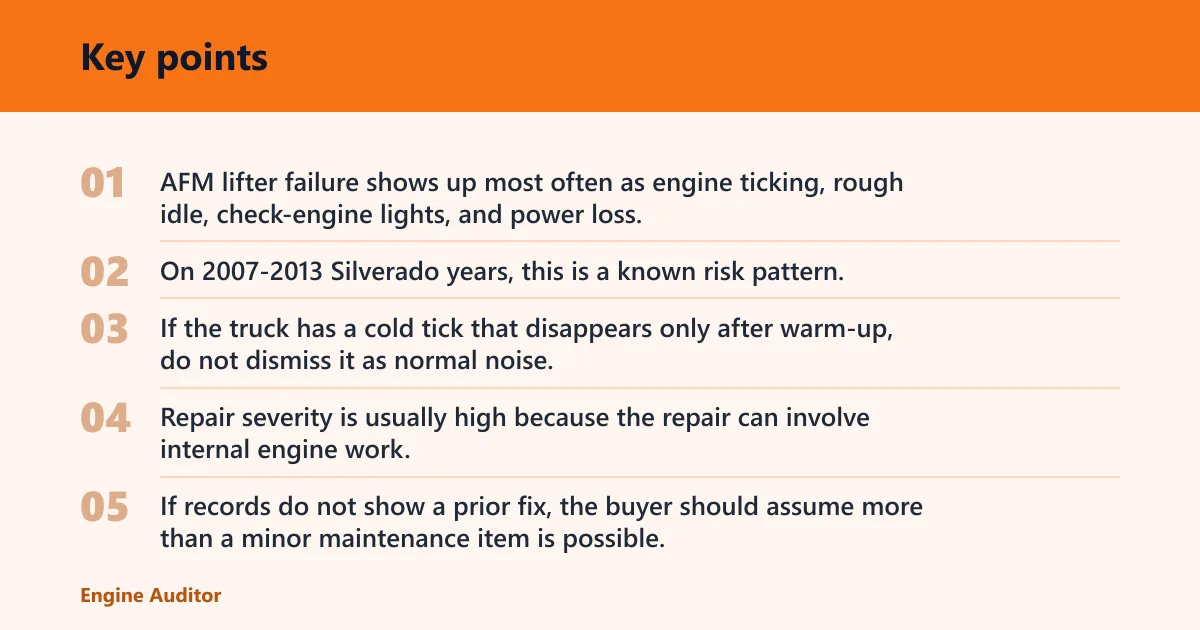
AFM lifter failure shows up most often as engine ticking, rough idle, check-engine lights, and power loss. On 2007-2013 Silverado years, this is a known risk pattern. If the truck has a cold tick that disappears only after warm-up, do not dismiss it as normal noise.
Repair severity is usually high because the repair can involve internal engine work. If records do not show a prior fix, the buyer should assume more than a minor maintenance item is possible.
Timing chain failure
Timing chain failure often starts with a cold-start rattle, then moves into misfires, rough running, or chain-related codes. It appears on multiple Chevy models, especially Equinox and Traverse years in this guide. The risk is not the noise alone. The risk is engine damage if the chain stretches far enough or jumps timing.
Use timing noise as a line in the sand. A brief rattle on startup can still be a warning. A persistent rattle, check-engine light, or low-power feel deserves a pre-purchase pass unless the repair is documented.
Transmission breakdowns
Transmission complaints matter because they can turn a roadworthy SUV or truck into a stranded vehicle. The worst signs are flare between gears, delayed engagement when shifting from park to drive, shudder on light throttle, and hard downshifts on the highway. That pattern appears on Equinox, Traverse, Silverado, and some Trax years.
For a buyer, transmission issues sit between safety-critical and expensive-to-fix. If the unit slips badly or bangs into gear, walk away. If it only has a slight shudder and records show prior service, the car may still be a candidate with caution.
Electrical and steering faults
Electrical malfunctions can be minor, but not when they affect steering assist or critical sensors. Malibu years 2013-2016 are the key example here. A power steering warning on the dash, a wheel that suddenly feels heavy, or intermittent accessory failures should be treated as red flags rather than nuisance problems.
A/C and suspension issues
A/C compressor failure and suspension weld problems are usually expensive or safety-related in a different way. The early Trax years show both. A weak cabin cooler is livable for a while. A suspension recall is not something to shrug off, because it can affect control and alignment.
How do recalls and complaints change the risk?
NHTSA complaints and recalls do not prove that every vehicle is bad, but they do tell you where owners are seeing the same issue over and over. A high complaint count means the symptom is common enough to show up in the public record. A recall means the manufacturer identified a defect pattern that may affect safety or compliance.
Using complaint counts
Complaint counts are best used as a comparison tool, not a score. A year with 780 complaints for one model deserves more attention than a year with a handful of reports, especially if the complaints line up with engine or steering problems.
Look for repetition, not one-off noise. If multiple owners report the same cold-start rattle, shudder, or steering warning, that is more useful than a single dramatic story.
Checking recall counts and VIN status
Count the recalls, then check the exact VIN. A used Chevy can sit in a problematic year and still have completed recall work, or it can sit in a seemingly safer year and still have an open campaign. The VIN recall lookup is the final gate before you move from browsing to negotiating.
- Run the VIN first. Check whether any recalls are open, incomplete, or flagged for stop-sale style work. This takes the guesswork out of the listing photos.
- Match recalls to symptoms. If a listing mentions steering, transmission, or suspension trouble, compare that to the recall history before you schedule a visit.
- Ask for proof of completion. Service invoices are better than verbal reassurance. If the seller cannot produce them, budget time for verification.
What a recall does and does not mean
A recall does not guarantee the vehicle is unsafe today if the repair was completed. It also does not mean every car in that year will fail. What it does mean is that the model year already crossed a threshold where the defect was important enough to track publicly. That should raise your inspection standard.
What should you inspect on a used Chevy?
Focus on the failure type that matches the model year. A cold-start chain rattle on an Equinox means more than a squeak from a trim panel. A Silverado with AFM ticking needs a different inspection than a Malibu with a steering warning light. The goal is to catch the symptom before the sale, not after the first repair bill.
Cold start and idle checks
- Start it cold. Ask that the engine not be warmed up before you arrive. Listen for ticking, rattle, or rough idle during the first 30 to 60 seconds.
- Watch the oil and warning lights. Check for low-oil messages, check-engine lights, and any delayed start behavior. These are especially important on Equinox and Silverado problem years.
- Let it settle. After the first minute, hold a steady idle and watch for misfire shake or stumbling. That can point to AFM lifter or timing-chain trouble.
Transmission and steering checks
- Test low-speed shifts. Move from park to drive and reverse, then roll from 15 to 35 mph. Delays, clunks, or flare are not normal for a clean buy.
- Check highway behavior. At steady throttle, watch for shudder, vibration, or gear hunting.
- Feel the steering assist. Turn at parking speeds and look for heaviness, warning lights, or intermittent assist loss. That is the Malibu risk pattern.
Service records and repair history
- Read the invoices. Look for engine repairs, transmission work, steering components, recall completion, and oil-consumption notes. A clean title does not tell you whether the expensive parts were already replaced.
- Check oil-change intervals. Long gaps can make timing-chain and oil-consumption problems worse. A consistent service log matters more on the known problem years.
- Prefer documented fixes. If a seller can show a repaired turbo, steering rack, or transmission service, the car is easier to price. If not, treat the asking price as a risk premium.
Picture a 2014 Malibu with a steering warning and intermittent radio resets. That is not a cosmetic annoyance. It points to an electrical path that could affect steering assist, so the correct move is to verify the fault before money changes hands.
Best Chevy years to consider instead
If you want a Chevy, the better years are the ones that sit outside the repeated problem windows and have cleaner recall and complaint patterns. That does not make them perfect. It does make them more sensible starting points for a used-car search.
Safer Trax years
For Trax shoppers, the main recommendation is simple: look for a 2019 or newer Trax. That gets you away from the 2015-2017 early first-generation problem years tied to turbo, A/C, and suspension recall issues.
Safer Traverse years
Even then, a clean service history and road test still matter.
Safer Equinox years
For Equinox shoppers, the better choice is to move outside the 2010-2015 problem window and favor later examples with cleaner service history and fewer repeated engine complaints. The key is to avoid the 2.4L oil-consumption subset when the records suggest that powertrain, and to give extra weight to any Equinox that has documented maintenance, completed recalls, and no cold-start noise.
Safer Silverado years
For Silverado shoppers, the better buy is usually a truck with documented maintenance and no sign of AFM lifter issues or transmission shudder, especially if the engine family is one that is less exposed to the known AFM pattern. A truck with clean shifting, consistent oil changes, and no tick at idle is a much safer starting point than one with vague history and bargain pricing.
Safer Malibu years
For Malibu shoppers, prioritize cars with no power steering warnings, no electrical gremlins, and a history that does not overlap the steering-heavy problem years. A clean, well-kept Malibu with no assist issues is far easier to own than one that already hints at electrical instability.
What to look for in cleaner examples
Choose the cleanest records, not just the lowest price. Look for proof of oil changes, transmission service, completed recalls, and no evidence of repeated warning lights. If a seller cannot document major work on a known-risk year, pass or price in a large repair reserve.
Frequently asked questions
What Chevy model years should I avoid when buying used?
Those years concentrate the most repeated engine, transmission, steering, and recall-related complaints.
Which Chevy models have the most common problems by year?
Equinox, Traverse, Silverado, Malibu, and early Trax models show the most recurring year-specific problems. The pattern is strongest where complaints and recalls line up with the same failure type, such as oil consumption on Equinox, AFM lifter failure on Silverado, or steering faults on Malibu.
Are early Chevy Trax years reliable?
No. The 2015-2017 Trax years are the early first-generation problem years and have well-documented reliability problems. Turbocharger failures, A/C compressor failure, and a lower control arm weld recall make them poor used buys unless the price is unusually low and the records are excellent.
Which Chevy Equinox years are the worst?
How do I check if a used Chevy has known issues or recalls?
Start with the VIN recall lookup, then compare the model year to complaint-heavy patterns in owner reports and service bulletins. If the car sits in a known problem range, ask for repair invoices and recall completion records before you inspect the vehicle in person.
What should I inspect on a used Chevy before I buy it?
Check for cold-start rattle, ticking, shudder, hard shifts, steering warnings, and oil-related alerts. Then verify service records, recall completion, and any prior engine or transmission work. A clean test drive matters, but a clean paper trail matters almost as much.
Products related to this article
Sponsored / affiliate links. As an Amazon Associate I earn from qualifying purchases. I may earn additional commission from eligible campaigns.