What Is a Luxury Vehicle Type and What Sets It Apart?
A luxury vehicle type delivers a quiet ride, high-grade materials, strong power, and advanced convenience as standard equipment. If those traits only appear on a top trim, it is usually premium, not luxury. Misreading the badge can leave you paying luxury money for a dressed-up mainstream model. This guide shows how luxury differs from premium and gives you a quick in-person test.
What counts as a luxury vehicle?
A luxury vehicle is judged by the experience it delivers, not by price alone. The cabin should feel quiet, the materials should feel substantial, the controls should respond cleanly, and the ride should filter out rough pavement without feeling vague. Luxury cars are typically positioned to emphasize refinement, comfort, technology, and craftsmanship rather than a single performance or equipment metric.
Core traits that matter
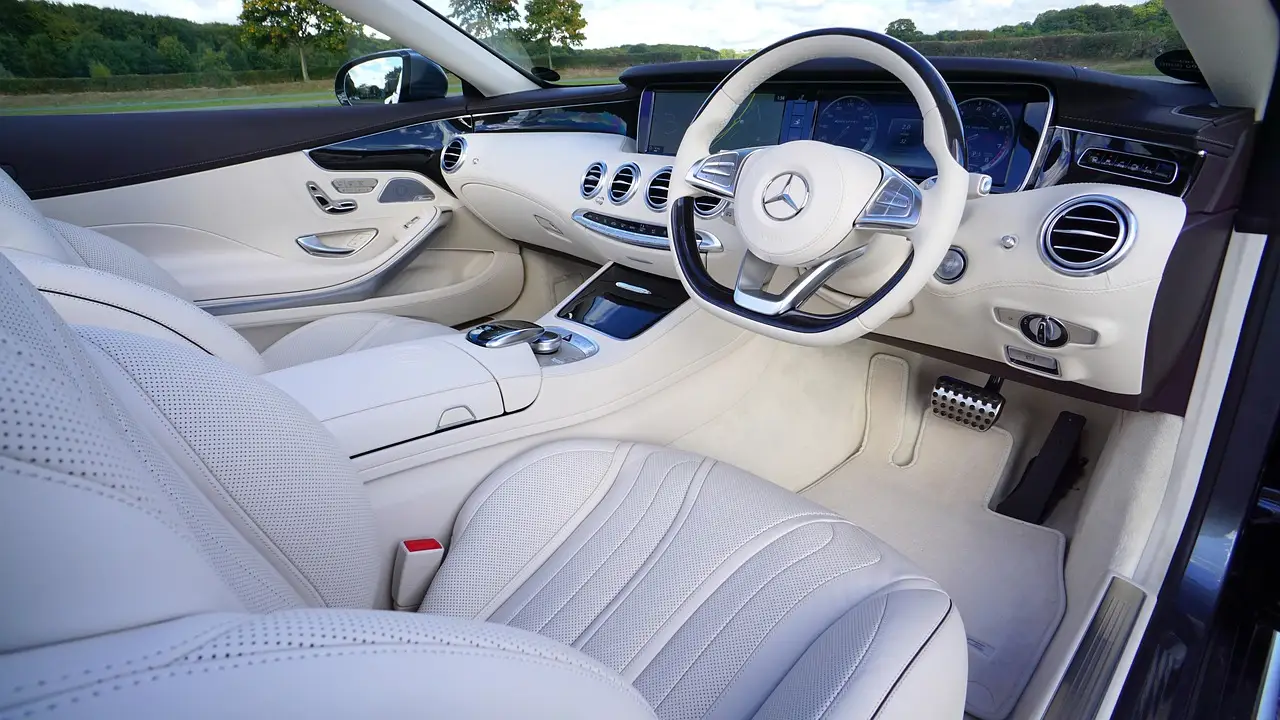
Higher-quality materials are part of the answer, but they are only one part. A true luxury vehicle also needs controlled noise, careful chassis tuning, seat design that supports you, and technology that feels built into the car rather than pasted on. Luxury cars are often associated with higher-grade interiors, thoughtful packaging, and smooth, low-stress operation.
That combination matters because a nice badge can hide ordinary bones. A vehicle can wear upscale trim, a large screen, and stitched surfaces while still sending too much road noise into the cabin, feeling busy over broken pavement, or using the same basic suspension tuning as a volume-brand model. For a broader vehicle-category context, see vehicle body style vs vehicle type and luxury SUV vs premium SUV.
Why a badge alone is not enough
Brand prestige can raise expectations and support resale claims, but it does not prove luxury by itself. Pricing can reflect materials, engineering, production volume, and brand positioning, so the sticker is only one signal. The real test is whether the vehicle feels meaningfully quieter, calmer, and better finished in everyday use than a mainstream model with similar equipment.
A useful rule of thumb is to include a short loop on coarse asphalt and speed bumps in the test drive. If the seat cushions, suspension, and cabin isolation all feel ordinary until you switch to a top package, that is a strong sign you are looking at a premium trim rather than a true luxury platform.
Luxury vs premium: what is the difference?
Premium usually means an upscale step up from mainstream, often with better trim, added technology, or a more polished badge. Luxury goes further. It should deliver a more complete cabin and ownership experience, with stronger exclusivity, clearer craftsmanship, and a calmer, more refined feel in everyday use.
Where premium fits
Premium vehicles can be very good. They may include leather, bigger displays, better audio, and extra driver aids. The difference is that these features often sit on top of a mainstream structure, so the vehicle may still sound, ride, or feel like a normal car beneath the packaging.
Where luxury goes further
Luxury is less about a long options list and more about depth. The doors should close with a solid sound, the seats should support you without pressure points, the controls should be easy to use, and the car should stay composed on poor roads. Stronger brand heritage and more customization often reinforce that feeling.
A common first-timer mistake is treating a premium badge package as proof of luxury. If the seating is ordinary, the road noise is average, and the rear seat feels like a compact family car with extra chrome, the car may be expensive without delivering the full luxury experience.
Which vehicle types can be luxury models?
Luxury vehicles can include sedans, SUVs, coupes, sports cars, hybrids, and EVs. The body style does not decide the category by itself. What matters is whether the vehicle delivers the expected level of refinement, comfort, technology, and ownership experience for its segment.
Luxury sedans
Luxury sedans usually prioritize a quiet cabin, refined ride quality, rear-seat comfort, and a technology-heavy interior. They tend to feel road-focused and settled, with lower seating and smoother motion over long distances. They are often the clearest example of luxury because their structure supports isolation and calm.
Luxury SUVs
Luxury SUVs are not defined by being wagon-like. They are generally taller, more upright vehicles with a raised seating position, available all-wheel drive in many trims, and an emphasis on space, visibility, and flexibility. Their luxury credentials come from refinement, ride quality, and a well-finished cabin, not from a single body-style template.
Size classifications vary by market and manufacturer, so a simple length rule is not reliable. Many compact and midsize luxury SUVs overlap in footprint with mainstream crossovers, while full-size luxury SUVs can stretch much longer. Drivetrain choices also vary widely: many offer gasoline turbocharged engines, hybrids, and electric powertrains rather than any one cylinder count or fuel type. For segment context, see luxury SUV comparisons.
Luxury coupes, sports cars, hybrids, and EVs
Luxury coupes and sports cars trade some practicality for style and sharper handling, but they still need refinement, strong material quality, and a well-finished cabin. Hybrid luxury vehicles add electrified assistance, smoother low-speed operation, and potential efficiency benefits, while electric luxury vehicles trade engine character for quiet operation, immediate power delivery, charging access, range planning, and battery warranty considerations. For more on coverage, see EV battery warranty basics.
How luxury SUVs differ from luxury sedans
Luxury SUVs and luxury sedans can both be quiet and well equipped, but they are built for different priorities. SUVs give you a taller driving position, more cargo flexibility, and easier access for some passengers. Sedans usually give you a lower, calmer, more road-focused feel with stronger cabin isolation.
Structure and seating
The SUV body brings more vertical space, a raised floor, and a higher hip point. That can help with entry, exit, and visibility. A sedan sits lower, which often helps it feel more planted and more aerodynamic, and can reduce the amount of wind and tire noise that reaches the cabin.
Ride feel and everyday use
Luxury sedans usually feel more settled at speed and more isolated from road texture. Luxury SUVs can still ride well, but their higher body and weight can make suspension tuning more demanding. In daily use, the SUV usually wins on flexibility; the sedan usually wins on quietness and composure.
Why luxury vehicles cost more
Luxury pricing reflects more than a badge. Higher material quality, tighter assembly standards, more sound insulation, more advanced powertrains, and more careful chassis tuning all add cost. The market also prices in brand positioning, feature content, and the ownership experience buyers expect from the segment.
Craftsmanship and material quality
Heavier use of soft-touch materials, real metal trim, better seat frames, and more exact cabin fit all add cost. So do the labor hours needed to assemble details that mainstream vehicles may simplify. Limited production can also push pricing upward, especially when the maker builds fewer units and offers more personalization.
Technology and engineering
Luxury vehicles often carry more advanced infotainment, better audio, driver assistance systems, and more complex suspensions or powertrains. Those features matter only if they work well together. A large display is not a luxury feature if it lags, distracts, or sits in a cabin that still feels loud and harsh.
Brand prestige and pricing
Brand prestige can support higher transaction prices and stronger resale-value claims, but it should never be the sole reason to buy. Because pricing shifts by model, trim, market, and incentives, a single brand-wide price example can age quickly. A better rule is to compare the vehicle’s content, refinement, and ownership costs against similarly positioned rivals.
Luxury vehicle reality check
Use this table as a quick filter for the checklist. A luxury vehicle is commonly expected to score yes on most rows, especially those tied to quietness, ride control, seat quality, and ownership support. If several answers are no, the car may be premium or upscale rather than truly luxury.
| Criterion | Yes means | No is a warning sign | Score |
|---|---|---|---|
| Cabin quietness | Low road, wind, and tire noise at city and highway speeds | You hear coarse pavement, mirror noise, or engine drone too easily | Yes / No |
| Seat materials | Surfaces feel durable, soft where needed, and well shaped | Trim looks upscale but feels thin, slick, or hard in contact areas | Yes / No |
| Rear-seat comfort | Adults have usable legroom, support, and easy entry | The back seat feels like an afterthought for short trips only | Yes / No |
| Ride isolation | Sharp pavement and expansion joints are filtered cleanly | The body fidgets, crashes, or follows every road seam | Yes / No |
| Powertrain refinement | Acceleration feels smooth, calm, and well controlled | Transmission hesitates, engine sounds coarse, or EV calibration feels abrupt | Yes / No |
| Tech integration | Displays, controls, and driver aids work together without fuss | Menus are cluttered, responses are slow, or features feel bolted on | Yes / No |
| Warranty coverage | Coverage clearly fits the vehicle type and powertrain, including battery terms for EVs | Terms are vague, short, or leave expensive systems exposed | Yes / No |
| Service access | There is a nearby dealer or qualified service center with parts support | You face long travel times or uncertain repair scheduling | Yes / No |
| Depreciation risk | You can explain why this model should hold value in your market | The car is likely to lose value quickly because demand is thin | Yes / No |
| Ownership cost signals | Tires, insurance, fuel or electricity, and software fees all look manageable | Each of those costs is meaningfully higher than you planned | Yes / No |
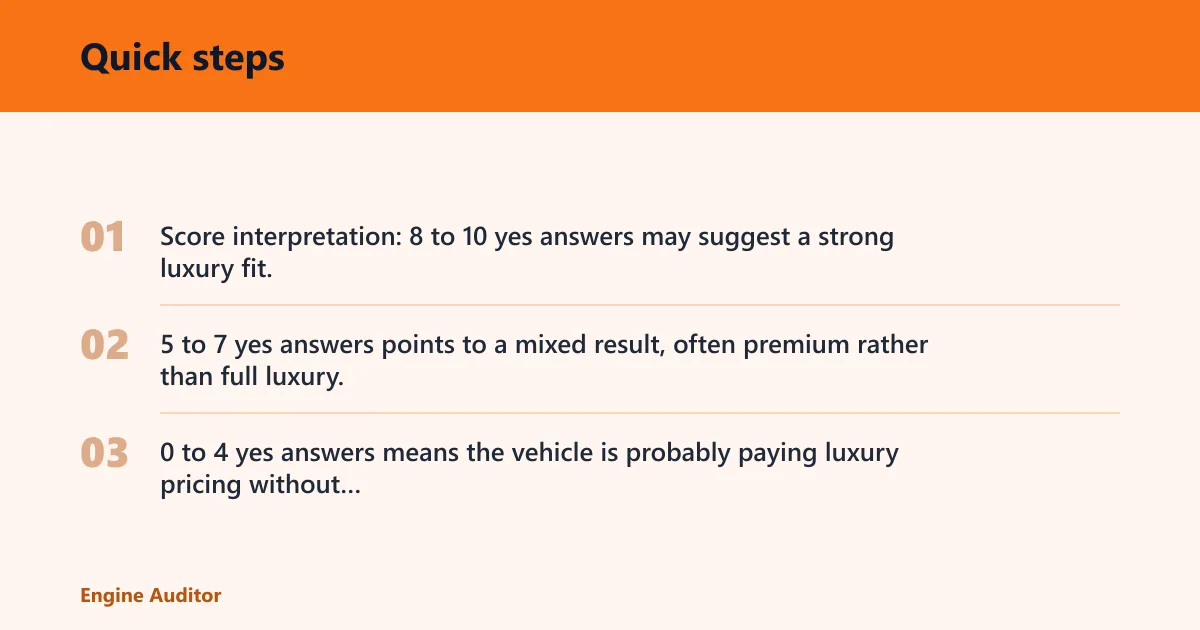
Score interpretation: 8 to 10 yes answers may suggest a strong luxury fit. 5 to 7 yes answers points to a mixed result, often premium rather than full luxury. 0 to 4 yes answers means the vehicle is probably paying luxury pricing without delivering luxury depth.
| Shared criterion | Premium | Luxury |
|---|---|---|
| Cabin quietness | Improved over mainstream, but not always fully hushed | Consistently calm at city and highway speeds |
| Seat quality | Comfortable and well trimmed | Supportive, durable, and carefully shaped for long-distance use |
| Ride quality | More polished than average | Clearly isolated, composed, and carefully tuned |
| Technology | Well equipped and often feature-rich | Integrated so it feels natural, not added on |
| Ownership experience | Can be upscale, but sometimes cost-conscious underneath | Built to feel special in daily use and after-sale support |
What should you compare before buying?
Compare the car in person, not just on a screen. Focus on quietness, seat support, suspension control, control layout, and how the technology behaves when you need it quickly. Then compare ownership costs, because a luxury vehicle can be expensive to buy and expensive to keep.
- Drive on rough pavement and note cabin noise, steering feel, and body motion.
- Check the front seats and rear seats for support, adjustability, and comfort after 15 minutes.
- Test the infotainment system, voice control, climate controls, and driver aids without help.
- Confirm warranty coverage, including battery warranty for EVs and any powertrain exclusions.
- Ask about insurance, maintenance intervals, tire prices, and software subscriptions.
- Estimate fuel or electricity use and depreciation before you decide.
Suppose you are choosing between a luxury SUV and a midsize sedan. The SUV gives you a higher seat and more cargo flexibility, but the sedan may be quieter, less expensive to insure, and better at isolating road noise. The better choice depends on which trade-offs matter more to you.
Total cost of ownership matters as much as the sticker. Purchase price is only the first line item. Insurance, maintenance, fuel or electricity, depreciation, tires, and software-related costs can change the real monthly burden by a wide margin, especially on higher-spec models and EVs. For a deeper breakdown, see total cost of ownership guide.
Frequently asked questions
What is a luxury vehicle type?
A luxury vehicle type is a car, SUV, coupe, sports car, hybrid, or EV that delivers a quieter cabin, better materials, stronger comfort, and more advanced features than a typical mainstream model. The key test is whether those traits are built into the vehicle’s core experience, not added only at the top trim.
What makes a car a luxury vehicle instead of a regular car?
A luxury car stands out through cabin quietness, ride isolation, material quality, powertrain refinement, and technology that feels well integrated. A regular car can borrow some of those features, but if the structure, suspension, and cabin feel ordinary, it is usually an upscale mainstream model rather than true luxury.
Is luxury just about price and brand?
No. Price and brand can point in the right direction, but they are not enough. A luxury vehicle should feel better to use every day, from the way it rides to the way the interior materials, seats, and controls work together. Badge value alone cannot prove that.
What features are common in luxury vehicles?
Common features include higher-quality upholstery, quieter cabins, stronger seat adjustment, larger displays, better audio, more driver assistance tech, and smoother power delivery. Those features only count if they are paired with good integration, solid ride control, and a cabin that feels calm over real roads.
What is the difference between luxury and premium cars?
Premium cars are usually upscale versions of mainstream vehicles or a step up in brand positioning. Luxury cars should deliver a more complete experience, with stronger refinement, more exclusivity, better customization, and a more convincing sense that the vehicle was designed from the start to feel special.
Do luxury vehicles always have better performance?
No. Many luxury vehicles are quick, but performance is not the only measure. Some luxury models focus more on quietness, comfort, and smoothness than outright speed. A strong luxury vehicle can be relaxed rather than aggressive, as long as the powertrain feels refined and responsive when needed.
Why are luxury vehicles more expensive?
They cost more because of better materials, more labor, advanced technology, refined powertrains, careful chassis tuning, and often lower production volume. Brand prestige can also raise prices. For buyers, the important question is whether the extra cost shows up in the way the vehicle feels, rides, and lasts.
Sources
- U.S. Environmental Protection Agency, Fueleconomy.gov: ownership-cost and fuel-economy guidance
- Consumer Reports: total ownership cost and depreciation coverage for vehicles
- J.D. Power: luxury vehicle and premium vehicle market-positioning coverage
- Manufacturer warranty documentation for new-vehicle and battery coverage terms
- Industry segment definitions and model-line specifications from manufacturer and market sources
Products related to this article
Sponsored / affiliate links. As an Amazon Associate I earn from qualifying purchases. I may earn additional commission from eligible campaigns.