How Does a Bad Wheel Bearing Sound at Low Speed?
A bad wheel bearing at low speed often makes a humming, growling, or rumbling noise that changes with vehicle speed, and it may get louder when you turn or load that corner. Ignoring it can let play worsen, damage the hub, and in severe cases create unsafe wheel looseness. This guide explains how to separate wheel-bearing noise from tire, brake, and CV-joint sounds in parking lots and stop-and-go driving.
Why bad wheel bearing noise follows road speed

At low speed, a failing wheel bearing most often sounds like a hum, growl, rumble, or drone. Some drivers describe it as a low airplane-like drone. The sound tracks road speed, not throttle position or engine RPM, so it rises as the car rolls faster even if the engine note stays the same.
How the sound changes as speed rises
Early bearing noise can be faint at parking-lot speed and become clearer in neighborhood driving. Detroit Axle notes that early-stage noise may show up at 40–60 mph, but a bearing can still make itself known sooner if the damage is progressing. As wear gets worse, the tone can sharpen from hum to growl, then to grinding or metallic scraping.
A common pattern is that each wheel rotation can add more noise. A sound that changes with vehicle speed is much more suspicious than a sound that follows engine revs in park or neutral.
Why the noise is tied to wheel speed, not engine rpm
A wheel bearing supports wheel rotation with low friction. When the rolling surfaces pit or lose their smooth finish, the noise comes from that wheel motion itself. The same source says the noise is directly related to wheel rotation rather than throttle input, which is why a steady-speed roll through a parking lot can make the problem obvious.
Does a bad wheel bearing make noise at low speeds?
Yes. A bad wheel bearing can make noise at low speeds, especially once the wear is past the first faint stage. Some bearings stay quiet until road speed builds, while others are noisy in a straight line at neighborhood speeds and only change a little in turns. That uneven behavior is common.
Why some bearings are quiet at first
Early wear may affect only part of the race or rolling surface. At very low speed, the damaged area may not load enough to create a clear sound. As the wheel rotates faster, the defect passes under load more often, so the hum or growl becomes easier to hear.
Suppose a compact SUV makes a soft drone only between 20 and 35 mph, then seems quiet again above that range. That pattern can still fit a bearing, because road noise and tire noise can mask it at other speeds. A single speed window does not rule it out.
Why neighborhood speeds can make the noise obvious
Slow traffic, parking lots, and residential streets are useful because other sounds are lower. A failing bearing can stand out there as a steady hum, then disappear under wind and tire noise at faster speeds. That is why drivers often notice it first during stop-and-go driving, not on the highway.
How turning changes wheel bearing noise
Turning changes load across the car, and that load shift can make a bearing louder, quieter, or slightly higher in pitch. In many vehicles, left turns tend to load the right side more, and right turns tend to load the left side more. The change is a clue, not absolute proof, because some bearings are noisy even when driving straight.
Left turn versus right turn load transfer
The same source says a stronger noise when turning left can indicate a right-side bearing, and a stronger noise when turning right can suggest a left-side bearing. The reason is simple. The outside wheel in a turn carries more load, so the damaged bearing on that side can complain more loudly.
That turn clue is helpful when the noise changes clearly. It is less helpful when the bearing is already advanced or when tire wear and road surface noise are strong enough to blur the pattern.
Why a front bearing changes more than a rear bearing
Front bearings are more responsive to steering input because they sit on the corner that is being steered. That makes their noise more likely to shift in tone or volume during a turn. Rear bearings usually make a steadier drone and may react less dramatically, which is why they are easier to confuse with tire or exhaust noise.
Picture a sedan that hums on straight suburban streets and gets a little louder on left bends but only slightly. That can still be a right-front bearing. A turn test does not need a dramatic change to be meaningful.
How bad wheel bearing table
This table gives a quick path from sound to likely source. Use it with speed, turn load, and warning lights together. One symptom alone is not enough for a final call.
| Sound | When it happens | How it changes in a left or right turn | Likely side | Likely source | Urgency |
|---|---|---|---|---|---|
| Soft hum or low drone | Low-speed rolling, often more noticeable in quiet streets | May get slightly louder on the outside of the turn | Either side, often front if steering changes it | Wheel bearing | Mild, but inspect soon |
| Growl that builds with road speed | Parking-lot exit, stop-and-go traffic, neighborhood speeds | Often stronger when the bad side is loaded | Right side if louder in a left turn; left side if louder in a right turn | Wheel bearing | Prompt inspection |
| Rumble that changes little with throttle | Any speed where the wheel is rolling | May change only a little in turns | Often rear if the sound is steadier | Wheel bearing or tire wear | Prompt inspection |
| Metallic scraping or grinding | Late-stage bearing wear, sometimes even at low speed | Usually worse when loaded, but may be loud straight ahead | Either side | Wheel bearing; also check brake parts | Urgent |
| Rhythmic roar that follows road texture | Changes with pavement and tire surface | May shift with lane position more than with turns | Either side | Tire wear pattern | Inspect soon |
| Clicking on tight turns | Low-speed turns, parking maneuvers | Gets worse while steering sharply | Usually the side opposite the turn if outer joint is loaded | CV joint | Prompt inspection |
| Squeal or rub that changes with brake pedal use | Light braking or constant brush contact | Usually little turn effect | Could be any wheel | Brake drag or rotor rub | Prompt inspection |
What else can sound similar at low speed?
The main look-alikes are tire wear, brake drag, CV joint noise, and sometimes driveline or exhaust sounds. Tire wear is the easiest to miss because cupping, feathering, scalloping, or saw-tooth wear can create a hum or roar that changes with pavement. That noise can sound very close to a bad bearing.
Tire wear patterns that mimic bearing noise
Uneven tread wear can make a repeating roar that seems to come from one corner. The noise often changes with road surface and lane position, which can fool drivers into blaming a bearing. A quick visual check for cupping, feathering, scalloping, or saw-tooth wear helps sort that out.
Brake drag or rotor rub
Brake issues usually sound different from a bearing because the noise may change when you press the pedal or after the brakes heat up. A rotor shield or pad drag can make a scrape or rub at low speed. If the sound changes right when braking, inspect the brakes before assuming the hub is bad.
CV joint clicks and other driveline noise
CV joint problems usually show up as clicking or popping during tight turns, especially at low speed. That sound is sharper than bearing hum. Driveline or exhaust noises are less tied to one wheel corner and often do not change the same way with left-right load transfer.
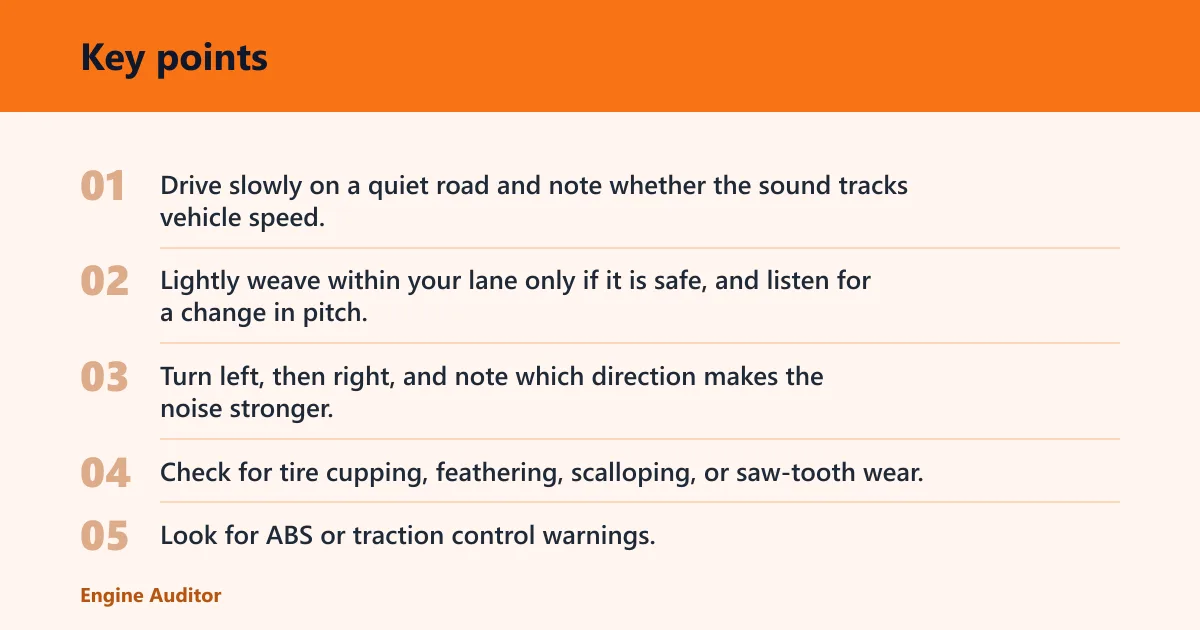
- Drive slowly on a quiet road and note whether the sound tracks vehicle speed.
- Lightly weave within your lane only if it is safe, and listen for a change in pitch.
- Turn left, then right, and note which direction makes the noise stronger.
- Check for tire cupping, feathering, scalloping, or saw-tooth wear.
- Look for ABS or traction control warnings, which can happen when a loose bearing affects the wheel speed sensor.
- If the noise becomes a grind or scraping sound, stop planning a diagnosis and arrange inspection.
Front vs rear wheel bearing symptoms
Front and rear bearings can both make a hum or growl, but they often behave differently. Front bearings usually react more to steering input and may add steering wheel vibration or a slight pull. Rear bearings are often steadier and can be mistaken for tire roar, road noise, or even exhaust resonance.
Front bearing clues
A front bearing is more likely to change with steering load and may make the wheel feel slightly rough or vague. In some vehicles, a loose front bearing can also disturb the wheel speed sensor and trigger ABS or traction control warnings. That makes dashboard lights a useful clue, though not a guarantee.
Rear bearing clues
A rear bearing often produces a steadier drone that seems to come from the back of the car even when the sound source is not obvious. Because rear noise changes less with steering, it is easier to confuse with tire wear or an exhaust tone. That is why a careful speed test matters.
When should you stop driving?
Faint bearing noise usually means the car should be inspected soon, not ignored. Grinding, metallic scraping, a hot hub, wheel play, or ABS and traction-control warnings move the issue into urgent territory. A bearing can fail in stages, and late-stage wear can damage the hub assembly or create unsafe looseness.
What makes the issue urgent
If the noise becomes a grind, the bearing may be close to metal-on-metal contact. Late-stage bearing noise can sometimes become metallic scraping or grinding at low speeds. That is the point where driving should be limited until the wheel end is checked.
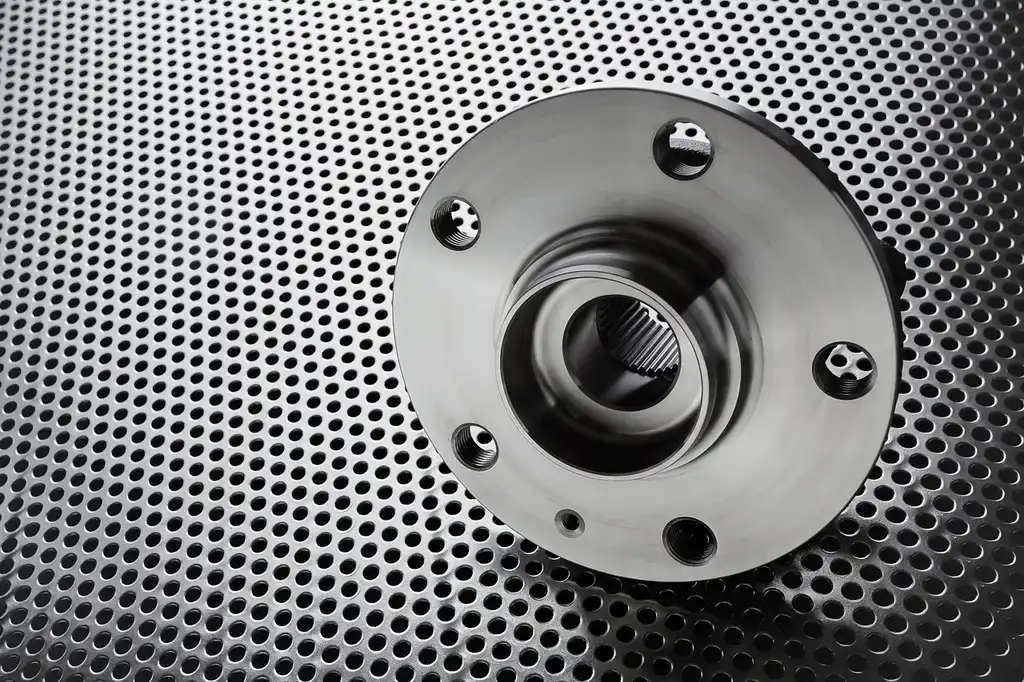
The wheel hub assembly houses the bearing in many modern vehicles, and it may also include the wheel speed sensor. When the bearing is integrated into the hub, the replaceable unit is often the whole assembly rather than the bearing alone. That is why a shop may quote a hub assembly instead of a separate bearing.
Frequently asked questions
What does a bad wheel bearing sound like at low speeds?
A bad wheel bearing at low speeds usually sounds like a hum, growl, rumble, or low drone. The sound often becomes easier to hear as the car rolls faster, and it may change when you turn because the load moves to one side of the car.
Does wheel bearing noise get louder with speed?
Usually, yes. A failing wheel bearing commonly makes a growl or hum that gets louder as speed increases, because the noise is tied to wheel rotation. If the sound follows vehicle speed more than throttle input, the bearing moves higher on the list.
What does a bad wheel bearing sound like when driving slow?
When driving slow, a bad wheel bearing often sounds like a steady hum or rumble that follows the car, not the engine. It may grow louder during gentle turns or lane changes, and a front bearing is more likely to respond to steering input than a rear one.
What does a failing wheel bearing sound like?
A failing wheel bearing can begin as a faint hum, then shift to a growl or rumble, and finally become grinding or metallic scraping. The exact sound depends on how far the bearing has worn, but the common thread is that the noise follows road speed and often changes under load.
What does a bad wheel bearing sound like at high speed?
At high speed, the same fault often sounds like a louder drone, growl, or roar that can blend with tire noise. Some drivers notice it most around 40–60 mph, while late-stage damage may keep scraping or grinding even at lower speeds.
Products related to this article
Sponsored / affiliate links. As an Amazon Associate I earn from qualifying purchases. I may earn additional commission from eligible campaigns.