Vehicle Types for Fuel Economy: Which Bodies Use Less Gas?
Sedans and hatchbacks usually burn the least fuel. Compact, low-roof models often beat crossovers by roughly 5 to 15 mpg. Trucks usually burn the most. Pick the wrong body type and you can pay more at the pump for every mile, even before trim, drivetrain, and engine changes. This guide ranks sedan, hatchback, crossover, SUV, minivan, and truck shapes by gas use and points out the cases where a larger vehicle can return better mpg.
Which body types use less gas?
Sedans and hatchbacks usually lead the fuel-economy list because they sit lower, weigh less, and cut through air more cleanly. Trucks and tall SUVs usually land near the bottom because they carry more mass and push more air, especially at highway speed. Crossovers and minivans usually fall in the middle.
Why sedan shape usually helps mpg
A sedan usually has a lower roofline, a smaller frontal area, and less body mass than a taller utility vehicle. Those traits matter most at steady speed, where aerodynamic drag rises fast as speed climbs. A sedan with front-wheel drive and a smaller engine usually has a clear edge over a taller vehicle with the same power.
Where hatchbacks fit in the ranking
Hatchbacks often match or come close to sedans because they share the same basic car platform. They are often short and light, which helps city fuel economy. The open rear hatch adds usefulness without forcing the taller stance of an SUV, so many hatchbacks keep strong mpg while offering easier cargo loading.
Why trucks and tall SUVs usually land near the bottom
Pickup trucks and large SUVs usually carry more weight, sit higher, and present more surface area to the wind. An open bed, large grille opening, four-wheel drive, and heavy-duty suspension parts can all add drag or mass. Those traits raise fuel use in city driving and usually hurt highway mileage too.
What does the ranking look like by body type?
The broad ranking below reflects the way body style affects fuel use before trim and engine details are added. Smaller, lower, lighter vehicles usually rank best. Taller, heavier vehicles usually rank worst. The biggest swing comes from aerodynamics on the highway and curb weight in stop-and-go traffic.
| Body type | Fuel-economy tendency | City tendency | Highway tendency | Aerodynamics | Curb weight | Ride height | Drivetrain availability | Why it tends to rank here |
|---|---|---|---|---|---|---|---|---|
| Hatchback | Usually among the best | 1-2 | 1-3 | Low roof, small frontal area | Often light | Low | Usually FWD, sometimes AWD | Low mass and compact size help both city and highway mpg; AWD can trim roughly 1-4 mpg versus comparable FWD models |
| Sedan | Usually among the best | 1-2 | 1-2 | Low drag shape | Usually lighter than SUVs | Low | Commonly FWD, also AWD or RWD | Lower ride height and cleaner airflow help especially at speed; added AWD and larger wheels can reduce mpg by about 1-4 mpg |
| Minivan | Often better than SUVs, worse than small cars | 3-4 | 3-4 | Boxier than a sedan, but car-based | Medium to high | Moderate | Usually FWD, sometimes AWD | More space raises weight and frontal area, but car-based packaging usually keeps the mpg penalty smaller than many SUVs of similar size |
| Compact SUV | Middle of the pack | 4-5 | 4-5 | Taller and less clean in the wind | Often heavier than cars | Higher | FWD and AWD are both common | Extra height and weight typically cost mpg; AWD commonly lowers fuel economy by about 1-3 mpg compared with FWD in similar models |
| Midsize SUV | Usually below compact SUV | 5-6 | 5-6 | Larger frontal area | Usually heavier | Higher | Often AWD or 4WD, sometimes FWD | More passenger and cargo room usually means more mass and drag, and 4WD/AWD hardware can add further losses versus FWD versions |
| Pickup truck | Usually worst among mainstream body types | 6 | 6 | High drag, open bed, tall stance | Often heavy | High | Often RWD or 4WD | High stance, large frontal area, and heavier powertrains usually place trucks at the bottom; 4WD, crew cabs, and larger beds can cut mpg further |
Aerodynamics column: what it means for highway mpg
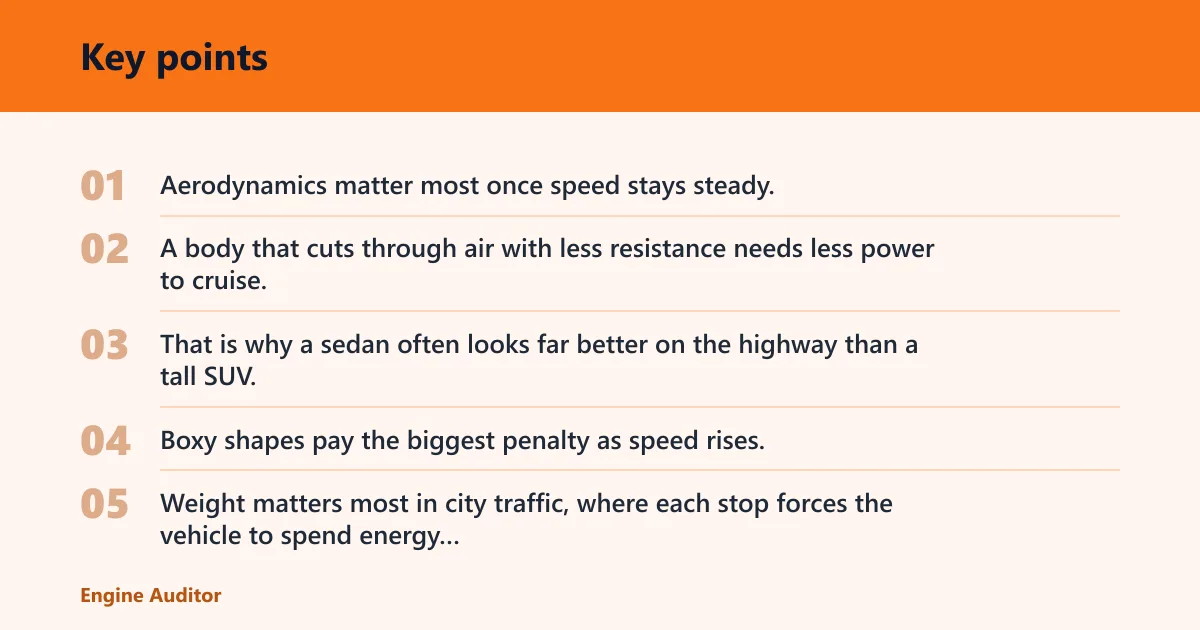
Aerodynamics matter most once speed stays steady. A body that cuts through air with less resistance needs less power to cruise. That is why a sedan often looks far better on the highway than a tall SUV, even if both use similar engines. Boxy shapes pay the biggest penalty as speed rises.
Curb weight column: why stop-and-go driving changes the ranking
Weight matters most in city traffic, where each stop forces the vehicle to spend energy accelerating again. A heavier body type can lose more mpg in stop-and-go driving than on the highway. A lighter hatchback or sedan often keeps a bigger edge in traffic than it does at steady cruising speed.
Ride height and drivetrain columns: why the same class can split apart
Two vehicles with the same body type can post very different mpg figures. A compact SUV with front-wheel drive can beat a taller, heavier version with all-wheel drive. A similar split is often seen in trucks, where 4WD usually costs mpg. Taller ride height also increases drag and can nudge a vehicle down the ranking.
Do SUVs use more gas than sedans?

Yes, in most cases SUVs use more gas than sedans because they are taller, heavier, and less aerodynamic. The gap is usually widest in highway driving, where shape matters more. A small SUV can come close to a sedan, but the sedan usually keeps the advantage when engines and transmissions are otherwise similar.
Compact SUV versus midsize SUV
A compact SUV usually does better than a midsize SUV because it is smaller, lighter, and often has a smaller engine. A midsize SUV adds frontal area and mass, which usually hurts both city and highway mpg. If you want utility without a large fuel penalty, the compact class usually makes more sense.
How frontal area and weight raise fuel use
Front area affects how much air the vehicle must push aside, and weight affects how much energy it needs to move away from a stop. Those two factors work together. A taller body usually pays more at highway speed, while a heavier one pays more in city traffic. Many SUVs lose on both counts.
When a small SUV can narrow the gap
A small SUV can narrow the gap if it uses a small turbo engine, a well-matched automatic transmission, and front-wheel drive. Some hybrid crossovers also post very good numbers for their size. Even then, you should compare the exact model against a sedan or hatchback, not just the badge on the tailgate.
Are hatchbacks better on fuel economy than sedans?
Often yes, but not always. Hatchbacks usually stay very close to sedans because both body types are compact and low. A hatchback can sometimes beat a sedan if it is lighter or has a better powertrain, but a sedan often has the slight edge when the two share the same engine and drivetrain.
Cargo space versus mpg tradeoffs
A hatchback gives you more flexible cargo loading than a sedan, especially for awkward items. That extra utility does not always cost much fuel, because the body can still be short and low. The tradeoff appears when the hatchback is heavier, has larger wheels, or comes only with a less efficient drivetrain.
When a hatchback beats a sedan in the real world
Suppose two compact cars share the same platform, but the hatchback has the lighter trim and the sedan has larger wheels and a more powerful engine. The hatchback can win on mpg. The body style alone does not decide it; the exact equipment list can move the result more than the shape does.
What makes a vehicle body type less fuel efficient?
Three traits usually hurt fuel economy most: poor aerodynamics, higher curb weight, and a drivetrain that adds losses. A tall, heavy, all-wheel-drive vehicle usually uses more fuel than a lower, lighter front-wheel-drive vehicle. The effect shows up in city, highway, and mixed driving, though not equally in each case.
Aerodynamics and highway drag
At highway speed, drag becomes a major reason some body types burn more fuel. Taller roofs, upright fronts, roof racks, and wide mirrors all add resistance. That is why a boxy SUV or pickup can lose ground quickly once traffic moves at a steady pace. The penalty grows with speed.
Vehicle curb weight and city driving
Weight hurts most when the vehicle repeatedly accelerates from low speed. That makes curb weight a city mpg issue as much as a highway one. A heavier minivan, SUV, or truck needs more energy every time traffic starts moving again. Trims with larger wheels or extra equipment can add weight too.
AWD, 4WD, and added drivetrain losses
All-wheel drive usually lowers mpg versus front-wheel drive because it adds extra parts and rotating mass. Four-wheel drive often adds even more loss in exchange for extra traction. That tradeoff can be worth it for snow, dirt, towing, or steep driveways, but it should not be treated as free capability.
Which comparisons are the most useful exceptions to the body-style rule?

The body-style rule is real, but equipment can override it. Hybrids, drivetrain choice, and weight changes can shift a larger vehicle ahead of a smaller one. The most useful comparisons are between vehicles with different powertrains or drivetrains, not just different shapes. Those matchups reveal where the biggest mpg wins actually are.
Hybrid minivan versus non-hybrid midsize SUV
A hybrid minivan can outperform a gas-only midsize SUV because the hybrid system offsets the minivan’s size and weight. That comparison matters for families who need room but still care about fuel use. The hybrid badge can matter more than the body style when the alternative is a less efficient gasoline SUV.
FWD compact SUV versus AWD compact SUV
A front-wheel-drive compact SUV often gets better mpg than the same model with all-wheel drive. The added hardware, rotating mass, and drivetrain losses usually cost fuel. If winter traction is not a priority, FWD is usually the more efficient choice in this class.
Compact hatchback versus base midsize sedan
A light hatchback can sometimes beat a heavier midsize sedan, especially if the sedan uses wider tires or a stronger engine. The hatchback’s smaller footprint helps in traffic and on the highway. This is a common example of a smaller shape undercutting a larger one on fuel use.
AWD wagon or crossover versus RWD truck-based SUV
A car-based wagon or crossover can return better mpg than a truck-based SUV with rear-wheel drive or 4WD. The lower body and lighter structure matter more than the number of drive wheels. This comparison shows why platform design can beat badge size in real fuel use.
Hybrid sedan versus non-hybrid compact SUV
A hybrid sedan often beats a non-hybrid compact SUV even when the SUV is smaller in cargo terms. The hybrid’s efficiency gain can outweigh the SUV’s utility advantage. This is one of the clearest examples of a more efficient powertrain changing the whole ranking.
2WD pickup versus 4WD pickup
Two-wheel-drive pickups usually do better than 4WD versions of the same truck. The smaller drivetrain loss and lower mass can improve mpg enough to matter, especially for drivers who do not need off-road or low-traction capability. The body style stays the same, but the fuel use does not.
How should you compare models before you buy?
Start with the body type that fits your cargo and passenger needs, then compare exact trims, engines, and drivetrains. Body style gives the first clue, but EPA estimates, AWD versus FWD, and hybrid availability usually decide the final result. The goal is the smallest fuel penalty that still fits the job.
- Start with the body type that fits your cargo and passenger needs.
- Compare the same body type with FWD, AWD, and 4WD if all are offered.
- Check the exact engine and transmission, not just the model name.
- Look at city and highway estimates separately, then compare combined mpg.
- Choose the smallest, lowest, lightest body that still handles your daily use.
Why the EPA label matters more than the badge
The EPA fuel-economy label gives a model-specific estimate that is more useful than broad assumptions about sedans, SUVs, or trucks. Two versions of the same vehicle can differ meaningfully once AWD, wheel size, and engine tuning are added. That is why the exact label should guide the final decision.
What to compare when two body styles seem close
If two models look similar on mpg, compare their city and highway numbers separately, then check whether one has a hybrid option or a lighter drivetrain. A small difference in shape can be outweighed by a bigger difference in weight or AWD. The closest match is usually the most informative one.
City, highway, and mixed driving: what changes most?
City driving rewards lighter body types because stop-and-go motion punishes weight. Highway driving rewards lower and cleaner shapes because drag matters more at steady speed. Mixed driving usually softens the gap, but the ranking still tends to favor sedans and hatchbacks over SUVs and trucks.
Best body types for city fuel economy
Hatchbacks and sedans usually do best in city use because they are lighter and easier to move from one stop to the next. A compact car with front-wheel drive often has the strongest city mpg. Minivans and compact SUVs can still do well, but they usually trail the smaller cars.
Best body types for steady highway driving
Low, streamlined vehicles usually hold the edge on the highway. Sedans often lead, with hatchbacks close behind. Minivans can be surprisingly competitive because they are car-based, while tall SUVs and pickups usually fall behind because their shapes create more drag at speed.
How mixed driving softens the gap
Mixed driving pulls city and highway effects together, so no single body type wins every time. A sedan still usually comes out ahead, but a well-chosen crossover or minivan can get close if it uses a sensible engine and front-wheel drive. That is why the exact model matters so much.
Frequently asked questions
Which vehicle body type gets the best gas mileage?
Sedans and hatchbacks usually get the best gas mileage among mainstream body types. They are low, often lighter, and usually less draggy than SUVs or trucks. A hybrid sedan or hybrid hatchback can move even higher. The exact model still matters more than the badge, engine, or drivetrain choice. (Motortrend)
Which body style is best for city fuel economy?
Small sedans and hatchbacks usually do best in city driving because they are lighter and need less energy to get moving again after each stop. A compact hybrid can also do very well. Large SUVs and trucks usually fall behind in traffic because curb weight matters more when speeds keep changing.
Do vans always use more gas than cars?
No. Minivans usually use more gas than compact cars, but they do not always use more than every car-based vehicle. A minivan can beat a large SUV because it rides on a car-like platform and often has a more efficient shape than a tall, body-on-frame vehicle of similar size.
How much does vehicle weight affect gas mileage?
Weight matters most in stop-and-go driving, where each acceleration costs energy. A heavier vehicle usually uses more fuel in the city, and extra mass can also trim highway mpg. Trim changes, larger wheels, AWD hardware, and added features can all raise curb weight enough to change the result.
Sources
- EPA FuelEconomy.gov vehicle comparison data for model-specific MPG trends by body style, drivetrain, and powertrain.
- U.S. Department of Energy Alternative Fuels Data Center guidance on why weight, aerodynamics, and drivetrain layout affect fuel use.
- EPA Green Vehicle Guide and fuel-economy label resources for city, highway, and combined MPG estimates.
- DOE AFDC and EPA consumer guidance on AWD and 4WD efficiency tradeoffs versus FWD.
- MotorTrend body-style fuel-economy roundups for secondary context on category-level comparisons.
Products related to this article
Sponsored / affiliate links. As an Amazon Associate I earn from qualifying purchases. I may earn additional commission from eligible campaigns.