Cheap Car Electrical Diagnostic Tools That Help
For many DIY electrical faults, a budget digital multimeter is one of the most useful tools for voltage, ground, and continuity checks; adding a test light can help with quick power checks. Guessing can drain batteries, replace good parts, and turn a small fault into a tow bill. This guide matches common symptoms to the cheapest tool that works, and shows where budget gear stops being reliable.
What cheap car electrical diagnostic tool is actually worth buying?
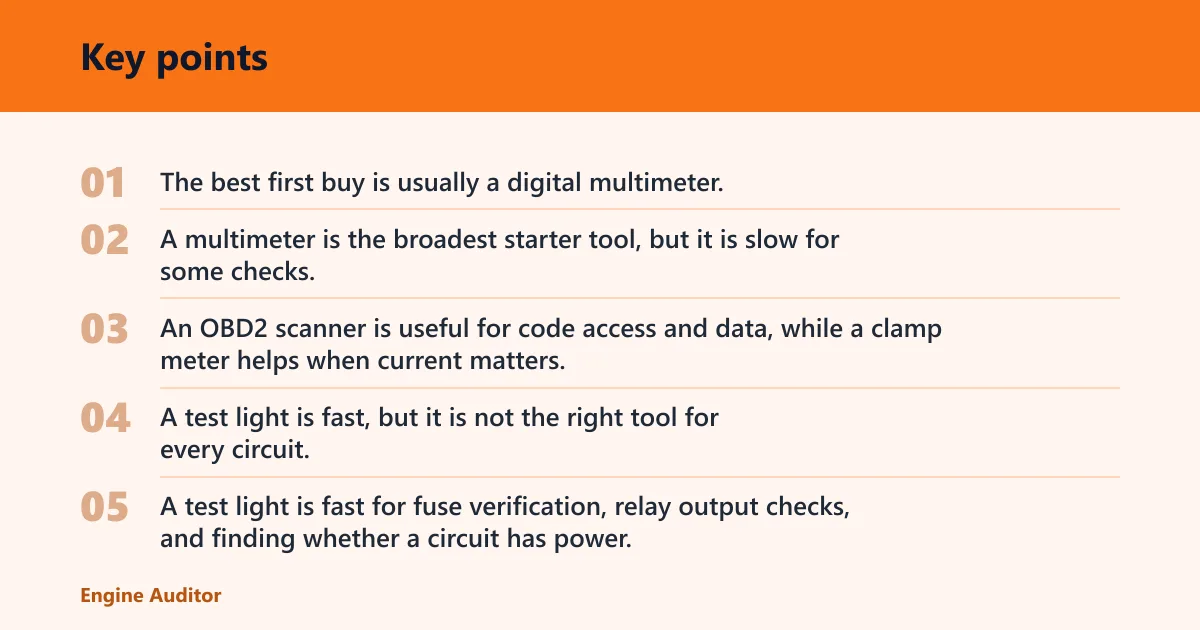


The best first buy is usually a digital multimeter. It covers battery voltage, charging voltage, continuity, and basic resistance checks, which is enough for many no-start and dead-battery complaints. Add an LED test light if you need quick power and ground checks, then move to a scanner or clamp meter when the fault demands more than voltage alone.
Cheap diagnostic tools compared by job
Different faults call for different tools. A multimeter is the broadest starter tool, but it is slow for some checks. An OBD2 scanner is useful for code access and data, while a clamp meter helps when current matters. A test light is fast, but it is not the right tool for every circuit.
| Tool | Best use | Main limit | Budget feature to insist on |
|---|---|---|---|
| Digital multimeter | Voltage, continuity, resistance, basic current checks | Slow for tracing intermittent faults; weak for low-current draw unless it has the right range | DC voltage, continuity beep, ohms mode, current jack, CAT rating |
| 12V test light | Quick power and ground checks | Can load sensitive circuits and give false confidence on high-resistance faults | LED style for lower draw |
| OBD2 scanner | Read/clear codes, live data, freeze frame | Does not diagnose every electrical fault | Live data and freeze frame, not code reading only |
| Clamp meter | Current draw checks, especially parasitic drain | Cheap units may lack milliamps resolution or have jaws too large for tight cable routing | DC amperage, low-amp range, usable jaw opening |
Battery and charging checks
Start with a multimeter. A healthy 12V battery often reads about 12.6V at rest, and a running charging system commonly sits in the mid-13V to mid-14V range, though exact targets vary by vehicle. That is enough to separate a weak battery from a charging problem before parts get replaced.
Fuse and power checks
A test light is fast for fuse verification, relay output checks, and finding whether a circuit has power. Use an LED test light for modern cars whenever possible, because old incandescent lamps draw more current and can stress sensitive modules. For fuse work, a puller and spare blade fuses make the job cleaner and safer.
No-crank diagnosis
For a no-crank fault, a practical low-cost setup is a multimeter plus a test light. Voltage drop at the battery, power at the starter signal wire, and ground quality are the first checks. If the starter relay, fuse, or ignition switch feed is missing, the meter tells you where power stops.
Parasitic draw testing
A clamp meter is the cheapest practical path when you need parasitic draw testing, but only if it can read low amps or milliamps with enough resolution. Many cars settle into a low sleep-current range, and cheap meters that cannot resolve that range can give misleading readings.
Which tool matches your symptom?
Match the symptom first, then buy the least expensive tool that can prove or rule out the fault. A battery, alternator, fuse, relay, starter, or ground issue may produce similar symptoms, but the test path is different. That is why the cheapest useful tool changes with the job.
No crank
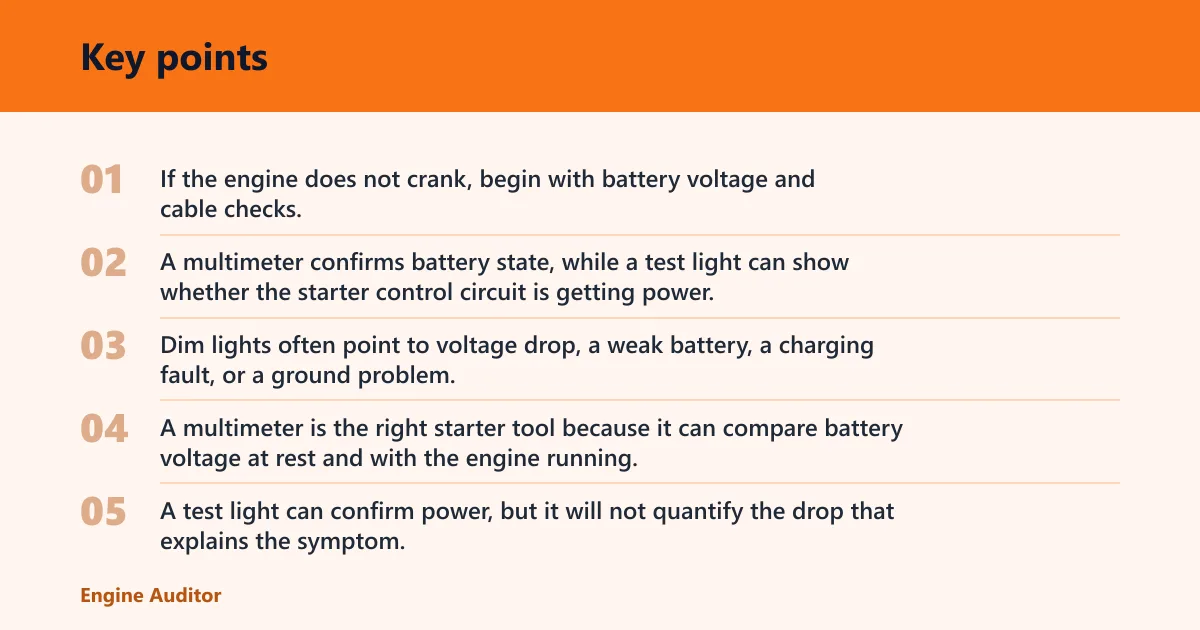
If the engine does not crank, begin with battery voltage and cable checks. A multimeter confirms battery state, while a test light can show whether the starter control circuit is getting power. If the battery is charged but voltage collapses under load, a battery load tester is more useful than another voltage-only check.
Dim lights
Dim lights often point to voltage drop, a weak battery, a charging fault, or a ground problem. A multimeter is the right starter tool because it can compare battery voltage at rest and with the engine running. A test light can confirm power, but it will not quantify the drop that explains the symptom.
Blown fuse
When a fuse blows, the cheapest useful kit is a fuse puller, spare blade fuses, and a test light or meter. Replace the fuse only with the same amperage rating, then check the circuit for a short before powering it again. Do not step up fuse size to “make it work.”
Dead battery
A dead battery may be flat from age, parasitic draw, or a charging issue. Voltage alone cannot tell you battery health, so a battery load tester earns its place when you need cold cranking amps testing and a stronger state-of-health read. A multimeter still helps confirm charging voltage after the jump or charge.
Charging issue
If the battery keeps going flat while driving, check alternator output with a multimeter before buying parts. A running system that stays near battery voltage is suspicious; a charging system that sits well above normal can also be bad. An OBD2 scanner may show charging-related data on some cars, but it is not enough by itself.
Bad ground
Ground faults are where a test light and multimeter work together. A test light can reveal whether a ground path can carry current, while the meter can measure voltage drop across the ground side. Cheap meters that only claim resistance checks are not enough if their leads and internal fuse are poor.
Intermittent fault
Intermittent faults often need live data, freeze frame, and careful back-probing. A scanner helps capture the conditions when the fault set, while a multimeter and back-probe pins help check the circuit without damaging the connector. If the fault appears only while flexing a wire run, poor probe access can hide the problem.
Electrical diagnostic tools decision table
This table maps common symptoms to the minimum tool that can actually answer the question. It also marks the point where budget gear stops being trustworthy enough for the job.
| Symptom | Minimum tool | Exact test to run | When cheap gear is too limited |
|---|---|---|---|
| No crank | Digital multimeter | Measure battery voltage at rest, then while cranking if safe; check starter feed and ground drop | When lead quality is poor or the meter cannot hold a stable reading under load |
| Dim lights | Digital multimeter | Compare resting battery voltage to running voltage and measure drop across suspect cables | When the meter lacks accurate DC voltage or good low-ohm behavior |
| Blown fuse | 12V test light | Check power on both sides of the fuse and follow the circuit load side for shorted wiring | When the circuit feeds a sensitive module and the light may load it too hard |
| Dead battery | Battery load tester | Apply a load and compare results to the battery’s rated cold cranking amps | When only voltage is available and battery health remains unknown |
| Charging issue | Digital multimeter | Measure alternator output at idle and with accessories on | When the meter’s accuracy is poor or the current jack is misused |
| Bad ground | Digital multimeter | Measure voltage drop from the component ground to battery negative under load | When probe tips cannot reach the connector cleanly |
| Intermittent fault | OBD2 scanner plus multimeter | Read freeze frame, watch live data, then back-probe the suspect circuit while wiggling wires | When the scanner only reads codes and has no useful live data |
| Parasitic drain | Clamp meter | Let the car enter sleep mode, then measure standby current and isolate fuses one by one | When the clamp cannot read low amps or milliamps with enough resolution |
Suppose the battery is flat every Monday morning, but a jump start gets the car moving. A clamp meter that reads milliamps can show whether the car settles near a normal sleep current or stays at a clearly elevated level, which points to an active drain. A voltage-only meter cannot finish that job.
What features matter before you buy?
The right features matter more than the brand name on a budget tool. Look for the minimum functions that match the fault you are chasing, then stop there. Cheap gear can work well enough, but only if the range, accuracy, and safety details are honest.
Multimeter accuracy, continuity, resistance, current input, and CAT rating
A budget multimeter should have a usable DC voltage range, continuity testing, resistance or ohms mode, and a current input you understand. The current jack matters because many meters are fused only on the higher current range, and that range is easy to misuse. A CAT safety rating helps, especially if you probe higher-energy circuits near the battery and alternator.
Scanner live data, freeze frame, and code depth
An OBD2 scanner that only reads and clears codes is a code reader, not a full diagnostic tool. For electrical problems, live data and freeze frame are the features that matter because they show what the vehicle saw when the fault happened. Basic scanners stop short of module-level diagnosis on many cars.
Clamp meter low-current resolution and jaw access
Parasitic draw testing needs a clamp meter that can resolve low amps or milliamps, not just starter current. Jaw size matters too, because tight battery cables and bundled wire runs can block access. If the jaw cannot fit cleanly around one conductor, the reading can be useless.
Test leads, back-probe pins, and fuse tools
Good leads and back-probe pins keep you from forcing a meter tip into a connector and spreading the terminals. Needle and back-probe options are worth the small extra cost because access problems create bad readings. A fuse puller, plus spare blade fuses in common amperages, finishes the starter kit.
Choose a multimeter if… / Choose an OBD2 scanner if…
Pick the multimeter first if your main job is voltage, ground, fuse, or starter diagnosis. Pick the scanner first if the car has a check-engine light and you need codes, live data, or freeze frame. If you are chasing electrical faults beyond codes, you eventually need both.
Choose a multimeter if…
Choose a multimeter if the car has power but will not crank, if lights are dim, or if you need to check battery and charging voltage. It is also the better first buy when you want one tool that can handle continuity and resistance checks. This is the cheapest tool with the widest reach.
Choose an OBD2 scanner if…
Choose a scanner if the main clue is a fault code and you need freeze frame or live data to see when the problem happened. It helps with sensor, charging, and module clues that a meter cannot see directly. It does not replace a meter for continuity or voltage-drop work.
Choose both if…
Choose both when the fault is intermittent, when the car sets electrical codes, or when the battery keeps draining overnight. The scanner tells you what the vehicle noticed, and the meter tells you whether the circuit can actually carry power. That combination solves more problems than either tool alone.
When cheap gear stops being enough
Cheap gear stops being enough when you need milliamps accuracy, stable low-ohm readings, or module-level diagnosis on a modern networked car. It also falls short when the probe quality is poor, the current range is unclear, or the scan tool cannot show live data. At that point, spend more on accuracy, safety, or both.
How much should you spend on a starter kit for electrical troubleshooting?
A sensible starter kit usually costs less than a single premium scan tool. The first purchase should cover voltage, continuity, and quick power checks, then add current testing only if you are chasing drains or charging faults. Spend where the fault demands it, not where the box looks more impressive.
-
Buy the multimeter first. A $20 to $40 meter is usually the best first buy if it has DC voltage, continuity, ohms, and a fused current input. That covers most battery and no-start checks.
-
Add a test light next. Choose an LED 12V test light for power and ground checks. Keep it away from sensitive module circuits unless you know the circuit can tolerate the load.
-
Pick the scanner by symptom. If you need codes, live data, or freeze frame, spend more on a scanner with those features. A basic code-only tool is enough for simple emission faults, but not for deeper electrical work.
-
Upgrade for current faults. Buy a clamp meter or battery load tester when the problem involves parasitic drain or battery health. Those jobs need current or load information that voltage alone cannot provide.
A common first-timer mistake is buying a scanner for a dead battery and skipping the meter. The scanner may show nothing useful because the battery voltage is already too low for full module communication. Another mistake is poking a connector with a thick probe and then chasing a connector problem that the probing caused.
Frequently asked questions
Do I need a multimeter or an OBD2 scanner for car electrical problems?
For most electrical problems, start with a multimeter. It measures the basic things that fail: voltage, ground quality, and circuit continuity. A scanner becomes useful when the car stores codes, needs live data, or needs freeze-frame information to show the fault conditions.
Can a cheap multimeter test a car battery, alternator, and fuses?
Yes, for basic checks. A cheap meter can show battery voltage, alternator charging voltage, and continuity through a fuse. It cannot reliably prove battery health by voltage alone, and low-resistance or milliamps readings may be poor on budget models.
What features should I look for in a budget car diagnostic tool?
For a multimeter, look for DC voltage, continuity, resistance, a fused current input, and a safety rating you trust. For a scanner, look for live data and freeze frame, not code reading only. For a clamp meter, low-amp or milliamps resolution matters more than headline current capacity.
What is the best cheap tool for checking parasitic draw?
A clamp meter is the best low-cost path if it can read low amps or milliamps accurately enough. The test starts after the vehicle enters sleep mode, then you isolate fuses one by one to find the circuit pulling current. A basic meter that cannot read low draw is not enough.
Are inexpensive test lights safe for modern cars?
LED test lights are safer than old incandescent ones because they draw less current. Even so, you should not use a test light on every sensitive module circuit. Use it for quick power and ground checks, and switch to a multimeter when the circuit may be delicate.
Products related to this article
Sponsored / affiliate links. As an Amazon Associate I earn from qualifying purchases. I may earn additional commission from eligible campaigns.