
How Long Should You Pedal on a Stationary Bike?
Figuring out workout times can feel tricky, especially when you’re starting. For many, the question How Long Should You Pedal on a Stationary Bike? pops up a lot. It’s easy to get confused with all the different advice out there.
But don’t worry, it’s simpler than you might think! We’ll break it down step-by-step so you know exactly what to do. Let’s get you pedaling with confidence.
Getting Started With Your Stationary Bike
How Long Should You Pedal on a Stationary Bike Key Factors
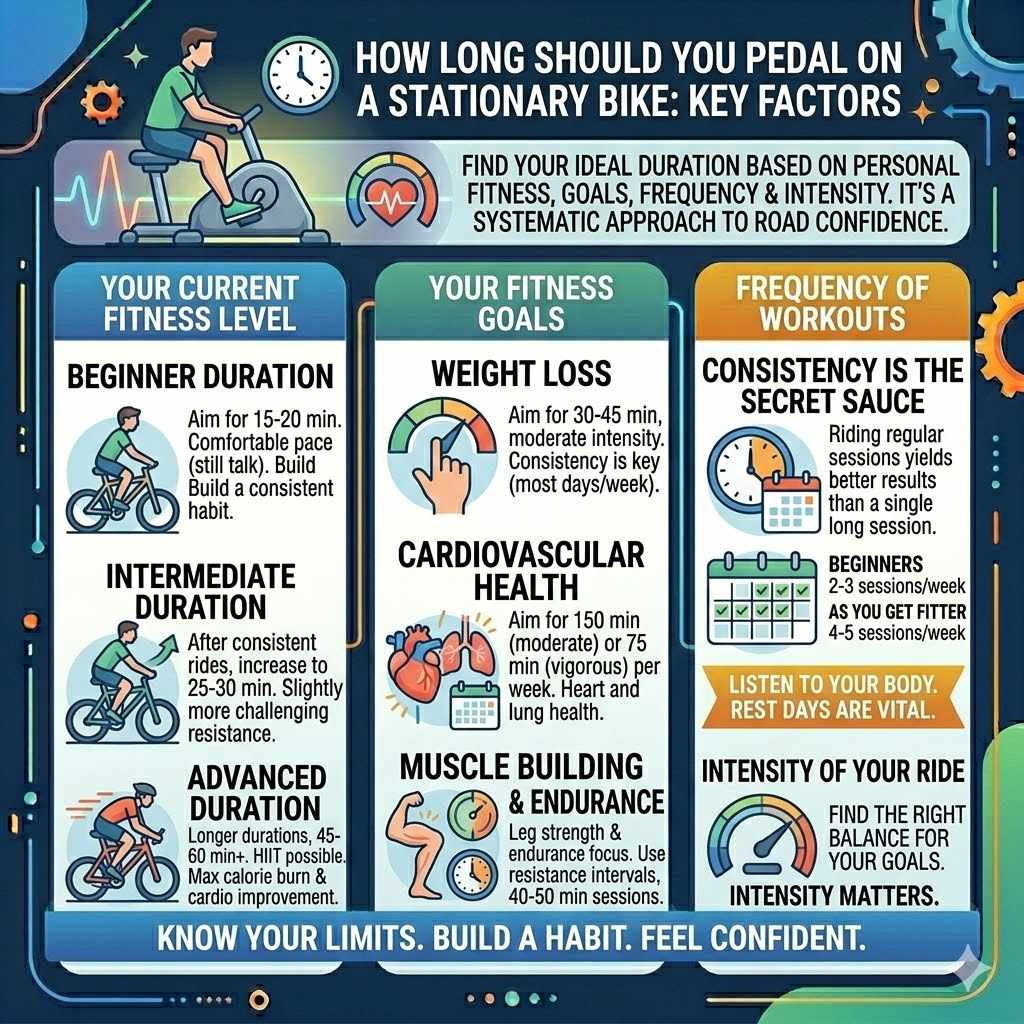
Deciding on the right duration for your stationary bike sessions involves looking at a few important things. It’s not a one-size-fits-all answer. Your personal fitness level plays a big role.
Someone just beginning will have different needs than someone who exercises regularly. Your fitness goals are also key. Are you trying to lose weight, build stamina, or simply stay active?
What you hope to achieve will shape how long you spend on the bike.
Your Current Fitness Level
When you first hop on a stationary bike, your body isn’t used to the motion and effort. Pushing too hard or too long right away can lead to feeling exhausted or even sore. It’s smart to start with shorter sessions.
This helps your muscles and lungs get accustomed to the activity. Over time, as you feel stronger and more comfortable, you can gradually increase the time. This slow and steady approach prevents burnout and keeps you motivated.
- Beginner Duration
If you are new to cycling or exercise, aim for 15 to 20 minutes per session. Focus on maintaining a comfortable pace where you can still talk. This allows your body to adapt without feeling overwhelmed.
It’s about building a consistent habit.
- Intermediate Duration
After a few weeks of consistent 15-20 minute rides, you might feel ready to extend your time. Try increasing to 25 to 30 minutes. You can also introduce slightly more challenging resistance or a bit more intensity during parts of your ride.
- Advanced Duration
For those with established fitness, longer durations are possible. Sessions can range from 45 to 60 minutes or even more. This is often combined with high-intensity interval training (HIIT) for maximum calorie burn and cardiovascular improvement.
Your Fitness Goals
The reason you’re on the stationary bike matters a lot. Different goals require different workout structures and lengths. If you’re aiming to shed pounds, longer, steady-state cardio sessions can be effective.
For building muscle strength or improving speed, you might focus more on intensity and shorter bursts. Knowing your specific target helps you design the best workout plan.
- Weight Loss
To burn calories for weight loss, you generally need to sustain an elevated heart rate for a good amount of time. Aiming for 30 to 45 minutes of moderate-intensity cycling most days of the week can contribute significantly to a calorie deficit. The key here is consistency.
Burning more calories than you consume is essential for weight loss.
- Cardiovascular Health Improvement
For a healthier heart and better lung function, consistent cardio is important. Aim for at least 150 minutes of moderate-intensity aerobic activity or 75 minutes of vigorous-intensity activity per week, according to health guidelines. This could be split into shorter, regular sessions on your stationary bike.
Even 20-30 minute rides a few times a week make a difference.
- Muscle Building and Endurance
While stationary bikes are primarily for cardio, you can use them to build leg strength and endurance. Incorporating resistance intervals and slightly longer rides can help. This might mean doing 40-50 minute sessions with periods of high resistance to challenge your leg muscles.
Frequency of Workouts
How often you ride your stationary bike is just as important as how long. Riding for an hour once a week won’t yield the same results as riding for 30 minutes four times a week. Consistency is the secret sauce for fitness.
Your body benefits from regular challenges. It allows your muscles to adapt and get stronger over time.
For beginners, starting with two to three sessions per week is a good pace. This gives your body enough rest to recover and prevent soreness. As you get fitter, you can gradually increase the frequency to four or five days a week.
Listen to your body; rest days are vital for muscle repair and preventing injuries.
Intensity of Your Ride
The speed and resistance you use on your stationary bike greatly impact how long you should pedal. A high-intensity workout, where you’re pedaling hard with significant resistance, will be shorter. You can only sustain that level of effort for a limited time.
Conversely, a low-intensity ride allows you to pedal for much longer. Finding the right balance for your goals is key.
Structuring Your Stationary Bike Workouts
Optimizing Your Stationary Bike Time
Once you have an idea of how long you should pedal based on your fitness level and goals, it’s time to think about how to structure your actual bike sessions. Simply pedaling for a set amount of time might not be the most effective. Incorporating variety and different types of rides can make your workouts more engaging and beneficial.
This section will explore how to make the most of your time on the bike, ensuring you get great results.
Warm-Up and Cool-Down
Every good workout starts with a warm-up and ends with a cool-down. These are not just extra steps; they are crucial for preparing your body for exercise and helping it recover afterward. Skipping them can increase your risk of injury and soreness.
- Warm-Up
Before you start pedaling at your target intensity, spend about 5 to 10 minutes warming up. This involves light pedaling at a very low resistance. The goal is to gradually increase your heart rate and blood flow to your muscles.
This makes them more flexible and ready for more strenuous activity. Think of it as gently waking up your body.
- Cool-Down
After you finish your main cycling session, don’t just stop. Spend another 5 to 10 minutes cooling down. This means pedaling at a very easy pace with minimal resistance.
It helps your heart rate slowly return to normal and allows your body to clear out waste products like lactic acid. This can reduce muscle soreness the next day.
Interval Training vs. Steady-State Cardio
There are two main ways to structure your stationary bike workouts: interval training and steady-state cardio. Both have their own benefits and are suited for different goals. Understanding the difference helps you pick the best approach for your fitness plan.
- Steady-State Cardio
This type of workout involves maintaining a consistent pace and intensity for the entire duration of your session, after your warm-up. For example, you might pedal at a moderate effort for 30 minutes straight. Steady-state cardio is excellent for building endurance and improving your body’s ability to use oxygen efficiently.
It’s often favored for longer cardio sessions aimed at fat burning.
- Interval Training
Interval training alternates between periods of high-intensity effort and periods of low-intensity recovery. For instance, you might pedal as hard as you can for 30 seconds, then pedal very slowly for 60 seconds. You repeat this cycle several times.
This method is great for improving cardiovascular fitness quickly and burning a lot of calories in a shorter amount of time. It can also boost your metabolism.
Sample Workout Structures
To help you visualize how to put this into practice, here are a couple of sample workout structures. These can be adjusted based on your current fitness level and how much time you have.
Beginner Steady-State Workout (25 minutes)
- 5 minutes warm-up (very light pedaling)
- 15 minutes moderate effort pedaling (you can talk but it’s a little hard)
- 5 minutes cool-down (very light pedaling)
Intermediate Interval Workout (30 minutes)
- 5 minutes warm-up (light to moderate pedaling)
- 20 minutes of intervals: 1 minute high intensity followed by 2 minutes low intensity (repeat 7 times)
- 5 minutes cool-down (very light pedaling)
Advanced Steady-State Workout (45 minutes)
- 5 minutes warm-up (light to moderate pedaling)
- 35 minutes moderate to high effort pedaling (hard to talk, breathing heavily)
- 5 minutes cool-down (very light pedaling)
Listen To Your Body and Progress
How Long to Pedal for Maximum Benefit
It’s essential to remember that your body is unique. What works perfectly for one person might not be ideal for another. Paying close attention to how you feel is your most important guide.
Pushing yourself too hard without recovery can lead to injuries or burnout, setting you back. Gradually increasing the duration and intensity of your stationary bike rides will help you achieve better, long-term results without the risk.
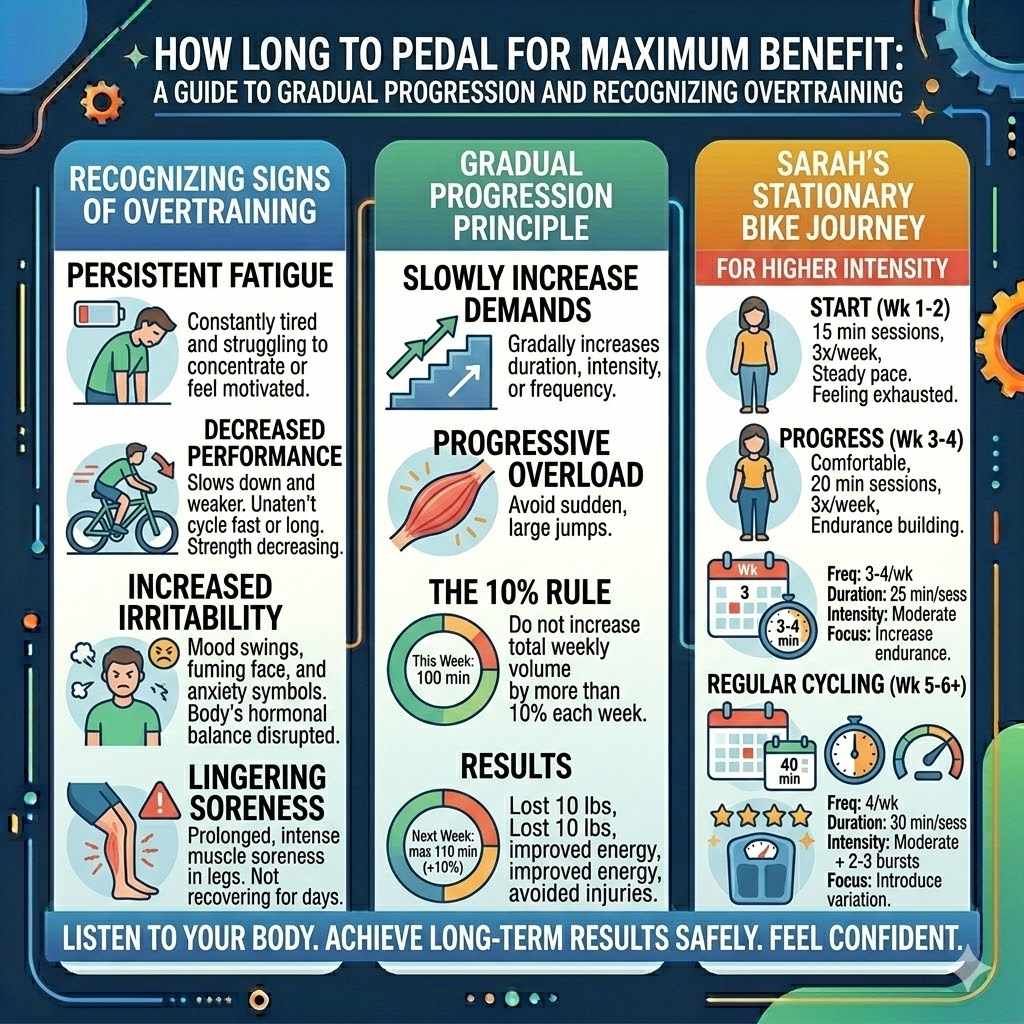
Recognizing Signs of Overtraining
Overtraining happens when you exercise too much without enough rest and recovery. This can negatively impact your performance and your overall health. Your body will give you signals if you’re pushing too hard for too long.
Recognizing these signs early can help you adjust your routine before it becomes a serious problem.
- Persistent Fatigue
If you feel constantly tired, even when you’re not exercising, it could be a sign of overtraining. Your body isn’t recovering properly from the stress of workouts. This can affect your energy levels throughout the day, making it hard to concentrate or feel motivated.
- Decreased Performance
Ironically, working out too much can make you perform worse. You might find that you can’t cycle as fast or as long as you used to. Your strength might decrease, or you might feel generally weaker during your workouts.
This is your body telling you it needs a break.
- Increased Irritability or Mood Swings
Physical stress can also affect your mental state. If you find yourself feeling more irritable, anxious, or experiencing unexplained mood swings, overtraining could be a factor. Your body’s hormonal balance can be disrupted by excessive exercise.
- Soreness That Won’t Go Away
Some muscle soreness after a workout is normal. However, if you experience prolonged or intense soreness that lingers for days, it could indicate that your muscles aren’t recovering. This is a clear sign that your training load might be too high.
Gradual Progression
The principle of progressive overload is fundamental to improving fitness. This means slowly increasing the demands placed on your body over time. For stationary biking, this can involve increasing the duration, intensity, or frequency of your rides.
Avoid making sudden, large jumps in your workout parameters.
A good rule of thumb is the 10% rule. This suggests that you should not increase your weekly training volume (total time spent cycling) by more than 10% each week. For example, if you cycle for 100 minutes this week, aim for no more than 110 minutes next week.
This allows your body to adapt safely and effectively.
Case Study: Sarah’s Stationary Bike Journey
Sarah started using a stationary bike to lose some weight. Initially, she could only pedal for 15 minutes without feeling exhausted. She followed a simple program: three 15-minute sessions per week, focusing on a steady, moderate pace.
After three weeks, she felt comfortable and increased her duration to 20 minutes.
Within two months, Sarah was regularly cycling for 30 minutes, four times a week. She also started incorporating short bursts of higher intensity during her rides. This gradual progression helped her shed 10 pounds and significantly improve her energy levels.
She avoided injuries by listening to her body and not pushing too hard too soon.
Sample Scenario Progression
Here’s how someone might progress on their stationary bike over a few weeks:
- Week 1-2:
- Frequency: 3 times per week
- Duration: 20 minutes per session
- Intensity: Light to moderate (can hold a conversation)
- Focus: Building a habit, getting comfortable with the bike.
- Week 3-4:
- Frequency: 3-4 times per week
- Duration: 25 minutes per session
- Intensity: Moderate (can talk but with slight effort)
- Focus: Increasing endurance slightly.
- Week 5-6:
- Frequency: 4 times per week
- Duration: 30 minutes per session
- Intensity: Moderate, with 2-3 short bursts of higher intensity during the ride.
- Focus: Introducing intensity variation.
Frequently Asked Questions
Question: How long should I pedal on a stationary bike for weight loss
Answer: For weight loss, aim for 30-45 minutes of moderate-intensity cycling most days of the week. Consistency is key to burning enough calories.
Question: Is 30 minutes on a stationary bike enough
Answer: Thirty minutes on a stationary bike is a great starting point, especially for beginners or those with moderate fitness goals. It provides a good cardiovascular workout and can contribute to calorie burning.
Question: How long should a beginner pedal on a stationary bike
Answer: Beginners should start with 15-20 minutes per session, focusing on a comfortable pace. Gradually increase the time as your fitness improves.
Question: Can I pedal for an hour on a stationary bike
Answer: Yes, experienced individuals can pedal for an hour or more. This is suitable for advanced fitness levels and endurance training.
Question: How often should I use a stationary bike
Answer: For beginners, 2-3 times a week is recommended. As you get fitter, you can increase to 4-5 times a week, ensuring you include rest days.
Summary
Knowing how long to pedal on a stationary bike depends on your fitness level, goals, and frequency. Start with shorter rides and gradually increase duration and intensity. Always warm up, cool down, and listen to your body to prevent overtraining and ensure progress.