Are Metal Pedal Covers Legal on Street Cars?
Metal pedal covers are usually legal on street cars if they fit securely, leave full pedal travel, and do not interfere with brake, clutch, or throttle operation. Loose, sharp, or slip-prone covers can fail inspection. Bad fit can turn a simple mod into a safety defect, and it may lead to failed inspection, pedal hang-up, or reduced grip in wet shoes. This guide explains what makes them acceptable, what usually makes them fail, and how to check fitment before you drive.
Are metal pedal covers legal on street cars?


Yes, sometimes. There is no single rule that applies everywhere, so legality usually depends on the country and local inspection process. A metal pedal cover can be street-legal when it stays fixed in place, leaves full pedal return, and does not create a hazard such as a sharp edge, loose fastener, or blocked travel.
What inspectors usually look
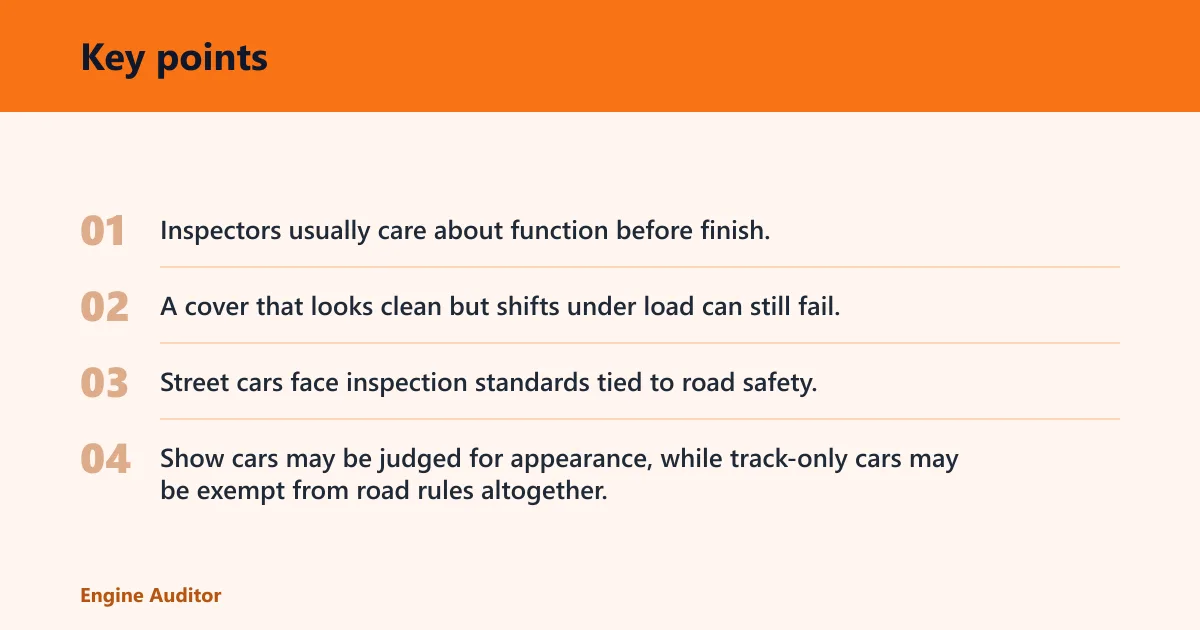
Inspectors usually care about function before finish. The cover must stay attached under normal foot pressure, the pedal must return freely, and the added part must not change the pedal’s working range in a way that causes drag, sticking, or delayed return.
Inspection rules often focus on the same failure points: secure mounting, no interference with moving parts, and no sharp edges where a foot or shoe can catch. A cover that looks clean but shifts under load can still fail.
Why street use differs from show or track use
Street cars face inspection standards tied to road safety. Show cars may be judged for appearance, while track-only cars may be exempt from road rules altogether. A cover that is fine in a display build can still be a problem if it reduces pedal clearance or loosens with vibration on a daily driver.
Metal pedal covers and street legality
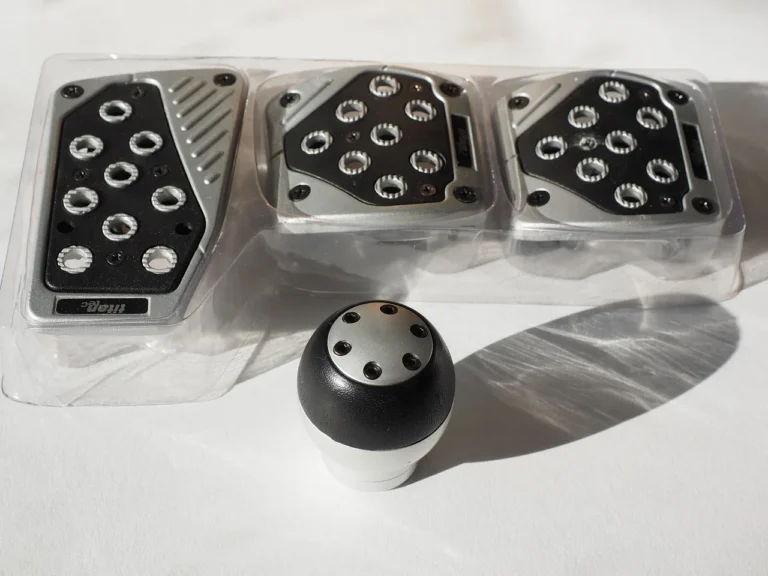
Metal pedal covers are usually aluminum or another alloy. Many use a non-slip surface texture, such as knurled metal, rubber inserts, or raised ridges. Those features can improve foot contact, but legality still turns on fitment, attachment, and whether the cover changes how the accelerator, brake, or clutch works.
Aluminum and alloy covers
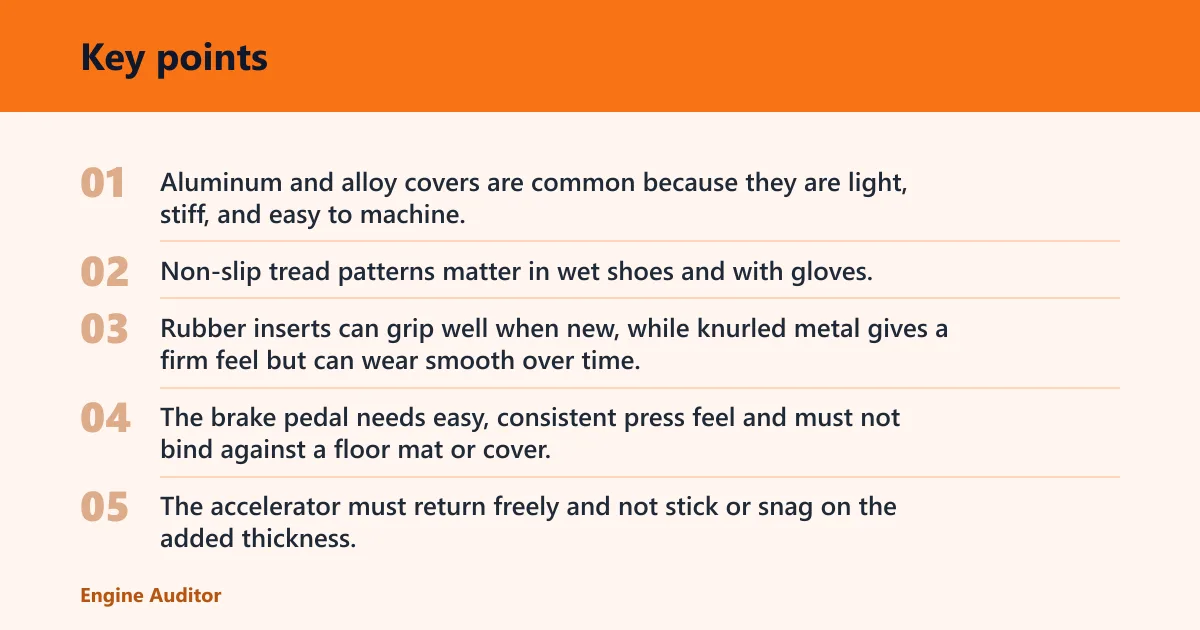
Aluminum and alloy covers are common because they are light, stiff, and easy to machine. That does not make them automatically safer than plastic. Safety depends more on edge finish, surface grip, and how firmly the cover is mounted to the pedal than on the material alone.
Non-slip tread patterns
Non-slip tread patterns matter in wet shoes and with gloves. Rubber inserts can grip well when new, while knurled metal gives a firm feel but can wear smooth over time. Either design can pass inspection if it is secure and free of burrs, but worn tread can become a foot-slip issue long before the cover falls off.
Brake, accelerator, and clutch fitment
The brake pedal needs easy, consistent press feel and must not bind against a floor mat or cover. The accelerator must return freely and not stick or snag on the added thickness. The clutch, on manual-transmission cars, needs stable slip-resistant contact and enough clearance to preserve full stroke without scuffing or dragging.
Thickness matters here. Even a few millimeters can change spacing between pedals, heel-toe feel, and the sense of travel under your foot. A wider face can help braking comfort, but it can also make emergency braking feel different if it changes where your shoe lands.
What makes a pedal cover fail inspection?
Many inspection failures come from fit, not simply from the fact that the cover is metal. Loose mounting, sharp edges, blocked pedal return, and floor-mat interference are common problems. If a cover alters pedal movement or creates a new snag point, it can fail even if the part itself is well made.
Loose mounting and fastener problems
Fasteners are a common weak point. Screws can back out, backing plates can shift, and clip-on retainers can loosen after repeated pedal use. Inspectors may reject a cover that rocks, twists, or shows missing hardware, because any movement can change pedal feel at the exact moment the driver needs consistency.
Sharp edges and exposed hardware
Any exposed corner, burr, or protruding screw head can become a defect. A pedal cover should not have sharp edges that can cut a shoe, catch a floor mat, or snag a foot during a quick transition. Clean deburring and flush hardware matter as much as the material choice.
Blocked pedal return or floor-mat contact
Pedal return must stay free. A thicker cover can press into a mat, touch the lower dash trim, or sit close enough to neighboring pedals that it changes return speed. If the throttle does not spring back cleanly, or if the brake sits too close to the floor mat, that is an inspection risk and a driving risk.
How mounting method affects legality
Mounting method matters because inspection rules usually care about secure attachment. Screw-on, clamp-on, and adhesive-backed covers can all be acceptable in some places, but only if they stay fixed, do not loosen, and do not interfere with pedal movement. Adhesive-only fitment is the most likely to raise questions if the bond is thin or the pedal face is textured.
Screw-on covers
Screw-on covers are often the most inspection-friendly when installed correctly. They usually use screws, backing plates, or both, which helps resist movement. The downside is hardware management: fasteners need proper torque, thread retention where appropriate, and periodic re-checks after the first few drives.
Clamp-on covers
Clamp-on designs can work when the clamp fully captures the pedal face and does not shift under load. They need enough clamping force to resist vibration and hard braking, plus smooth contact surfaces so the pedal itself is not damaged. Loose clamps are a common reason for inspection trouble.
Adhesive-backed covers
Adhesive-backed covers are the most dependent on surface prep, temperature, and bonding area. They may be acceptable for light-duty use if the adhesive is rated for the load and the pedal face is clean and flat. If the cover lifts at the edges, it should be treated as unsafe until reattached or replaced.
Street-legal pedal cover decision checklist
This table helps separate a cover that is likely acceptable from one that is likely to cause inspection trouble. The key question is not whether the cover is metal. It is whether the part stays secure, preserves pedal movement, and leaves no sharp or loose features behind.
| Cover type | Mounting method | Thickness concern | Inspection risk | Pass/fail notes |
|---|---|---|---|---|
| Aluminum pedal cover with knurled face | Screw-on with backing plate | Moderate; check spacing on brake and clutch | Low if fasteners stay tight | Usually passes when edges are smooth and pedal return is unchanged |
| Alloy cover with rubber inserts | Clamp-on retainer | Low to moderate; depends on pedal shape | Moderate if clamp slips | Can pass if the clamp fully grips and does not move under heavy press |
| Thin cosmetic metal face | Adhesive-backed only | Low | Moderate to high if bond lifts | May pass in some areas, but edge lift or peeling is a common fail point |
| Performance-style cover with exposed hardware | Screws and pins | Moderate; can change pedal feel | Moderate if hardware protrudes | Passes only when hardware is flush, secure, and free of sharp edges |
| Oversize cover for larger foot contact | Screw-on or clamp-on | High; can alter reach and spacing | High if it affects emergency braking feel | Use only if pedal clearance, return, and mat clearance remain unchanged |
How to self-check a pedal cover before driving
Do a short inspection any time a cover is installed, swapped, or re-tightened. A common rule of thumb is to do a brief check when a cover is installed, swapped, or re-tightened, looking for looseness, sharp edges, pedal return, and floor-mat interference. If anything feels vague, stop and correct it before road use.
-
Wiggle the cover. Push the cover side to side and up and down with firm hand pressure. There should be no rocking, no click, and no visible shift at the fasteners or clamp points.
-
Feel every edge. Run a finger along the perimeter and over the hardware. The surface should be smooth enough that it will not catch a sock, shoe seam, or mat edge.
-
Press each pedal fully. Check brake, accelerator, and clutch one at a time. The pedal should return freely, without dragging, sticking, or touching nearby trim at full stroke.
-
Check mat clearance. Move the floor mat as it would sit in driving position, then press the pedal again. The mat should not ride up, trap the pedal, or cover the lower edge of the cover.
-
Re-check fasteners. After the first drive, inspect screws, clamps, or adhesive edges again. Vibration can reveal a weak install, and a fresh check helps catch loosening before it becomes a defect.
Say your daily driver has a 6 mm-thick aluminum brake cover with a backing plate. If the pedal still clears the mat by several millimeters and returns cleanly after a full press, the cover may be acceptable. If that same cover shifts enough to touch the mat edge, the problem is fitment, not the metal.
A common mistake is picking a shiny metal pedal cover without checking whether it provides secure grip and stays firmly attached on a street car. A 4 mm throttle cover that looks tidy can still fail if it shortens the gap to the brake pedal enough to change foot placement during quick transitions.
Are aluminum pedal covers safer than plastic ones?
Not automatically. Aluminum may resist wear and offer a firmer surface, while plastic can be lighter and sometimes softer on shoes. What matters more is whether the cover stays attached, has a safe edge profile, and keeps the pedal’s original movement and return behavior intact.
Grip and wear concerns
Material choice affects wear rate and surface feel. A good aluminum cover with rubber inserts or knurled texture can give predictable grip in wet conditions, but worn metal can become slick. Plastic may wear differently, but a poor plastic cover can still be unsafe if it flexes, cracks, or loosens.
Thickness and pedal feel
Thickness can matter more than material. A thicker cover can move the foot closer to the driver, change ankle angle, and alter the spacing between brake and accelerator. That is why a cover can feel fine in a parked car but feel wrong in hard braking or a quick heel-toe downshift.
When material matters less than fit
Fit is the deciding factor in most inspection regimes. A thin metal cover with sharp hardware can be worse than a thicker part with smooth edges and solid retention. If the cover follows the pedal shape, stays tight, and leaves full travel, the material itself is usually secondary.
Frequently asked questions
Do pedal covers have to be rubber or non-slip to be street legal?
No universal rule requires rubber, but the pedal surface must provide safe control. A non-slip tread pattern, such as rubber inserts or knurled metal, helps with grip in wet shoes. A smooth metal face can be legal in some places if the inspection standard does not require a specific surface.
Can metal pedal covers fail inspection?
Yes. Common failure points are loose mounting, protruding fasteners, sharp edges, blocked pedal return, and floor-mat interference. A cover can also fail if it changes pedal spacing enough to affect brake use or accelerator return. Inspectors often look at function first and appearance second.
Do pedal covers need to be bolted on to be legal?
Not always. Screw-on covers with backing plates are often the easiest to defend in an inspection, but clamp-on and some adhesive-backed covers can be acceptable if they stay fixed and do not interfere with the pedal. Bolted fitment is stronger evidence of secure attachment, not a universal legal requirement.
Can aftermarket pedal covers affect brake or accelerator safety?
Yes. A cover can change reach, spacing, and foot angle, and it can also interfere with pedal return or mat clearance. On the brake, that can affect emergency stopping feel. On the accelerator, it can cause sticking or delayed return if the cover sits too thick or moves under load.
What should I check before buying pedal covers for a daily driver?
Match the cover to the exact pedal shape, including width, face angle, and mounting points. Check thickness, fastener design, and edge finish before buying. For a daily driver, also confirm the part will not reduce pedal travel, interfere with a floor mat, or require frequent re-tightening.
Are pedal covers legal if they increase pedal grip?
Increasing grip helps, but it does not override inspection rules. A cover can improve wet-shoe traction and still be rejected if it is loose, sharp, or too thick. Grip is only one part of the decision; secure attachment and free pedal movement matter just as much.
Products related to this article
Sponsored / affiliate links. As an Amazon Associate I earn from qualifying purchases. I may earn additional commission from eligible campaigns.