How to Find a Parasitic Battery Drain in a Car
To check for a parasitic battery drain, charge the battery fully, let the vehicle enter sleep mode, then measure key-off current; many vehicles settle below about 50 mA, and anything higher may point to a draw, a weak battery, or a charging-system leak. Ignore it, and you get repeat dead starts, wasted parts, and a fault that returns. This guide shows a repeatable diagnostic sequence to separate true draw from battery, alternator, and sleep-delay problems.
What a parasitic draw


A parasitic draw is current flowing with the ignition off. Some standby draw is normal because modules, clocks, alarms, and memory circuits stay alive, but the draw should drop after the vehicle enters sleep mode. If the current stays high, something is staying awake or pulling power all night. OEM service information often lists a key-off quiescent-current spec and a timeout window; common timeout ranges are roughly 15 to 45 minutes, but some late-model vehicles, hybrids, and networked platforms can take longer.
Common sources include interior lights, glove box switches, relays, modules, and aftermarket accessories on constant power. A drain complaint is not proof of a bad battery. A weak or sulfated battery can create the same dead-start symptom, so test the battery first. On the shop floor, the most common awake modules are telematics, keyless-entry receivers, infotainment units, door modules, convenience modules, and control units that are waiting on a missed shutdown command.
What you’ll need
- Digital multimeter with a fused current jack and a milliamp range
- Battery charger
- Memory saver, if the vehicle needs retained settings during disconnects
- Fuse puller or needle-nose pliers
- Fuse map or fuse-box labels for the interior and under-hood panels
- Basic hand tools for battery access and accessory inspection
How do you test for a parasitic battery drain?
Charge the battery fully, confirm that it can hold a healthy resting voltage, then measure key-off current with the meter connected in series. Wait for sleep mode before trusting the reading. If the draw stays above a normal standby level after the timeout, start isolating circuits. Use the vehicle’s service information when possible, because some platforms need a longer wake-up-to-sleep sequence than others and a few require a hood-switch or latch strategy before they will time out.
- Fully charge the battery, then let it sit until the charge settles.
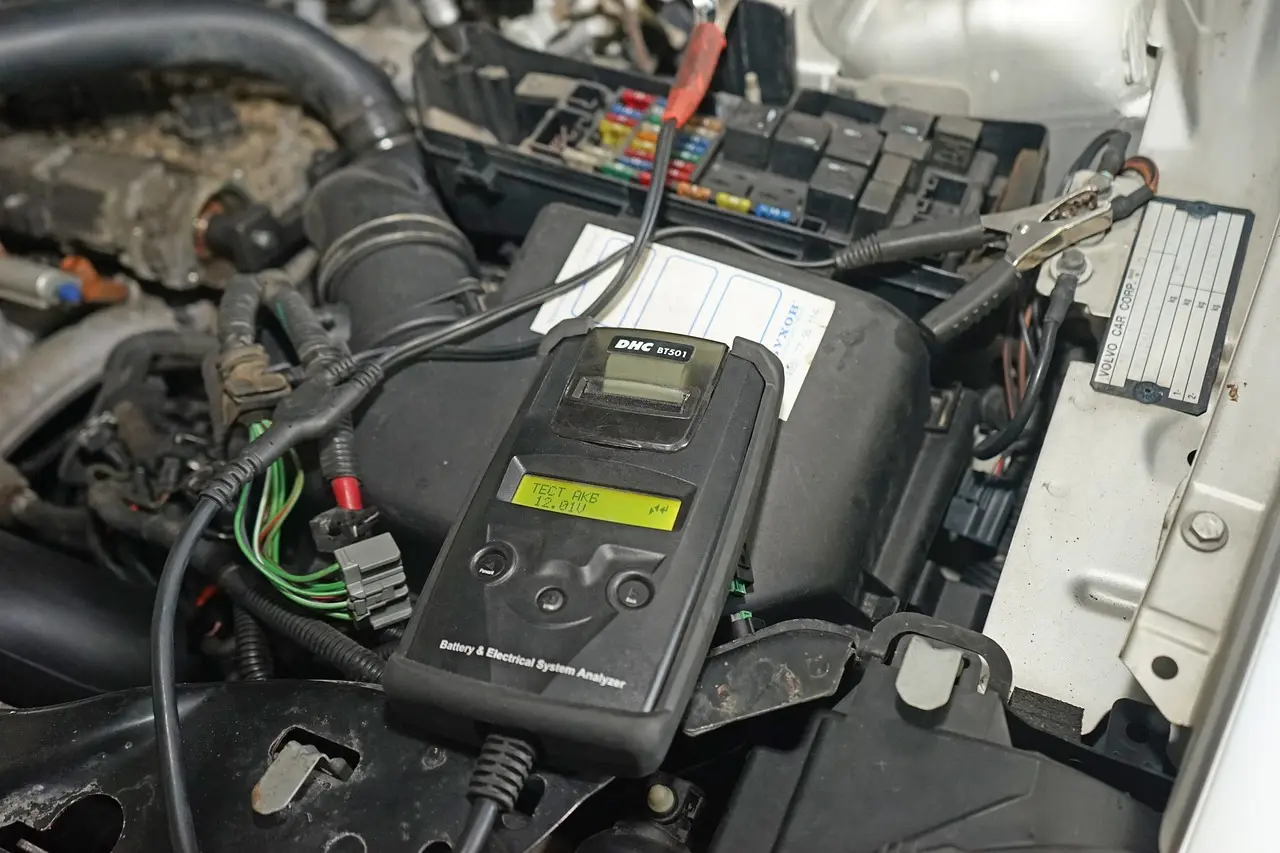
- Check battery voltage after the charger is removed. Around 12.6 volts is a common fully charged resting value for a 12-volt battery.
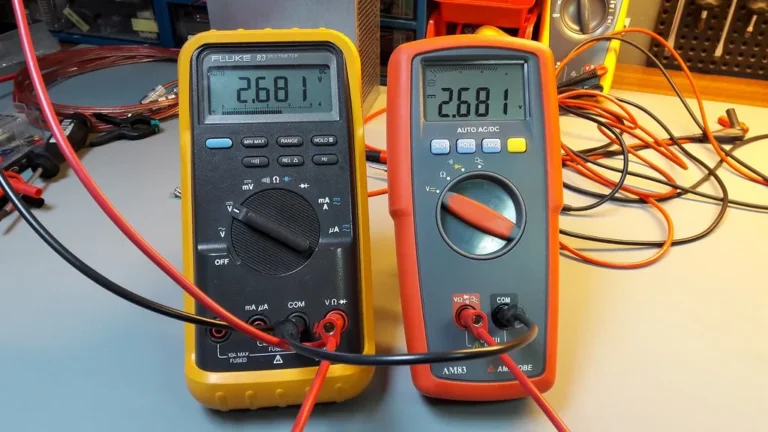
- Set the multimeter to DC amps or milliamps and move the lead to the fused current input jack.
- Disconnect the battery cable and place the meter in series between the cable and the battery post.
- Wait for the vehicle to enter sleep mode before reading current. Many cars need several minutes; some need longer.
A reading around 20 to 50 mA is often treated as normal standby on many vehicles, though there is no single universal cutoff. Use the maker’s spec when available. If the draw is still high after sleep, the meter is telling you to keep going. For a simple battery-health baseline, many technicians also compare the open-circuit voltage against a standard lead-acid reference before they spend time on the drain test; a battery that is already low or unstable can mislead the diagnosis.
Say your sedan sits overnight and starts weak in the morning. The battery tests fully charged at 12.6 volts, but the current settles at 180 mA after 20 minutes. That points away from a dead battery and toward a live draw that is staying awake after shutdown. If the reading stays near zero while the battery still goes flat, suspect battery condition or an intermittent charging fault instead of a constant draw.
Parasitic drain vs bad battery vs alternator leak
| Symptom | Resting-voltage behavior | Meter reading pattern | Sleep-mode timing | Fuse-pull result | Next test step |
|---|---|---|---|---|---|
| Parasitic draw | Good at first, then falls overnight | High key-off current after sleep; often above the OEM quiescent-current spec, commonly 50 mA or more on many vehicles | Current drops only after the full timeout; some platforms need 15 to 45 minutes, and some longer | One fuse pulls current down sharply | Trace that circuit, including add-on wiring |
| Bad or sulfated battery | Low or unstable even after charging | Current may look normal, but voltage recovery is poor and load testing fails | Sleep timing does not change the complaint much | No clear fuse change | Load-test or replace the battery before chasing wiring |
| Alternator diode leakage | May seem normal at rest, then drop after sitting | Key-off current stays high; AC ripple or reverse leakage may be present even if charging voltage looks acceptable | Sleep still completes | Fuse pulls may not change the draw | Isolate the alternator output cable or charging circuit |
| Sleep-delay complaint | Voltage stays acceptable | High current only during countdown, then normalizes | Timeout is longer than expected, often because a module or switch is keeping the network awake | Fuse pulls may not help until the awake module is identified | Check doors, latches, hood switch, scan data, and networked modules |
How do you isolate the circuit?
Pull fuses one at a time after you confirm the draw and the modules are asleep. Check both the interior and under-hood fuse boxes, because the bad circuit may be fed from either panel. Use the fuse map so you do not guess. A clamp meter is useful for a quick under-hood or cable-level check, but it cannot replace an in-series meter when you need exact parasitic current at the battery.
- Leave the meter connected and note the stable current reading.
- Pull one fuse.
- Watch for a clear drop in current.
- Reinstall that fuse, then move to the next one.
- When the draw falls to normal, read the fuse label and inspect that branch first.
Aftermarket accessories are a common first stop. Alarm systems, dash cams, remote starters, trackers, chargers, and stereo add-ons are often tied to constant power feeds. A fuse pull that only drops part of the draw can point to a module on that circuit or to added wiring spliced into it. In many bays, a hardwired dash cam or GPS tracker is the culprit because it never truly powers down, even though the factory fuse label looks normal.
Suppose an SUV shows about a 120 mA draw and removing the 15 amp “ACC” fuse drops it to about 25 mA. That does not prove the factory accessory is bad. It tells you the fault is on that feed, so the added dash cam or stereo adapter becomes the first inspection point. If the draw only falls after a door module or infotainment fuse is removed, inspect that module and its wake inputs before replacing parts.
How do you tell if the alternator is the problem?
Alternator diode leakage can create an overnight drain even when charging voltage looks normal. OEM diagnostic paths commonly call for isolating the alternator output cable or B+ lead, because a bad diode can leak to ground without showing up in a simple charging-voltage check. If the draw persists with all obvious loads removed, check the alternator next. Reputable charging-system references also note that a failed diode can cause AC ripple or reverse current flow after shutdown.
- Keep the meter in series and confirm the draw is still present.
- Disconnect the alternator output lead with the battery isolated as required by the vehicle service procedure.
- Watch for the current to drop sharply.
- If the draw falls, test the alternator for AC ripple or diode failure with the meter on AC volts.
A charging system can pass a simple voltage check and still leak through a failed diode. That is why alternator testing belongs in the sequence, not after it. If the current changes only when the alternator is isolated, the problem is on the charging side. For shop confidence, compare the AC reading and the battery drain behavior together instead of using charging voltage alone as proof.
Common mistakes
Testing before sleep mode is the biggest trap. The reading is not valid until the modules time out, and that can take several minutes. Wrong meter setup is another common issue: the leads should be in the fused current jack, and the meter should be in series, not across the battery like a voltage check. Clamp meters are helpful for screening, but an in-series meter is the one that gives the sub-100 mA detail you need for diagnosis.
Do not skip battery state-of-charge testing. A weak battery can mimic a drain complaint. Do not ignore lights, relays, or add-on wiring either. If the draw disappears when the meter is connected, the meter may be waking a module; let the vehicle settle again, then repeat the test. Also watch for platform-specific quirks: some vehicles need the doors latched, the hood switch taped, or a scan-tool sleep command before the current will fall to its true standby level.
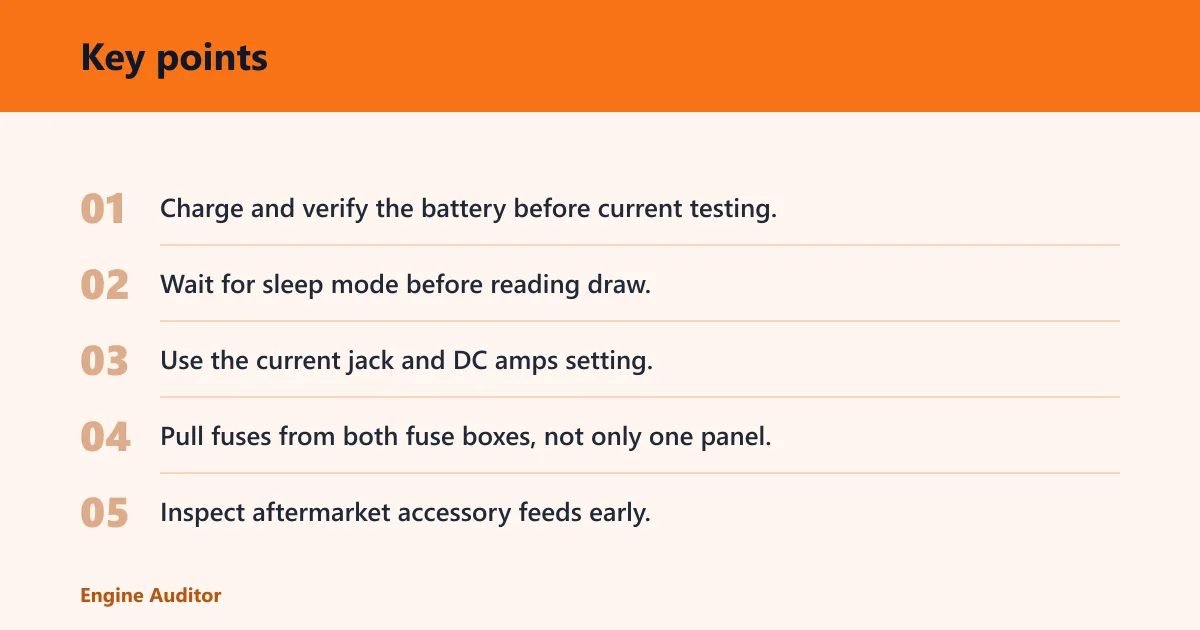
- Charge and verify the battery before current testing.
- Wait for sleep mode before reading draw.
- Use the current jack and DC amps setting.
- Pull fuses from both fuse boxes, not only one panel.
- Inspect aftermarket accessory feeds early.
A battery disconnect or memory saver may be needed for some repairs or deeper isolation steps, but it can change learned settings and clock presets. Use it only when the diagnostic step calls for it. Do not let it replace a proper current-draw test. If you use a memory saver, connect it only as the service manual allows and avoid cycling the key or opening doors in ways that wake modules and corrupt the sleep test. For certain vehicles, a safer approach is to preserve power at the OBD-II port or underhood jump posts, then confirm the draw with the battery isolated in the exact sequence the OEM specifies.
How do I stop parasitic battery drain?
Stop the drain by repairing the circuit that caused the current drop, then retest the key-off draw after the vehicle sleeps again. If the fault is an accessory, fix the feed, relay, or ground on that add-on circuit. If the fault is a module or alternator, repair or replace that component before returning the car to service. A proper fix should bring the vehicle back into its normal standby-current range after the same timeout window.
After the repair, let the vehicle sit through the same sleep cycle and confirm the current returns to a normal standby range. That second check matters. It proves the fix, rather than hiding the problem behind a charged battery. If the draw is gone but the battery still will not recover, recheck the battery itself for sulfation or capacity loss.
Frequently asked questions
How do I find a parasitic battery drain in my car?
Charge the battery, verify its resting voltage, then measure key-off current after the vehicle sleeps. If the reading stays high, pull fuses one at a time and watch for the first sharp drop. If no fuse changes the draw, check the alternator and any add-on wiring next.
How do you check a parasitic battery drain with a multimeter?
Set the meter to DC amps or milliamps, move the lead to the fused current jack, and place the meter in series with the battery cable. Wait for the sleep timeout before trusting the number. If the meter has a milliamp range, use it once the current is safely below the higher range limit.
What is normal parasitic drain on a car battery?
Many vehicles settle somewhere below about 50 mA after sleep, but the exact value depends on the model and its equipment. Some newer vehicles need a longer settle time and may show a slightly higher short-term draw before they fully time out. Use the service information when available.
How do I tell if it’s a parasitic drain or a bad battery?
A bad battery often shows low or unstable resting voltage even after charging, while a parasitic draw usually looks normal at first and then falls overnight. If the key-off current is normal but the car still dies, load-test the battery before chasing wiring. That keeps you from replacing parts in the wrong order.
Can a parasitic drain ruin a battery?
Yes. Repeated deep discharge shortens battery life and can leave the battery sulfated, which then makes the starting complaint worse. The longer the car sits with an active draw, the more likely the battery is to lose usable capacity. Fix the drain quickly and recharge the battery fully afterward.
What can drain a car battery when the car is off?
Interior lights, glove box switches, stuck relays, control modules that stay awake, and aftermarket accessories are common causes. Alternator diode leakage can do it too, even when charging seems fine. If the drain only appears after shutdown, the problem is usually on a key-off circuit or charging path.
Products related to this article
Sponsored / affiliate links. As an Amazon Associate I earn from qualifying purchases. I may earn additional commission from eligible campaigns.