Car Price Comparison: India vs Germany, Nearly Double
A German car can cost nearly double in India due to 60-100% import duty and 28% GST — the same car in Germany avoids these charges entirely. This guide breaks down entry-level to luxury pricing, plus the 2026 tariff cuts starting to close that gap.
Why Compare Car Prices Between India And Germany?
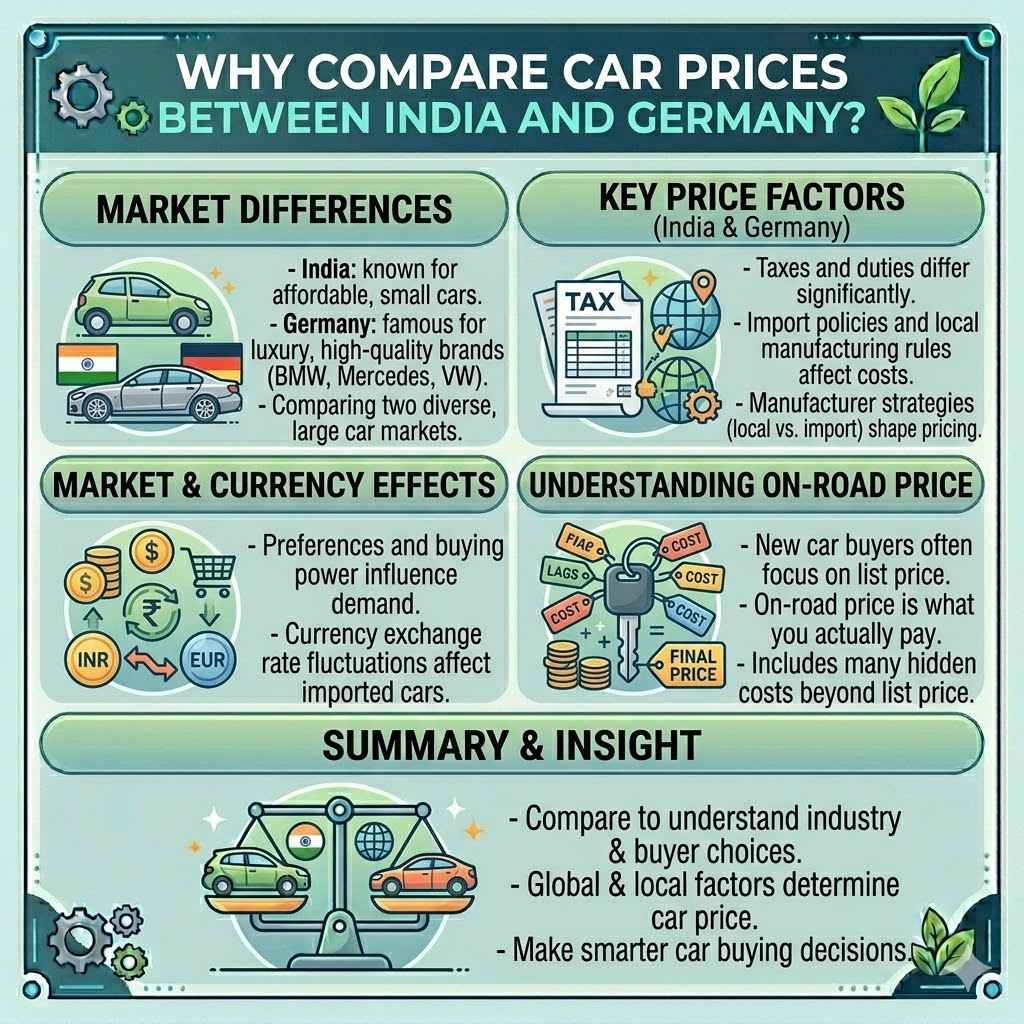
India and Germany are both large car markets, but they are very different. India is known for its affordable, small cars. Germany is famous for its high-quality, luxury brands like BMW, Mercedes-Benz, and Volkswagen. Comparing these two countries helps us see how global and local factors shape the price you pay for a car. This can help buyers make smarter choices, and also helps understand the car industry better.
Key Factors That Affect Car Prices
Before jumping into price comparisons, it’s important to know what shapes the final price of a car. Here are the main factors:
- Taxes and duties: Both countries have different tax structures.
- Import policies: Tariffs and local manufacturing rules affect costs.
- Manufacturer strategies: Some companies focus on local production, others import more.
- Market demand: Preferences and buying power influence the types of cars sold.
- Currency exchange rates: Fluctuations can make imports more or less expensive.
Most new car buyers focus only on the list price. But the on-road price (what you actually pay to drive away) includes many other costs. Let’s break down these costs in both countries.
How Car Prices Are Calculated: India Vs. Germany
India
In India, the on-road price of a car includes several components:
- Ex-showroom price (base price set by manufacturer)
- Goods & Services Tax (GST): 28% for most cars, higher for SUVs/luxury
- Cess (additional tax): 1% to 22% depending on engine size and type
- Registration charges: Varies by state (often 8-15%)
- Road tax: State-specific
- Insurance: Mandatory
- Handling charges and accessories
All these can add 30-50% to the base price.
Germany
In Germany, the on-the-road price is simpler but still has extra costs:
- Nettopreis (base net price, before tax)
- Value Added Tax (VAT): 19% standard rate
- Registration fees: Usually €30-€80
- Insurance: Required, but priced separately
- Delivery/handling: Sometimes included
Additional local taxes or environmental charges may apply, but the system is more unified compared to India.
Comparing Typical Car Prices: Entry-level Models
Let’s compare the prices of some popular entry-level cars in both countries. For this comparison, we’ll use similar models from global brands available in both markets.
| Model | India (INR, On-road) | Germany (EUR, On-the-road) | Germany (INR, Approx.) |
|---|---|---|---|
| Volkswagen Polo | ₹8 lakh | €21,000 | ₹19 lakh |
| Hyundai i20 | ₹9 lakh | €22,000 | ₹20 lakh |
| Honda Jazz | ₹9.5 lakh | €23,000 | ₹21 lakh |
Why are entry-level cars cheaper in India? The main reason is local manufacturing and lower features. Most cars in India are built locally, with simpler engines and less advanced safety features compared to their German versions. German models often come with more safety and tech features as standard.
Non-obvious insight: Even though the German cars look expensive in INR, the average income in Germany is much higher, so the car is actually more affordable for the typical German buyer.
Comparing Mid-range And Luxury Cars
The story changes as we move to mid-range and luxury models. Let’s look at some examples.
| Model | India (INR, On-road) | Germany (EUR, On-the-road) | Germany (INR, Approx.) |
|---|---|---|---|
| BMW 3 Series | ₹58 lakh | €48,000 | ₹43 lakh |
| Mercedes-Benz C-Class | ₹60 lakh | €52,000 | ₹47 lakh |
| Audi A4 | ₹50 lakh | €44,000 | ₹40 lakh |
Here, luxury cars are much more expensive in India than in Germany. This is mainly because of high import duties, extra GST, and luxury taxes in India. Most of these models are imported as CKD (Completely Knocked Down) or CBU (Completely Built Units), which adds even more cost.
Non-obvious insight: Some luxury cars are assembled in India, but even then, the tax structure makes them costlier than in Germany. Also, Indian models may have fewer standard features to keep costs down.
Taxes And Import Duties: The Real Price Drivers
India’s Complex Tax System
India has one of the world’s highest taxes on imported vehicles. For cars imported as CBU:
- Import duty: 60% to 100% (depending on price and engine)
- GST: 28%
- Compensation cess: 15% to 22%
- Registration, road tax, and other fees
This means that a car costing ₹30 lakh before taxes can end up at ₹60 lakh or more on the road.
Germany’s Simpler System
Germany charges a standard 19% VAT on cars, whether local or imported from the EU. For non-EU imports, there may be a small customs duty (usually 10%), but it’s far less than in India. Registration fees are minor, and there are incentives for low-emission vehicles.
Non-obvious insight: Germany often has tax incentives or cashbacks for electric and hybrid cars, making them even cheaper for local buyers.
Local Production Vs. Imports
Local manufacturing is a big reason why small cars are cheaper in India. Most popular models are made in Indian factories, so they avoid high import duties. In Germany, many cars are also made locally or in nearby EU countries, so taxes are low.
However, when a car is imported into India, costs skyrocket. For example, a Toyota Camry made in Japan may cost ₹45 lakh in India, while a locally made Toyota Innova costs much less.
Important tip: If you are buying a car in India, look for models made locally to save money.
Feature Differences: Not All Models Are Equal
Even when cars have the same name, the Indian and German versions are often different.
- Safety features: German cars usually have more airbags, better crash ratings, and advanced driver aids as standard.
- Engine options: Indian models often use smaller, less powerful engines to keep prices and taxes down.
- Interior quality: German models often use better materials and offer more high-end options.
Example: The Volkswagen Polo sold in India has fewer airbags and a simpler infotainment system compared to the German version.
Non-obvious insight: Some carmakers design special “India versions” to meet local price and tax limits, which can mean fewer features or downgraded parts.
Ownership Costs: Beyond The Sticker Price
Buying a car is not just about the initial price. Let’s compare ongoing costs in both countries.
India
- Fuel: Petrol and diesel are highly taxed, making fuel expensive.
- Servicing: Labor is cheaper, but spare parts can be costly, especially for imported brands.
- Insurance: Premiums are lower, but coverage is often less comprehensive.
Germany
- Fuel: Lower taxes mean cheaper petrol/diesel compared to India.
- Servicing: Labor is expensive, but spare parts are often cheaper for European brands.
- Insurance: Higher premiums, but coverage is very comprehensive.
- Environmental taxes: Older, high-emission cars may face extra yearly taxes.
Non-obvious insight: In Germany, older cars become more expensive to keep because of environmental policies. In India, older cars may not face high taxes, but resale values drop quickly.
Used Car Market: A Different Story
The used car market is growing in both countries, but prices behave differently.
- In India, used cars lose value quickly because of high new car prices and changing technology. Many first-time buyers choose used cars for affordability.
- In Germany, used cars hold value longer, especially well-maintained models. Leasing is popular, so the market has many nearly-new vehicles.
Practical tip: In Germany, buying a used luxury car can be a real bargain compared to India, where taxes keep prices high even for older models.
Cost Of Living And Affordability
Just looking at car prices in rupees or euros doesn’t tell the whole story. We have to consider average income and cost of living.
- Average monthly income in Germany: €3,500 (~₹3 lakh)
- Average monthly income in India: ₹30,000 to ₹40,000
So, a €21,000 car in Germany (6 months of salary) is actually more affordable for Germans than a ₹9 lakh car (20+ months of salary) is for most Indians.
Non-obvious insight: Even though Indian cars are cheaper in absolute terms, they are often less affordable for the average person than in Germany.
Electric Vehicles: The New Battleground
Electric vehicles (EVs) are changing the car industry. Let’s see how the price comparison works here.
| Model | India (INR, On-road) | Germany (EUR, On-the-road) | Germany (INR, Approx.) |
|---|---|---|---|
| MG ZS EV | ₹24 lakh | €32,000 | ₹29 lakh |
| Tesla Model 3 | Not officially available | €42,000 | ₹38 lakh |
| Hyundai Kona Electric | ₹25 lakh | €35,000 | ₹31 lakh |
Key differences:
- Germany offers government incentives, sometimes up to €6,000 off for electric cars.
- In India, incentives exist but are smaller and only for certain models.
- Many global EVs are not officially available in India due to import rules.
Practical tip: If you want the latest EVs, Germany is a better place for more choices and lower effective prices.
Case Study: Buying A Car In Both Countries
Let’s imagine a buyer with a budget of ₹20 lakh (about €22,000).
- In India, this budget buys a well-equipped Hyundai Creta or Honda City with automatic transmission.
- In Germany, the same budget can get you a base model Volkswagen Golf, or a nearly new, two-year-old BMW 1 Series.
But, for a luxury car, the difference becomes huge:
- A BMW 3 Series costs around ₹58 lakh in India (often out of reach for most).
- In Germany, you can get the same car for under €50,000 (about ₹45 lakh).
Non-obvious insight: If an Indian working in Germany wants to buy a German car, they get much more value for money. This is why many Indian expats in Europe are surprised by how affordable luxury cars are.
What Buyers Should Watch Out For
- Hidden taxes: In India, always ask for the final on-road price, not just the ex-showroom price.
- Feature differences: Check if the model has the same safety and tech features as in Germany.
- Servicing costs: European cars are expensive to maintain in India due to part imports.
- Resale value: German cars hold value better in their home market.
- Loan options: Interest rates for car loans are usually higher in India.
Practical tip: Always compare the total cost of ownership, not just the sticker price.
How Car Makers Set Prices Differently
Car companies use different strategies in each country:
- In India, they often strip down features, use local suppliers, and design cars for cost.
- In Germany, cars are sold with more features as standard, and buyers expect high safety and performance.
- Some brands (like Maruti Suzuki) are only strong in India, while others (like Opel) focus on Europe.
Non-obvious insight: Some brands sell the same car under different names or with small changes to fit local tastes and tax rules.
Government Policies And Their Impact
- India: High tariffs are meant to protect local industry, but they also keep prices high for consumers. Electric car policies are changing but still limited.
- Germany: Focus on cleaner cars, tax rebates for EVs, and tougher rules for emissions. This helps lower prices for new technology but may push up costs for older cars.
Practical tip: Watch for new government incentives before buying. They can make a big difference in the final price.
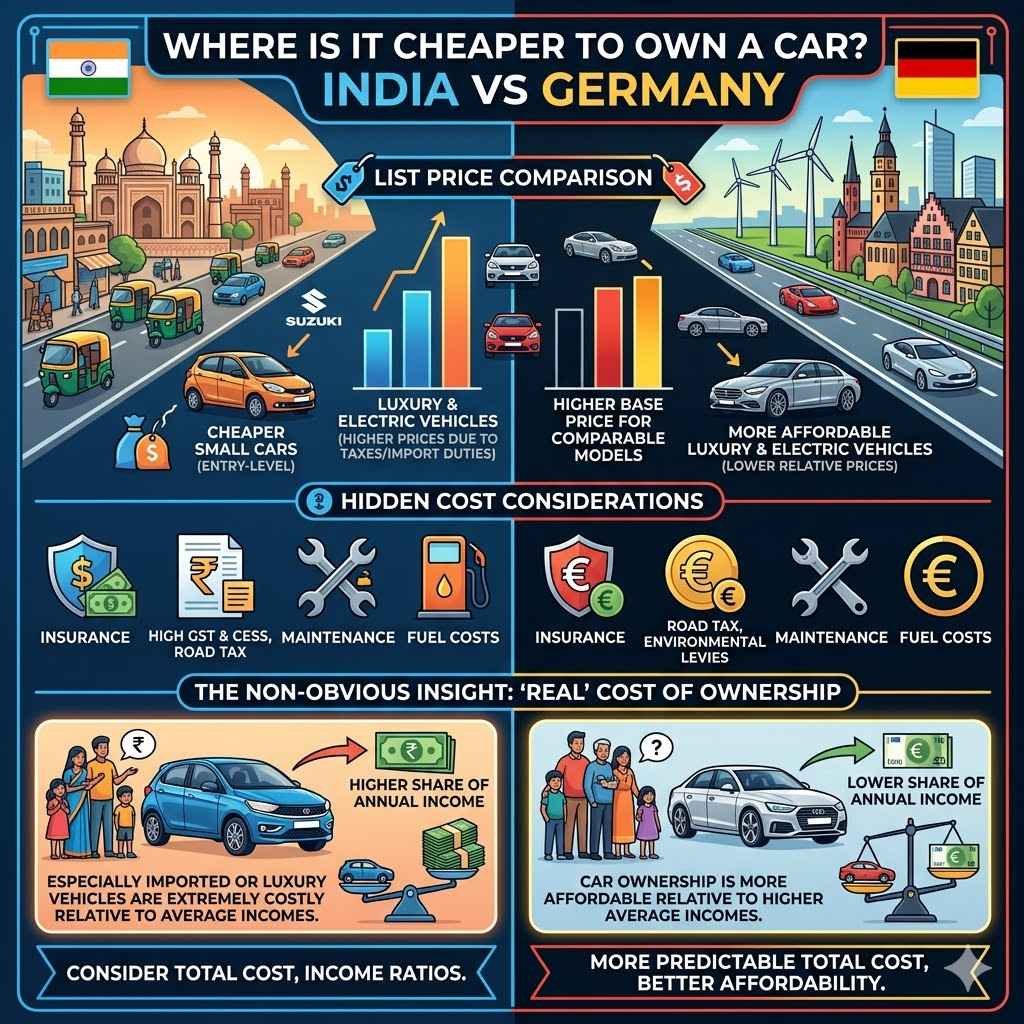
Where Is It Cheaper To Own A Car?
If you only look at the list price, small cars are cheaper in India, but most other cars—especially luxury and electric—are cheaper in Germany. However, this ignores other costs like insurance, taxes, and cost of living.
Non-obvious insight: For most buyers, the “real” cost of owning a car in India is higher as a share of income than in Germany, especially for imported or luxury vehicles.
Final Thoughts: What This Means For You
Comparing car prices between India and Germany shows much more than just numbers. Taxes, local production, features, and income all play a role. For most buyers in India, small cars are affordable, but luxury and imported models are out of reach.
In Germany, a wider range of cars is within reach for more people.
If you are buying a car in India, focus on locally made models for the best value. If you are moving to Germany, you’ll be amazed by the affordable options—especially for luxury and electric vehicles. Understanding these differences can help you make smarter decisions and avoid surprises.
For more details on international car taxation, check the Vehicle Import Regulations page on Wikipedia.
Frequently Asked Questions
Why Are Cars So Expensive In India Compared To Germany?
Cars are expensive in India mainly because of high import duties, GST, and extra taxes like registration and road tax. Even cars built in India are taxed heavily. In Germany, taxes are lower, and the market is more open, so prices stay lower.
Are German Cars Better Equipped Than Their Indian Versions?
Yes, German versions of cars usually have more safety features, better build quality, and more technology as standard. Indian versions are often made cheaper to keep prices down and fit local tax rules.
Is It Cheaper To Buy A Used Car In Germany Or India?
Used cars are generally cheaper and hold their value better in Germany, especially for European brands. In India, used cars lose value quickly, but they are still expensive if they are luxury or imported models.
Do Electric Cars Cost Less In Germany?
Yes, electric cars are often cheaper in Germany because of government incentives and a wider range of choices. In India, incentives are smaller, and many global EV models are not available.
What Is The Best Strategy For Buying A Car In India Or Germany?
In India, buy locally manufactured models with good service networks to save money. In Germany, look for nearly new used cars or take advantage of government EV incentives for the best deals.
By understanding these details, you’ll be better prepared to buy a car, wherever you are.
Products related to this article
Sponsored / affiliate links. As an Amazon Associate I earn from qualifying purchases. I may earn additional commission from eligible campaigns.