
How to Compare Ride Comfort in Two Cars
To compare ride comfort in two cars, score seat support, suspension harshness, cabin noise, steering effort, braking feel, and fatigue on the same road, then compare the weighted totals after about a 15- to 20-minute drive. Short loops miss the car that feels tiring on real roads.
What you’ll need
- A fixed route with city streets, highway miles, rough pavement, and one speed-bump section
- A note sheet or phone checklist
- A 1 to 5 rating scale, where 1 is poor and 5 is excellent
- A simple weight plan for the scorecard
- Both cars in the same trim level if possible
- The same tire size and wheel size if you can match them
How do I compare two cars for ride comfort?
Use one route, one scorecard, and one driving order. Compare the same seats, roads, speeds, and stop patterns in both cars, then score each category right away. That keeps memory bias low and shows which car feels calmer, quieter, and less tiring after the drive.
Start with the same baseline
Before driving, record the trim, wheel size, tire type, and suspension package for each car. Those details matter because sporty trims, larger wheels, and low-profile tires often make a car feel firmer and busier. If you skip them, the comparison can punish the wrong car.
Choose five to seven must-haves
Pick five to seven items that matter most for your driving. For a commuter, that may mean seat comfort, cabin quiet, braking smoothness, and low-speed steering effort. For a family car, add rear-seat space, cargo room, and safety tech. Weight the features that affect your commute length, passenger count, cargo needs, and long-term use.
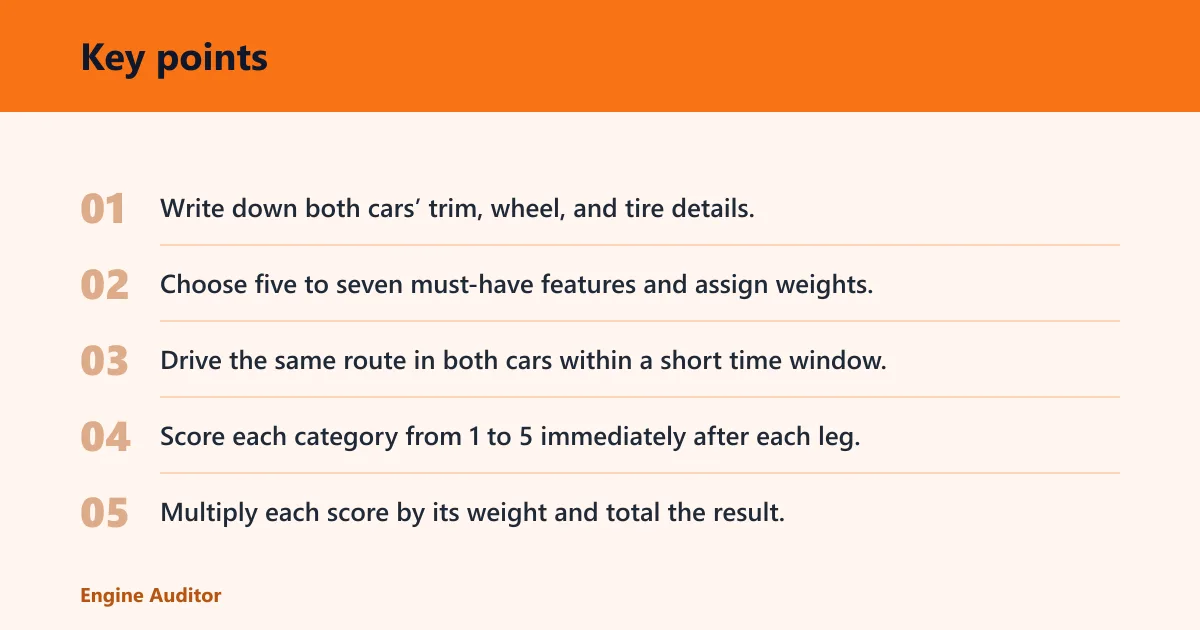
- Write down both cars’ trim, wheel, and tire details.
- Choose five to seven must-have features and assign weights.
- Drive the same route in both cars within a short time window.
- Score each category from 1 to 5 immediately after each leg.
- Multiply each score by its weight and total the result.
- Use the notes field to capture seat support, road harshness, noise, and fatigue.
Ride comfort scorecard
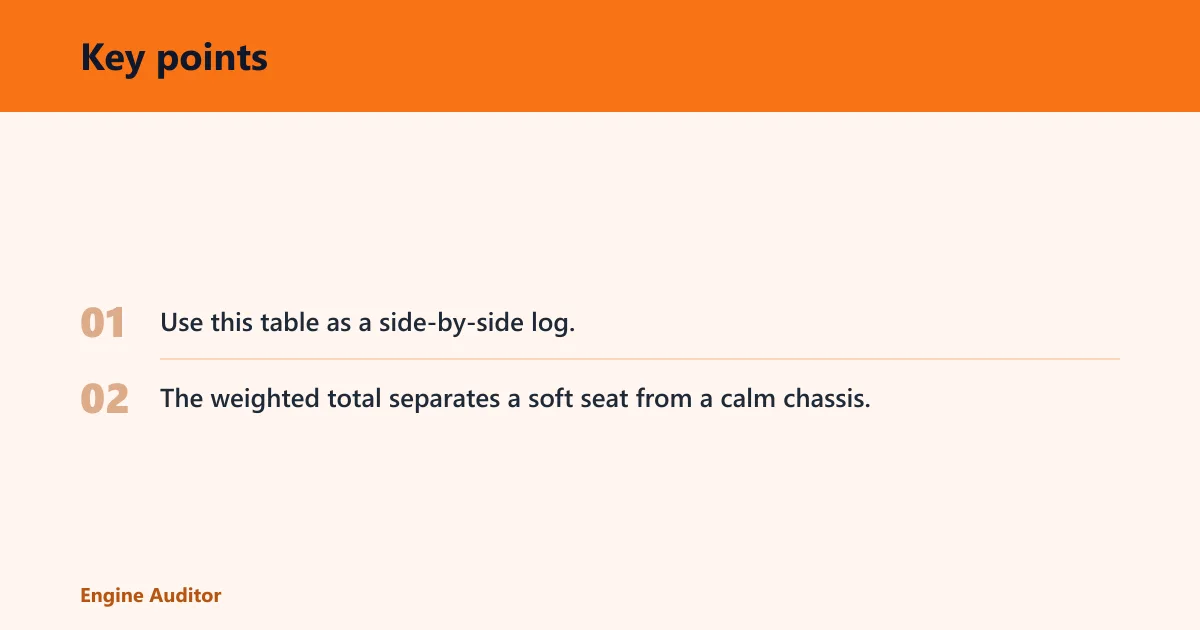
Use this table as a side-by-side log. The weighted total separates a soft seat from a calm chassis, which is useful because ride comfort is more than one sensation.
| Criterion | Weight | Car A score | Car A notes | Car B score | Car B notes |
|---|---|---|---|---|---|
| Seat cushion length and thigh support | 3 | 4 | Good thigh support, cushion slightly short | 3 | Front edge presses after 20 minutes |
| Lumbar support and seat shape | 3 | 4 | Backrest holds lower back well | 4 | Good shape, lumbar less adjustable |
| Headrest position and adjustment range | 2 | 3 | Headrest tilts forward | 4 | Easy to set for taller driver |
| Ride smoothness over broken pavement | 4 | 3 | More jiggle on rough patches | 4 | Smoother over patched asphalt |
| Road harshness over sharp bumps | 4 | 3 | Sharp impact on speed bumps | 4 | Less kick through the body |
| Wind noise at highway speed | 3 | 4 | Mirror area stays quiet | 3 | Noticeable hiss near A-pillar |
| Tire roar on coarse pavement | 3 | 3 | Some hum on rough concrete | 2 | Louder tire roar at 60 mph |
| Steering effort and on-center feel | 2 | 4 | Easy at low speed, stable at cruise | 3 | Heavier parking effort |
| Braking smoothness and confidence | 2 | 4 | Easy to stop without jerkiness | 3 | Initial bite feels abrupt |
| Post-drive fatigue | 5 | 4 | Less tense shoulders and back | 3 | More tired after highway loop |
Set up a back-to-back route
Use city streets and highway miles in the same loop so both cars face stop-and-go traffic, steady cruise, coarse pavement, and a few sharp bumps. That mix helps you compare ride smoothness, cabin noise, steering responsiveness, and brake confidence in one repeatable drive.
Use city streets and highway miles
City driving exposes low-speed ride motion, braking smoothness, and steering effort when parking or turning. Highway driving reveals wind noise, tire roar, on-center feel, and how relaxed the car feels after several minutes at a steady speed.
Add rough pavement and speed bumps
Run the same rough section in both cars. Pay attention to sharp impacts, jiggle, and whether the body settles quickly after a bump. Those details separate controlled suspension tuning from a car that only feels soft at low speed.
Drive in the same order or alternate
If possible, alternate the order on a second pass. That reduces the chance that traffic, fatigue, or road changes bias the result. A back-to-back comparison works best when the time gap is short enough that memory stays fresh.
How do I compare seat comfort between two cars?
Judge the seat as a support system, not a cushion alone. Check cushion length, thigh support, lumbar support, seat shape, headrest position, and the full adjustment range. A seat can feel soft for five minutes and still create fatigue on a longer drive.
Check cushion length and thigh support
Sit with your back against the backrest and look for full support under the thighs. Short cushions can leave the legs dangling, while long cushions can press behind the knees. This matters more on longer commutes and highway drives.
Check lumbar support and seat shape
Move the lumbar adjuster through its range and note where the back feels supported without pressure points. Also check whether the seat shape holds you in place during turns without forcing a narrow posture. That balance affects both comfort and long-term use.
Check headrest position and adjustment range
The headrest should line up with the back of the head without pushing the head forward. If it sits too far forward or too low, the car may feel tiring even if the seat cushion seems plush.
How does each car ride?
Separate ride smoothness from body control. A comfortable car can move a little over bumps without feeling busy, while a stiff car can keep the body flat but send sharper impacts into the cabin. Score the road surface, not just the softness of the seat.
Watch for sharp impacts and jiggle
On broken pavement, note whether the car sends one clean movement or a series of small shakes through the seat and floor. Sharp impacts point to more road harshness. Jiggle points to poor settling after the bump. Both affect fatigue.
Note how low-speed and highway ride differ
Some cars feel fine in town but tire you on the highway, especially if the suspension is busy over coarse concrete. Others feel firmer at low speed but more settled at cruise. Record both conditions separately so the result is not distorted by one short segment.
Say your first car has 19-inch wheels and low-profile tires, while the second uses 17-inch wheels with taller sidewalls. Keep everything else the same on the route, then note whether the larger wheels add more impact over patched asphalt. That one change often explains a firmer ride.
How quiet is each car?
Quiet ride means low-speed calmness, highway refinement, and enough noise isolation that the car does not feel tiring. Check wind noise, tire roar, engine noise, and radio clarity at cruising speed. A car can be smooth yet still feel loud.
Listen for wind noise and tire roar
At highway speed, listen near the mirrors, A-pillars, and wheel wells. Wind noise often comes from the upper body area. Tire roar usually rises on coarse pavement. Separating the two helps you tell whether the issue is aero noise or road texture.
Check engine noise and vibration
Accelerate gently and then hold steady speed. A noisy powertrain can make the cabin feel less relaxed even if the ride itself is smooth. EVs may reduce engine noise, but tire roar and suspension sharpness can still stand out because the cabin is quieter overall.
Test radio clarity at cruising speed
Set the radio to a normal listening level and see whether you need to raise the volume to follow speech or music. If you do, note the speed and road surface. That gives you a practical measure of cabin noise, not just a general impression.
Compare steering and brakes

Compare steering responsiveness during a test drive, then compare brake confidence during a test drive. Steering should feel stable on center, light enough for parking, and precise enough for lane changes. Brakes should feel firm, smooth, and easy to modulate without jerkiness.
Judge on-center feel and low-speed effort
At parking speeds, note how much effort the wheel needs in a lot or tight turn. Then, on the highway, check whether the wheel tracks straight without constant correction. A car that feels calm on center is usually less tiring on longer drives.
Judge highway effort and turn-in precision
Make a few gentle lane changes and note how quickly the car responds. Too much effort can feel heavy. Too little can feel vague. The best balance gives clear turn-in without making the car nervous at speed.
Judge pedal firmness, bite, and stop smoothness
Brake from low speed and from highway speed, if traffic allows. Look for predictable initial bite, firm pedal support, and a smooth stop without lurching. If the car jerks at the end of the stop, that can wear on the driver in traffic.
Suppose one SUV stops with a soft first inch of pedal travel, then grabs abruptly in the last part of the stop. Compare that to a sedan with a firmer, more linear pedal on the same route. The second car will usually feel easier to modulate in traffic, even if the first feels softer at rest.
Common mistakes
The biggest mistake is letting wheel size, tire choice, or a sport package decide the outcome without recording it. Another is mixing up road noise with suspension harshness. A third is relying on memory instead of notes, which makes the quieter car from the first drive seem better than it really was.
- Do not compare a base trim to a sporty trim without noting the difference.
- Do not use brochure claims as proof of comfort.
- Do not score one overall feeling without separating seats, ride, noise, steering, and brakes.
- Do not skip the rough-road section, because that is where harshness shows up.
- Do not wait until the end to write notes. Record them after each car.
How do I know which car feels more relaxed to drive?
Use the fatigue score and your notes, not a gut reaction from the first few minutes. The more relaxed car usually has better seat support, less road harshness, lower wind and tire noise, and smoother braking. If the scorecard is close, choose the one that leaves fewer pressure points and less tension.
Frequently asked questions
What makes one car ride smoother than another?
Suspension tuning, tire sidewall height, wheel size, and vehicle weight all matter. A car with smaller wheels and taller tires often filters sharp bumps better, while a heavy vehicle can feel calmer over some surfaces but busier on others if the suspension is too stiff.
How can I tell if a car is quiet enough on the road?
Check wind noise, tire roar, engine noise, and radio clarity at a steady highway speed. If you need to raise the radio much above normal listening volume or you notice hiss and hum on coarse pavement, the cabin may not be quiet enough for long trips.
What should I notice on a test drive for comfort?
Notice seat support, road harshness over bumps, cabin noise at speed, steering effort in town and on the highway, brake smoothness, and how you feel after the drive. Test drives help assess comfort and features, but only if you use the same route and note the same items.
What’s the best way to compare steering feel and handling?
Compare on-center stability, low-speed effort, highway effort, and turn-in precision on the same streets. Steering responsiveness is easiest to judge when you repeat the same lane changes and parking maneuvers in both cars, then write down whether the wheel feels light, heavy, vague, or precise.
Should I compare comfort using specs or a test drive?
Use specs as context, not proof. A test drive shows how relaxed each car feels on the road, while specs can only hint at possible differences. Wheel size, tire type, and suspension package are useful clues, but they do not replace the drive itself.
Products related to this article
Sponsored / affiliate links. As an Amazon Associate I earn from qualifying purchases. I may earn additional commission from eligible campaigns.