How to Compare Driver Assist Features Across Models
Compare driver assist features by what they do on your roads: adaptive cruise response, lane-centering precision, hands-on alerts, and stop-and-go behavior, then match the system to the roads you drive most. If you compare only feature names, you can pay more for tech that chatters, hunts in lanes, or fails in traffic where you need it. This guide gives you a practical checklist for comparing trims and packages, plus the spec details that separate usable systems from mere marketing labels.
What driver assist does
Driver assist is convenience and safety technology that helps with speed control, lane guidance, collision warning, blind-spot alerts, parking, and driver monitoring. It is not fully self-driving. The key question is not whether a model lists these features, but how each one behaves, what conditions it needs, and whether it comes standard or buried in a package.
Core functions shoppers should expect
Most shopping lists include adaptive cruise control, lane keeping assist or lane centering, automatic emergency braking, blind-spot monitoring, traffic sign recognition, driver attention monitoring, and parking cameras or sensors. The same name can cover very different behavior, so function matters more than the badge on the brochure.
For example, one car may hold speed and a gap smoothly until traffic stops, while another may brake late, surge on re-entry, or drop out below a certain speed. The label says ACC in both cases. The driving feel does not.
Why feature names vary by brand
Automakers use different names for similar systems. One brand may call it lane centering, another lane trace assist, and another lane keeping with steering assist. Some systems are camera-only. Others pair radar with cameras, or add a driver-facing camera for attention monitoring.
That means you should ask three things for every feature: what sensors it uses, when it works, and what it does when conditions get messy. Faded lane paint, sharp curves, construction cones, and dirty sensors can expose the difference fast.
Driver assist matrix template
Use this matrix to compare cars on behavior, not just feature names. Score each category from 1 to 5, add notes from the drive, and mark whether the feature is standard or optional. If a model needs a package, subscription, or higher trim, put that in the cost column too.
| Model | Highway following | Lane centering | Stop-and-go smoothness | Blind-spot coverage | Parking help | Driver monitoring strictness | Weather tolerance | Total package cost | Standard? | Notes from drive |
|---|---|---|---|---|---|---|---|---|---|---|
| Car A | 4 | 5 | 4 | 3 | 2 | 4 | 3 | $1,500 package | No | Steady in light traffic; drifted near faded lane paint. |
| Car B | 3 | 3 | 5 | 4 | 4 | 2 | 2 | Included on top trim | Yes | Smooth in stop-and-go; camera warnings were late in rain. |
| Car C | 5 | 4 | 3 | 5 | 3 | 5 | 4 | $9/mo subscription after trial | No | Strong highway gap control; hands-on alerts came quickly. |
How to record test-drive notes
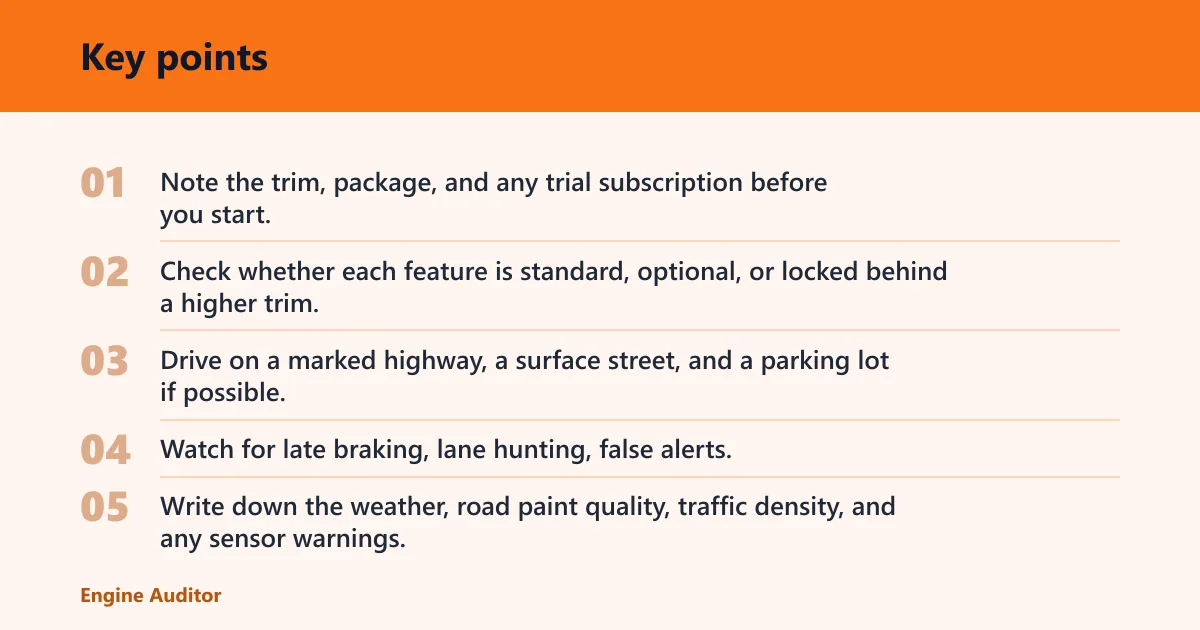
- Note the trim, package, and any trial subscription before you start.
- Check whether each feature is standard, optional, or locked behind a higher trim.
- Drive on a marked highway, a surface street, and a parking lot if possible.
- Watch for late braking, lane hunting, false alerts, and driver warnings that feel too strict or too lax.
- Write down the weather, road paint quality, traffic density, and any sensor warnings.
Standard versus optional checkboxes
- Standard: included on the trim you are pricing.
- Optional package: requires extra equipment or a higher trim.
- Subscription: may work only during a trial or for a monthly fee.
- Market-specific: available in one country or region, but not another.
How do you compare adaptive cruise control and lane centering?
Compare adaptive cruise control and lane centering separately, because they solve different problems. ACC controls speed and following distance. Lane centering keeps the car near the middle of the lane. A car can do one well and the other poorly, especially on curves, in traffic, or where lane markings fade.
Adaptive cruise control behavior to check
ACC maintains a set speed and following gap, and many systems now handle stop-and-go traffic. Look for the speed range, the minimum speed it can hold, how quickly it resumes, and whether it uses radar, cameras, or both. Radar-based systems usually track traffic more steadily in poor visibility, while camera-heavy systems can be more sensitive to rain, glare, or dirt.
Also watch for abrupt brake inputs. Some systems keep a neat gap on open roads but feel jerky when traffic compresses. Others hesitate too long, then brake hard. That matters more than a brochure claim of “advanced cruise.”
Lane centering versus lane departure warning
Lane centering actively helps hold the vehicle in the lane center. Lane departure warning only alerts you, and sometimes applies light correction. That difference matters on long drives. A warning system can nag without guiding much, while a centering system can reduce steering work if it stays calm and accurate.
Check whether the system requires hands on the wheel, whether it disengages on gentle curves, and how it behaves when lane paint is worn. Many systems depend on clear markings. In faded-lane conditions, the steering can wander or drop out without much warning.
Stop-and-go performance in traffic
For heavy traffic, smooth stop-and-go control matters more than top-end speed range. You want a system that brakes predictably, restarts without a lurch, and does not cut in and out at low speeds. If the car gives frequent “keep hands on wheel” alerts in slow traffic, that is a useful clue about how strict the driver monitoring is.
Say your commute includes a six-mile freeway crawl with frequent merges. A system that follows smoothly from about 0 to 40 mph and resumes cleanly after a full stop will usually feel better than one that surges, nags, and then overreacts to cut-ins.
Which features matter most for your driving?
The best mix depends on where you spend time. Highway commuters should care most about ACC, lane centering, and attention monitoring. City drivers usually get more value from blind-spot coverage, rear AEB, parking sensors, and a clear 360-degree camera. Families hauling cargo often want both highway comfort and low-speed camera help.
Highway commuting
On highways, the strongest features are ACC with smooth stop-and-go, lane centering that stays calm on curves, and clear driver monitoring. Traffic sign recognition can help, but only if it reads signs accurately and does not rely too heavily on outdated map data. For long trips, weather tolerance also matters because dirty sensors and spray can change how the system behaves.
Urban driving and parking
In town, blind-spot monitoring, cross-traffic alert, rear AEB, parking sensors, and a high-resolution 360-degree camera often matter more than highway lane keeping. Low-speed visibility is the issue. If the camera image looks grainy or the sensors miss curbs and posts, the package is less useful than the spec sheet suggests.
Family hauling and road trips
For larger vehicles, a system that is steady with passengers and cargo can feel very different from a light commuter car. You may also want a wider blind-spot system, stronger rear cross-traffic alerts, and parking aid that helps with long hoods or tall rear pillars. If the vehicle has automated parking, check whether it works in tight real-world spaces or only in ideal demo conditions.
How are driver assist systems packaged and priced?

Packaging changes the real cost. A feature may be standard on one trim, a paid package on another, and a subscription after a trial on a third. Compare the trim price, the package price, and the cost of any software service together. That total is what you are actually paying for the system.
Trim-level content
Some brands load more driver assist gear into mid-level trims, while others reserve the best systems for top trims. That matters because a trim jump may include wheels, audio, or upholstery you do not want. If you only need better ACC and lane centering, the cheaper trim plus a package may be the smarter route.
Option packages and bundles
Look for packages that bundle features you value with ones you do not. A driver assist package may include ACC, lane centering, traffic sign recognition, and a driver-facing camera, while a different package adds parking assist and a head-up display. If you only want two items from a bundle, the extra cost can get high fast.
Subscriptions and software support
Some features may work only during a trial period, then require a monthly or annual fee. Others need over-the-air updates to keep maps, camera logic, or hands-on alerts current. Before you buy, ask how long the trial lasts, whether the subscription is transferable, and whether software support is included in the price or billed later.
In one example, lane centering is included in the purchase price, while traffic sign recognition and enhanced highway assist may expire after about 12 months. That car may look cheaper on the window sticker and cost more over three years than a model with a higher upfront price and no subscription.
How do brands differ in sensor strategy?
Brands differ in how they sense the road and monitor the driver. Some lean on cameras. Others pair cameras with radar. Some use a driver-facing camera, while others rely on steering torque to guess if you are paying attention. That sensor mix affects weather behavior, alert timing, and privacy tradeoffs.
Camera-only versus radar-based systems
Camera-only systems can read lane markings and signs well in clear conditions, but they tend to be more sensitive to glare, rain, snow, and dirty lenses. Radar helps track vehicles ahead through poor visibility and can improve ACC stability. A mix of camera and radar is often more forgiving in traffic and bad weather, though calibration and software still matter.
Driver-facing cameras and torque sensing
Driver attention monitoring may use a camera aimed at your face, steering wheel torque sensing, or both. Camera-based systems can better tell if you are looking away, but some buyers dislike the privacy tradeoff. Torque-based systems are less invasive, yet they can miss distraction if you keep a light touch on the wheel.
What sensor setup means in bad weather
Weather exposes weak points quickly. Snow and slush can cover camera views and radar surfaces. Heavy rain can confuse lane tracking. Dirty sensors can trigger warnings or disable features. When a brand explains its sensor placement and cleaning needs clearly, that is a better sign than a vague claim about “all-weather confidence.”
How should you test a car before buying?
Test the system on the roads where you will actually use it. Check lane paint, curves, merges, stop-and-go traffic, blind spots, parking visibility, and how quickly the system complains if you relax your grip. The goal is to find out whether the package feels calm and useful or fussy and inconsistent.
Lane markings, curves, and construction zones
Start with a road that has decent paint, then try a section with worn markings or a gentle construction setup if possible. Watch whether lane centering holds steady or starts to hunt. Construction zones are a useful stress test because cones, temporary lines, and narrow lanes often confuse systems that look strong on open roads.
Blind-spot, AEB, and parking checks
Check blind-spot alerts during lane changes, then confirm whether the system includes cross-traffic alert. Ask if the rear camera and rear automatic emergency braking are standard or optional. In a parking area, judge whether the 360-degree view is crisp enough to spot curbs, posts, and tight gaps, or whether the picture is too soft to trust.
Questions to ask the salesperson
- Is this feature standard, optional, or subscription-based?
- Does ACC use radar, cameras, or both?
- Does lane centering stay active at low speeds or only on highways?
- Does the driver monitoring system use a camera or steering torque?
- Are software updates and map updates included?
- What happens when sensors are blocked by snow, mud, or heavy rain?
Frequently asked questions
Who has the best driver assist technology?
There is no universal winner. The best system depends on your roads, your tolerance for alerts, and the trim or package you can afford. One model may excel at highway centering, while another may be better at parking or traffic. Compare the actual behavior, not the brand name on the spec sheet.
What is driver assist?
Driver assist is a set of convenience and safety features that help with speed control, lane guidance, collision warning, blind-spot alerts, driver monitoring, and parking. It is not autonomous driving. The driver still needs to supervise, keep attention on the road, and stay ready to take over when conditions change.
How do I compare driver assist features across different car models?
Compare by sensor type, speed range, stop-and-go behavior, lane-centering quality, driver-monitoring strictness, and package cost. Then read the trim sheet carefully to see whether the feature is standard, optional, or subscription-based. A matrix with notes from a drive is the fastest way to separate good hardware from good marketing.
Which driver assist features matter most for highway driving?
Adaptive cruise control and lane centering matter most on highways, especially if they work smoothly in stop-and-go traffic. Driver monitoring also matters because long trips invite distraction. Traffic sign recognition can help, but only if it is accurate. Strong weather tolerance helps too, because highway spray and grime can interfere with sensors.
What is the difference between adaptive cruise control and lane centering?
Adaptive cruise control controls speed and following distance. Lane centering helps keep the car in the middle of the lane. ACC can work without lane centering, and lane centering can work without ACC. For the easiest highway drive, you usually want both, plus clear hands-on alerts and predictable behavior in traffic.
How can I tell if a car’s driver assist package is worth the extra cost?
Add up the trim jump, package price, and any subscription fees over the time you plan to keep the car. Then compare that total with the features you will actually use. If the package mainly adds features for parking or weather you rarely face, it may not be worth the extra cost.
Which driver assist features work best in traffic and bad weather?
For traffic, smooth stop-and-go ACC, lane centering that does not hunt, and driver monitoring that gives clear but not constant warnings matter most. In bad weather, radar-assisted ACC, clear camera placement, and systems that tolerate blocked or dirty sensors tend to behave better. No system is immune to heavy rain, snow, or grime.
Products related to this article
Sponsored / affiliate links. As an Amazon Associate I earn from qualifying purchases. I may earn additional commission from eligible campaigns.