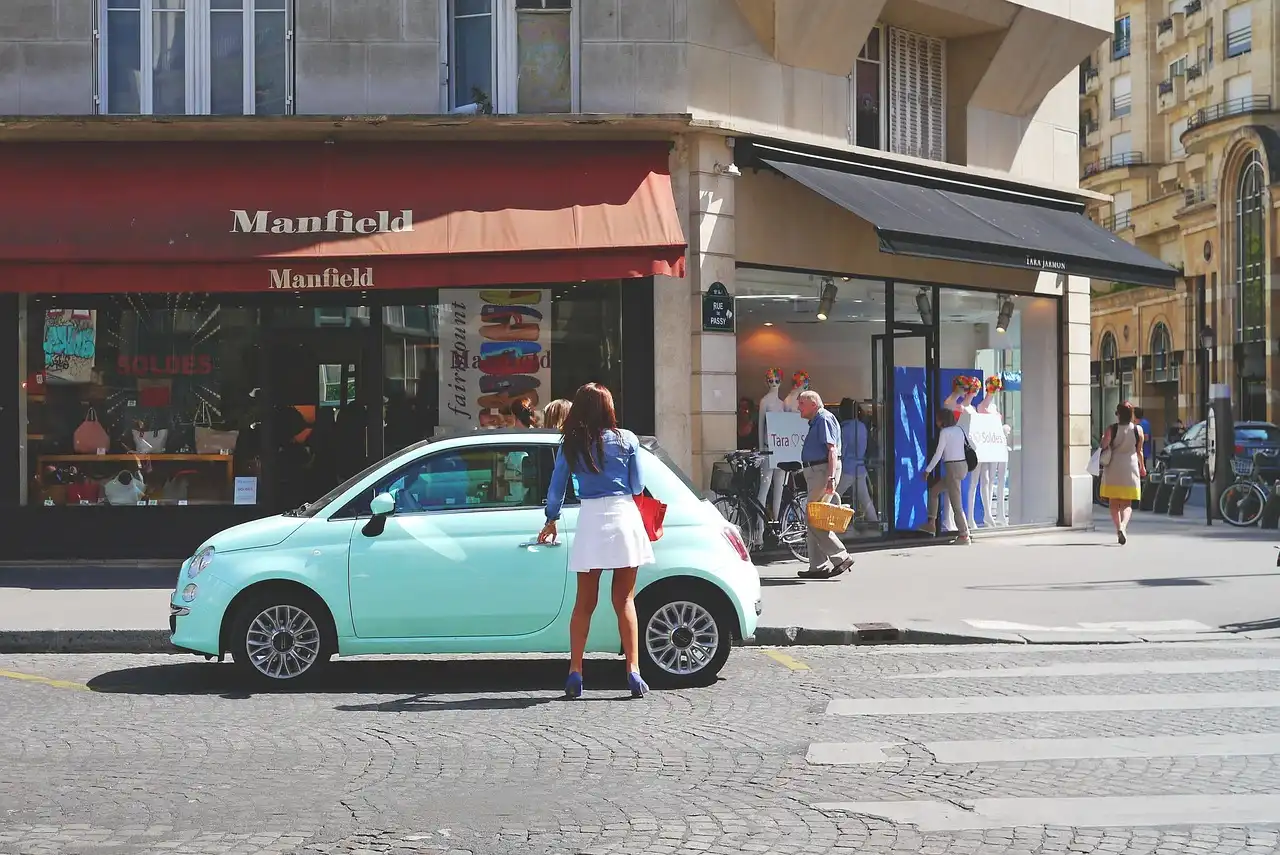
How to Compare Small Cars for City Driving
For city driving, compare small cars by curb-to-curb turning radius of about 35 feet or less, width under about 70 inches, outward visibility, and parking aids; those traits often matter more than badge size. Ignore them, and parking slows down, blind spots widen, and tight turns start to feel like work. Judge the city specs that affect daily driving most, then compare models on the features that fit your streets and parking.
Quick city-driving checklist: turn first, then width, then visibility, then parking aids, then efficiency. If two cars are close on paper, give the edge to the one that is easier to place in tight spaces, easier to see out of, and easier to crawl through traffic without extra effort. For most city use, the most important order is parking and tight turns first, then visibility, then comfort, then fuel use.
What matters most in city traffic?
Turning radius, exterior width, and visibility decide how a car behaves on narrow streets, in garages, and at stoplights. A short body helps, but it is not enough on its own. Large mirrors, thick rear pillars, or weak low-speed driver aids can cancel the benefit of a compact footprint.
Turning radius and low-speed maneuvering
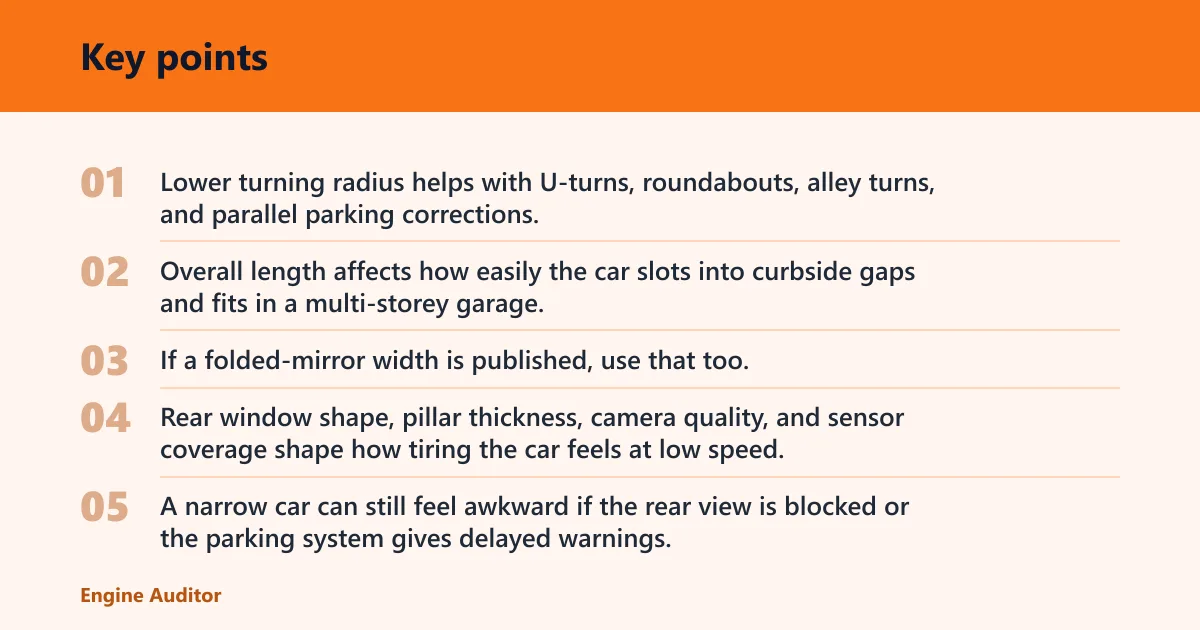
Lower turning radius helps with U-turns, roundabouts, alley turns, and parallel parking corrections. If a spec sheet lists both kerb-to-kerb and wall-to-wall figures, compare both; wall-to-wall tells you more about how much sidewalk or lane space the car actually needs. For a simple city score, treat a figure at about 35 feet or less as strong, slightly above that as middle-of-the-road, and clearly larger figures as a drawback.
Length and width with mirrors
Overall length affects how easily the car slots into curbside gaps and fits in a multi-storey garage. Width including mirrors often matters more than cabin width because mirrors are what touch pillars, posts, and neighboring cars first. If a folded-mirror width is published, use that too. As a comparison rule, under about 70 inches wide with mirrors folded is easier to live with in narrow garages, while wider cars need more care at the edges.
Visibility, parking aids, and assist behavior
Rear window shape, pillar thickness, camera quality, and sensor coverage shape how tiring the car feels at low speed. A narrow car can still feel awkward if the rear view is blocked or the parking system gives delayed warnings. Low-speed AEB and lane-keep tuning also matter in stop-go traffic and dense lanes. Check the owner’s manual or spec sheet for camera, sensor, and parking-assist availability so you know exactly what is fitted.
City car comparison matrix
Use this matrix to score any candidate small car from 1 to 5. A 5 means the spec is well suited to urban use; a 1 means the feature is likely to create daily friction. Look up the stated measurement, then decide how well it fits your streets, parking, and route mix.
| Urban task | 1 to 5 score guide | Exact specs to look up | Best for |
|---|---|---|---|
| Curbside parking | 5 = easy to place in short gaps; 4 = comfortable with little correction; 3 = workable but needs attention; 2 = tight and awkward; 1 = bulky in gaps | Overall length; width including mirrors; folded-mirror width if listed | Parallel parking in short curb gaps |
| Multi-storey garage fit | 5 = easy clearance and door opening margin; 4 = needs care but no drama; 3 = manageable in average bays; 2 = awkward in tight bays; 1 = difficult in narrow ramps and posts | Overall length; width including mirrors; turning radius; rear visibility | Parking decks, ticket barriers, narrow ramps |
| Low-speed visibility | 5 = clear rear view and strong camera help; 4 = mostly clear with minor blind spots; 3 = acceptable with aids on; 2 = hard to place accurately; 1 = blind spots and weak aids | Rear window size; pillar thickness; backup camera quality; parking sensors; 360-degree camera | Backing into spaces and merging in dense traffic |
| Tight-turn maneuvering | 5 = easy U-turns and roundabout exits; 4 = usually one clean move; 3 = acceptable with some extra space; 2 = frequent three-point turns; 1 = awkward in tight streets | Kerb-to-kerb turning radius; wall-to-wall turning radius; wheelbase if listed | Narrow streets, roundabouts, short dead-end roads |
| Stop-go comfort | 5 = smooth creep, good hill-hold, low fatigue; 4 = generally calm in traffic; 3 = fine but not seamless; 2 = clunky at low speed; 1 = tiring in traffic | Transmission type; creep control; hill-hold behavior; stop-start tuning; urban fuel economy | Rush-hour commuting and frequent light changes |
| Cargo flexibility | 5 = easy fold and useful opening; 4 = flexible with minor compromises; 3 = usable for everyday loads; 2 = limited opening or awkward fold; 1 = awkward loading | Rear seat fold split; trunk opening size; cargo volume; load lip height | Groceries, strollers, work bags, weekend carry |
Say your route includes a tight underground garage and a curbside space between two SUVs. A car with a 34-foot turning radius, folded mirrors under 70 inches wide, and good rear sensors will feel simpler to place than a slightly shorter car with a poor rear window and no camera lines. The difference shows up every day.
How do you judge turning and parking?
Turning and parking are related, but they are not the same test. Turning radius tells you how the car rotates in traffic; length and width decide whether the car fits the space after the turn is done. A good parking package can make a mediocre body easier to live with.
Kerb-to-kerb versus wall-to-wall
Kerb-to-kerb is the cleaner city number because it reflects the space needed to complete a turn on the road. Wall-to-wall is still useful in garages and tight lots, where mirrors and body overhang can matter more than the published circle. Lower is better for both measures, but compare like for like.
Length, width, and folded mirrors
Overall length should be compared in millimeters or inches, not by class name. A shorter car is easier to thread into a gap, but a narrow body with wide mirrors can still clip posts or force awkward corrections. Folded-mirror width is one of the best numbers for narrow garages and alley access.
Rear camera, sensors, and 360-degree views
Look for a clear rear camera, front and rear parking sensors, and, if available, a 360-degree camera or park assist. The camera should show fixed guidelines clearly in low light, and the sensor system should warn early enough to let you stop before the bumper is close. Weak graphics and late alerts reduce the value of a compact body. Owner’s manuals and spec sheets are the best place to confirm whether these aids are standard, optional, or not offered.
-
Measure the turn first. Put the turning radius at the top of the shortlist, then compare it with your usual street width and garage ramps. A lower figure matters most if you make frequent U-turns or enter narrow slots from a steep angle.
-
Check the mirrors next. Compare width including mirrors, not only cabin width. If the maker lists folded-mirror width, use that to judge whether the car will clear posts, pillars, and narrow bays without repeated folding.
-
Inspect parking help. Confirm rear camera quality, sensor count, and whether a 360-degree camera is available. For city use, a good camera and audible sensors can matter more than a slightly smaller body.
What should you check inside the cabin?
Inside the cabin, the main question is whether the driver can see enough of the car’s corners to place it cleanly. Rear visibility, seat height, and the behavior of the transmission shape how stressful the car feels in traffic. A small footprint does not help if the driver sits low and sees very little behind.
Rear visibility and pillar thickness
Wide rear pillars, a shallow rear window, or a high cargo shelf can hide motorcycles, scooters, and posts. Check the rear window from the driver’s seat, not from outside the car. If the mirror view feels narrow, note whether the backup camera is sharp enough to replace what the glass cannot show.
Driving position and city sight lines
A slightly higher seat often helps with seeing over parked cars and reading traffic flow. The goal is not SUV height. It is a view that lets you place the nose, see cross traffic early, and avoid constant head movement when turning into gaps.
Transmission feel, hill-hold, and creep control
An automatic is usually easier in stop-go traffic because the driver can focus on spacing and steering rather than clutch work. Hill-hold matters on sloped streets and garage ramps, and creep control matters when inching toward a parking spot. A manual can still suit some drivers, but it adds workload in dense traffic.
Suppose two cars have the same width, but one has a narrow rear window and delayed camera graphics. That car will feel harder to park even though its numbers look identical on paper. The failure point is not size; it is what the driver can actually see.
Which features matter most for daily city use?
Urban fuel use, low-speed driver aids, and ride quality matter because city driving has more stops, more bumps, and more short trips. A small car that uses fuel well on paper can still disappoint if the engine runs cold on short errands or if the suspension bounces over broken pavement.
Urban fuel economy and short-trip penalty
Look for city MPG or consumption figures, not only combined ratings. Stop-start systems help most when traffic is slow and frequent, but short trips can still hurt real-world economy because the engine spends more time warming up. If the commute is short, compare the city figure more closely than the highway one. Use official fuel-economy figures where available so the comparison stays consistent.
Low-speed AEB and lane-keep calibration
Driver-assist systems should behave politely at city speeds. Low-speed automatic emergency braking needs to respond smoothly in traffic queues, while lane-keep should avoid tugging at the wheel on narrow streets, sharp curves, and construction detours. Traffic-jam assist, when available, is useful only if it works predictably below highway speeds. Check the owner’s manual or safety sheet for the exact assist wording and operating limits.
Ride comfort on rough streets
Wheelbase, tire sidewall, and suspension tuning shape comfort over speed bumps and potholes. A car with a short wheelbase can feel more reactive, while a longer wheelbase may smooth some bumps but be less nimble in parking lots. What matters is how well the suspension absorbs repeated low-speed impacts without sending sharp jolts into the cabin.
How should you match a small car to your city?
Match the car to your actual routes, not to the idea of a small car. Dense downtown driving rewards a tighter turning circle and better parking aids. Suburban errands may favor easier garage access and a calmer ride. Frequent passenger use shifts the balance toward rear seat access and cargo flexibility.
Dense downtown and frequent parallel parking
Choose a shorter car with a lower turning radius, clear rear camera graphics, and strong sensor coverage. In dense downtown use, folded-mirror width and rear visibility can matter more than boot volume. That combination makes curbside parking and lane changes less stressful.
Suburban errands with garage access
If most trips involve a garage, driveway, or shopping center ramp, compare wall-to-wall turning radius, mirror width, and ride comfort over broken concrete. A car that is easy to thread through a garage entrance can be more useful than one that looks small from the outside but feels clumsy at the posts.
Passenger carrying and weekend cargo needs
If you often carry adults or tall bags, compare rear-seat fold split, trunk opening size, and cargo volume. A 60/40 split rear seat is usually more useful than a single-piece backrest, because it keeps one seating position open while still making room for long items. The opening shape matters as much as the quoted volume. (Motortrend)
Frequently asked questions
What is the easiest small car to drive?
The easiest small car to drive is usually the one with the lowest turning radius, clear rear visibility, and strong parking aids, not simply the shortest one. An automatic with good creep control and hill-hold will feel calmer in traffic and on ramps, especially if the mirrors are narrow when folded.
Are smaller cars easier to drive in the city?
Often yes, but only if the body size works with the mirrors, visibility, and parking tools. A small car with thick pillars and weak sensors can still feel awkward. The right comparison is how easily it fits your streets, garages, and parking spaces, not the badge class.
What is the best small car for city driving?
The best small car for city driving is the one that combines a low turning radius, modest width with mirrors, good rear visibility, and a usable parking camera. If your city has steep ramps or rough pavement, add hill-hold and a compliant ride to the list before choosing.
Which small car is most fun to drive?
The most fun small car is usually the one with quick steering, a tidy turning circle, and a transmission that responds cleanly at low speed. Fun in the city also depends on visibility and parking ease, because a car that feels easy to place encourages more relaxed driving.
What should I compare when choosing a small car for city traffic?
Compare turning radius, overall length, width including mirrors, rear visibility, parking aids, transmission type, and urban fuel economy. Then add cargo flexibility and ride comfort if your routes include groceries, passengers, or rough streets. That list tells you more than size class alone.
Is a small automatic car better for city driving?
Usually yes, because it removes clutch work from stop-go traffic and makes creeping into a space much easier. The gain comes from transmission behavior, not from the car being small. Check hill-hold, creep control, and slow-speed smoothness before assuming every automatic will feel easy.
Products related to this article
Sponsored / affiliate links. As an Amazon Associate I earn from qualifying purchases. I may earn additional commission from eligible campaigns.