How to Compare Car Battery Warranty Terms the Right Way
Compare car battery warranties by three terms first: failure trigger, payout structure, and claim steps; ignore total length unless those terms match closely. A long headline term can still leave you paying full price if the battery fails outside the free-replacement window, falls under an exclusion, or needs prior approval before work begins. This guide shows how to read the fine print line by line, compare offers side by side in one view, and spot terms that make a warranty hard to use.
Battery warranty comparison checklist
Use this table as a side-by-side filter, not a scorecard. It is a reusable blank checklist template: fill in the actual warranty wording, then judge whether the claim trigger, payout rule, labor coverage, and approval steps are workable. A warranty that looks long on the label can still be weak if it pays only after prorating, excludes installation, or demands paperwork that most owners will not have on hand.
| Model | Term length | Mileage cap | Free-replacement window | Prorated period | Exclusions | Proof required | Labor coverage | Claim steps | Verdict |
|---|---|---|---|---|---|---|---|---|---|
| Model A | Enter warranty term | Enter mileage cap or N/A | Enter free-replacement window | Enter prorated period or N/A | Enter exclusions listed in the policy | Enter receipt, install date, and any records required | Enter parts only or parts and labor | Enter seller, approval, and return steps | Pass if trigger, payout, labor, and approval are clear; fail if any of those are vague, heavily restricted, or hard to document |
| Model B | Enter warranty term | Enter mileage cap or N/A | Enter free-replacement window | Enter prorated period or N/A | Enter exclusions listed in the policy | Enter receipt only or more if required | Enter labor coverage | Enter prior approval, return, and filing steps | Pass if the warranty clearly favors the owner on trigger, replacement, and claim friction; fail if the claim depends on broad exclusions or extra burdens |
| Model C | Enter warranty term | Enter mileage cap or N/A | Enter free-replacement window | Enter prorated period or N/A | Enter exclusions listed in the policy | Enter VIN, receipt, and service history if required | Enter parts and labor or parts only | Enter dealer inspection, prior approval, or authorized-shop steps | Pass if the warranty is easy to prove, easy to file, and pays as written; fail if the burden shifts most of the cost or paperwork to the owner |
- Check the failure trigger. Compare what has to happen before coverage starts: a dead battery, a failed test, low retained capacity, or a specific defect. If the warranty only covers a manufacturing defect, a battery that weakens from heat or repeated undercharging may fall outside the claim.
- Split payout from duration. Read the free-replacement period and the prorated period separately. A free-replacement claim usually gives a new battery with no charge to the owner, while a prorated claim reduces the payout as the battery ages, so the same warranty can pay very differently depending on timing.
- Check who pays labor. Some warranties cover only the battery itself. Others also pay diagnostic time, installation, or both. If labor is excluded, a low-cost battery can still turn into an expensive claim because removal, testing, and reinstallation stay on you.
What counts as a battery warranty claim?
A valid claim starts with the event the warranty covers, then moves through the payout rule and the claim process. In practice, that means checking whether the battery failed by defect, by loss of capacity, or by a condition the policy excludes, and whether the seller or manufacturer must approve the job before repair begins.
Failure trigger rules
Compare the trigger language line by line. Some warranties pay only after mechanical or electrical failure, while an EV battery warranty may use a state-of-health threshold or a minimum retained capacity standard. That difference matters because a battery can feel weak long before it meets the exact trigger in the policy.
Free-replacement vs prorated coverage
Free-replacement coverage pays the full replacement cost during the protected window, usually subject to the other claim rules. Prorated coverage starts later and shifts part of the cost to the owner. If the battery is already two years old and the policy is mostly prorated, the headline term can be misleading.
Replacement, repair, and labor
A warranty may promise replacement, repair, or both. It may also cover parts and labour after mechanical or electrical failure, but standard 12V batteries may be excluded under some vehicle warranties. Do not assume installation, diagnostics, or towing are included unless the wording says so.
How do you compare warranty length?
Warranty length is only the first filter. You need the start date rule, the mileage cap, and the end trigger, because a policy can expire by time or mileage, whichever comes first. For high-mileage drivers, that difference often matters more than the headline term in years.
Time limit and start date
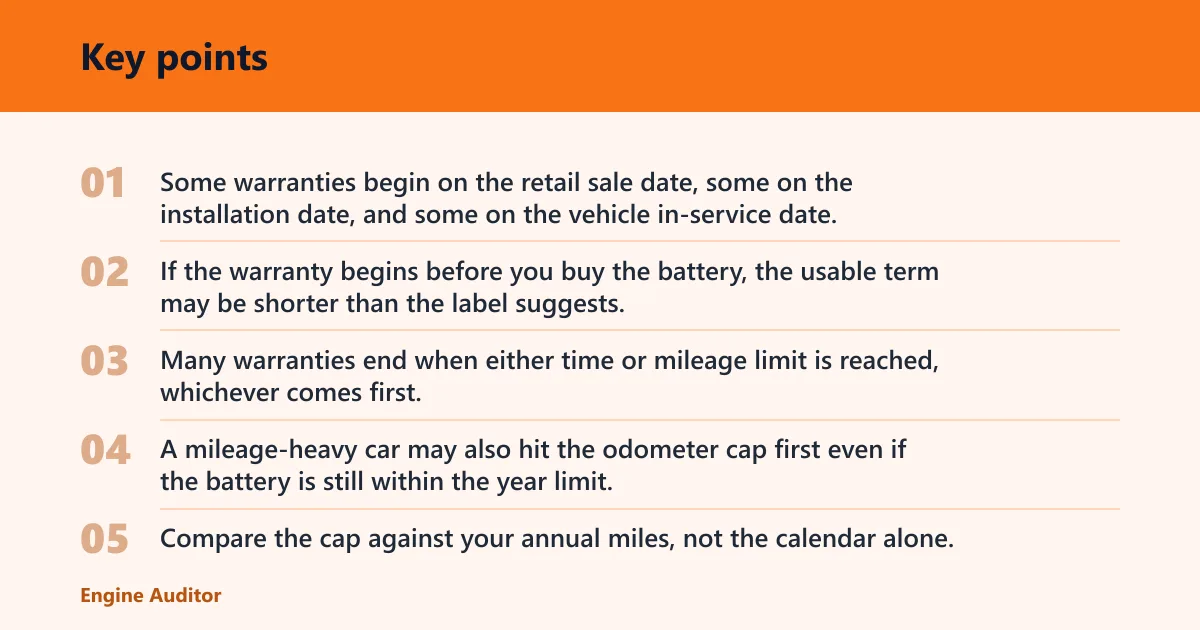
Check when the clock starts. Some warranties begin on the retail sale date, some on the installation date, and some on the vehicle in-service date. If the warranty begins before you buy the battery, the usable term may be shorter than the label suggests.
Mileage cap and whichever comes first
Many warranties end when either time or mileage limit is reached, whichever comes first. A policy with 36 months and 36,000 miles can expire in about 18 months for a delivery vehicle, while a low-mileage commuter may use the full time period. That is why mileage cap language belongs in the first pass, not the last.
Expiry rules for high-mileage driving
Short-trip city driving and commercial use can age a battery by heat, vibration, and repeated starts before the mileage cap is reached. A mileage-heavy car may also hit the odometer cap first even if the battery is still within the year limit. Compare the cap against your annual miles, not the calendar alone.
Say a van that runs about 28,000 miles a year under a battery warranty of 24 months or 40,000 miles, whichever comes first, may reach the mileage cap before the time limit. The mileage cap ends coverage first, so the second year may be gone before the date limit matters. That is a different result from a similar warranty with no mileage cap.
What exclusions can void coverage?
Exclusions are the clauses that make a claim fail even when the battery seems to have died early. Misuse, neglect, wrong charging, corrosion, and missing service records are common problem areas, and some policies also exclude wear-and-tear items such as tyres, wipers, brakes and clutches from broader vehicle coverage.
Misuse and neglect
Read for language about abuse, contamination, deep discharge, or leaving electrical loads on. A battery damaged by incorrect charging or repeated undercharging may be treated as owner-caused, not warranty-caused. If the policy says negligence voids coverage, parking for weeks with an accessory draw can become a claim problem.
Wear items and service records
Service history can decide the claim. A warranty claim can depend on whether the vehicle is serviced to the manufacturer’s schedule, and some policies ask for evidence that the battery has been inspected or maintained. If the paperwork is missing, the seller may deny the claim even when the battery itself is defective.
Charging, corrosion, and installation errors
Look for exclusions tied to terminal corrosion, wrong fitment, loose mounting, or installation by an unapproved shop. A battery that fails after a bad install may be treated as installation damage rather than product failure. That distinction can matter as much as the battery brand or the stated term.
Claim paperwork and approval
Claims are easier to lose than to win when the paperwork is thin. Keep the receipt, installation record, and any service history that shows the battery was used and maintained as required, because repairs may need to be authorised before work begins and the claim may need to be filed with a specific seller or manufacturer.
Proof of purchase
Keep the dated receipt and the battery label information. Many claims need the purchase date to confirm the term and the battery serial or part number to match the product line. If you cannot prove when the battery entered service, the warranty period may be hard to establish.
Maintenance documentation
Save oil-change records, inspection sheets, charging records, and any battery test printout if the policy asks for them. The goal is to show the battery was serviced to schedule and not neglected. A claim file with dates and mileage is easier to defend than memory alone.
Prior authorization and claim steps
- Confirm the claim channel. Check whether the seller, dealer, or manufacturer handles the warranty. Filing in the wrong place can waste time and may miss a deadline.
- Get approval first. Some warranty policies require prior authorization before repairs. Do not replace the battery first unless the policy allows it, because an unapproved repair may be denied.
- Keep the old battery. Save the failed unit until the claim is settled. Some claim processes require inspection, return, or verification of the old battery before payment.
Battery types and warranty terms
Do not blend 12V starter battery terms with EV traction battery terms. They fail under different conditions, use different trigger language, and often sit under different warranty documents. AGM batteries can also have their own wording, especially where charge acceptance and cycling are part of the claim test.
12V starter batteries
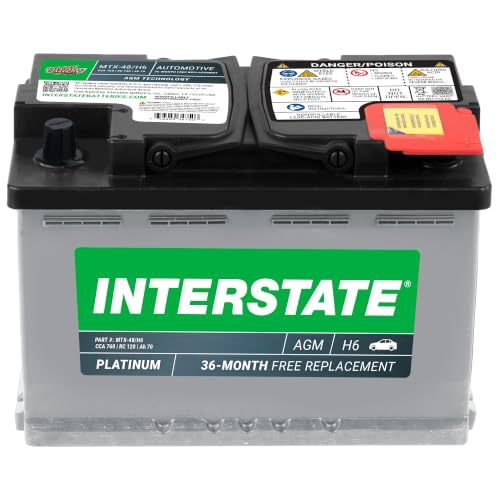
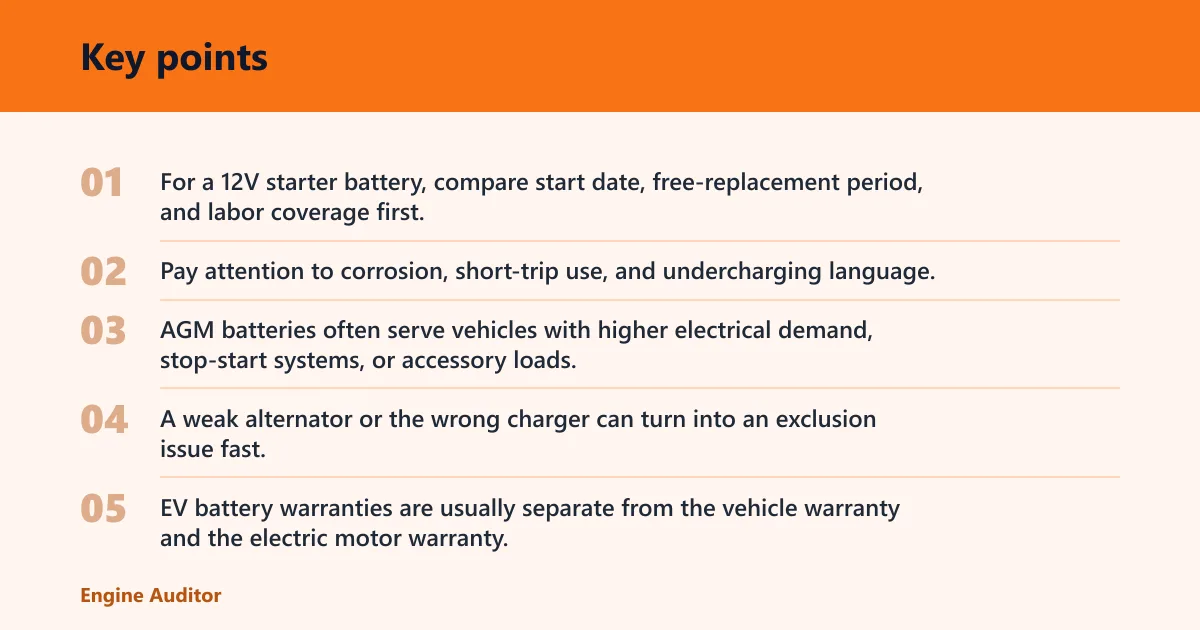
For a 12V starter battery, compare start date, free-replacement period, and labor coverage first. Standard 12V batteries may be excluded under some vehicle warranties, so a battery-specific warranty can matter more than the car warranty itself. Pay attention to corrosion, short-trip use, and undercharging language.
AGM batteries
AGM batteries often serve vehicles with higher electrical demand, stop-start systems, or accessory loads. Their warranty may still use the same time-and-mileage format as a standard battery, but the claims can focus more on correct charging and installation. A weak alternator or the wrong charger can turn into an exclusion issue fast.
EV high-voltage batteries
EV battery warranties are usually separate from the vehicle warranty and the electric motor warranty. They may cover battery defects or reduced capacity below a stated level, such as a minimum retained capacity or state-of-health threshold. That means the trigger is often performance loss, not just a no-start event.
Suppose an EV battery warranty promises coverage if capacity falls below a stated level. If the car still drives but the battery no longer meets that threshold, the claim may still be valid. That is very different from a 12V battery warranty, where the failure usually shows up as a start problem.
Which warranty is better for your use?
The better warranty is the one that fits your driving pattern, battery type, and claim burden. Short-trip drivers, cold-weather drivers, hot-climate drivers, and high-mileage owners do not face the same failure pattern, so the same wording can be strong for one use case and weak for another.
Short-trip driving and cold weather
Short trips and cold weather stress 12V batteries because they may not recharge fully between starts. Look for a stronger free-replacement window, clear labor coverage, and fewer charging exclusions. A long prorated tail is less useful if the battery is likely to fail early from repeated shallow charging.
Hot climates and undercharging
Heat and undercharging can shorten battery life and trigger exclusions about neglect or charging faults. In that case, a warranty with a simple claim path and a less restrictive service-record rule is often more useful than a long but hard-to-use term. Verify whether corrosion or installation language is broad enough to block common failures.
High-mileage and commercial use
For delivery routes and other high-mileage use, the mileage cap can end coverage long before the date limit. Choose terms that match actual annual miles and check whether the policy says whichever comes first. A longer term with a low mileage cap can be weaker than a shorter term with no mileage limit.
Frequently asked questions
How do I compare car battery warranty terms?
Start with failure trigger, payout structure, and claim steps. Then check the term length, mileage cap, exclusions, and whether labor is covered. A warranty that sounds longer can still pay less if it is heavily prorated or needs strict preapproval and service records.
What is a good battery warranty length?
A good length depends on the battery type and your driving pattern. The best term is the one that stays valid under your actual use, not just the one with the biggest headline number. Check whether time, mileage, or both can end coverage first.
Does a car battery warranty cover replacement labor?
Sometimes, but not always. A vehicle warranty may cover parts and labour after mechanical or electrical failure, yet many battery warranties cover only the battery itself. Check whether diagnostics, installation, and towing are listed, because those costs can stay outside the written warranty.
What voids a car battery warranty?
Common problems include misuse, neglect, incorrect charging, corrosion, missing service records, and installation errors. Claims can also fail if repairs were done without prior authorisation or if the vehicle was not serviced to the required schedule. Read the exclusions before you rely on the term length.
Is battery warranty different from car warranty?
Yes. Battery coverage can be separate from the vehicle warranty, and EV battery warranties are usually separate from the vehicle warranty and the electric motor warranty. Standard 12V batteries may also be excluded under some vehicle warranties, so a separate battery policy can matter.
Should I choose free replacement or prorated warranty?
If you want the strongest early-value coverage, free replacement is usually better because it pays the full amount during the covered window. Prorated coverage can still help later, but it shifts more cost to you as the battery ages. Match the structure to the battery’s likely failure timing.
Does mileage matter?
Yes. Mileage can end coverage before the time limit if the policy says whichever comes first. That matters most for delivery, commuting, and other high-use driving patterns. Always compare the mileage cap against your annual miles, because a long calendar term can still disappear early.
Are EV battery warranties the same as 12V battery warranties?
No. EV battery warranties usually focus on traction-battery capacity, state of health, or defect language, while 12V battery warranties usually focus on start failure and replacement terms. The claim trigger, proof needed, and coverage structure can be very different even when the word warranty sounds the same.
What paperwork should I keep?
Keep the receipt, installation record, and any service history tied to the battery. If the policy asks for it, keep battery test results, mileage notes, and the old battery until the claim is settled. The claim is easier to support when the date, product, and usage history are all documented.
Products related to this article
Sponsored / affiliate links. As an Amazon Associate I earn from qualifying purchases. I may earn additional commission from eligible campaigns.