How to Tell If a Car Battery Is Original or Replacement
Check the battery case date code, any dealer install sticker, and service records. For this guide, “factory-original” means the battery was installed at the factory, while “original to the vehicle” can also include a battery installed by a dealer before first sale. If the battery’s manufacture date is later than the car’s build date, that usually means it was not factory-original unless paperwork shows a dealer-installed pre-sale battery. Miss this, and you may pay more for a used car, miss evidence of poor maintenance, or replace a battery that was already swapped. This guide shows how to read date codes, dealer labels, and paperwork so you can sort factory-original, dealer-installed before first sale, and aftermarket batteries.
Quick battery verdict
-
Find every date clue. Open the hood and inspect the battery case, top cover, terminal area, and any dealer labels on the battery or nearby support. You are looking for a case stamp, a round colored sticker, a top sticker, or a terminal post stamp. Each clue can point to a different date, so collect them before deciding anything.
-
Compare those dates. Match the battery date to the vehicle build date, first-sale date, and service records. A battery can be newer than the car and still be part of the car’s original pre-sale setup if it sat in dealer stock before sale. A battery can also be older than the car if it was replaced later and the label is missing.
-
Check fitment after identity. Confirm the battery group size and terminal layout against the vehicle requirements. A correct original or replacement battery should fit the tray and cables without strain. If the brand or case shape looks odd, fitment helps separate a normal replacement from a poor swap or a wrong part.
What you’ll need
- Flashlight or penlight
- Clean rag or paper towel
- Gloves
- Vehicle build-date or door-jamb label information
- Service records, dealer paperwork, or inspection report
- Battery tester or digital multimeter for a resting voltage check
- Vehicle owner’s manual or fitment chart for group size confirmation
Where is the battery date code?
The battery date code can sit on the case, on top of the cover, on a round colored sticker, or near a terminal post. Some codes are easy to read; others are heat-stamped into the plastic or lead and can be faint. Start with the top, then check the upper rim, corners, and terminal area with a light.
-
Inspect the top cover. Look for a sticker, printed code, or a round colored date label on the battery’s top surface. A top sticker can be one clue in the battery’s history, but it does not always equal factory manufacture date.
-
Check the case edges. Scan the upper rim, front corner, and side walls for an alpha-numeric stamp. Some manufacturers put the date in a heat-stamped code on the plastic case, and that mark can be shallow or partly hidden by dirt.
-
Look at the terminal area. On some European batteries, the negative terminal post carries the date stamp. That stamp may use a week-year format, so the location matters as much as the characters.
What does the date code mean?
Battery date codes usually point to manufacture timing rather than purchase timing. In one common format, the letter means the month and the number means the year, and A can mean January in standard month coding. Brand rules differ, so the same style does not mean the same thing on every battery.
Month-letter and year-digit formats
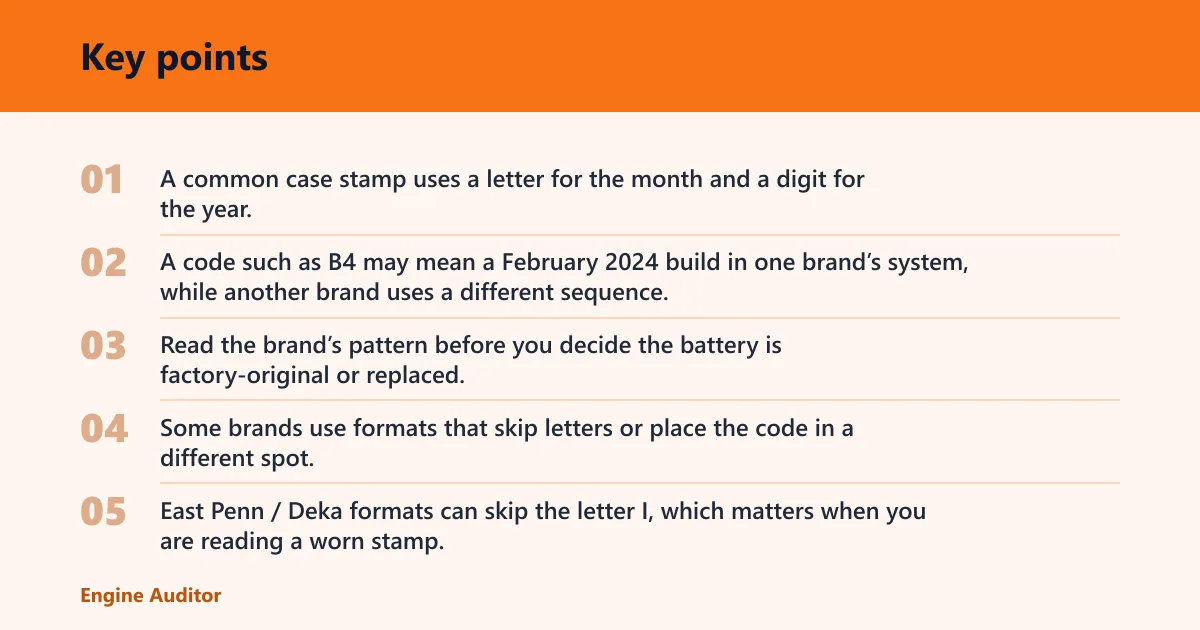
A common case stamp uses a letter for the month and a digit for the year. A code such as B4 may mean a February 2024 build in one brand’s system, while another brand uses a different sequence. Read the brand’s pattern before you decide the battery is factory-original or replaced.
Brand-specific code styles
Some brands use formats that skip letters or place the code in a different spot. Some batteries also use a round colored sticker for age tracking, but that sticker may mark stock or handling rather than factory build date.
Heat-stamped versus stickered dates
A heat-stamped code is permanent and often harder to read. A sticker is easier to spot, but it can be changed, covered, or added later. Treat the sticker as one clue, then verify it against the case stamp and service history before deciding whether the battery is factory-original.
How do you compare battery age with vehicle age?
Do not treat battery age and battery originality as the same question. Most car batteries last 3 to 5 years in normal use. A battery younger than the car may still be original if the car sat in stock, while an older battery may have been installed later.
-
Check the vehicle’s timeline. Use the build date, first registration date, and sale date from paperwork or the door label. If the battery date is earlier than the sale date but later than the build date, dealer stock can explain the gap. That is a common factory-original pattern on new inventory.
-
Read the service history. Look for battery replacement notes, parts invoices, or inspection sheets. A dealer install label near the battery can show a later replacement date even when the vehicle still carries old stock stickers elsewhere. That conflict usually means the battery changed after delivery.
-
Confirm condition separately. Test resting voltage and, if needed, cold cranking amps.
For example, a car built in March 2023 may have a battery stamped 02/23 and a first-sale date in June 2023. That battery can still be factory-original if the car sat on the lot. If the same car has a 2025 installation label on the battery, then the battery is likely a later replacement even if the case stamp still looks close to the car’s age.
A common first-timer mistake is seeing a round colored sticker and calling it proof of installation. That sticker may only reflect retail stock handling. Use it with the case code, the vehicle paperwork, and the battery tray fit before you decide anything.
Battery verdict checklist
This plain-text checklist helps you separate original, replacement, and uncertain cases without mixing in battery health. Use all three clues together: case or terminal code, sticker type, and vehicle history. If they conflict, service records usually settle the question better than the sticker alone.
| Verdict | Date-code location | Code style | Sticker type | Vehicle age vs battery age | What conflicting clues mean |
|---|---|---|---|---|---|
| Likely original | Case stamp, top cover, or terminal post matches the vehicle timeline | Month-letter/year-digit, or week-year on some European batteries | No later install label; stock sticker may exist | Battery date is on or before first-sale timing, and close to build date | Dealer stock can explain a newer battery date than the build date |
| Likely replacement | Case, top sticker, or terminal stamp shows a later date | Readable brand-specific code or fresh install tag | Install label or service sticker shows a later date | Battery date is clearly after first sale or service records mention replacement | Older stock stickers on the car do not override a later battery install record |
| Uncertain | Code is faint, missing, or partially hidden | Brand format is unclear or incomplete | Sticker is torn, faded, or ambiguous | Battery age and vehicle age do not line up cleanly | Use paperwork, fitment, and a voltage test before you decide |
-
Read the battery first. Record the exact code, location, and sticker type. If the stamp is faint, use a flashlight and clean the area with a dry rag before guessing.
-
Match the vehicle timeline. Compare the battery date with the build date, first-sale date, and service records. A mismatch does not automatically mean replacement if the car spent time in dealer stock.
-
Classify the clue conflict. If the battery date is later than the build date but earlier than first sale, treat it as likely the original battery. If the battery date is later than first sale and there is an install label, treat it as replacement. If the evidence conflicts, mark it uncertain and keep digging.
Common mistakes
Do not use voltage as proof of originality. A battery can test fine and still be a replacement, or test poorly and still be original. Also do not assume a brand mismatch alone proves a swap. Replacement batteries often come from different makers, and fitment is one clue, not the main way to distinguish OEM from a proper replacement.
- Reading only one sticker. A top sticker or colored dot can point to stock or install timing, not always manufacture date.
- Ignoring dealer stock time. A newer battery date than the car’s build date can still fit an original battery story.
- Skipping service records. When the stamp is faint or the format is brand-specific, paperwork matters.
- Confusing condition with identity. Weak starting and dim or dead headlights can mean battery trouble, charging trouble, or both.
- Missing fitment clues. A misshapen battery case is a warning sign, and the wrong group size can point to a replacement that does not belong there.
That is a later replacement, even if the battery still looks clean. If the same SUV also shows sluggish starting, the next question is charging-system health, not originality alone.
If the battery has no readable date code, move to the service records and the physical fit. Check whether the tray, hold-down, and terminal layout match the original equipment spec. Then test resting voltage and charging output, because a clean replacement battery can still be the wrong part or a worn one.
Frequently asked questions
How can I tell if a car battery is original or replacement?
Use three clues together: the battery date code, any dealer install or stock sticker, and service history. If the battery date falls before first sale and near the car’s build date, it may still be original. If an install label or invoice shows a later date, it is likely a replacement.
Where do I find the battery date code on a car battery?
Check the top cover first, then the upper rim, corner, and terminal area. Many batteries use an alphanumeric case stamp, while some use a round colored sticker. Some European batteries stamp the production week and year into the lead terminal, so the code may not be on the case at all.
What does a battery date code mean?
It usually shows when the battery was manufactured. In one common format, the letter means the month and the number means the year, and A can mean January in standard month coding. Brand-specific formats vary, so the same-looking code may mean something different from one maker to another.
Can a sticker on the battery tell me when it was installed?
Sometimes, yes, but treat it as a clue rather than proof. A top sticker or round colored date sticker may show retail stock arrival, dealer handling, or install timing. Compare it with the case stamp and the vehicle paperwork before deciding whether it marks manufacture date or a later swap.
Is a battery that is newer than the car always a replacement?
A newer battery date can still belong to the original battery if the car sat in dealer stock before first sale. The key is whether the battery date is earlier than the sale date and whether service records show a later battery change. Vehicle timeline matters as much as the stamp.
How old should a car battery be before I worry?
Most car batteries last 3 to 5 years. If a battery is older than 3 years, inspect it more closely, especially if starting is sluggish or headlights are dim. Age alone does not prove failure, but it raises the odds.
What do I check if the battery has no readable date code?
Use the service records, the install label, and the battery’s fitment. Then test resting voltage and check the charging system, since a battery warning light may point to alternator trouble instead of a bad battery. If the case is misshapen or the group size is wrong, treat that as a replacement clue.
Do different battery brands use different date code formats?
Yes. Brand rules vary, and some skip certain letters or use a week-year stamp instead of a month-year stamp. Read the brand pattern before judging originality.
Products related to this article
Sponsored / affiliate links. As an Amazon Associate I earn from qualifying purchases. I may earn additional commission from eligible campaigns.