Honda Civic Starter Issues: Signs, Checks, and Repair Costs
A Honda Civic starter problem usually shows up as a single click, rapid clicking, slow cranking, or a no-start with a good battery; if voltage is healthy and the engine still will not crank, inspect the starter and its circuit next. Ignore it, and you can end up stranded or swapping the wrong parts, from batteries to alternators to flywheels. This guide covers the symptoms, quick checks, common causes, and typical repair costs so you can separate starter failure from battery, clutch, or charging-system trouble.
Honda Civic starter symptoms


Starter trouble on a Civic usually falls into two buckets: the engine does not crank at all, or it cranks weakly and then quits. A bad starter can also make a whining or squealing sound during start, and an 8th generation forum case described only a whistling sound before the car later would not start and had to be towed.
No-crank versus crank-and-won’t-start
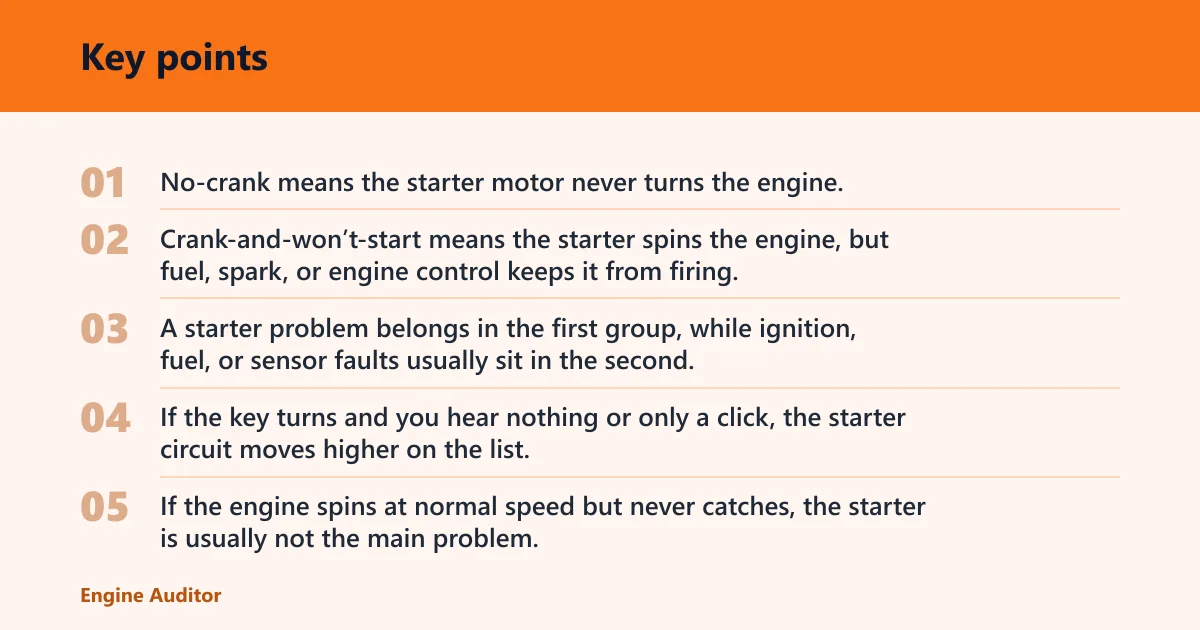
No-crank means the starter motor never turns the engine. Crank-and-won’t-start means the starter spins the engine, but fuel, spark, or engine control keeps it from firing. Those are different failures. A starter problem belongs in the first group, while ignition, fuel, or sensor faults usually sit in the second.
If the key turns and you hear nothing or only a click, the starter circuit moves higher on the list. If the engine spins at normal speed but never catches, the starter is usually not the main problem.
Clicking, whining, or slow cranking
A single click often points to a starter solenoid that is engaging but not turning the motor. Rapid clicking often points to low battery voltage, weak terminals, or a bad connection that drops voltage under load. Slow cranking can be a weak battery, high cable resistance, or a starter motor that is wearing out and drawing too much current.
Whining or squealing during start can mean the starter drive is not meshing cleanly with the flywheel, or the starter gear is slipping after engagement. On a Civic, that sound deserves quick attention because repeated attempts can wear the starter drive and ring gear.
Starter failure that happens suddenly
Yes, a Civic starter can fail suddenly, even after earlier warning signs. A worn motor may crank slowly one day and do nothing the next. That kind of failure is common enough that a car can seem normal at parking-lot start and then refuse to crank later the same day.
In the 8th generation forum case, the owner reported 41,000 km at the time and said the starter failed after the battery had already been reported as OK. The repair also included the clutch, was covered under warranty, took exactly fourteen days, and Honda Assistance provided a free replacement car for three days.
Starter diagnosis table
This table separates starter clues from battery, clutch, and interlock faults. Use it to decide whether you need a battery test, a circuit check, or a tow.
| Symptom | Likely cause | Quick check | Next step |
|---|---|---|---|
| Single click, no crank | Starter solenoid or starter motor, but also battery or cable loss | Watch the dash lights and measure battery voltage while someone turns the key | Test battery under load, then starter current draw and cable voltage drop |
| Rapid clicking | Weak battery, poor terminals, or high resistance in the supply path | Try the headlights; if they dim hard during crank, voltage is collapsing | Clean and test battery cables before condemning the starter |
| Slow cranking | Weak battery or starter motor drag | Check battery load test and engine cranking speed | Replace the battery if it fails load test; inspect starter if battery is healthy |
| Whining or pískání during start | Starter drive slip, gear mesh issue, or starter wear | Listen for a high-pitched sound only while the key is held to START | Stop repeated attempts and have the starter and flywheel inspected |
| No crank in a manual Civic with clutch pedal pressed | Clutch switch, interlock circuit, or starter circuit fault | Confirm the pedal switch is fully depressed and the start signal reaches the relay | Test the interlock and relay circuit before replacing parts |
| No crank in an automatic Civic with selector in P or N | Neutral-safety or range switch fault | Try starting in Neutral after confirming the brake pedal is pressed | Inspect the range switch, relay, and ignition signal path |
| Starts after a jump, then later no-start returns | Battery or charging-system fault, not proof of a bad starter | Measure charging voltage with engine running | Test alternator output and battery health before replacing the starter |
| Burning smell and repeated failed starts | Starter overheating, clutch damage in a manual, or heavy cable loss | Stop after a few attempts and check for smoke or hot cables | Arrange a tow if the smell or heat returns |
Is it the battery or the starter?
The battery comes first because it can make a healthy starter look bad. A Civic can have some lights, radio power, or dash activity and still not have enough current for cranking. If the battery is weak under load, the starter may only click or turn slowly.
Why the battery comes first
Battery voltage at rest can look acceptable and still collapse when the starter is asked to turn the engine. That is why the battery should be tested before condemning the starter. A healthy-looking dash does not prove the battery can supply cranking current.
Suppose the headlights stay bright with the key off, but the starter only clicks when the key is turned. That does not prove the starter is bad. It can still be a weak battery, corroded terminals, or a bad main cable.
Load and crank checks that separate faults
-
Test battery under load.
Use a battery tester or have a shop apply a load test. A battery that looks fine at rest can fail when asked to supply starter current, especially if one cell is weak. -
Watch voltage during crank.
During cranking, voltage that drops very low points to battery or cable trouble. If voltage stays healthy but the starter does not turn, the starter or its control circuit moves up the list. -
Check cable condition.
Inspect the positive and ground cables for corrosion, looseness, or heat damage. A bad connection can mimic a dead starter.
What a jump start can and cannot tell you
A jump start can show that the battery was too weak to crank, but it does not prove the starter is good or bad. If the car starts with a jump and later refuses to restart after sitting, test the battery and charging system first. If it still will not crank with a known good power source, inspect the starter circuit next.
What a mechanic should inspect
A proper diagnosis starts with the battery, then moves through the starter motor, relay, ignition signal, and interlock circuits. On a Civic that starts only after a jump, the charging system should also be checked so the root cause does not come back.
Battery test results and cable condition
A shop should record battery state of charge, load-test result, and cranking voltage. It should also inspect terminal tightness, corrosion, ground straps, and the main positive cable. Those items can create the same symptom as a bad starter.
Starter motor and starter relay checks
The starter should be checked for current draw, command voltage, and physical engagement. The relay should be tested, not guessed at. If the relay does not send power to the starter, the starter may be fine.
Ignition signal, fuse, and interlock circuit checks
-
Verify the start signal.
Confirm that the ignition switch or push-button system sends a start command. If the command does not reach the relay, the starter never gets power. -
Check the interlock.
On a manual Civic, the clutch switch must close when the pedal is fully pressed. On an automatic, the range switch must see Park or Neutral. -
Inspect related fuses.
Check the starter, ignition, and control fuses in the under-hood and cabin fuse boxes listed in the owner’s manual. A blown fuse points to a circuit fault that should be found before parts are replaced.
A common first-timer mistake is replacing the starter before proving the relay and control circuit. That can waste money when the real fault is a clutch switch or a weak battery cable.
Charging-system follow-up if the car starts after a jump
If the Civic starts only after a jump, the alternator should be checked with the engine running. A charging-system test should confirm that output is steady and that the battery is being recharged. If the alternator is weak, a fresh battery may still go flat and create the same no-start later.
How much does starter repair cost?
Starter replacement on a Honda Civic usually costs less when the fault is caught before it damages related parts, but the total can vary a lot by labor rate, access, and whether the starter is repaired or replaced. Typical independent-shop starter repair pricing is often about $350 to $700, while dealer or Honda service center pricing can run about $500 to $1,000 or more.
Independent shop range
An independent shop often charges about $100 to $200 for diagnosis, then around $150 to $400 for the starter part on many Civics, plus roughly $150 to $300 in labor. If the relay, cable, or battery also needs work, the total rises. Those figures are common repair-range estimates, not a fixed quote.
Dealer or Honda service center range
A Honda service center may cost more because of higher labor rates and genuine parts pricing. The upside is authorized diagnosis and repair handling, which matters if the car is under warranty or if the symptom could be tied to another covered electrical fault. Expect the service process to take longer when parts must be ordered.
Parts-only versus labor-driven cost differences
The starter itself is often not the expensive part. Labor can drive the bill higher if the starter sits in a cramped location or if a technician must remove surrounding parts to reach it. A relay replacement is usually cheaper, often under $100 to $200 installed, but only if the relay is actually the fault.
Towing and diagnostic fee ranges
If the car will not crank at all, towing can cost about $75 to $200 depending on distance and local rates. Diagnostic fees commonly fall around $100 to $150 at independent shops and may be higher at dealerships. If the starter failure leaves the car stranded, a tow is cheaper than repeated failed attempts that may damage the flywheel or drain the battery further.
Can a bad starter damage the clutch?
On a manual-transmission Civic, a failing starter can overlap with clutch symptoms, and repeated forced starts can make the situation worse. A burning smell, grinding, or repeated whistling during start deserves quick attention. If the clutch is already worn or the interlock switch is acting up, the no-start can look like a starter fault when more than one part is involved.
Manual-transmission symptoms to watch
If the clutch pedal feels normal but the engine only starts intermittently, the starter circuit and clutch switch both need attention. If the pedal switch does not close, the starter may never receive the start command. If the starter drive slips, the flywheel can also be affected.
Burning smell and repeated-start warning signs
A burning smell after several start attempts usually means heat buildup in the starter, cables, or clutch area. Stop trying after a few tries and let the system cool. Repeated cranking can flatten the battery, overheat the starter, and make diagnosis harder.
Picture a manual Civic that gives a short whine, then a faint hot smell after three key turns. That pattern points away from a simple dead battery and toward a starter drive, cable, or clutch-related problem that needs inspection before more attempts.
Honda service center and assistance
A Honda service center can diagnose starter, relay, clutch-switch, and charging-system faults together, which helps when the symptom is not obvious. If the car is under warranty, authorized repair handling can matter because the diagnosis and repair may be covered. When parts are needed, wait time can stretch beyond a same-day visit.
Wait-time expectations
Wait time depends on parts stock, dealer workload, and whether the technician confirms a simple starter issue or finds related electrical faults. A one-day repair is possible when the part is on hand. If the car needs a clutch, relay, or wiring repair too, the visit can take much longer.
When loaner-car support may apply
Honda Assistance may provide short-term support such as a replacement car when coverage applies, as in the forum case where a free replacement car was provided for three days. That support is not automatic for every repair, so check the warranty and assistance terms before assuming it is available.
Frequently asked questions
What are the signs of a bad starter on a Honda Civic?
The most common signs are a single click, rapid clicking, slow cranking, a whining or squealing sound during start, or a complete no-crank with a healthy battery. If the dash still lights up but the engine does not turn over, the starter or its control circuit moves high on the list.
How do I tell if it’s the battery or the starter?
Test the battery first. A weak battery can cause clicking, dim lights, and slow cranking even when some accessories still work. If the battery passes a load test and the car still will not crank, inspect the starter, its relay, cable connections, and the start-signal circuit next.
Why does my Honda Civic make a clicking or whining sound when I start it?
Clicking often means the starter solenoid is trying to engage but the motor is not turning, which can happen with a weak battery or a worn starter. Whining or pískání during start can point to poor gear engagement or a slipping starter drive, and that usually deserves prompt inspection.
Can a Honda Civic starter fail suddenly?
Yes. A starter can give warning signs such as slow cranking or odd noises, then fail without warning. The 8th generation forum case is a good example of a no-start that followed earlier symptoms and ended with towing and service. Sudden failure is common enough that a no-start should be treated seriously.
How much does it cost to replace a Honda Civic starter?
Typical independent-shop starter repair pricing is often about $350 to $700. The total depends on part price, labor time, diagnosis, and whether other faults are found at the same visit.
What should a mechanic inspect if the Civic won’t start?
A mechanic should check battery state of charge, load performance, cable condition, starter command voltage, relay operation, ignition or push-button signal, clutch or range-switch interlock, and charging output if the car only starts after a jump. That sequence separates starter failure from the faults that imitate it.
Products related to this article
Sponsored / affiliate links. As an Amazon Associate I earn from qualifying purchases. I may earn additional commission from eligible campaigns.