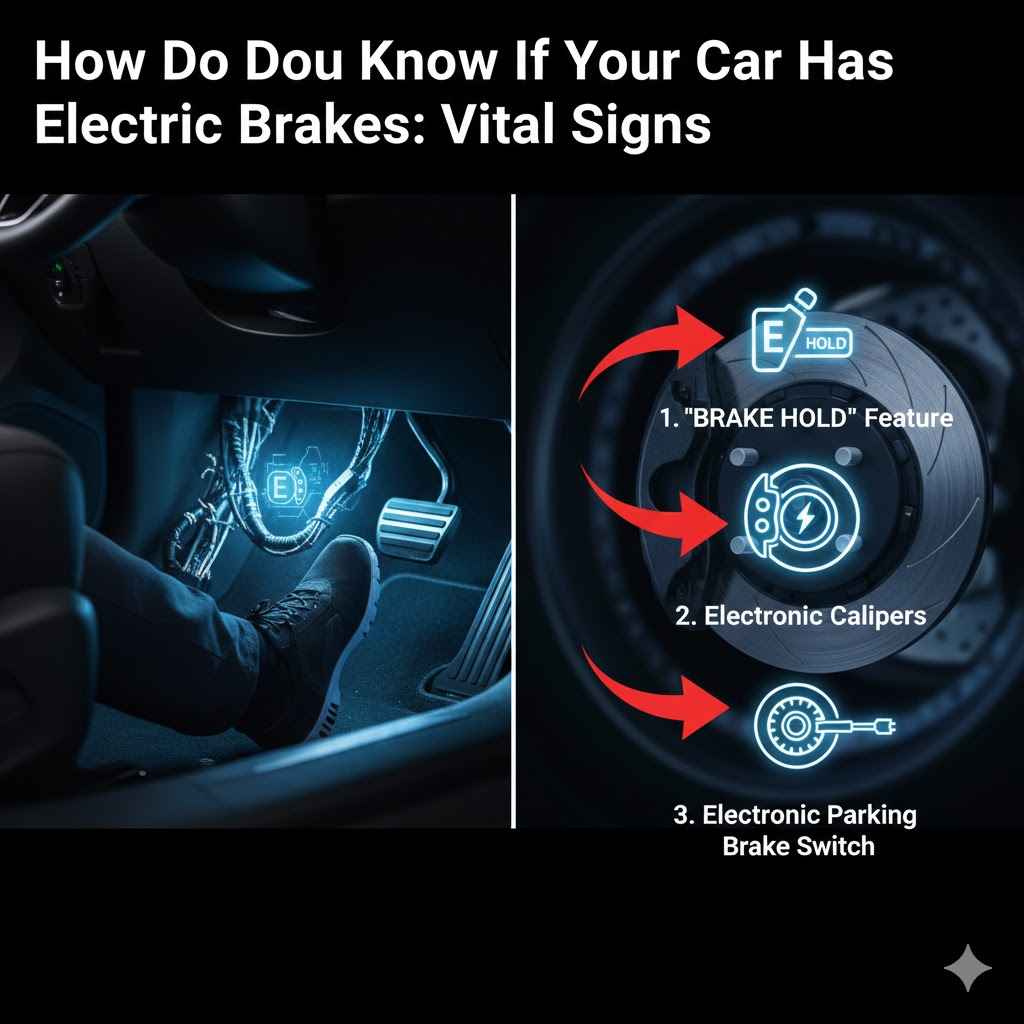
How Do You Know If Your Car Has Electric Brakes: Vital Signs
To know if your vehicle is set up for electric trailer brakes, look for an electric brake controller—a small box with a slider or buttons—mounted on or under your dashboard. Another key sign is a 7-pin trailer wiring connector near your hitch, as this plug has the specific circuit needed to operate electric brakes.
Ever hitched up a trailer and wondered about the brakes? You’re not alone. The world of towing can feel confusing, especially with terms like “electric brakes.” You might worry if your car is ready, or if you are missing something important for safe driving. It can be a frustrating puzzle.
Don’t worry, I’m here to help clear things up. This guide will show you exactly how to check your vehicle for an electric brake system. We will walk through simple, visual checks you can do in minutes. You’ll learn the vital signs to look for and understand what they mean. Let’s make you a confident tower!
What Are Electric Brakes, Anyway? A Simple Explanation
Before we start looking, let’s get one thing straight. When people talk about “electric brakes” in the context of towing, they are almost always talking about the brakes on the trailer, not the car or truck itself. Your car has its own braking system, which is usually hydraulic.

SEHNSUCHT
Trailer Axle Electric Brake Kit, Pair of…
- Premium Material: This brake drum is made of high-quality iron and uses electroplating technology to protect the drum body, enabli…
- About The Drum and Self-Adjusting Electric Brakes: Classic design and rich production experience make the brake drum more excellen…
- Package Including: 2*brake drum 5 hole, 4.5" bolt, 2*Bearing inner ring replace for L68149( I.D:1.377", O.D:2.164"), 2*Bearing inn…
As an Amazon Associate I earn from qualifying purchases.
Electric trailer brakes use magnets and electricity to slow the trailer down. A special device in your car, called a brake controller, sends an electrical signal to the trailer’s brakes when you press the brake pedal. This helps the trailer brake along with your vehicle, making for a much safer and smoother stop.
This is very different from the regenerative braking you find in electric vehicles (EVs) or hybrids. Regenerative braking uses the electric motor to slow the car down and recharge the battery. It’s a cool feature for the car itself, but it has nothing to do with controlling the brakes on a separate trailer.
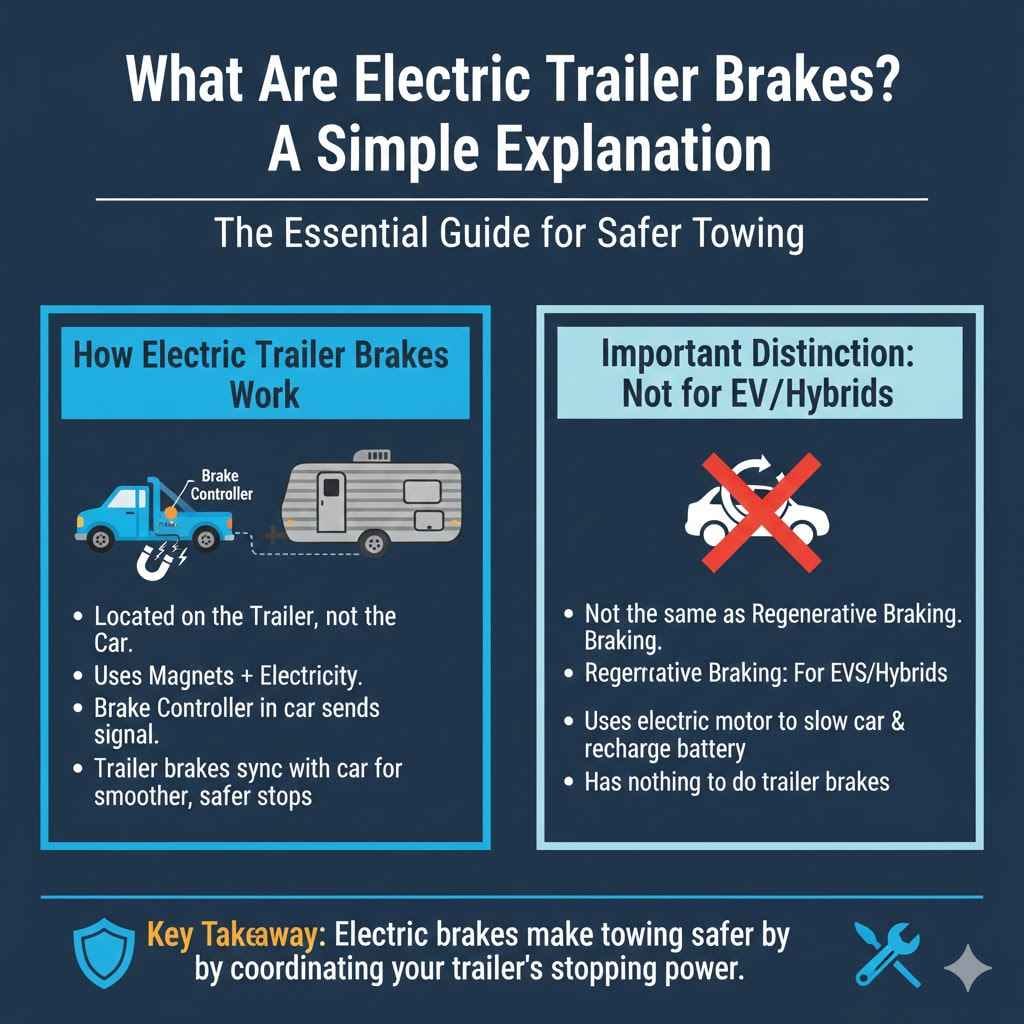
The Big Misconception: Your Car’s Brakes vs. Your Trailer’s Brakes
It’s easy to get confused, so let’s break it down. Your vehicle and your trailer have different jobs and, often, different types of brakes. Understanding this difference is the key to knowing what to look for.
Hydraulic Brakes (What Most Cars and Trucks Have)
Nearly every car, truck, and SUV on the road uses a hydraulic braking system. When you push the brake pedal, you are pushing a piston that forces special fluid through tubes (brake lines) to each wheel. This fluid pressure then pushes brake pads against a spinning disc (or shoes against a drum) to slow the car down. It’s a reliable, closed system that has been the standard for decades.
Regenerative Brakes (Found in EVs and Hybrids)
If you drive an electric or hybrid vehicle, you also have regenerative braking. This system does the opposite of what the electric motor normally does. Instead of using electricity to turn the wheels, it uses the wheels’ momentum to turn the motor, which generates electricity and recharges the battery. This process creates drag, which helps slow the car down without ever using the traditional hydraulic brakes. Your car still has hydraulic brakes for hard stops, but regenerative braking handles a lot of the gentle slowing.
Electric Trailer Brakes (The Focus of This Guide)
This is the system we are looking for. Electric trailer brakes are only found on the trailer. They are activated by an electrical signal from the tow vehicle. Without a special controller in your car and the right wiring, the trailer’s brakes won’t work. This is why checking your vehicle for the right equipment is so important for safe towing.
Step-by-Step Guide: Checking for an Electric Brake Controller
The most direct way to know if your vehicle is ready for electric trailer brakes is to find the brake controller. This little box is the brain of the operation. It tells the trailer brakes how hard to squeeze and when to do it.
Step 1: Look Inside Your Cabin
The brake controller needs to be within reach of the driver, so it will be somewhere in the front cabin. It’s a simple visual check you can do right now.
- Check Below the Dashboard: The most common spot is just below the steering wheel, on the right-hand side. Look for a small, rectangular box mounted to the lower part of the dash panel.
- Inspect the Center Console: Some owners or installers place the controller on the side of the center console, near the driver’s right knee.
- Look for a Dash Cubby or Pocket: Sometimes, the controller is neatly tucked into a small storage pocket in the dashboard to keep it out of the way.
- Scan for Integrated Controls: On many newer trucks, the brake controller is built right into the dashboard from the factory. It won’t look like an aftermarket box. Instead, you’ll see two small buttons or pinch levers and a small digital display, often located near the climate controls or traction control buttons. It will usually be labeled “Trailer Brake.”
A typical aftermarket controller is about the size of a garage door opener. It will have a small screen showing numbers (the “gain” or power setting), and a manual override, which is usually a slider or lever you can move with your thumb. This manual lever lets you apply the trailer brakes by hand, without touching the vehicle’s brake pedal.
Step 2: Identify the Types of Brake Controllers
If you find a controller, you can also tell what kind it is. There are two main types, and they work a little differently. Knowing the type helps you understand how it will feel when you’re towing.
| Controller Type | How It Works | Pros | Cons |
|---|---|---|---|
| Proportional (Inertia-Based) | Senses how quickly your vehicle is stopping (its inertia) and applies the trailer brakes with matching force. A gradual stop by the truck means a gradual stop by the trailer. | Smoothest braking experience. Better for all situations, especially heavy loads and panic stops. | More expensive. More complex installation. |
| Time-Delayed (Time-Based) | Applies a pre-set amount of braking power after a short delay once you press the brake pedal. The braking power ramps up over a few seconds. | Less expensive. Simpler to install and operate. | Can feel jerky or abrupt. Not as smooth or responsive in sudden stops. |
Step 3: What If You Don’t See a Controller?
If you’ve searched the cabin and can’t find a brake controller, it usually means one of two things. First, your vehicle may not have one installed. This is very common, especially if the previous owner never towed a heavy trailer. Second, your vehicle might be “pre-wired” for a controller but doesn’t have the final unit installed. This is great news, as it makes installation much easier.
Checking for Towing Package Clues on Your Vehicle
Even if you don’t find a controller inside, your vehicle can give you other big clues on the outside. These signs suggest that your car or truck was built with towing in mind and may be ready for a brake controller to be easily added.
The 7-Pin Trailer Connector
This is one of the biggest giveaways. Go to the back of your vehicle, right near the trailer hitch. You will see a plug for the trailer’s lights. There are two common types of plugs:
- 4-Pin Connector: This is a simple, flat plug. It only controls the basic trailer lights: running lights, left turn signal, right turn signal, and brake lights. It cannot operate electric brakes.
- 7-Pin Connector: This is a larger, round plug. It does everything the 4-pin does, plus it has extra connections for things like reverse lights, auxiliary power, and—most importantly—the electric trailer brakes.
If you see a 7-pin connector, your vehicle is very likely equipped with the necessary wiring to support a brake controller. The specific pin that runs the brakes is a critical piece of the puzzle. You can learn more about trailer wiring standards from trusted sources like the U.S. Department of Transportation, which sets guidelines for vehicle equipment.
The Factory Tow Package Sticker or Button
Many vehicles that are built for towing come with a “factory tow package.” This is an option the original buyer selected that includes helpful features like a heavy-duty radiator, a transmission cooler, and the pre-wiring for a brake controller.
To check for this, open the driver’s side door and look for a sticker on the door jamb. This sticker contains information about your vehicle, including its weight ratings. Sometimes it will explicitly mention a “Trailer Towing Package.”
Another clue is a “Tow/Haul Mode” button on your dashboard or gear shifter. Pressing this button changes how your vehicle’s transmission shifts gears to make it better at handling heavy loads. While this button doesn’t directly control electric brakes, its presence is a very strong sign that your vehicle was designed for serious towing and likely has the underlying wiring for a brake controller.
What If My Car Doesn’t Have Electric Brakes? Your Options
So, you’ve checked everywhere and found no controller and only a 4-pin plug. Don’t be discouraged! This is a very common situation, and you have excellent options if you need to tow a trailer that has electric brakes.
Option 1: Installing an Aftermarket Brake Controller
This is the most popular solution. You can have an aftermarket brake controller installed in your vehicle. A mechanic or a U-Haul center can do this for you, or if you’re comfortable with vehicle wiring, it can be a DIY project. The process usually involves:
- Mounting the controller box under the dash.
- Connecting it to a power source, your brake light signal, and the wiring that runs to the back of the vehicle.
- Upgrading your 4-pin connector to a 7-pin connector to send the brake signal to the trailer.
Adding a controller is a fantastic upgrade that dramatically improves your safety and control when towing. It’s a must-have for any trailer over a certain weight, and it’s legally required in many states.
Option 2: Using a Trailer with Surge Brakes
Another option is to use a trailer that has a different kind of braking system called “surge brakes.” These are common on boat trailers. Surge brakes are self-contained on the trailer and don’t require any special wiring or controller in your car.
Here’s a simple table comparing the two systems:
| Feature | Electric Brakes | Surge Brakes |
|---|---|---|
| How They Work | Activated by an electrical signal from the tow vehicle’s brake controller. | Activated by the trailer’s forward momentum (surge) pushing against the hitch. It’s a mechanical/hydraulic system. |
| Control | Driver has full control. Can adjust power and apply trailer brakes manually. | Fully automatic. No control from inside the cab. Cannot be used in reverse easily. |
| Best Use Case | Great for all types of trailers, especially heavy RVs, horse trailers, and equipment haulers. | Common on boat trailers (less electronics to get wet) and rental trailers. |
| Vehicle Requirements | Requires a brake controller and 7-pin wiring. | Requires no special equipment on the tow vehicle, just a standard hitch ball. |
Safety First: Why Electric Brakes Matter
Understanding and having a working electric brake system isn’t just about convenience; it’s about safety. When you are towing a heavy load, your vehicle’s brakes are working much harder than they were designed to. A heavy trailer can push your vehicle during a stop, significantly increasing the distance it takes to come to a halt.
Electric brakes help the trailer stop itself, taking a huge amount of strain off your vehicle’s brakes. This leads to shorter stopping distances, less wear and tear on your car, and better control during sudden maneuvers. It also helps prevent trailer sway, a dangerous situation where the trailer begins to fishtail behind you.
Organizations like the National Highway Traffic Safety Administration (NHTSA) provide extensive resources on safe towing practices, always emphasizing the importance of a properly functioning and matched braking system for both the vehicle and the trailer.
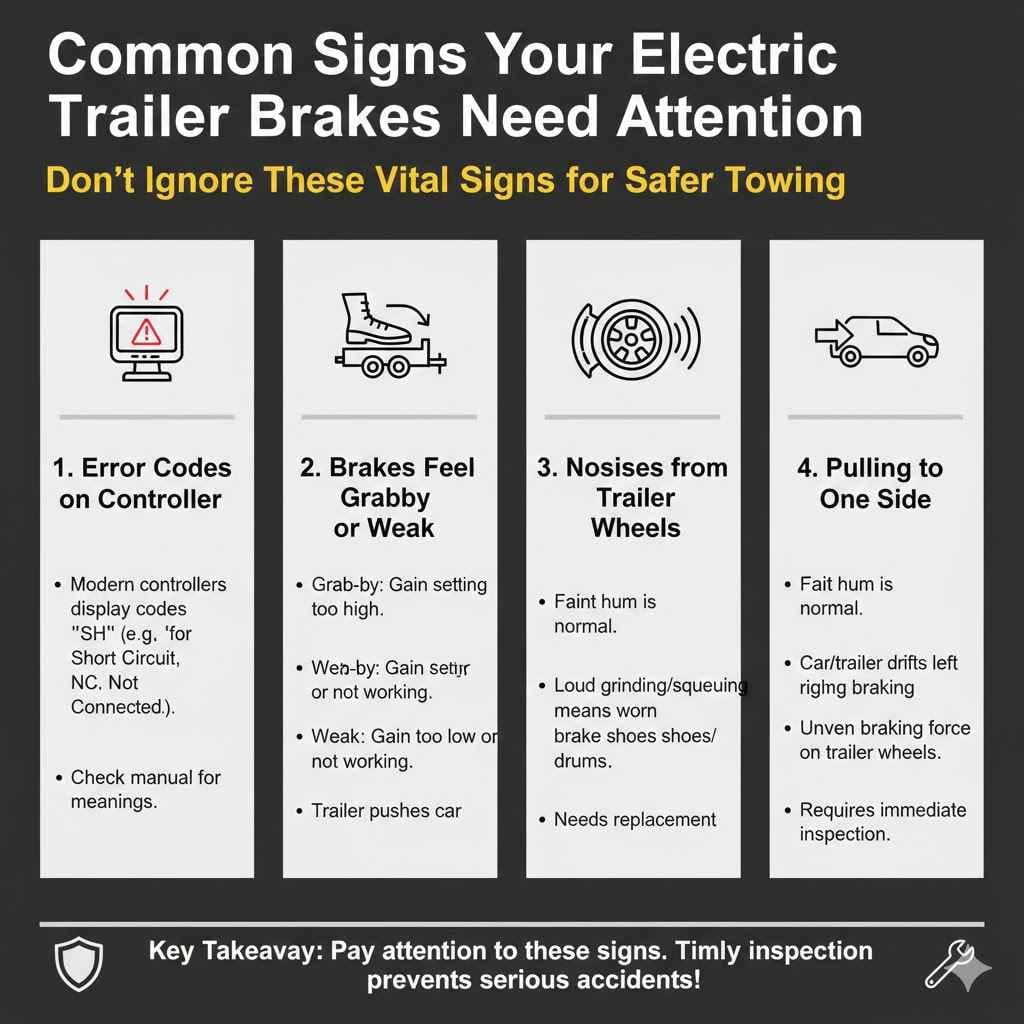
Common Signs Your Electric Brake System Needs Attention
Once you confirm you have an electric brake system, it’s important to make sure it’s working correctly. Brakes are not a “set it and forget it” item. Before and during each tow, pay attention to these vital signs that might indicate a problem.
- Error Codes on the Controller: Most modern controllers will display an error code or message if there is a problem. Common codes include “SH” (for short circuit) or “NC” (for not connected). Check your controller’s manual to understand what these mean.
- Brakes Feel Grabby or Weak: If the trailer brakes seem to lock up with just a light touch of the pedal, the gain setting on your controller is likely too high. If you feel the trailer pushing you when you brake, the gain is too low or the brakes aren’t working at all.
- Noises from the Trailer Wheels: When you apply the brakes, you might hear a faint hum from the electromagnets activating. However, if you hear loud grinding or squealing, it could mean the brake shoes or drums are worn out and need to be replaced.
- Pulling to One Side: If your truck and trailer pull to the left or right when you brake, it could mean the brakes on one side of the trailer are working harder than the other. This needs to be inspected right away.
Frequently Asked Questions (FAQ)
Here are answers to some of the most common questions new towers have about electric brakes. I hope these quick tips give you even more confidence.
Do all trucks come with electric brake controllers?
No, not all of them. While many heavy-duty trucks come with a factory-integrated brake controller as part of a tow package, it is often an optional feature on half-ton and lighter trucks. It’s rare for SUVs or cars to come with one from the factory.
What’s the difference between electric brakes and regenerative braking?
Electric brakes are for a trailer and are controlled by a device in the tow vehicle. Regenerative braking is a feature of an electric or hybrid car itself that uses the electric motor to slow down and recharge the battery. They are completely separate systems.
Can I install an electric brake controller myself?
If your vehicle is “pre-wired” for towing, the installation can be quite simple. It often involves a “plug-and-play” wiring harness that connects directly to a port under your dash. If your vehicle is not pre-wired, the installation is more complex and may be best left to a professional.
How much does it cost to have an electric brake controller installed?
The cost can vary widely. A good quality proportional controller might cost between $100 and $200. Professional installation can range from $100 to $300, depending on how much wiring work your vehicle needs.
Do I need electric brakes for a small trailer?
Most states have laws that require trailer brakes on any trailer weighing over a certain amount, typically around 3,000 pounds. However, even on lighter trailers, having brakes provides a significant safety advantage. Always check your local state laws to be sure.
What is a “break-away” system?
This is a crucial safety feature for trailers with electric brakes. It’s a small box on the trailer with a pin attached to a cable. You connect the cable to your tow vehicle. If the trailer ever detaches from your vehicle, the pin is pulled, activating a small battery on the trailer that applies the electric brakes to stop it safely.
Your Next Steps to Safe Towing
You did it! You now know exactly what to look for to determine if your vehicle is ready to handle electric trailer brakes. It really comes down to a few simple checks. A quick look inside your car for a brake controller and a peek at the back for a 7-pin connector will tell you almost everything you need to know.
If you don’t have the right equipment, remember that it’s a common and straightforward upgrade. Don’t let it stop you from pursuing your towing goals. Getting a brake controller installed is one of the best investments you can make for your safety and peace of mind on the road.
Taking the time to understand your vehicle’s capabilities is a huge step toward becoming a safe and confident driver. You’ve got this. Now you can focus on the adventure ahead, knowing that you and your trailer are ready to stop safely when it matters most.
Related pick: Check today's price on Amazon