How to Clean a Car Dashboard Without Leaving Streaks
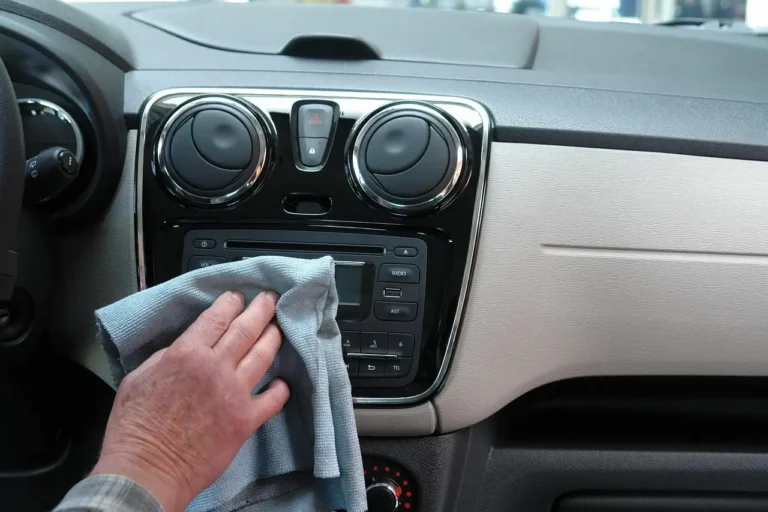
Clean the dashboard with a dry microfiber towel first. Then mist the correct interior cleaner onto a second microfiber towel, wipe in one direction, and finish with a dry buff. If streaks stay visible, the cleaner is too heavy or the towel is saturated. Wrong product choices leave haze, shiny patches, and dust-attracting residue. This guide shows how to diagnose streaks and match the cleaner, towel, and finish to vinyl, plastic, leather, and mixed surfaces.
Why dashboards streak
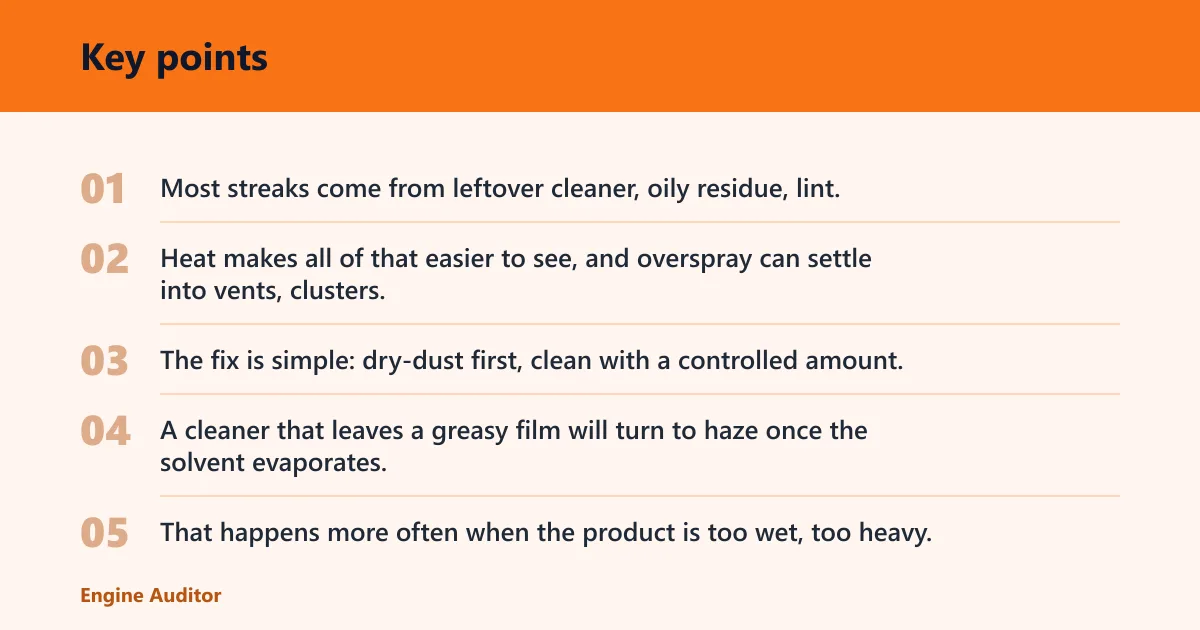


Most streaks come from leftover cleaner, oily residue, lint, or a finish that reflects too much light. Heat makes all of that easier to see, and overspray can settle into vents, clusters, and touch-screen edges where it gets smeared instead of removed. The fix is simple: dry-dust first, clean with a controlled amount, and buff with a second towel.
Residual cleaner and oily film
A cleaner that leaves a greasy film will turn to haze once the solvent evaporates. That happens more often when the product is too wet, too heavy, or built for shine rather than cleanup. A matte or satin finish is easier to keep clean than a glossy dressing because it shows less wipe pattern and holds less dust.
Lint, towel drag, and dried arcs
Lint trails usually come from worn cloths, cotton rags, or a towel already loaded with product. Dried arcs often appear when the wipe stops and starts in the same spot. Use a separate, clean microfiber towel for each stage so one cloth lifts soil and the other removes the remaining film.
Heat, overspray, and finish type
Warm panels dry cleaner too quickly, which can trap streaks before the residue is wiped away. Glossy trim also shows every swipe. If the dash has mixed materials, treat each section separately rather than applying one finish across vinyl, leather, soft-touch plastic, and piano-black trim.
What you’ll need
- Two lint-free microfiber towels for the dashboard
- A third clean microfiber towel is a common backup for the final buff if the first two get damp
- A pH-balanced interior cleaner that is ammonia-free
- A matte or satin UV protectant if the surface is compatible
- Vacuum attachment or dry dusting tool for loose debris
- Cotton swabs or a soft detailing brush for vents and seams
- Clean glass towels kept separate from dashboard towels
How do you prep the dashboard?
Start by removing loose dust with a dry microfiber towel, then keep clear of screens, gauge clusters, switches, and vents. Work in shade or with the cabin cool, because hot trim flashes cleaner too fast and leaves drag marks. Test any product on a hidden area before touching the visible dash.
- Wipe the surface dry with a clean microfiber towel to lift grit first.
- Cover or avoid touch screens, gauges, and nearby electronics.
- Open the doors and let the cabin cool if the trim is hot to the touch.
How do you clean it without streaks?
Use a pH-balanced interior cleaner and spray it onto the towel, not the dashboard, then wipe in straight lines. Let the cleaner sit briefly, just long enough to loosen soil, and follow with a dry microfiber buff. That order matters because wet cleaner left on the surface is the usual source of haze and dried arcs.
- Lightly mist the cleaner onto the microfiber towel.
- Wipe one small section with straight-line passes and light pressure.
- Wait for a short flash time before the next wipe.
- Buff the section dry with a second clean microfiber towel.
- Repeat the same sequence across the dashboard.
Suppose a roughly 12-inch strip above the glovebox still looks cloudy after the first pass. Add one more light pass of cleaner to the towel, not to the dash, then recheck after the dry buff. If the haze returns, the product is leaving residue or the towel is already saturated.
Dashboard streaks matrix
This table separates the common failure modes from the fixes. It also shows where the material changes the answer, because vinyl, leather, soft-touch plastic, and glossy trim do not behave the same way.
| Streak symptom | Likely cause | Best fix | What to avoid |
|---|---|---|---|
| Oily haze | Too much product; dressing left behind; glossy finish | Wipe with a clean dry microfiber towel after a short flash time; switch to a matte or satin finish if the surface is compatible | Heavy dressing, repeated wet passes, cotton rags |
| Lint trails | Worn towel; towel overloaded with residue | Swap to a fresh lint-free microfiber towel and finish dry | Paper towels, fuzzy cloths, reused damp towels |
| Dried cleaner arcs | Cleaner dried before it was buffed; wiping in circles | Work in small sections with straight-line passes and a quick dry wipe | Leaving cleaner pooled at edges or vents |
| Glossy film | Shine-first dressing or incompatible protectant | Clean again with a residue-free interior cleaner, then finish matte | Gloss dressings on matte panels and touch points |
| Vinyl | Cleaner too wet or too strong for the surface | Use a pH-balanced interior cleaner and a dry microfiber buff | Ammonia-based cleaners and oversaturation |
| Leather | Wrong cleaner or skipped conditioner | Use leather cleaner first, then conditioner if the surface needs it | Using the same product used on plastic or vinyl |
| Soft-touch plastic | Residue trapped in the texture | Apply to the towel, work gently, then wipe dry | Scrubbing hard or flooding seams |
| Glossy trim | Every wipe mark shows on the finish | Use the least-wet method and a dry final buff | Shiny dressing and repetitive back-and-forth wiping |
What should you use on each material?
Vinyl and plastic can usually be cleaned with the same pH-balanced interior cleaner, but leather needs its own routine. Mixed dashboards need section-by-section care, because a center stack insert, a stitched leather upper, and a glossy bezel each need different contact time and finish. If a product leaves shine, move to a matte or non-greasy option.
Vinyl and plastic
Use a pH-balanced, ammonia-free interior cleaner made for dashboards, door panels, center consoles, cockpit plastics, vinyl, and rubber trim. Good Stuff Interior Cleaner is ready-to-use, needs no dilution, and is designed for plastic, vinyl, and rubber. It claims no greasy shine and a natural finish.
Leather inserts
For leather, use cleaner first, then conditioner if the panel needs it. Do not borrow the plastic routine and call it done, because leather care should be handled separately from vinyl care. Keep the product light and finish with a dry towel so the surface does not look patchy.
Soft-touch surfaces
Soft-touch plastic and coated panels hold residue in the texture, so the towel matters as much as the cleaner. Wipe with light pressure, give the product a brief flash time, and dry-buff immediately. If the panel looks darker and slicker than the surrounding trim, the finish is too glossy.
Mixed-material dashboards
Use one cleaner only if it is compatible with every nearby surface, including leather, vinyl, and plastics. Otherwise, switch products by zone and keep separate cloths for each material. That prevents leather conditioner from moving onto glossy trim and keeps plastic cleaner off stitch lines.
How do you stop the windshield from streaking too?
Clean the dashboard first, then the glass, because interior film near the dash can move onto the windshield and look like fresh streaks. Use two clean, lint-free microfiber cloths for the glass and keep them separate from dashboard towels. The interior windshield is harder to clean because outgassing film keeps returning near the dash.
- Finish the dashboard and let the remaining film settle.
- Use a separate glass cleaner and two lint-free microfiber cloths.
- Wipe the inside glass after the dash, not before it.
A common first-timer mistake is polishing the windshield first and then cleaning the dash, which puts fresh residue right back on the glass edge. Clean the dash, wait a few minutes, then clean the windshield with its own cloths so the film does not travel back and forth.
Common mistakes
Most streak problems come from one of four habits: too much product, the wrong finish, skipping the dry buff, or mixing dashboard and glass towels. A separate issue is ammonia-based cleaner, which can haze plastics and does not belong on vinyl or coated trim. Keep the cleaner light and the cloths dry.
- Do not spray directly onto the dashboard; spray onto the towel instead.
- Do not use paper towels or cotton rags, as they are commonly avoided.
- Do not leave a glossy dressing as the default finish on matte trim.
- Do not use the same towel for dashboard work and interior glass.
- Do not keep wiping after the surface is already dry; that can redeposit lint.
If a cleaner still leaves a film after the dry buff, stop and switch products rather than adding more passes. On dashboards, more liquid usually makes the streak worse, not better. A thin UV protectant layer can be added only if the product is compatible with the surface and leaves the finish you want.
Frequently asked questions
What is the best thing to use to clean a car dashboard?
A pH-balanced, ammonia-free interior cleaner and separate lint-free microfiber towels are the safest default. Spray the cleaner onto the towel rather than the dash, then wipe dry. For leather, use leather cleaner and conditioner separately; for vinyl and plastic, a residue-free interior cleaner is the better match.
What to use to clean car interior dashboard?
Use a microfiber towel, a pH-balanced interior cleaner, and a second dry microfiber towel for the finish. A product made for dashboards, door panels, center consoles, cockpit plastics, vinyl, and rubber trim is a good fit, provided it leaves a natural or matte finish rather than a shiny film.
How to clean inside car windows without streaks
Clean the dash first, then use two clean, lint-free microfiber cloths on the glass so interior film does not transfer back from the dashboard area. A separate glass routine matters because outgassing film near the dash is harder to remove and can look like fresh streaking after the first wipe.
Should I spray cleaner directly on the dashboard?
No. Spray onto the microfiber towel, then wipe the panel in sections. Direct spraying increases the chance of overspray into vents, switches, screens, and seams, and it makes it harder to control flash time. A towel-first application also reduces the amount of residue left behind.
Can I use the same cleaner on vinyl, plastic, and leather dashboards?
Not as a default. Vinyl and plastic often work with the same pH-balanced interior cleaner, but leather should be handled separately, with cleaner first and conditioner afterward if needed. On mixed dashboards, use the product only where the label says it is compatible, and keep separate cloths for each material.
Products related to this article
Sponsored / affiliate links. As an Amazon Associate I earn from qualifying purchases. I may earn additional commission from eligible campaigns.