Coolant Keeps Disappearing with No Visible Leak
If coolant disappears with no puddle, start with an external leak, then check the cap, and if you see white exhaust, sweet odor, or tank bubbles, test for internal loss. Ignore it and you can overheat the engine, warp the head, or strand the car. This guide shows a 10-minute symptom check and the next safe test for each branch.
What coolant loss with no puddle usually means

Coolant can leave the system without dripping on the ground. The most common paths are a hidden external leak that only opens hot, a cap or reservoir that vents coolant into the overflow path, a heater core leak inside the cabin, or an internal engine leak that burns coolant or sends it into oil.
Start cold. Check the level in the reservoir, then look for the simplest pattern first: residue at hose ends, seams, the thermostat housing, the water pump, or the radiator tank edges. A small external leak may only show when the system is hot and pressurized, so a dry engine cold does not clear it.
Say your sedan is down half a reservoir after two highway trips, but the driveway is clean. That pattern points more toward a hot leak, cap venting, or internal loss than a floor puddle. The next test depends on what else you can observe in the first few minutes after shutdown.
The three main paths
- Hidden external leak: Coolant escapes at a hose clamp, radiator seam, thermostat housing, water pump weep hole, or fitting, then evaporates on hot parts.
- Venting through the cap or overflow: A weak radiator cap can let coolant escape as vapor or push it into the overflow system.
- Internal loss: Coolant enters a combustion chamber or the oil system through a head gasket or, on some vehicles, a worn turbocharger seal.
Coolant loss triage matrix
This table ranks the likely source by symptom pattern. Use it as a triage tool, not a diagnosis by itself. If more than one row fits, choose the more serious branch and test there first.
| Observation | Most likely source | First test | Urgency |
|---|---|---|---|
| Sweet smell after shutdown | Hidden external leak or heater core | Inspect hose ends, radiator seams, and cabin vents for dampness | Diagnose soon |
| Reservoir residue or crust near the cap | Cap venting or overflow behavior | Cold level check, then cap inspection and replacement if the seal looks weak | Diagnose soon |
| Cabin fogging, sweet smell, or damp carpet | Heater core | Check passenger footwell, console area, and HVAC vents for moisture | Diagnose soon |
| White exhaust after warm-up | Head gasket or other internal leak | Combustion-gas block test | Stop driving if persistent |
| Bubbling reservoir with engine running | Head gasket or combustion-gas intrusion | Block test and cooling-system pressure test | Urgent |
| Overheating under load or on hills | External leak, cap issue, low coolant, or circulation fault | Cold pressure test, then inspect radiator, hoses, and water pump | Urgent |
| Milky oil or rising oil level | Internal engine leak | Check dipstick and oil fill cap, then stop driving and test for combustion gas | Stop driving |
| No puddle, but level drops over days | Small external leak or cap venting | Cold-engine pressure test | Diagnose soon |
| Coolant smell from HVAC vents with no under-car leak | Heater core | Inspect carpet, defroster fogging, and HVAC drain area | Diagnose soon |
| White smoke plus rough startup | Head gasket or internal coolant loss | Block test, then leak-down evaluation if needed | Stop driving if ongoing |
What not to assume: no puddle does not mean no leak; a cold engine can hide a hot leak; reservoir residue can come from venting rather than a split hose; and white exhaust matters more when it continues after warm-up, not just for a brief cold-start plume.
Can a bad radiator cap cause coolant loss with no puddle?
Yes. A weak radiator cap can let coolant escape as vapor or push it into the overflow system, so the level falls without a driveway puddle. Radiator caps usually maintain about 13–16 PSI, and a new cap typically costs $10–$25, which makes it a reasonable early check when the rest of the system looks dry.
Look for crusty residue around the cap neck, overflow bottle, or the hose that connects to the reservoir. If the cap seal is hard, damaged, or loose, replacement is often cheaper than repeated top-offs. That said, cap failure is a common check, not proof that the cap is the only problem.
When cap replacement makes sense first
- Check coolant cold and note the level.
- Inspect the cap seal, neck, and reservoir for residue.
- Replace the cap if it is cheap, old, or visibly worn.
- Recheck the level after one full heat cycle.
- If it still drops, move to a pressure test.
Picture a compact car that leaves no puddle but shows white crust around the reservoir cap and needs a top-off every week. That pattern fits venting far better than a large hose rupture, and a cap swap is often the fastest low-cost test before deeper diagnostics.
How do you find a hidden coolant leak at home?
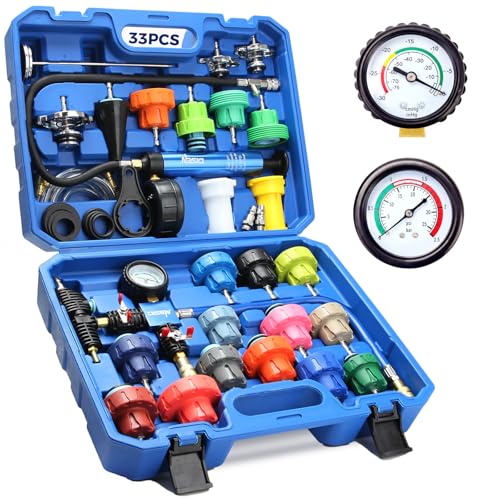
Begin with a cold-engine inspection, because that is when level checks are most meaningful and the engine bay is safe to touch. A cooling-system pressure test is often a useful first diagnostic step for hidden leaks, and it can reveal leaks at hoses, radiator seams, thermostat housing edges, water pump seals, and fittings that may stay dry when cold.
Before you pressure test, inspect the obvious points: hose ends, clamps, plastic fittings, the radiator tanks, the thermostat housing, and the water pump weep hole. Dried coolant often leaves white, pink, orange, or green crust, depending on the coolant type, and that crust tends to collect around the leak source rather than spread evenly.
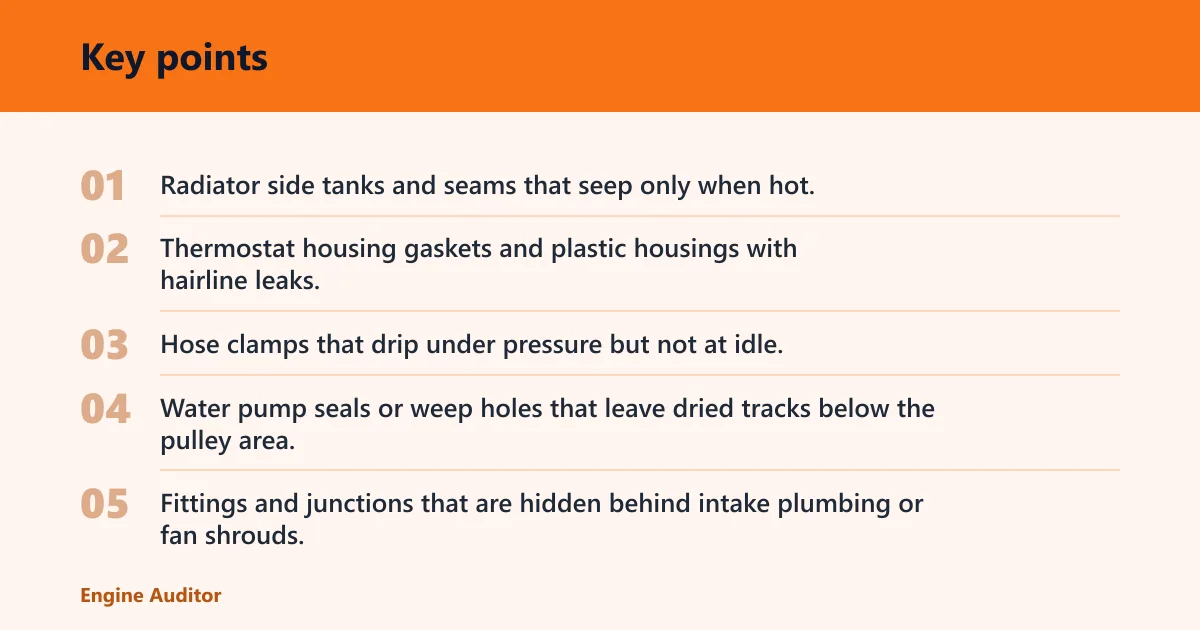
What pressure testing exposes best
- Radiator side tanks and seams that seep only when hot.
- Thermostat housing gaskets and plastic housings with hairline leaks.
- Hose clamps that drip under pressure but not at idle.
- Water pump seals or weep holes that leave dried tracks below the pulley area.
- Fittings and junctions that are hidden behind intake plumbing or fan shrouds.
Pressure testing is especially useful because a slow leak can evaporate on engine parts before it reaches the floor. Auto Chimps also recommends UV leak detection dye for finding coolant leaks when the source is hard to see, but the pressure test is usually the faster first pass.
Simple home inspection order
- Check the reservoir level cold and compare it with the mark.
- Look for residue at hose ends and clamp joints.
- Inspect radiator seams and the cap neck.
- Check the thermostat housing for wet edges or crust.
- Look under the water pump for tracks from the weep hole.
- If still unclear, schedule a pressure test.
Could the heater core be leaking?
Yes. The heater core is a cabin-mounted heat exchanger behind the dashboard, and it can leak into the passenger compartment or HVAC airflow instead of onto the ground. Typical clues include sweet smell, fogging on the inside of the windshield, damp carpet, and a coolant odor from the vents.
Heater core leaks often confuse drivers because the driveway stays clean. Coolant may drip into the HVAC case or soak insulation under the dash, so the loss is real even when the outside of the car looks dry. That is why cabin symptoms matter as much as under-car checks.
What to check before blaming the radiator
- Passenger-side carpet for dampness.
- Fogging that returns quickly with the heater on.
- Sweet odor from the defroster or center vents.
- Wetness under the glove box or center console.
Suppose the windows fog on a cool morning, the vents smell sweet, and the coolant level keeps dropping without any floor spot. That combination points more toward the heater core than the radiator, and it should move up your diagnosis list quickly.
When does coolant loss point to internal engine trouble?
Internal loss becomes more likely when coolant appears to enter the combustion chamber or oil system. Common clues are white exhaust after warm-up, rough startup, bubbling in the reservoir, overheating, or milky oil. White smoke from the exhaust can indicate coolant burning in a combustion chamber, and VehicleRuns identifies white exhaust after warm-up as a sign of blown head gasket.
Head gasket failure is not the only internal path, but it is a major one. Coolant can also mix with oil, which may show as a tan or milky appearance on the dipstick or under the oil cap. On some vehicles, worn turbocharger seals can also cause invisible coolant loss, especially when the leak path does not drip externally.
What tests confirm internal coolant loss
- Combustion-gas block test: Used when white smoke, overheating, or pressure buildup suggests head gasket failure.
- Leak-down evaluation: Useful when a block test is inconclusive or when internal leakage needs further confirmation.
- Oil inspection: Checks for coolant contamination in the crankcase.
Do not confuse brief condensation on a cold morning with ongoing white exhaust. Persistent white exhaust after warm-up, along with bubbling in the tank or repeated overheating, should move you to a block test or a shop inspection rather than another top-off.
Safety note: stop driving if the engine overheats or white smoke continues. Repeated overheating can damage the head gasket, warp the cylinder head, and turn a repairable problem into a far larger one.
Frequently asked questions
Why does my coolant keep disappearing with no visible leak?
Coolant usually disappears without a puddle because it is leaking where heat hides it, venting through a weak cap, entering the heater core, or being lost internally through the engine. Rank the clues by symptom: sweet smell, residue, cabin fog, white exhaust, bubbles, or oil contamination, then test the most likely branch first.
Is it safe to keep driving if coolant level keeps dropping?
Not if the engine is overheating, white smoke continues, or the level is falling quickly. A slow drop without those signs still needs diagnosis soon, but ongoing overheating or internal leak clues mean the risk is high enough to stop driving and test the system before further damage occurs.
How do I tell if coolant is going into the engine oil?
Check the dipstick and oil fill cap for a milky or tan appearance, and watch whether the oil level rises without a service reason. That pattern suggests coolant contamination in the oil system and points toward an internal leak rather than an external drip.
What tests confirm a head gasket leak?
The key confirmation test is a combustion-gas block test. If that points to exhaust gas in the cooling system, a leak-down evaluation can add more detail. White exhaust after warm-up, bubbling reservoir, rough startup, and repeated overheating make those tests more urgent.
Products related to this article
Sponsored / affiliate links. As an Amazon Associate I earn from qualifying purchases. I may earn additional commission from eligible campaigns.