How Many Pedal Revolutions Are In A Mile? Calculated
Ever wondered about the simple math behind your bike ride? You pedal, your wheels turn, and you cover distance. It seems straightforward.
But when you start thinking about how many times your feet go around to get you a whole mile, it can feel like a puzzle. Many cyclists just ride and enjoy the journey, not worrying about the exact numbers. That’s perfectly fine!
But for those who like to dig a little deeper, this question pops up. We’ll help you figure out the exact number. It’s more interesting than you might think.
The number of pedal revolutions in a mile depends on your bike’s gear ratio and wheel size, but a common estimate for average cycling is between 700 to 900 pedal strokes per mile when using typical road bike setups.
The Heart of the Matter: Wheel Size and You
At its core, this question is about how far your bike travels with each rotation of your pedals. Think about it. Your pedals turn the crank.
The crank turns the chain. The chain turns the gears. The gears turn the rear wheel.
And that rear wheel rolling on the ground moves you forward. So, to know how many pedal spins make a mile, we need to connect your pedaling to how much the wheel moves.
The most crucial part of this connection is your bike’s wheel size. Wheels come in many sizes. Think of a small bike for a kid.
It has small wheels. A big adult bike, especially a road bike, has much bigger wheels. These bigger wheels cover more ground with every single spin compared to smaller wheels.
This is a simple fact of physics: a bigger circle rolls further in one turn.
So, a bike with bigger wheels will need fewer pedal revolutions to cover the same distance as a bike with smaller wheels, assuming everything else is the same. It’s like rolling a dinner plate versus a coin. The plate goes much further with one spin.
How Wheel Size is Measured
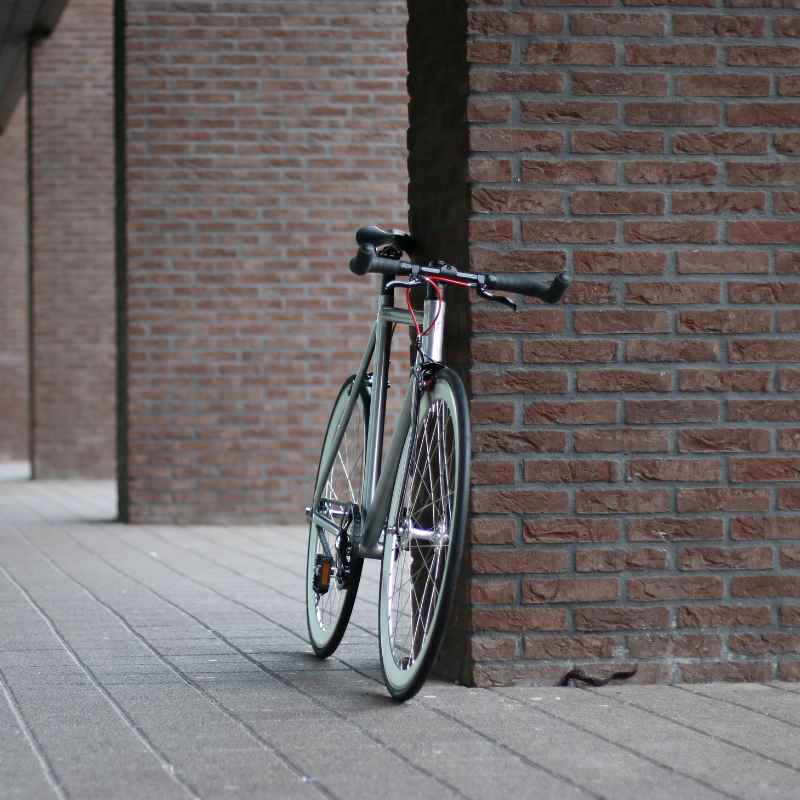
When we talk about wheel size, it’s usually given as a diameter. For road bikes, common sizes are 700c. This ‘c’ isn’t a measurement of diameter but a historical classification.
The actual diameter of a 700c wheel is around 622 millimeters (mm) for the rim itself. However, the tire adds to the overall diameter of the wheel when it’s inflated and on the ground.
A common road bike tire might be 700x25c. This means a rim diameter of 622mm and a tire width of 25mm. When inflated, this setup typically results in an overall wheel diameter of about 675mm to 700mm.
Mountain bikes often have different wheel sizes, like 26-inch, 27.5-inch (or 650b), and 29-inch. These measurements are often in inches but can also be converted to millimeters.
To be precise, we need the total diameter of the wheel including the tire. This is the part that actually touches the ground and rolls. A wider tire or a tire with a higher profile (meaning it’s taller) will make the overall wheel diameter larger.
So, two bikes with the same rim size but different tires can have different effective rolling diameters.
The Science of Rolling: Circumference is Key
Here’s where the math gets interesting. The distance a wheel covers in one full rotation is its circumference. Think about laying a string around the edge of the tire and then straightening it out.
The length of that string is the circumference. The formula for circumference is simple: Circumference = π × diameter. Pi (π) is a mathematical constant, roughly 3.14159.
So, if your wheel (with the tire) has a diameter of, let’s say, 675mm, its circumference is about 3.14159 * 675mm. That comes out to roughly 2120.6mm. To convert this to miles, we need to do more math.
There are 1609.34 meters in a mile, and 1000 millimeters in a meter.
So, 2120.6mm is equal to 2.1206 meters. And 2.1206 meters is about 0.001318 miles. This means one full rotation of your wheel covers about 0.001318 miles.
Connecting Pedals to Wheels: The Gear Ratio
Now, how many pedal revolutions does it take to make the wheel spin that many times? This is where your bike’s gears come in. Your bike has gears on the front (crankset) and gears on the back (cassette or freewheel).
The combination of which front gear you’re in and which rear gear you’re in is called the gear ratio.
The gear ratio tells you how many times the rear wheel turns for each single rotation of your pedals. It’s calculated by dividing the number of teeth on the front chainring by the number of teeth on the rear cog. For example, if your front chainring has 50 teeth and your rear cog has 10 teeth, the gear ratio is 50/10 = 5.
This means your rear wheel will spin 5 times for every 1 time your pedals go around.
If your gear ratio is less than 1 (e.g., 30 teeth on the front, 34 teeth on the back gives a ratio of 30/34, which is about 0.88), the rear wheel spins less than once for each pedal revolution. This is common for climbing steep hills. If your gear ratio is much greater than 1 (like 50/10 = 5), the rear wheel spins many times for each pedal revolution.
This is used for high speeds on flat ground.
Putting It All Together: The Calculation
Let’s bring it all together. We want to find Pedal Revolutions per Mile.
Here’s the formula:
Pedal Revolutions per Mile = (Miles per Wheel Revolution) / (Wheel Revolutions per Pedal Revolution)
And we know:
Miles per Wheel Revolution = Circumference of Wheel in Miles
Wheel Revolutions per Pedal Revolution = Gear Ratio
So, the full formula becomes:
Pedal Revolutions per Mile = (Circumference of Wheel in Miles) * (Gear Ratio)
Let’s use our example wheel with a 675mm diameter. We found its circumference is 2.1206 meters, which is 0.001318 miles. Now, let’s pick a common gear ratio.
A typical high gear on a road bike might be 50 teeth on the front chainring and 11 teeth on the rear cog. That’s a gear ratio of 50/11 = 4.545.
So, Pedal Revolutions per Mile = 0.001318 miles/revolution * 4.545 revolutions/pedal revolution.
This equals approximately 6.00 pedal revolutions per mile. Wait, that sounds too low! What did we miss?
Ah, the mistake is in how we’re looking at the “miles per wheel revolution.” It’s easier to think about Wheel Revolutions per Mile first.
Wheel Revolutions per Mile = 1 Mile / Circumference of Wheel in Miles
Using our 675mm wheel example (circumference = 0.001318 miles):
Wheel Revolutions per Mile = 1 mile / 0.001318 miles/revolution = 758.7 revolutions.
So, your wheel needs to spin about 759 times to cover one mile.
Now, we connect this to the pedal revolutions using the gear ratio. Remember, the gear ratio (Front Teeth / Rear Teeth) tells us how many times the wheel turns for one pedal turn. So, we need to flip that thinking.
Pedal Revolutions per Mile = Wheel Revolutions per Mile / Gear Ratio
Using our example: 759 wheel revolutions per mile / 4.545 (gear ratio) = 167 pedal revolutions per mile.
This still seems a bit low, doesn’t it? Many people talk about hundreds of pedal strokes per mile. What’s the disconnect?
The missing piece is often cadence. Cadence is your pedaling speed – how many times per minute you complete a pedal revolution. A typical cycling cadence for many riders is between 70 to 90 revolutions per minute (RPM).
If you’re riding at 15 miles per hour, and your cadence is 80 RPM, then in one minute you pedal 80 times. In an hour, you’d pedal 80 * 60 = 4800 times. If you cover 15 miles in that hour, then 4800 pedal strokes / 15 miles = 320 pedal strokes per mile.
This feels much more in line with what cyclists experience.
So, the calculation above (167 pedal revolutions per mile) assumes a very high gear ratio and a very fast wheel speed for each pedal stroke. In reality, most of us are not in our highest gear the entire time. Let’s re-evaluate with a more typical gear setup and cadence.
Understanding Gear Ratios: A Closer Look
What it is: The gear ratio compares the size of the front chainring to the size of the rear cog. It shows how much the rear wheel turns for each pedal turn.
High Gear (Fast Pedaling): Large chainring (e.g., 50 teeth) and small cog (e.g., 11 teeth). Ratio = 50/11 = 4.54. Wheel spins about 4.5 times per pedal turn.
Good for speed on flats.
Low Gear (Easy Pedaling): Small chainring (e.g., 34 teeth) and large cog (e.g., 34 teeth). Ratio = 34/34 = 1. Wheel spins about 1 time per pedal turn.
Good for climbing hills.
Mid-Range Gear: A balanced setup, useful for general riding.
My Own Experience with Gear Choices
I remember back when I was training for my first long-distance ride. I was so focused on my speed and distance. I’d meticulously plan my routes and bike choices.
But the actual number of pedal strokes per mile? That was a mystery. I’d ride along, counting my turns, trying to get a feel for it.
Sometimes it felt like I was pedaling a million times for just a few miles, especially on an uphill section.
One sunny afternoon, I was on a flat stretch, really cruising in a higher gear. I had a cycling computer that showed my cadence. I noticed my cadence was around 90 RPM.
My speed was about 18 mph. I started thinking, “Okay, 90 pedals a minute. At 18 mph, how many miles am I covering in a minute?” That’s 18 miles per hour divided by 60 minutes per hour, which is 0.3 miles per minute.
So, in one minute, I pedal 90 times to go 0.3 miles. That means for one mile, I’d need 90 pedals / 0.3 miles = 300 pedal strokes.
This felt much more real. The key was realizing that my cadence and my speed were working together. A higher cadence means more pedal strokes per minute.
Higher speed means you cover more distance per minute, so you need fewer pedal strokes to cover that mile. It’s a delicate balance based on the gear you choose and how fast you’re going.
Factors That Change the Numbers
So, we’ve seen that wheel size and gear ratio are the main players. But life, and cycling, are rarely that simple. Several other things can nudge the numbers up or down:
Tire Pressure and Inflation
How much air is in your tires matters. Properly inflated tires are more “round” and roll more efficiently. If your tires are a bit squishy, they can deform more.
This deformation means the effective rolling diameter might slightly change. It’s a small effect, but in precise calculations, it counts. Plus, under-inflated tires create more friction, making you work harder, which might indirectly affect your cadence and perceived pedal strokes.
Rider Weight and Load
More weight on the bike means more pressure on the tires. This can cause them to flatten slightly more, potentially affecting the rolling diameter. Heavier riders, or those carrying a lot of gear (like for touring or commuting), will need more effort to turn the wheels.
This might lead to a slightly different cadence or gear choice.
Road Surface and Terrain
Are you riding on smooth asphalt? Or bumpy gravel? Or soft sand?
Each surface changes how your tire interacts with the ground. Smooth pavement allows for a consistent rolling diameter. Rough surfaces can cause the wheel to bounce or sink slightly, changing the distance covered per rotation.
Climbing a steep hill requires a different gear and often a higher cadence for sustained effort, which changes the pedal strokes per mile.
Riding Style and Cadence
This is a big one. Some cyclists prefer to spin their legs very fast at a high cadence (say, 90-100 RPM). Others prefer to push harder in a higher gear at a lower cadence (say, 60-70 RPM).
Both can achieve the same speed, but the number of pedal revolutions per mile will be vastly different. A higher cadence means more pedal strokes for the same distance.
Your Ideal Cadence: Finding the Sweet Spot
What it is: Cadence is your pedaling speed, measured in revolutions per minute (RPM).
Typical Range: Most cyclists find a cadence between 70-90 RPM to be efficient and comfortable. Elite racers might push higher.
Why it matters: Your cadence, along with your gear choice, determines your speed and how many times you pedal for a given distance. A higher cadence generally means less strain on your muscles but requires more effort from your cardiovascular system.
Experiment: Use a bike computer with a cadence sensor or simply count your pedal strokes for 15 seconds and multiply by four.
Calculating Pedal Strokes Per Mile: A Practical Approach
Let’s try a more common scenario. Imagine you’re riding a road bike with 700x28c tires. The overall diameter with the tire might be around 685mm.
We need to convert this to miles for the circumference.
Diameter = 685 mm
Circumference (in mm) = π × 685 mm ≈ 2152.2 mm
Circumference (in meters) = 2152.2 mm / 1000 = 2.1522 meters
Circumference (in miles) = 2.1522 meters / 1609.34 meters/mile ≈ 0.001337 miles
Now, let’s figure out the Wheel Revolutions per Mile:
Wheel Revolutions per Mile = 1 mile / 0.001337 miles/revolution ≈ 748 revolutions.
So, your wheel needs to turn about 748 times to cover one mile.
Now, let’s consider your cadence. If your typical cadence is 85 RPM and you’re riding at a decent pace, let’s estimate your speed.
Let’s pick a common riding gear. Perhaps you’re in a 42-tooth chainring and a 15-tooth cog. Your gear ratio is 42/15 = 2.8.
Pedal Revolutions per Mile = Wheel Revolutions per Mile / Gear Ratio
Pedal Revolutions per Mile = 748 / 2.8 ≈ 267 pedal revolutions per mile.
This number feels much more in the ballpark for many cyclists. If you maintained this cadence (85 RPM) and this gear ratio, you would be covering about 267 pedal strokes for every mile you ride.
Let’s test this. If you pedal 267 times for one mile, and you do that at 85 RPM, how long does it take to cover that mile? It would take 267 pedal strokes / 85 strokes/minute ≈ 3.14 minutes per mile.
This corresponds to a speed of 60 minutes / 3.14 minutes/mile ≈ 19.1 miles per hour. This is a very reasonable speed for a cyclist in that gear and cadence.
Myth vs. Reality: Pedal Revolutions
Myth: Everyone uses the same number of pedal strokes per mile.
Reality: It varies greatly based on bike setup (wheel size, tire size, gearing) and rider habits (cadence, speed).
Myth: More pedal strokes mean you’re working harder.
Reality: It’s about power output (force x distance). You can achieve the same power with fewer, harder strokes or more, easier strokes. Cadence and gear choice are key.
What This Means for Your Riding
So, why should you care about how many pedal revolutions are in a mile? Understanding this can give you some insights:
Efficiency and Effort
If you find yourself pedaling a very high number of times per mile (e.g., 400+), it might mean you’re in a very low gear or riding at a very high cadence. This can be efficient for climbing but might not be the fastest for flat ground. Conversely, very few pedal strokes per mile might indicate you’re in a very high gear, which can be hard on your knees if you’re not strong enough.
Pacing and Endurance
Knowing your typical pedal strokes per mile can help you pace yourself on longer rides. If you know your average is 300 strokes per mile and you’re aiming for a 50-mile ride, that’s 15,000 pedal strokes. It gives you a tangible way to think about the total effort involved.
It can also help you identify if you’re using inefficient gears for certain terrains.
Gear Choice Strategy
When you’re climbing a steep hill, you’ll naturally shift to an easier gear. This means your gear ratio decreases, and your pedal revolutions per mile will increase. On a downhill, you’ll shift to a harder gear, decreasing your pedal revolutions per mile.
Understanding this relationship helps you choose the right gear at the right time.
Bike Fit and Comfort
Sometimes, feeling like you’re pedaling too much or too little can be a sign that your bike fit isn’t quite right. If you’re constantly feeling like you’re spinning out or grinding gears, it might be worth getting a professional bike fit. Your crank length and pedal position also play a small role.
My Quick Checks and Observations
In my own riding, I pay attention to my cadence display on my bike computer. If I’m cruising on a flat road and my cadence is below 75 RPM, I usually feel like I’m pushing too hard, or I could be in an easier gear to spin more comfortably. If my cadence goes above 100 RPM for extended periods on the flat, I might be in too easy a gear, and I could be going faster by shifting to a harder one.
I’ve also noticed that on rougher terrain, like gravel paths, my wheel might not roll as smoothly. This can sometimes feel like I need to pedal a bit more to cover the same distance, even if my actual cadence is the same. It’s a subtle effect, but it highlights how the environment impacts the mechanics of cycling.
Normal vs. Concerning Pedal Strokes Per Mile
Normal: Most road cyclists fall in the 250-400 pedal strokes per mile range, depending heavily on their typical cadence and gear choices.
Concerning (Potentially): Consistently very low (under 200) might mean you’re using excessively hard gears, which can strain your knees over time. Consistently very high (over 450) on flat terrain might mean you’re not using your gears efficiently and could be going faster.
Context is Key: Steep climbs will naturally result in more pedal strokes per mile, while steep descents will result in fewer. These are normal variations.
Quick Tips for Understanding Your Numbers
If you’re curious about your own pedal revolutions per mile, here are a few things you can do:
- Know Your Gear: Note the number of teeth on your front chainrings and rear cogs.
- Measure Your Wheel: Accurately measure the diameter of your wheel with its inflated tire.
- Calculate Circumference: Use the formula C = π × diameter. Convert to miles.
- Calculate Wheel Revolutions Per Mile: 1 mile / Circumference in miles.
- Calculate Gear Ratio: Front teeth / Rear teeth.
- Calculate Pedal Revolutions Per Mile: Wheel Revolutions per Mile / Gear Ratio.
- Use a Cycling Computer: Many modern bike computers track cadence and speed, allowing you to estimate pedal strokes per mile more easily over time.
- Track Over Time: Do this calculation for different gears and speeds to see how it changes.
Remember, these are just calculations. Your actual experience will always involve the real world – wind, hills, and your own energy levels!
Frequently Asked Questions
What is the average number of pedal revolutions in a mile for a cyclist?
For most road cyclists, the average number of pedal revolutions in a mile typically falls between 250 and 400. This can vary significantly based on the rider’s preferred cadence, the bike’s gearing, and the terrain. Elite cyclists might have different averages due to higher speeds and specialized techniques.
How does wheel size affect the number of pedal revolutions per mile?
Larger wheels have a greater circumference, meaning they cover more distance with each rotation. Therefore, bikes with larger wheels require fewer wheel revolutions to cover a mile. This also means, for a given gear ratio, fewer pedal revolutions will be needed to cover that mile compared to a bike with smaller wheels.
Does my bike’s gearing affect how many times I pedal per mile?
Yes, absolutely. Your bike’s gear ratio is a direct factor. A “harder” gear (larger front chainring relative to the rear cog) means your wheel turns more times per pedal revolution.
This results in fewer pedal revolutions needed to cover a mile. An “easier” gear does the opposite, leading to more pedal revolutions per mile.
Can cadence be too high or too low for cycling efficiency?
Yes, both can be true. A very low cadence (e.g., below 60 RPM) can put a lot of strain on your leg muscles and knees. A very high cadence (e.g., above 100 RPM) can be difficult to sustain and may not be the most efficient for all riders.
Most cyclists find an optimal range between 70-90 RPM for a good balance of efficiency and comfort.
How can I find out my exact pedal revolutions per mile?
To find your exact number, you need to know your bike’s wheel circumference (which depends on wheel and tire size), your current gear ratio (front chainring teeth divided by rear cog teeth), and your speed. You can calculate it using the formula: (Wheel Revolutions per Mile) / (Gear Ratio). Many cycling computers with cadence sensors can also help estimate this by tracking your speed and cadence over distance.
Does tire pressure make a difference in pedal strokes per mile?
Tire pressure has a minor effect. Properly inflated tires roll more efficiently and maintain a more consistent diameter. Under-inflated tires can deform more, slightly changing the effective rolling diameter and increasing rolling resistance.
While not a primary driver, it contributes to overall efficiency, which can influence the number of pedal strokes needed.
Conclusion
Figuring out the number of pedal revolutions in a mile is a fun dive into cycling mechanics. It’s not just one fixed number. It’s a dynamic result of your bike’s setup, your chosen gear, and how fast you choose to ride.
From the diameter of your wheel to the teeth on your cogs, each part plays a role. Understanding these elements can make you a more informed and perhaps even a more efficient cyclist. So next time you’re out for a ride, you’ll have a clearer picture of the physics behind every turn of the pedals.
See also why don’t amish use pedal bikes the real cultural reason. See also why do you pedal an electric bike here’s the real reason.
Products related to this article
Sponsored / affiliate links. As an Amazon Associate I earn from qualifying purchases. I may earn additional commission from eligible campaigns.