How Do I Describe a Car Noise to My Mechanic?
Describe the noise with four facts: what it sounds like, when it happens, where it seems to come from, and how often it repeats. Leave those out, and a mechanic can chase the wrong part, burn diagnosis time, and add repair cost. This guide shows you how to turn a vague sound into a clear symptom report the shop can use fast.
| Sound | Trigger | Likely system to inspect first | How urgent | What to tell the mechanic |
|---|---|---|---|---|
| Grinding or loud scraping | Braking, constant while driving, or getting worse quickly | Brakes first; then wheel bearing or backing plate if the brakes check out | High; do not delay | “It grinds when I brake / while rolling, and it has gotten louder.” |
| Hum, drone, or growl | Road speed rises; may change when turning | Wheel bearing, tyre, or nearby hub components | Moderate to high, sooner if the sound is growing | “The noise follows speed, not engine revs, and changes when I turn.” |
| Clicking in tight turns | Low-speed turns, parking-lot manoeuvres, or accelerating while turning | CV joint and axle assembly first | Moderate; book soon | “It clicks mainly on tight turns, especially under light throttle.” |
| Whine or groan when turning | Steering input, especially at low speed or full lock | Power steering system or electric power steering components | Moderate; sooner if steering effort changes | “It whines only when I turn the wheel, and the steering feels normal / heavier.” |
| Squeal at startup or with moisture | Cold start, rain, or accessories on | Serpentine belt, pulley, or accessory drive | Moderate unless the belt looks damaged | “It squeals cold or wet, then quiets down.” |
| Whistling or hiss under throttle | Acceleration, boost, vacuum demand, or AC load | Vacuum leak, intake tract, or accessory-related airflow noise | Moderate; sooner if power drops or the check-engine light is on | “It whistles only when accelerating, and it is quieter at idle.” |
Fill-in example: “A faint whine from the front right wheel area, constant at 30 to 60 mph, louder when turning left, and quieter after the car warms up.”
- Write the closest sound word first.
- Add when it happens.
- Point to the area that seems loudest.
- Note what makes it louder, softer, or disappear.
- If it is intermittent, say what road, speed, weather, or pedal input brings it back.
Why does your wording matter so much?
A mechanic needs a symptom, not a guess. “Weird noise” gives almost no usable direction, while a note that says “high-pitched squeal from the front right at cold start, mostly in reverse” narrows the search fast.
Good wording separates the sound itself from the condition that triggers it. That split matters because a noise tied to engine revs points somewhere else from a noise that rises with road speed or changes only when you turn.
Use plain terms. Say whine, grind, squeal, squeak, clunk, click, pop, hum, hiss, rattle, or thump. Then add what changes it, such as acceleration, braking, steering input, cold weather, moisture, AC on, or hill climbing.
What does the noise sound like?
Start with the closest sound word, then add pitch, loudness, and rhythm. A squeal is different from a hum, and a rhythmic thump is different from a steady whine. That extra detail helps the mechanic sort belt, brake, wheel, and steering possibilities faster.
Which sound words help most?
Pick from common sound families: whine, grind, squeal, squeak, clunk, click, pop, hum, hiss, rattle, or thump. “Metallic grind” tells more than “bad noise,” and “intermittent click” is more useful than “it comes and goes.”
For pitch, say high-pitched, low growl, metallic, or rhythmic. For loudness, say faint, intermittent, constant, or getting louder. For example, a squeal at startup points somewhere different from a low growl that rises with speed.
How should you describe the moment it happens?
Say “whine on acceleration,” “clicking in tight turns,” or “grind while braking.” Those combinations are more useful than naming a single sound alone, because the trigger often matters more than the word itself.
A common first-timer mistake is to say “it sounds terrible” and stop there. A better note is “front-right squeak, faint at idle, louder when the wheel turns left at parking-lot speed.”
When does the noise happen?
The trigger often points to the relevant system. A noise that changes with engine revs while stationary is different from one that rises only with vehicle speed. Add whether it shows up during acceleration, braking, turning, starting, idle, reversing, or at a specific temperature.
Does it change with acceleration or engine revs?
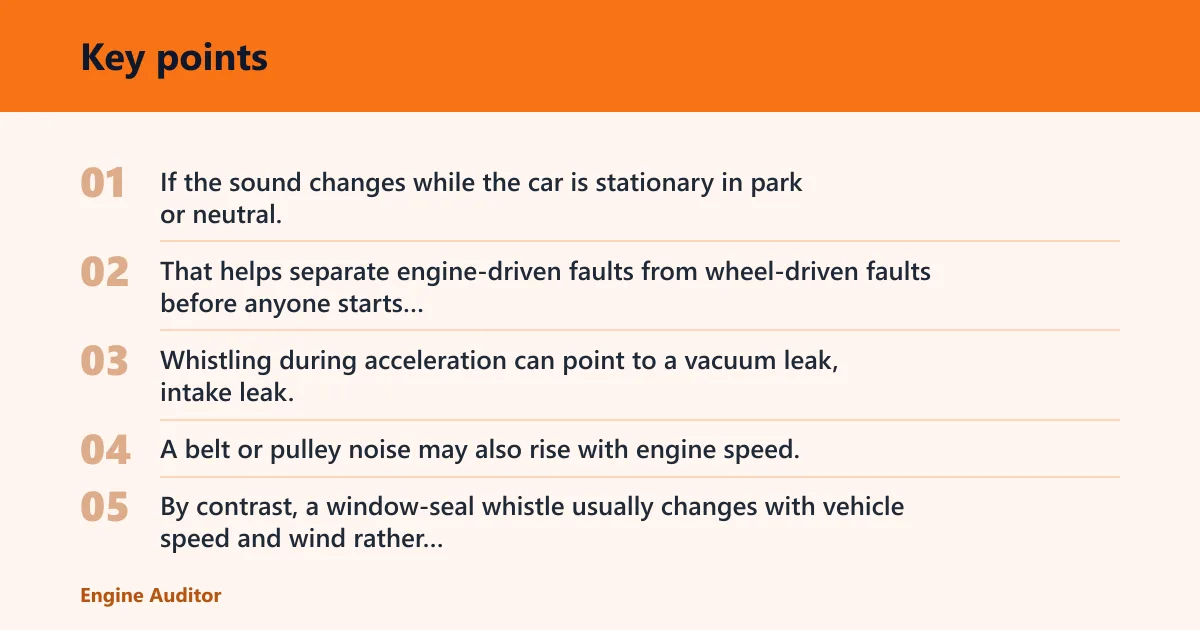
If the sound changes while the car is stationary in park or neutral, the engine side gets more attention than the wheels. That helps separate engine-driven faults from wheel-driven faults before anyone starts guessing.
Whistling during acceleration can point to a vacuum leak, intake leak, or airflow path issue. A belt or pulley noise may also rise with engine speed. By contrast, a window-seal whistle usually changes with vehicle speed and wind rather than throttle position. Low transmission fluid is not a reliable generic explanation for whistling, so it is better to describe the exact trigger than to assume that cause.
Does it track road speed instead?
If the noise rises with vehicle speed, note the speed range. A steady observation at about 30 to 60 mph can point toward tyres or a wheel bearing rather than a part that only reacts to engine revs.
A worn wheel bearing may be quieter at times and louder when turning. Road-speed noise that stays in step with the car, not the engine, often belongs in the wheel area, tyre set, or nearby suspension parts. That pattern helps separate a bearing hum from an engine whine.
Does it change when you turn, brake, start, idle, or reverse?
If the sound changes when you steer, brake, start the car, sit at idle, or reverse, say so. A turning noise can be a clunk, click, pop, groan, or whine. Pressing the brake pedal is another clear clue.
Say your car squeals only when you back out of a parking space on a damp morning. That points the mechanic toward a condition-based noise, not a constant one, and moisture becomes part of the description.
Do cold, moisture, and load change it?
Cold-start noise, warm-engine noise, and moisture-related noise all matter. A worn serpentine belt can squeak, squeal, or whistle when worn or loose, and cold start, moisture, or glazing can make it more obvious. Load matters too: AC on, steering input, or hill climbing can change the sound.
Suppose a hiss appears only with the AC on and disappears when the compressor cycles off. That is useful because it tells the shop the noise tracks a load change, not a random rattle.
Where does it seem to come from?
Use location words that point the inspection in the right direction: front, rear, left, right, under bonnet, or wheel area. If the sound seems to move, say which side sounds louder during a turn, brake, or lane-change weave test.
Should you say front, rear, left, or right?
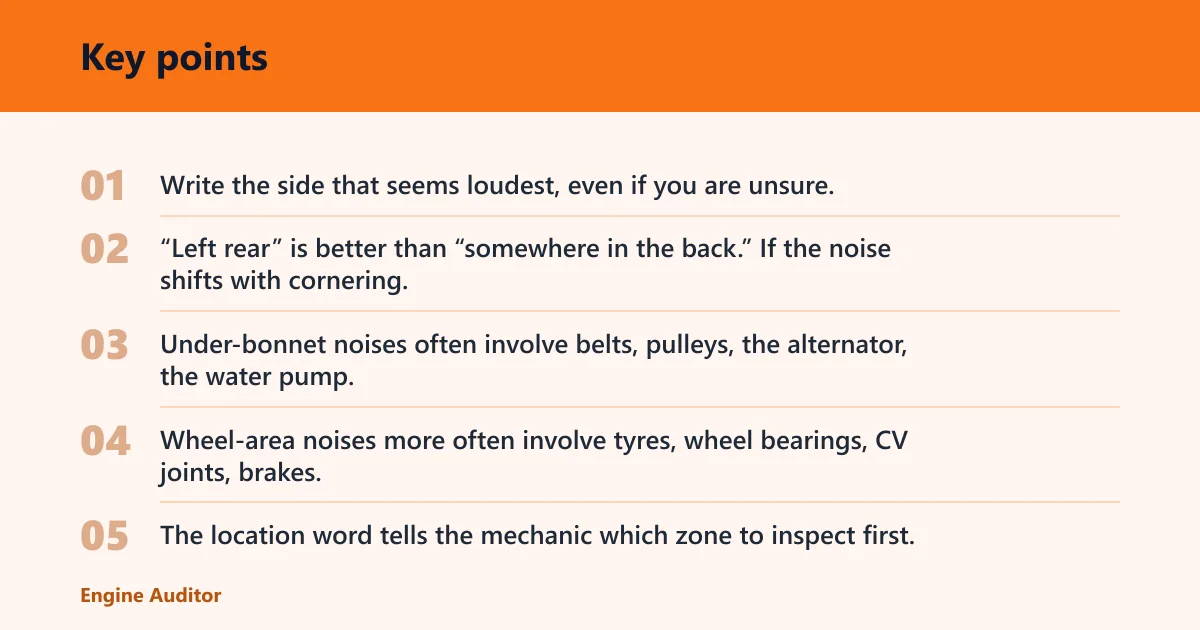
Write the side that seems loudest, even if you are unsure. “Left rear” is better than “somewhere in the back.” If the noise shifts with cornering, note which direction makes it louder or softer.
Is it under the bonnet or in the wheel area?
Under-bonnet noises often involve belts, pulleys, the alternator, the water pump, or the AC compressor. Wheel-area noises more often involve tyres, wheel bearings, CV joints, brakes, or nearby suspension parts. The location word tells the mechanic which zone to inspect first.
Some steering-related noises seem to come from the front corners rather than the centre of the car. That is why “front left wheel area” can be more useful than “front end.”
Why is it only happening then?
The pattern matters as much as the sound. Engine-driven noises change with engine revs. Road-speed noises rise with vehicle speed. Steering-related noises change with turning. Brake-related noises change when you press the pedal. That split prevents a lot of wrong guesses.
What does an engine-driven noise suggest?
Test this while parked: if the sound changes in park or neutral, the engine side moves higher on the list. That can fit a serpentine belt, alternator, water pump, pulley, vacuum leak, or other under-bonnet parts.
Squeaking noise while driving can be caused by a worn serpentine belt, worn bearings, or brake pads. Grinding noise can come from a damaged water pump, worn alternator, or worn wheel bearing. A worn clutch can cause grinding when changing gears. Those are possibilities, not certainties, so the trigger matters more than the sound word alone.
What does a wheel-speed noise suggest?
If the sound rises with road speed and does not follow engine revs, note that clearly. A wheel bearing often hums, drones, or grinds, and a worn wheel bearing may be louder when turning. Uneven tyre wear can also fit this pattern.
What does a steering-related noise suggest?
If the sound appears or worsens when turning, say whether a left-right weave changes it. A weaving test at safe speed can help separate steering input from straight-line driving. Power steering noise often shows up as a whine or groan when turning.
Groaning or whining when turning usually points toward the power steering system, while squeaking can also come from low fluid in hydraulic systems. Many newer cars use electric power steering with no fluid reservoir, so the system type matters; on those cars, the sound can come from the motor, gears, or column assistance rather than fluid level.
Clicking or popping noise during tight turns commonly indicates a worn CV joint. A worn CV joint can make grinding, ticking, or clicking noises, especially on front-wheel-drive and all-wheel-drive cars. Boot tears and grease loss speed up wear.
What does a brake-related noise suggest?
If the sound changes when you press the brake pedal, mention it. Brake noises often squeak, squeal, or grind, and worn pads, rotors, or calipers are common causes. That pedal test is one of the clearest clues you can give the shop.
Brake noise deserves urgency because worn pads can damage rotors, and grinding can mean the friction material is already gone. NHTSA advises getting brake issues inspected promptly, especially when the sound is new, loud, or accompanied by reduced braking performance.
How urgent is the noise?
Use urgency to decide whether to book soon or stop driving. Grinding, a loud new clunk, or a brake noise that changes sharply when the pedal is pressed needs prompt attention. A wheel bearing that grows louder when turning, a CV joint that clicks in tight turns, or a steering groan should not wait long.
AAA and NHTSA both emphasize that brake, steering, and suspension symptoms can become safety issues quickly, especially when they change rapidly or affect control. If the car pulls, vibrates, or feels harder to steer or stop, treat the noise as urgent.
How should you call the shop?
Use this as a verbatim one-line script: “My car makes a [sound] from [location] when [trigger], and it gets [louder/quieter/change] with [engine revs/road speed/turning/braking].”
Example: “My car makes a metallic hum from the front left wheel area when I drive above 30 mph, and it gets louder when I turn right.”
If the noise is intermittent, add the condition that brings it back: cold start, rain, steering input, braking, AC on, hill climbing, or reverse. That extra line helps the mechanic reproduce the symptom instead of guessing at it.
Frequently asked questions
What noise does a car make?
A car can make many normal and abnormal sounds, but the useful part is the pattern, not the label. Whine, grind, squeal, squeak, clunk, click, pop, hum, hiss, rattle, and thump are common words to use. Add where it happens and what changes it.
How do I describe a car noise to my mechanic?
Give four facts: what it sounds like, when it happens, where it seems to come from, and what changes it. Say whether it follows engine revs, road speed, turning, or braking. If it is cold-only or intermittent, include that too.
What should I tell the mechanic about the noise?
Tell the mechanic the sound word, the trigger, the location, and the frequency. “Front right squeak only on cold start” is better than “it makes noise sometimes.” Add whether it changes with steering, braking, acceleration, moisture, or AC load.
Is the noise coming from the engine, wheels, or steering?
Check what changes the sound. If it changes in park or neutral, engine-driven parts move higher on the list. If it rises with road speed, wheel bearings or tyres become more likely. If turning changes it, steering or CV joint issues move up.
What car noises are urgent?
Grinding, a loud new clunk, or a brake noise that changes sharply when the pedal is pressed needs prompt attention. A wheel bearing that grows louder when turning, a CV joint that clicks in tight turns, or a steering groan should not wait long.
What does the noise sound like when I accelerate?
Describe whether it whines, whistles, squeals, or grows louder under throttle. A whistling sound while accelerating can point to a vacuum leak, intake leak, or another airflow-related issue, while belt or pulley noise usually rises with engine speed regardless of throttle feel. Window-seal noise, by contrast, usually tracks vehicle speed and wind more than acceleration. If the noise only changes while revving in park or neutral, tell the mechanic that too.
Products related to this article
Sponsored / affiliate links. As an Amazon Associate I earn from qualifying purchases. I may earn additional commission from eligible campaigns.