Fuel Smell Inside the Cabin: Sources You Should Inspect
If fuel odor reaches the cabin, a common first step is to inspect the EVAP system, fuel lines, injectors, filler neck, and exhaust path. A strong gasoline smell after refueling or with the engine running is often treated as a reason to stop driving until the source is found. Ignoring it can mean fire risk or a leak that gets harder and more expensive to trace. This guide sorts gasoline smells by symptom pattern, then shows which checks point to liquid leaks, vapor leaks, or exhaust intrusion.
When fuel odor means stop driving
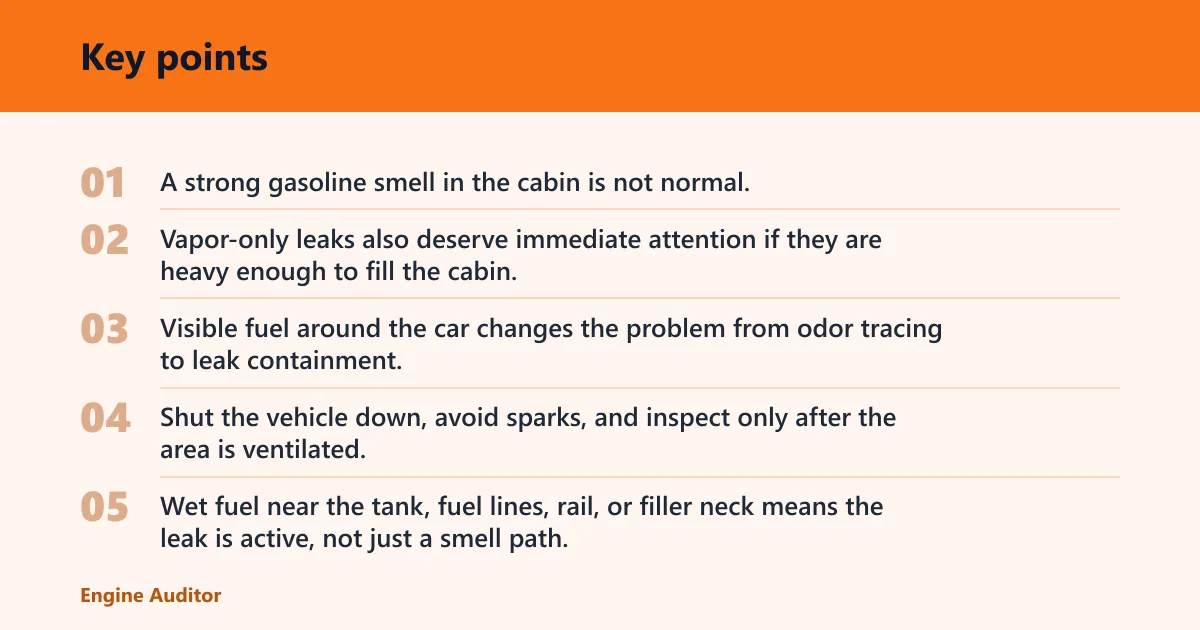


A strong gasoline smell in the cabin is not normal. Treat it as a stop-driving issue if wet fuel is visible, the smell is getting stronger, the engine runs rough, or the odor returns quickly after wiping away a suspected spot. Vapor-only leaks also deserve immediate attention if they are heavy enough to fill the cabin.
Strong odor with wet spots or drips
Visible fuel around the car changes the problem from odor tracing to leak containment. Shut the vehicle down, avoid sparks, and inspect only after the area is ventilated. Wet fuel near the tank, fuel lines, rail, or filler neck means the leak is active, not just a smell path.
Odor with a check-engine light or rough running
When the smell appears with misfires, a warning light, or poor idle quality, the fault may involve the EVAP system, fuel delivery, or a leak that affects mixture control. Codes and freeze-frame data help narrow the source before you start replacing parts. Do not assume the gas cap is the only issue.
Odor that returns after a short drive
If the smell fades and then comes back after a few miles, heat and pressure are probably opening the leak path. That pattern can point to a fuel line seep, injector seal leak, tank seam issue, or exhaust intrusion that becomes stronger once the system warms up.
Cabin fuel smell flowchart
| Symptom pattern | Likely source family | First inspection point | Severity |
|---|---|---|---|
| Smell after refueling | EVAP vapor leak or filler-neck issue | Fuel filler cap, cap gasket, filler neck, EVAP vent path | Ventilate and inspect |
| Smell only with AC on | Cabin air intake pulling in outside fumes | Cowl area, fresh-air intake, HVAC filter area | Ventilate and inspect |
| Smell strongest at the rear | Tank, filler neck, rear fuel lines | Fuel tank top seals, pump module seal, underbody lines | Inspect soon; stop if wet |
| Smell strongest in the engine bay | Injectors, rail, pressure-side lines, purge plumbing | Fuel rail, injector O-rings, hose clamps, purge valve area | Inspect soon; stop if wet |
| Smell with a check-engine light | EVAP fault, misfire, or fuel-control issue | OBD-II scan tool, stored and pending codes, freeze-frame data | Inspect soon; stop if rough running |
Why does the smell change by condition?
The pattern matters because it points to the system that is active at that moment. Refueling loads the EVAP path. AC use can pull outside fumes into the cabin. Idle, cold start, and full-tank conditions change fuel pressure, vapor flow, and leak visibility. That is why symptom timing is more useful than a generic checklist.
After refueling
Smell right after topping off often points to the filler cap, filler neck, EVAP vent valve, or charcoal canister area. Fuel vapor can escape when the tank is full and the vapor space is small. A bad cap seal or cracked filler neck can let the odor escape without leaving a large puddle.
With the AC
When the odor gets worse in fresh-air mode, the HVAC intake may be pulling fumes from the cowl area or from under the hood. Recirculation may reduce the smell because it limits outside air entry. That pattern does not prove the leak is in the cabin; it often means the source is outside and the intake is drawing it in.
At idle or cold start
Idle and cold-start odor often points to injectors, top-of-engine fuel rail hardware, or an EVAP purge problem. Cold-start leakage can show up before the system stabilizes. A purge valve that sticks open can move vapor when it should not, and a leaky injector O-ring can seep under pressure.
At the rear or near the engine bay
Rearward odor usually tracks to the tank, filler neck, or rear fuel lines. Engine-bay odor usually tracks to the rail, injectors, purge plumbing, or hot exhaust nearby. A smell strongest in one area is a useful clue, but not proof on its own. Follow the smell to the nearest component group first.
What should you inspect first?
Start with the easiest outside checks, then move to scan data and pressure testing. That order saves time because many fuel odors come from parts you can inspect without disassembly. If you find wet fuel, stop there and treat the car as unsafe until the source is repaired.
-
Check the fuel cap.
Make sure it tightens according to the vehicle instructions, often to a single click. Look for a damaged gasket, cracked shell, or deformation that keeps the seal from seating on the filler neck. -
Inspect the filler neck.
Look for cracks, rust, loose clamps, or an incompatible cap that does not match the neck design. A damaged filler connection can leak vapor after refueling and may not leave an obvious drip on the ground. -
Trace the EVAP path.
Inspect the purge valve, vent valve, and charcoal canister area for broken hoses, loose fittings, and fuel staining. These parts manage fuel vapor containment, so a leak here can often smell strongest after the tank is filled. -
Look at the engine bay.
Check the fuel rail, injector tops and bottoms, and nearby pressure-side hoses for dampness. Cold-start leakage and hot soak can both make injector or rail leaks smell stronger even when no fuel reaches the floor. -
Inspect the tank area.
Check the sending unit seal, pump module seal, top-of-tank seepage, impact damage, and the rear filler connection. These faults often show up at the rear of the vehicle and can be easiest to spot from underneath with good lighting.
Say your sedan smells strongest for the first five minutes after refueling, then fades on the highway. That pattern points first to the cap, filler neck, or EVAP vent path, not the injectors. Suppose the same car later shows a P0455 code and a loose cap gasket; that combination makes the vapor leak path more likely than a liquid leak.
Gas cap and filler neck
The cap is a simple check, but it is only one part of the system. Inspect the seal condition, the cap gasket, and the neck face for cracks or debris. If the filler neck and cap do not match correctly, the cap may tighten but still fail to seal.
EVAP purge valve, vent valve, and charcoal canister
The EVAP system stores fuel vapor and routes it back into the engine when commanded. A purge valve stuck open, a vent valve stuck shut or open, or a cracked charcoal canister hose can create cabin odor without a liquid fuel leak. OBD-II codes such as P0440, P0441, P0442, and P0455 can point you here, but they do not by themselves confirm the exact part.
Fuel injectors and fuel rail
A leaking injector can make the cabin smell like gasoline, especially if an O-ring is torn or hardened. Check the top and bottom seals, the rail connection, and the pressure side for dampness. A leak at idle or cold start often shows up before it becomes visible on the ground.
Fuel lines and tank seals
Fuel lines can fail at rubber sections, hard line joints, hose clamps, or along underbody routing where abrasion and road debris create cracks. Liquid leaks on the pressure side usually smell stronger and may spray or wet nearby surfaces. At the tank, inspect the pump module seal, sending unit seal, filler neck connection, and any top-of-tank seepage.
Could the HVAC system be pulling in fumes?
Yes. Cabin odor can come from outside air being pulled in through the HVAC intake, even when the leak is not inside the cabin. That is why a smell that changes with the fan setting or fresh-air mode deserves attention at the cowl, filter area, and nearby engine-bay source paths.
Fresh-air mode versus recirculation mode
Fresh-air mode draws outside air through the cowl area. Recirculation reduces outside intake and can reduce odor if the source is outside the cabin. If the smell drops in recirculation and returns in fresh-air mode, inspect the intake path and the nearest underhood source.
Cowl area and cabin air intake
The cowl area sits near the base of the windshield and can pull fumes from the engine bay or a nearby leak. Leaves, broken seals, or an exposed odor path can let vapor enter the intake stream. That route can make a minor underhood leak feel like a cabin problem.
HVAC filter and nearby odor entry paths
A clogged or poorly seated cabin air filter does not create fuel odor by itself, but it can change how air moves through the HVAC box. Check the filter housing, intake seals, and any openings near the firewall. Odors can enter through gaps that are easy to miss during a quick glance.
Can exhaust leaks smell like gas?
Yes. Exhaust leaks can smell like gasoline inside the car, especially if hot exhaust enters through body seals or underbody openings. The odor may seem fuel-like even when the source is combustion gases rather than raw fuel. That is why exhaust, fuel vapor, and liquid fuel leaks must be separated early.
Manifold leaks, downpipe joints, and flex pipe
Leaks at the manifold, downpipe joints, or flex pipe can send hot exhaust odor toward the cabin. The smell may be strongest at idle or low speed, then change with airflow. A damaged flex pipe or loose joint can mimic a fuel problem because the odor is sharp and persistent.
Body seals that let exhaust enter the cabin
Trunk seals, floor grommets, and other body seals can let exhaust into the cabin, especially if the vehicle has a rear or underbody leak. If the odor is worse with windows closed and the fan off, inspect body openings and the exhaust path together. A cabin odor does not always mean a fuel-system leak.
Hot-exhaust odor versus fuel vapor odor
Fuel vapor smells raw and can be strongest after refueling or around EVAP hardware. Hot exhaust odor often feels sharper and may track with engine load, idle, or rear-floor intrusion. If the smell changes with vehicle speed more than with refueling, exhaust deserves a close look.
OBD-II and leak checks
Scan data and controlled leak testing can separate vapor faults from liquid leaks. Use an OBD-II scan tool to read stored codes, pending codes, and freeze-frame data before parts are replaced. If the system is still not obvious, follow with fuel-pressure testing after relieving system pressure and checking the service procedure for the vehicle.
-
Read the scan tool first.
Check stored codes, pending codes, and freeze-frame data, then note any EVAP or misfire codes. Live data can show whether purge command, fuel trims, or tank pressure behavior lines up with the smell. -
Compare fuel pressure.
Perform a fuel pressure test and compare static pressure and residual pressure with service-spec information for the vehicle. A leak-down rate outside spec can point to an injector, rail, pump, or line problem in the fuel-injection system. -
Trace with safe leak checks.
Use leak-check methods only under proper ventilation and with the engine off unless the test procedure says otherwise. Soapy water can reveal external leak points on the applicable components, and UV dye helps in dark areas where wetness is hard to see.
A common first-timer mistake is to spray every hose and stop at the cap. Picture a compact SUV that smells only after a fill-up and shows P0455. The cap may be loose, but if the filler neck seam is cracked or the vent hose at the canister is split, the odor will return even after a new cap.
Frequently asked questions
Why does my car smell like gas inside the cabin?
Cabin gasoline odor usually comes from one of three places: a liquid fuel leak, an EVAP vapor leak, or exhaust intrusion. The location and timing matter. Smell after refueling points to the cap, filler neck, or EVAP path; smell near the engine bay points to injectors, rail, or underhood lines.
Is it safe to drive if I smell fuel in my car?
Not always. If the odor is strong, persistent, paired with a check-engine light, or joined by wet spots or rough running, limit driving and inspect the car. A light vapor smell that appears only briefly after refueling is less urgent, but it still needs a prompt check.
What are the most common fuel smell sources under the hood?
The usual underhood suspects are the fuel rail, injector O-rings, pressure-side fuel lines, hose clamps, and EVAP purge plumbing. A purge valve fault can let vapor move at the wrong time, while a leaking injector or hose can release liquid fuel. Check the rail area first if the smell is strongest in front.
Can a gas cap cause fuel smell in the cabin?
Yes. A damaged cap gasket, cracks, deformities, or an incompatible filler neck can let vapor escape, especially after refueling. The cap should tighten fully and seal cleanly. Still, do not stop at the cap if the smell returns, because the filler neck and EVAP system can fail in the same way.
Could a leaking fuel injector make the cabin smell like gasoline?
Yes. Injector leaks at the top or bottom O-rings can release fuel around the rail area, and that odor can enter the cabin through the HVAC intake or firewall openings. Cold-start leakage and pressure-side seepage often smell strongest before the engine warms up or after key-on prime.
Why does the fuel smell get worse when the AC is on?
AC use can pull outside air through the cabin intake and carry fumes from the cowl or engine bay into the cabin. If the smell weakens in recirculation mode, the source is often outside the cabin. That pattern does not point to the HVAC box itself; it points to the intake path.
Can exhaust leaks smell like gasoline inside the car?
Yes. Exhaust leaks at the manifold, downpipe joints, or flex pipe can create a hot, fuel-like odor that enters through body seals or underbody gaps. If the smell changes with idle, load, or vehicle speed rather than refueling, exhaust intrusion should be checked alongside fuel-system leaks.
How do I find a fuel smell that only happens after filling up?
Start with the gas cap, filler neck, EVAP vent path, and charcoal canister area. After a full tank, vapor pressure rises and small leaks show up more clearly.
Does a bad EVAP purge valve cause a gas smell inside the car?
Yes. A purge valve that sticks open can move vapor when it should be sealed, and that can send fuel odor into the cabin or create rough running and EVAP codes. Check the valve, its hoses, and related scan data if the smell appears with no visible liquid leak.
What should I inspect first if there is fuel odor but no visible leak?
Start with the cap and filler neck, then the EVAP system, then the engine-bay fuel rail and injectors, and finally the tank and underbody lines. If the smell is strong, returns quickly, or comes with wet spots or a warning light, get professional diagnosis instead of continuing to drive.
Products related to this article
Sponsored / affiliate links. As an Amazon Associate I earn from qualifying purchases. I may earn additional commission from eligible campaigns.