Why Your Gas Cap Warning Keeps Coming Back
Your gas cap warning keeps returning when the EVAP system still finds a leak in the cap path, so replace the cap only if the seal is damaged or it will not click tight. Ignoring it can keep the check engine light on, fail an emissions test, and hide a purge or filler-neck fault. This guide shows how to trace the leak from the cap to the filler neck and purge components.
Common causes of EVAP pressure leaks


The warning returns when the EVAP system cannot hold pressure or vacuum after the cap is tightened. A loose cap is one cause, but a worn gasket, bad thread fit, filler-neck corrosion, or a purge valve that leaks internally can trigger the same light. A scan tool is the only way to see which EVAP path the system reports.
The check engine light may stay on for several drive cycles even after the physical issue is fixed. Most vehicles need the fault to pass its self-check again before the light clears, and some keep the stored code until you clear it with an OBD-II reader.
What you’ll need
- OBD-II scan tool or code reader
- Flashlight
- Clean rag
- Gloves
- Replacement cap only if the old one is damaged, missing, or will not seal
Is the cap actually sealing?
Start here if the warning came back after you tightened the cap and heard it click. A cap can feel tight and still leak if the gasket is cracked, flattened, or hardened, or if the ratcheting mechanism no longer pulls it down evenly. Aftermarket caps can also fit differently from OEM parts, especially on vehicles with vented cap designs.
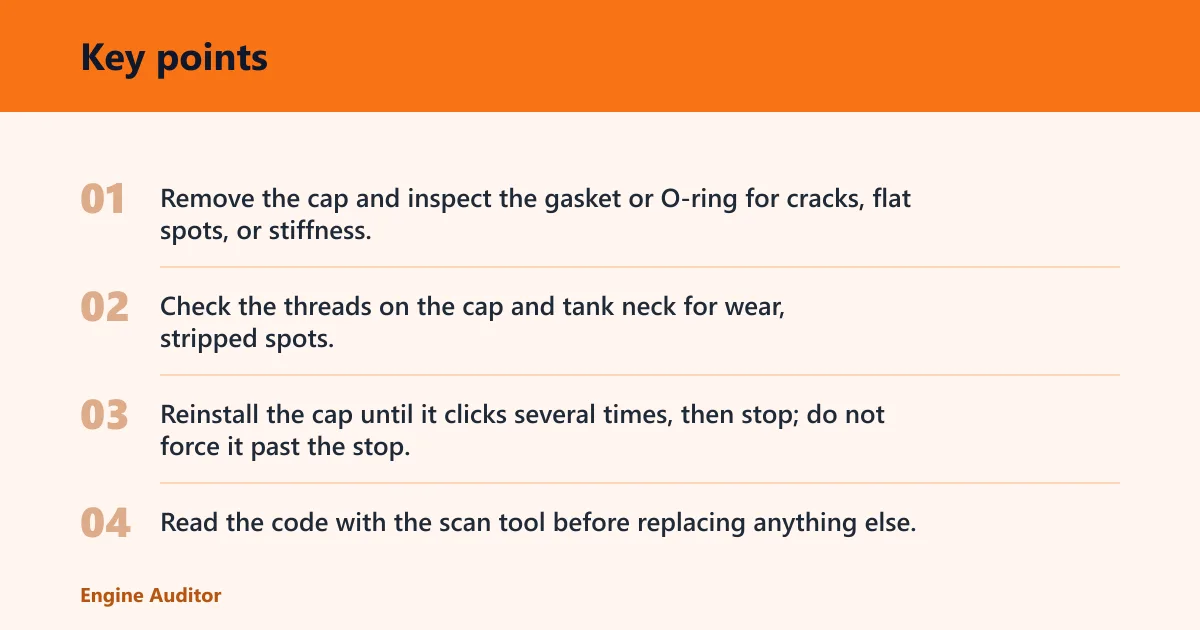
- Remove the cap and inspect the gasket or O-ring for cracks, flat spots, or stiffness.
- Check the threads on the cap and tank neck for wear, stripped spots, or broken ratchet teeth.
- Reinstall the cap until it clicks several times, then stop; do not force it past the stop.
- Read the code with the scan tool before replacing anything else.
Say your cap clicks twice but the light returns after two trips. That often points away from the cap alone and toward a leak that the system can still detect during its self-test, especially if the cap gasket looks flattened or the threads feel rough.
What else can leak at the filler neck?
The filler neck can leak the same way a bad cap does. Corrosion on the sealing surface, debris around the opening, bent threads, or a damaged lip can keep the gasket from sitting flat. If the cap cannot align correctly, the seal fails even when the cap itself is new.
- Clean the neck opening with a flashlight and rag.
- Look for rust, fuel residue, dirt, or a nicked sealing surface.
- Check that the cap seats squarely and does not cross-thread.
- If the neck is pitted or the threads are damaged, plan on repair before another cap replacement.
A common first-timer mistake is buying a second cap when the neck surface is the real problem. That usually leaves the same code in place, because the leak path never changed.
Gas cap warning decision tree
This tree follows the leak path from easiest to hardest fault. Use the stored code, the cap fit, and the neck inspection together instead of guessing from the warning alone.
| Starting symptom | Most likely path | Next action | Common code pattern |
|---|---|---|---|
| Cap was loose or not fully seated | Loose seal at the cap | Tighten until it clicks, then clear the code and drive | P0455 or P0456 |
| Cap is damaged, missing, or the gasket is hard | Cap seal failure | Replace the cap with the correct fit and retest | P0455, P0456, or P0442 |
| New cap was installed and the warning returned | Filler neck or EVAP leak elsewhere | Inspect the neck, then smoke-test the EVAP system | P0442 or P0456 |
| Light stays on after refueling or idle quality changes | Purge valve stuck open | Scan live data and check purge flow | P0441 or P0440 |
| Repeated warning after several cap checks | Small EVAP leak or purge fault | Use a smoke test instead of another cap | P0442, P0456, or P0440 |
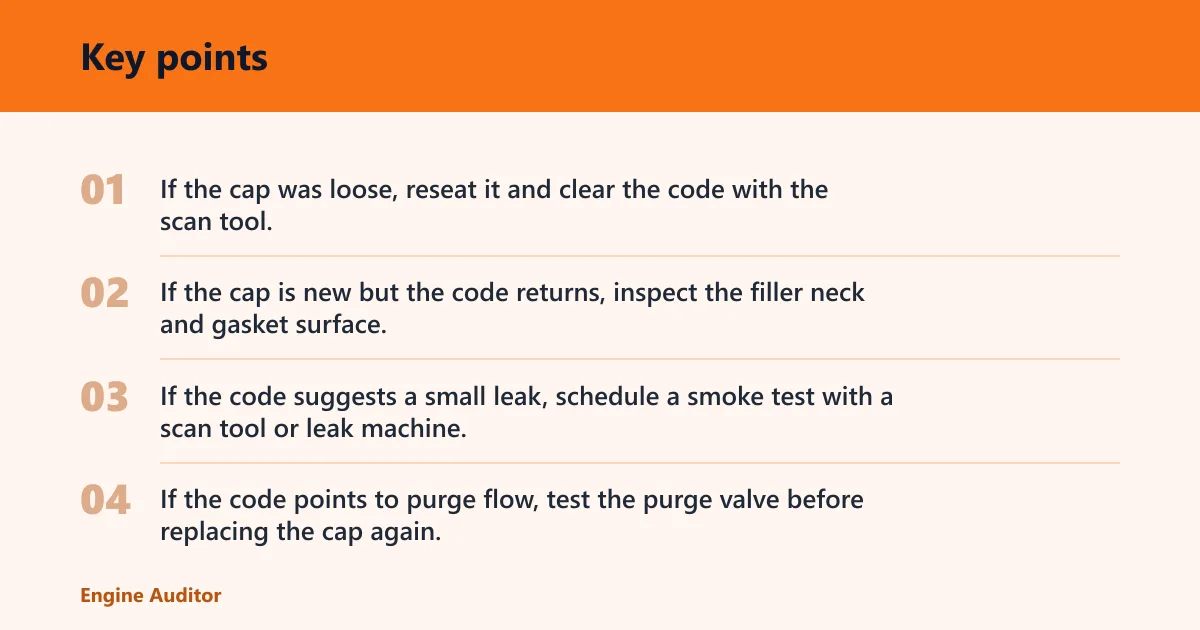
- If the cap was loose, reseat it and clear the code with the scan tool.
- If the cap is new but the code returns, inspect the filler neck and gasket surface.
- If the code suggests a small leak, schedule a smoke test with a scan tool or leak machine.
- If the code points to purge flow, test the purge valve before replacing the cap again.
How long should you drive before the warning clears?
There is no fixed number for every vehicle. Some lights may clear after one or two successful drive cycles, while others stay on until the code is erased with an OBD-II scan tool. If the fault is fixed but the light remains after several trips, scan for P0440, P0441, P0442, P0455, or P0456.
Suppose the cap was loose on a 15-minute commute and you tightened it before the next drive. The light may still stay on for the rest of that day because the EVAP monitor has not rerun its check yet. A stored code can outlast the fix.
Common mistakes
Most repeated warnings come from treating every EVAP light as a bad cap. That skips the scan, the neck inspection, and the purge-valve check.
- Replacing the cap again without reading the code first.
- Ignoring a missing cap and assuming any temporary cover will work.
- Using an aftermarket cap that fits loosely or has the wrong venting design.
- Missing purge-valve clues and ordering another cap when P0441 points elsewhere.
- Skipping a smoke test when the code returns after a new cap.
Prevention: Keep the filler neck clean, and inspect the cap gasket during routine refueling checks. If the cap feels rough when you turn it, replace it before the seal starts leaking.
Frequently asked questions
Why does my gas cap warning keep coming back after I tighten it?
The warning returns when the EVAP system still sees a leak after the cap is seated. That can come from a tired gasket, worn threads, a corroded filler neck, or a purge valve fault. If the light stays on, read the stored code and test the next likely leak path.
How does a gas cap go bad?
A cap goes bad when the gasket cracks, flattens, or hardens, or when the ratcheting mechanism no longer clamps evenly. Thread wear and a poor OEM-to-aftermarket fit can do the same thing. If the cap no longer clicks firmly, replace it with the correct part number.
Will a bad gas cap cause problems?
Yes. A bad cap can trigger the check engine light, store EVAP codes, and may keep the vehicle from passing an emissions inspection. On some vehicles it can also let fuel vapor escape enough to set P0455 or P0456. Read the code before assuming the cap is the only fault.
Why won’t my gas cap open?
Fuel residue, rust, or a damaged latch can keep the cap from turning or releasing. Use a flashlight to check for debris around the neck, then try again with steady pressure rather than force. If the cap is stuck because the threads are damaged, replacement is usually the safer fix.
Why do gas caps fail?
Heat, fuel vapor exposure, and repeated tightening wear out the seal and ratchet over time. Cross-threading and mismatched aftermarket parts can shorten that life further. A cap that no longer seats squarely should be replaced, and the filler neck should be checked for the same damage.
Can a missing gas cap cause problems?
Yes. A missing cap can create an EVAP leak and may bring on the check engine light fairly quickly. It can set large-leak codes such as P0455 and may leave the system unable to hold pressure during its self-test. Fit the correct cap before clearing the code.
What else can trigger a gas cap warning besides the cap itself?
Common causes include filler-neck corrosion, damaged threads, debris on the sealing surface, and a purge valve stuck open. Those faults can mimic a cap leak because they break EVAP pressure or vacuum integrity. If a new cap does not fix it, move to a smoke test.
Products related to this article
Sponsored / affiliate links. As an Amazon Associate I earn from qualifying purchases. I may earn additional commission from eligible campaigns.