Ford Oil Pressure Light on: What It Means and What to Do
A Ford oil pressure light usually means the engine should be stopped if the warning is red or the message says low oil pressure; if it flashes briefly at startup, checking the oil level first is a common first step. Ford owner’s manuals for models such as F-150, Escape, and Explorer consistently treat a red oil-pressure warning as a shutdown-level alert, while amber oil-life reminders are maintenance notices. Ignoring a real oil pressure loss can quickly damage bearings, camshafts, and other engine parts, and may lead to major engine failure. This guide explains what the icon or message means, the first checks to make, when to stop driving, and the Ford-specific false alarms most likely. Reviewed against Ford/Motorcraft service guidance and owner’s manual procedures.
What the warning means


The red oil-can light is the low-oil-pressure warning, not a routine maintenance reminder. In Ford clusters, the meaning can change by model and message, so the owner’s manual and the exact dash text matter. On many Ford trucks and SUVs, the cluster may show a red oil-can icon alone, the icon plus a “low oil pressure” message, or a text-only warning in the information display. If the engine is running and the red warning stays on, the safest assumption is possible pressure loss.
Red light versus maintenance reminder
The red oil pressure light means the engine may not be receiving enough oil pressure. That is a mechanical protection warning. An amber oil-life or oil-change reminder is different; it is tied to service-interval tracking, and it is generally safe to keep driving while service is arranged. Do not treat the red warning like a reset reminder.
Ford owners sometimes see a cluster message instead of a simple icon. That message can be more specific than the light itself. A low-oil-pressure message should be treated as urgent. An oil-life message should not be treated as urgent unless another warning is present. In Ford terminology, “oil pressure low” or “engine oil pressure low” is a stop-and-check condition, while “oil change required” or “oil life 0%” is a maintenance prompt.
Why the owner’s manual matters first
Ford models do not all present the same warning language, and some clusters combine icons with text. The owner’s manual tells you which symbol means pressure loss, which message means service due, and how to check oil level correctly. It also gives the correct response for that model. Ford owner’s manuals also note that warning wording can vary by powertrain and instrument cluster type, especially across F-150, Escape, Explorer, and other model families.
That matters because the same dashboard symbol can point to a true engine problem on one model and a service reminder on another message screen. The manual removes the guesswork. It also tells you whether the engine should be shut down immediately or restarted only after a level check. Ford and Motorcraft service information likewise emphasizes confirming the oil level first, then confirming actual pressure with a gauge if the warning remains.
What should you do right away?
Pull over safely, shut the engine off, and check the owner’s manual before deciding anything else. If the warning is red or the message says low oil pressure, keep the engine off until you know the cause. The first physical check is oil level on level ground, using the Ford procedure for that engine.
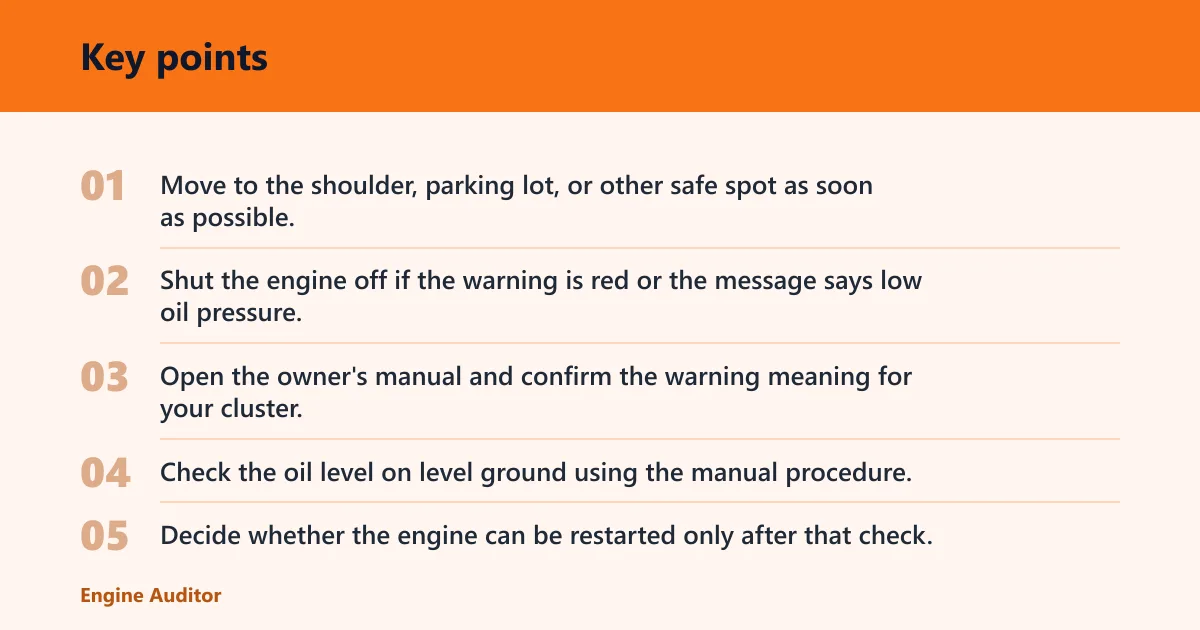
Stop, park, and shut it off
- Move to the shoulder, parking lot, or other safe spot as soon as possible.
- Shut the engine off if the warning is red or the message says low oil pressure.
- Open the owner’s manual and confirm the warning meaning for your cluster.
- Check the oil level on level ground using the manual procedure.
- Decide whether the engine can be restarted only after that check.
Very low oil pressure can wreck an engine within just a few seconds. Running with no oil pressure can ruin the engine in minutes, though exact timing depends on rpm, load, oil temperature, and whether the engine truly has pressure or only a false warning. That is why the red warning is not something to monitor while you continue driving.
Suppose your Ford idles at a stoplight and the red oil-can light comes on with a low-pressure message. That is a shut-down event. If the same cluster briefly flashes an amber oil-life reminder after a scheduled interval, that is a service message, not a pressure-loss warning.
Check the oil level on level ground
Low oil level is the most common cause of a low oil pressure warning. Check the dipstick with the vehicle parked on flat pavement, and follow the owner’s manual procedure for engine temperature and shutoff timing. If the level is below the safe mark, add the correct oil before trying to diagnose anything else. Ford service procedures commonly direct technicians to verify the oil level and inspect for leaks or incorrect service before condemning the pump or sender.
A common first-timer mistake is checking the level on a sloped driveway right after shutdown and treating the result as final. The reading can be misleading. Use the Ford procedure, because some engines require a wait period and others need a warm or cool check at a specific point. Some Ford engines also drain back more slowly after shutdown, so the manual’s wait time matters.
Ford oil warning triage table
| Warning type or message | Immediate action | Likely next diagnostic step | Stop, continue, or tow |
|---|---|---|---|
| Red oil-can icon; “Low Oil Pressure”; “Engine Oil Pressure Low”; red message plus chime | Pull over safely and shut the engine off | Check oil level first; if full, confirm pressure with a gauge | Stop and likely tow |
| Amber oil-life or oil-change reminder; “Oil Change Required”; “Oil Life 0%” | Schedule service; normal driving is usually okay | Verify service interval and reset procedure in the manual | Continue driving, then service soon |
| Low-oil-level message; “Oil Level Low”; “Add Oil” without red pressure warning | Park safely and check the dipstick on level ground | Add oil if low, then recheck for pressure warnings | Usually continue after correcting level; tow if red warning follows |
| Warning after an oil change | Shut off if the red warning stays on; do not keep driving | Check for overfill, wrong filter, loose filter, or sensor issue | Continue only if the warning is clearly a service reminder |
Can you keep driving?
If the warning is red or the message says low oil pressure, the answer is no. A real pressure loss can damage the engine very quickly, so the safer call is to shut down and tow if the warning does not clear after a proper oil-level check. An amber service reminder is the exception.
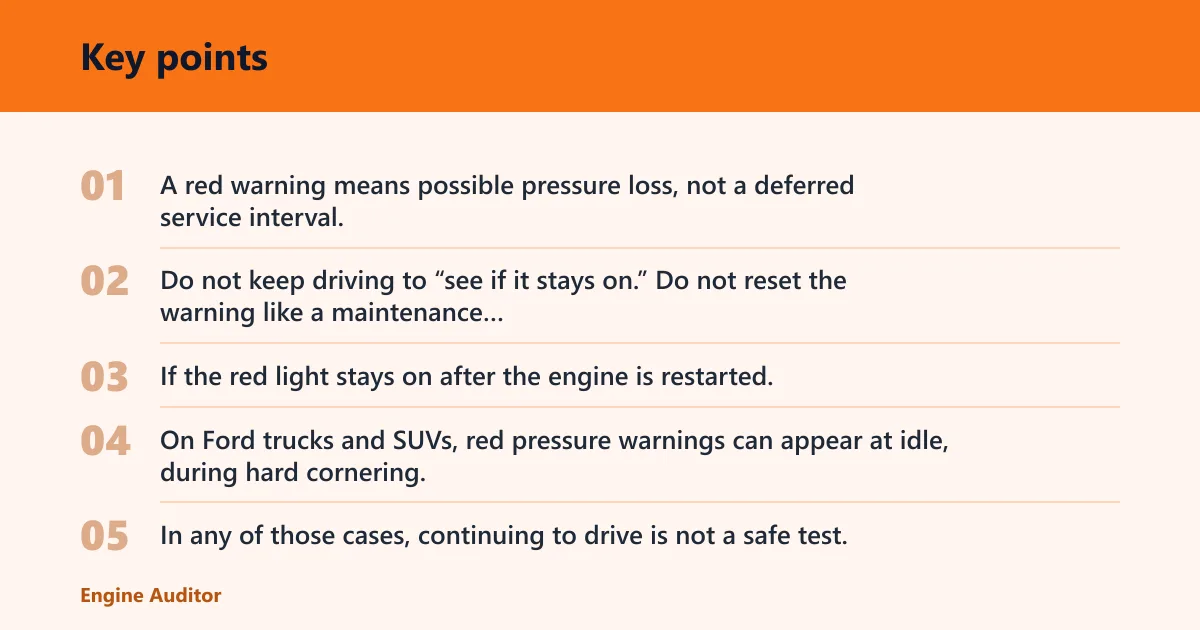
When the answer is no
A red warning means possible pressure loss, not a deferred service interval. Do not keep driving to “see if it stays on.” Do not reset the warning like a maintenance light. If the red light stays on after the engine is restarted, or if the message names low oil pressure, the engine should remain off.
On Ford trucks and SUVs, red pressure warnings can appear at idle, during hard cornering, after a hot restart, or during towing if the engine is actually losing pressure or the sender circuit is lying. In any of those cases, continuing to drive is not a safe test. If the warning is accompanied by ticking, knocking, or a lifter-type rattle, shut the engine down immediately.
When a maintenance reminder is still driveable
An amber oil-life reminder is usually the least urgent case in this group. It tells you that service is due, not that pressure is gone. That message is normally safe to drive with for a short time while you plan an oil change, unless another warning, noise, or leak appears.
When towing is the safer call
If the oil level is correct and the red warning remains, towing is the safer call. That is also the better choice when the engine rattles, taps loudly, or loses power with the light on. A mechanical fault such as a bad pump or clogged pickup tube cannot be solved by driving farther.
Picture a Ford F-150 that shows a red oil light after a highway merge, then starts ticking louder at idle. Even if the truck still moves, that is not a “drive home carefully” situation. It needs shutdown, diagnosis, and likely a tow if the warning does not clear after a proper level check. The same logic applies to Escape and Explorer models that show a red pressure warning after a hot stop-and-go drive.
What causes a false warning on a Ford?
A false warning can come from the oil pressure sensor, the wiring, the connector, or an after-service mistake. Those faults can trigger the lamp even when actual pressure is okay. Ford owners should confirm pressure with a gauge before replacing major parts, because the sensor circuit can lie. Common sender-location issues on Ford engines include oil filters or oil filter housings that sit near the sender, sensors mounted low on the block where heat and splash damage the connector, and wiring routed near exhaust heat or oil leaks.
Bad oil pressure sensor
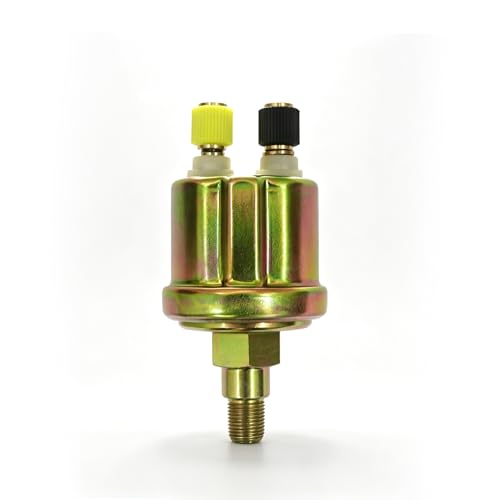
A faulty oil pressure sensor can cause a false warning. That sensor may fail electrically, drift out of range, or send an incorrect signal to the cluster. On many repairs, the sensor is not the first part to replace blindly; it should be tested against actual pressure.
An oil-pressure sensor often costs about $100 to $300 at a shop, but Ford-specific labor can change that if the sender is buried behind intake components, a turbo plumbing run, or a tight filter area. That is much less than major engine work, but it still should not be guessed at. Testing first avoids paying for the wrong part when the real problem is oil level or wiring.
Corroded connector or broken wiring
Faulty oil pressure sensor wiring can also turn the light on. A corroded connector, loose terminal, damaged wire bundle, or broken wire can interrupt the signal and mimic low pressure. Those faults are common enough that the electrical path should be inspected before major parts are replaced.
That inspection should include the connector at the sender, the condition of the wire insulation, and any oil contamination or corrosion at the plug. A poor connection can create intermittent warnings that appear only on bumps, turns, or hot restarts. On some Ford models, the connector may sit close to a hot exhaust manifold or oil-cooler plumbing, which makes heat damage more likely after years of service.
After-oil-change mistakes
After-service problems are common. A wrong filter, a loose filter, an overfilled crankcase, or a missing gasket can all create symptoms that look like pressure trouble. The light after an oil change is not proof of a bad pump; it is a reason to inspect the service work carefully. Ford owners also see false alarms after a filter change when the oil pressure sender was bumped, left unplugged, or contaminated with fresh oil from a spill.
Suppose a Ford shows a red warning five minutes after an oil change. If the filter is the wrong size or not seated correctly, pressure can drop. If the oil was overfilled, aeration can also confuse the system. Those are service errors, not proof that the engine needs a new pump. After-service false alarms are especially worth checking on Escape and Explorer models where the filter and sender areas are tight enough to make installation mistakes more likely.
How mechanics confirm real pressure
The ground-truth diagnostic step is a mechanical oil pressure gauge. That tool measures actual pressure at the engine, which lets a technician separate a bad sensor or wiring fault from a true oiling problem. Scan data alone is not enough when the warning may be false. Ford service guidance and Motorcraft procedures use the same basic logic: verify the oil level, then verify actual pressure.
Mechanical gauge test
A mechanical gauge is connected to the engine where pressure can be measured directly. If the gauge shows normal pressure but the dash warning remains, the sensor circuit is suspect. If the gauge confirms low pressure, the problem is real and deeper diagnosis is needed.
That step matters because an electronic reading can be affected by a bad sensor or wiring fault. The gauge removes that uncertainty. It is the correct way to decide whether the engine needs a sensor, an oil change fix, or more invasive repair. For Ford-specific diagnosis, technicians usually compare the gauge reading to the expected warm-idle and higher-rpm behavior for that engine family rather than relying on the lamp alone.
Scan data versus ground truth
Scan tools can show what the module thinks the sensor is reporting. That is useful, but it is not the same as actual oil pressure. A scan result that looks normal does not rule out a clogged pickup tube, and a bad reading does not prove a mechanical failure by itself.
Mechanics usually move from level check to gauge test before replacing the pump. That sequence saves time and avoids unnecessary labor. It also catches low-pressure problems that would otherwise be hidden behind a bad sender signal.
What repairs usually come next?
The next repair depends on what the pressure test shows. If the oil level was low, the fix may be as simple as correcting the level or servicing the oil change. If the gauge confirms true low pressure, the likely path shifts toward sensor testing, wiring repair, pump work, or pickup-tube service. Cost varies widely by Ford engine family, access, and whether the problem is external or internal.
Oil level correction or oil change
If the level is low, correct that first and then recheck for the warning. If the oil is contaminated, old, or overfilled, an oil change may be the right repair. An improper filter installation should also be corrected before any bigger diagnosis.
That sequence is important because low oil level is the most common cause of a warning. Fix the simplest and most likely issue first. Only after that should you move toward more expensive parts.
Sensor and wiring repair
If pressure is actually normal, the sensor or its wiring is the likely repair path. That can include replacing the sender, repairing a corroded connector, or fixing a broken wire in the bundle. Those repairs are usually far less expensive than internal engine work.
Oil pump or pickup tube service
A faulty oil pump can cause low oil pressure. A clogged oil pickup tube can prevent the pump from sucking oil. Pickup-tube service usually requires oil pan removal, and pump replacement can be expensive because of the labor involved. On many Ford applications, especially where the pan or front cover access is tight, the labor time is often the biggest part of the bill.
An oil pump can cost $500 to $2,200 plus, and the total can be higher or lower depending on model, labor rate, and whether related seals, gaskets, and oil service items are included. If a pickup tube is clogged with sludge or debris, the repair can be just as involved because the pan has to come off. Reputable repair-cost sources commonly show wide variation here because Ford layout, drivetrain, and labor access change the job substantially.
Frequently asked questions
What does the oil pressure light mean on a Ford?
It means the engine may not be getting enough oil pressure, especially if the light is red or the dash says low oil pressure. That warning is urgent. It is separate from the amber oil-life reminder, which is a service message and not the same as a pressure-loss warning.
Can I keep driving if my Ford oil pressure light comes on?
No, not if it is the red pressure warning or a low oil pressure message. Move to a safe place and shut the engine off. A true pressure loss can damage the engine in minutes, so driving farther is riskier than stopping and checking the oil level or arranging a tow.
What should I check first when the oil pressure light is on?
Check the engine oil level first, on flat pavement, using the Ford procedure in the owner’s manual. Low oil level is the most common cause of the warning. If the level is correct and the red warning remains, the next step is pressure confirmation with a mechanical gauge.
Is the Ford oil pressure light the same as the oil change light?
No. The red oil pressure light is a warning about possible pressure loss. The amber oil-life or oil-change light is a maintenance reminder. The maintenance reminder is usually safe to drive with for a short time, but the red pressure warning should not be ignored.
What if the oil pressure light comes on after an oil change?
Stop and inspect the service work. A wrong filter, loose filter, overfill, or missed gasket can create a warning after an oil change. If the light is red and stays on, do not assume it is only a reset issue; confirm actual pressure before driving again.
How do mechanics test real oil pressure on a Ford?
They use a mechanical oil pressure gauge to measure actual pressure at the engine. That is the ground-truth test. It helps separate a bad sensor or wiring fault from a real engine problem, and it keeps parts from being replaced before the cause is confirmed.
How much does it cost to fix an oil pressure problem?
It depends on the cause. A sensor repair is often far less expensive than pump or pickup-tube work, and an oil pump can cost $500 to $2,200 plus. If the fix is only oil level correction, the cost is much lower; if the warning points to internal wear, it can rise fast. Ford model, engine layout, and labor access are the biggest reasons prices vary.
Which Ford models are most likely to show a confusing oil warning?
F-150, Escape, and Explorer owners often report that the cluster wording or icon can be easy to misread because the display may mix a red oil-can symbol, a text alert, and a separate maintenance reminder. That is why Ford documentation for the exact model and year matters. The same basic warning can mean different things depending on whether the cluster is using a simple lamp, a message center, or both.
Can a repaired Ford still show a warning after the fix?
Yes. After-service false alarms can happen if the sender connector is loose, the oil was overfilled, the wrong filter was installed, or the cluster needs the correct reset procedure. If the red warning remains after a repair, the next step is not to assume the engine is fine; it is to verify actual pressure and inspect the service work again.
Products related to this article
Sponsored / affiliate links. As an Amazon Associate I earn from qualifying purchases. I may earn additional commission from eligible campaigns.