Ford Explorer vs Ford Expedition: key differences explained
If you park in tight spaces or tow under 5,000 lb, the Explorer is usually the better fit; if you need eight seats, up to 9,000 lb of towing, or real cargo room with all rows up, choose the Expedition. Pick the wrong one and daily driving gets old fast, from garage fit to loading gear. This guide compares both on parking, cargo, towing, and family use.
This guide is part of our Ford cars guide series.
Ford Explorer vs Ford Expedition: the practical difference
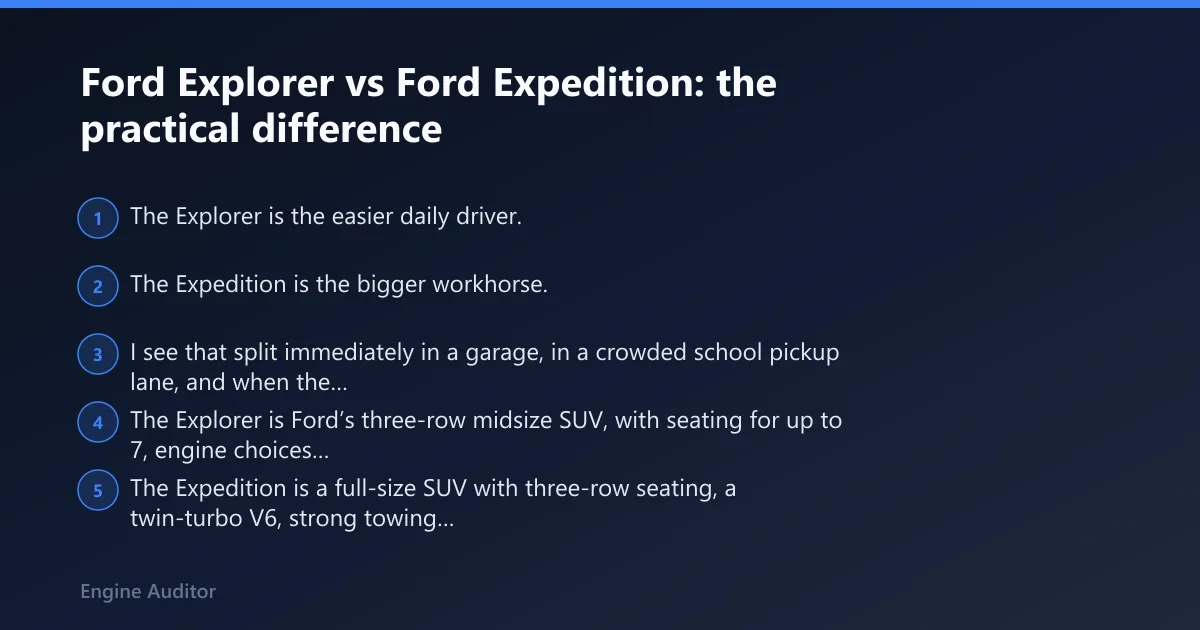


The Explorer is the easier daily driver. The Expedition is the bigger workhorse. I see that split immediately in a garage, in a crowded school pickup lane, and when the third row has to carry people plus luggage instead of acting like a backup bench.
The Explorer is Ford’s three-row midsize SUV, with seating for up to 7, engine choices that include the 2.3L EcoBoost I4, 3.0L EcoBoost V6, and hybrid power, up to 5,600 lbs of towing, up to 87.8 cubic feet of cargo space, and available AWD/4WD. The Expedition is a full-size SUV with three-row seating, a twin-turbo V6, strong towing capability, generous cargo space, and available rear- or four-wheel drive.
| Decision factor | Ford Explorer | Ford Expedition: key differences explained | Winner |
|---|---|---|---|
| Daily size and parking | Midsize footprint; easier to place in tight parking spots and garages | Full-size footprint; more space to manage in city traffic and small garages | Ford Explorer |
| Passenger capacity | Up to 7 passengers | Up to 8 passengers | Ford Expedition |
| Cargo room | Up to 87.8 cubic feet | Up to 104.6 cubic feet | Ford Expedition |
| Towing | Up to 5,600 lbs | Up to 9,600 pounds | Ford Expedition |
| Value for mixed daily use | Lower starting price and smaller footprint | Higher starting price, more capability, more space | Ford Explorer |
Daily size and parking
The Explorer wins for urban life because it is easier to place. It is the better bet for narrow garages, crowded grocery lots, and quick errand runs where every extra foot matters. The Expedition is manageable, but its size becomes part of every drive.
That matters more than people admit before purchase. A big SUV that feels fine on a test drive can turn into a daily nuisance when there is a short driveway, a tight turn into the garage, or a compact curbside space outside school drop-off.
Passenger capacity
The Expedition wins if the third row has to carry people often. With seating for up to 8, it gives families more flexibility when a friend joins the crew or when an adult needs the back seat. The Explorer still works well for up to 7, especially when the third row is occasional rather than constant.
That difference becomes real on school mornings and weekend carpools. If the third row is mostly for kids, the Explorer is usually enough. If the third row needs to be a normal seat, the Expedition makes life easier.
Cargo room
The Expedition wins because 104.6 cubic feet is a different kind of utility than 87.8 cubic feet. The extra volume matters when the SUV is full of people and still needs to swallow suitcases, strollers, sports bags, folding chairs, or a week’s worth of road-trip gear.
The Explorer’s cargo area is good for a midsize SUV, but it asks for more packing discipline once the rear seats are occupied. The Expedition is the one that lets families keep more of the cabin usable without turning the back seat into a cargo bin.
Towing
The Expedition wins by a wide margin. The Explorer’s top towing figure shown is 5,600 lbs, which is enough for many campers, small boats, and utility trailers. The Expedition can tow up to 9,600 pounds, and the dealer comparison also shows 9,300 pounds with the trailer tow package.
That is the line between “we tow sometimes” and “towing is part of the ownership plan.” If the trailer stays under 6,000 lbs, the Explorer usually makes more sense. If towing is regular and the load is heavy, the Expedition’s extra capability pays off quickly.
According to riverbend-ford.com — The Explorer is listed with up to 7 passengers.
What are the towing and power differences?
The Explorer is the easier choice for moderate towing and everyday commuting. The Expedition is built for larger trailers and stronger acceleration under load, with a 3.5L twin-turbo EcoBoost V6 that makes 400 hp in standard form and 440 horsepower in the high-output version. Both SUVs use a 10-speed automatic transmission, but the power and payload intent are very different.
Explorer engines, output, and towing
The Explorer comparison page lists a 2.3L EcoBoost I4 with 300 hp, and the model also offers a 3.0L EcoBoost V6 and hybrid power. That gives buyers a wider spread of choices, from efficiency-minded commuting to stronger passing power. Its top towing figure shown is 5,600 lbs, which fits light-to-moderate trailer duty.
Expedition 3.5L EcoBoost, 400 hp or 440 hp, and towing
The Expedition’s 3.5L twin-turbo EcoBoost V6 is the main reason it feels like a different class of SUV. Ford’s review says the standard engine makes 400 hp, the high-output version is rated at 440 horsepower, and the model can tow up to 9,600 pounds. That combination is aimed at buyers who use the extra size. (caranddriver.com)
Where the 10-speed automatic fits in
Both SUVs use a 10-speed automatic transmission, so the basic comparison is not about transmission count. It is about how the same style of gearbox is matched to two different size and duty targets. The Explorer uses that setup for balanced daily driving; the Expedition uses it to manage more mass and more towing demand.
How do they work for family loading and road trips?
The Expedition is better when a full cabin and full cargo area have to coexist. The Explorer is often the easier compromise when the third row is used less often and the vehicle still needs to fit into normal suburban life. For families, the key question is whether the back row is seating or storage.
Third row with car seats and adults
If car seats stay in the second row, the Explorer can still serve as a practical three-row SUV. When the second row is full of child seats, though, access to the third row gets harder and the usable space behind it shrinks fast. The Expedition handles that scenario with less compromise because it starts from a larger cabin.
Luggage, strollers, sports gear, and coolers
The Explorer works when packing is planned carefully. The Expedition is the one that leaves more room for bulky items without asking the driver to choose between people and gear. For families who travel with strollers, coolers, folded camp chairs, and sports equipment, that extra cargo room is often what saves the trip from feeling cramped.
Long-distance comfort and highway behavior
On a road trip, the Expedition’s size can be a plus because it gives passengers more room to spread out and keeps the load from feeling maxed out. The Explorer is still a strong travel SUV, especially for families that value easier fuel-cost pressure and simpler parking at the destination.
FordPass Connect Wi-Fi hotspot matters more on these trips than on a short commute. That feature helps keep kids busy and devices connected on long highway days, and both models can be equipped for that kind of family use.
Which Ford SUV is bigger: Ford Explorer or Ford Expedition?
The Expedition is bigger in every way that matters to ownership: passenger room, cargo volume, and road presence. The Explorer is the smaller midsize SUV, which is why it is easier to park, easier to place in a garage, and easier to live with in dense traffic. Bigger is useful only when the added space gets used often.
What is the difference between the Ford Explorer and Ford Expedition?
The Explorer is the more manageable three-row Ford for daily life, while the Expedition is the larger, more capable full-size model for buyers who need more room and higher towing limits. The Explorer is usually the better fit for commuting, school runs, and lighter trailer duty. The Expedition is the right answer when space becomes a regular need, not an occasional want.
How many seats does the Explorer have compared with the Expedition?
The Explorer is listed with up to 7 passengers, while the Expedition is listed with up to 8. That extra seat is not the whole story, though. The real difference is how comfortably each SUV carries those passengers when the back row is in use and cargo still needs to come along.
Decision matrix: which SUV fits which buyer?
This is the cleanest way to separate them. The Explorer wins where footprint, cost pressure, and daily convenience matter most. The Expedition wins where the household needs space, towing strength, and full-load usefulness more often than it needs easy parking.
| Buyer scenario | Ford Explorer | Ford Expedition: key differences explained | Best fit |
|---|---|---|---|
| City parking and daily commuting | Smaller and easier to park | Bigger and more demanding in tight spaces | Ford Explorer |
| Under-6,000-lb towing households | Up to 5,600 lbs, enough for many common trailers | More capability than needed for this use | Ford Explorer |
| Big-family or frequent-haul buyers | Works, but cargo gets tight with people aboard | More seats, more cargo, more breathing room | Ford Expedition |
| Maximum luggage or family-haul utility | Good, but not the roomiest choice | Expedition Max adds even more cargo space | Ford Expedition |
City parking and daily commuting
The Explorer is the smarter daily choice for most urban and suburban shoppers. It keeps the three-row format without making every errand feel like a size exercise. The Expedition can do the job, but the driver pays for the extra room every time a space is tight.
Under-6,000-lb towing households
The Explorer is usually enough for this group. Its 5,600-lb maximum towing figure covers a lot of common needs without forcing a buyer into a full-size SUV. That keeps the purchase and daily ownership burden lower while still handling weekend utility.
Big-family or frequent-haul buyers
The Expedition is the clear answer when people and gear both matter every week. It gives more margin for third-row use, more cargo volume with the cabin occupied, and a better fit for households that feel cramped in midsize packaging. That margin is what families notice after the first few road trips.
Expedition Max versus base Expedition
Expedition Max is the version to look at when the base Expedition still feels short on cargo room. It extends the wheelbase and adds more space, which makes sense for maximum luggage or family-haul duty. If the regular Expedition already covers the daily load, the Max is extra bulk that only some buyers need.
What technology and safety differences matter?
The main tech and safety story is less about one SUV having features and more about how the features fit the buyer’s routine. Ford Co-Pilot360 matters for driver-assistance peace of mind, SYNC 4A versus SYNC 3 matters for interface and screen experience, and FordPass Connect Wi-Fi hotspot matters most on family trips.
Ford Co-Pilot360
Both models fit into Ford’s driver-assistance approach, so the comparison is not about one being a safety outsider. The practical question is how much a buyer values those aids in a larger vehicle. In the Expedition, those systems can be especially helpful because the SUV is bigger to place in traffic and parking lots.
SYNC 4A versus SYNC 3
SYNC 4A is the newer-feeling interface in this comparison context, while SYNC 3 is the older point of reference many shoppers still know. If the buyer cares about screen flow, map handling, and easier menu use, the infotainment version can matter more than trim badges. That said, the SUV size decision still matters more than the screen version.
FordPass Connect Wi-Fi hotspot
This feature matters most when the family is in motion. It keeps tablets, phones, and laptop-class devices connected on road trips, which is especially useful in the Expedition because the bigger cabin is more likely to be used for long-haul travel. The Explorer benefits too, but its advantage is not technology alone; it is easier everyday ownership.
Which model is easier to park and daily drive?
The Explorer is easier to park and daily drive. It fits better in standard garages, turns less into a parking chore, and is more forgiving in downtown lots and tight neighborhood streets. The Expedition is still a normal vehicle to own if space is available, but it asks for more attention every time the driver threads it into a small opening.
Is the Expedition worth the extra money over the Explorer?
The Expedition is worth the extra money only if the added space and towing are being used often. The Explorer starts at $34,010 MSRP in the cited dealer comparison, while the Expedition starts at $53,045 MSRP, so the gap is large. For many families, that extra spend is only justified when the vehicle’s size solves a real recurring problem.
What trims or versions make the Expedition different from the Explorer?
The biggest meaningful differences are not trim names alone. They are the model’s size class, the engine family, the towing ceiling, and whether you need the Expedition Max for extra cargo room. The Explorer also stands apart because its powertrain mix includes the 2.3L EcoBoost I4, 3.0L EcoBoost V6, and hybrid options, which changes the purchase conversation before trim choice even starts.
Ford’s showroom page identifies the Explorer and Expedition as separate current models, and Ford’s truck page lists the 2026 Expedition as part of its current lineup. That matters because these are not trim variants of the same SUV. They are different ownership answers.
Choose Ford Explorer if… / choose Ford Expedition if…
Choose Ford Explorer if your priority is easier daily use and lower running-cost pressure. It fits better in a garage, is easier to park, handles family duty well when the third row is occasional, and its 5,600-lb towing limit covers many real-world trailers without forcing a jump to full-size size and price.
Choose Ford Expedition if your priority is passenger space, cargo volume, or serious towing. It makes sense when the third row is used often, when luggage stays with the passengers, when towing pushes well past the Explorer’s limit, or when the family wants the room and can live with the larger footprint.
Frequently asked questions
What is the difference between the Ford Explorer and Ford Expedition?
The Explorer is Ford’s midsize three-row SUV, while the Expedition is the larger full-size model. The practical difference is daily use: the Explorer is easier to park and live with, while the Expedition gives more room, stronger towing, and better cargo flexibility when every seat is filled.
Which is bigger: Ford Explorer or Ford Expedition?
The Expedition is bigger. That extra size shows up in seating, cargo capacity, and road presence. The trade-off is that it is harder to manage in tight garages, narrow parking spots, and crowded city streets, so the extra space only makes sense if it will be used regularly.
How many seats does the Explorer have compared with the Expedition?
The Explorer is listed with up to 7 passengers. The Expedition is listed with up to 8. That extra seat gives the Expedition more flexibility for carpools and bigger families, but the larger benefit is usually the added room around the seats rather than the seat count alone.
What is the towing capacity of the Explorer vs Expedition?
The Explorer’s top towing figure shown is 5,600 lbs. The Expedition can tow up to 9,600 pounds, and the dealer comparison also shows 9,300 pounds with the trailer tow package. If towing is under 6,000 lbs, the Explorer is usually enough; if it is heavier, the Expedition is the better tool.
Which Ford SUV is better for families and road trips?
The Expedition is better for larger families and longer trips with lots of gear because it gives more space for people and cargo at the same time. The Explorer is often the smarter choice for families who still want road-trip ability but need easier parking, lower purchase price, and a smaller footprint at home.
Is the Expedition worth the extra money over the Explorer?
It is worth the extra money only for buyers who will actually use the added room, towing, and passenger capacity. With the Explorer starting at $34,010 MSRP and the Expedition starting at $53,045 MSRP in the cited comparison, the price gap is large enough that daily needs should drive the decision.
Which model is easier to park and daily drive?
The Explorer is easier to park and easier to daily drive. Its smaller midsize size class makes garage fit, school runs, and city errands less stressful. The Expedition can still be a family vehicle for daily use, but it demands more space and more patience in tight places.
Products related to this article
Sponsored / affiliate links. As an Amazon Associate I earn from qualifying purchases. I may earn additional commission from eligible campaigns.