Ford Won’t Accelerate? Ford Throttle Problems Explained
If a Ford won’t accelerate and the wrench or check-engine light is on, start with the throttle body, accelerator pedal sensor, fuses, and wiring; many cases are limp mode, not a failed transmission. Ignoring it can leave you with reduced power, unsafe merging, and a parts bill for the wrong fix. This guide maps Ford throttle problems, shows how they differ from fuel or transmission faults, and lists the first checks to make.
Ford throttle triage table


This table separates the most common no-acceleration patterns on Ford vehicles so you can narrow the fault before replacing parts. Use it as a first pass, then confirm with codes, live data, and basic under-hood checks.
| Symptom | Likely system | Likely next test | Stop-driving risk |
|---|---|---|---|
| Wrench light with reduced throttle response | Electronic throttle body, throttle position sensor, pedal sensor, wiring | Scan codes, inspect throttle connector, check fuses, review live throttle angle and pedal input | Moderate to high. Limp mode may limit speed, but sudden power loss can make merging unsafe |
| Check engine light with hesitation and rough running | Misfire, fuel delivery, air leak, or throttle fault | Read codes, check for misfire counts, inspect spark plugs, fuel pressure, and vacuum leaks | Moderate. If the engine is shaking or flashing the lamp, stop driving |
| Engine revs but vehicle does not move faster | Transmission slip, low fluid, overheating, or internal wear | Check transmission fluid condition and scan for transmission codes | High. A slipping transmission can worsen fast and may leave the vehicle stranded |
| Intermittent failure in cold weather or on first start | Dirty throttle body, TPS fault, connector issue, or moisture in wiring | Watch live throttle data cold, wiggle-test connectors, inspect for corrosion, compare hot and cold behavior | Moderate. If the fault disappears after warm-up, it still needs diagnosis |
| Stall at idle or on takeoff | Throttle body, fuel pump, fuel filter, vacuum leak, or ignition fault | Check codes, inspect idle airflow, fuel pressure, and spark plugs | High if stalling happens in traffic or at intersections |
Why your Ford won’t accelerate
A Ford that will not pick up speed is usually losing either air, fuel, spark, or transmission transfer. On modern models, a throttle fault is one branch, not the whole tree. The Ford wrench light shifts the odds toward throttle control or limp mode, while a check-engine light can point just as easily to fuel, ignition, or sensor trouble.
What the symptom actually points
Acceleration loss with no movement change usually means the engine is not making enough power or the power is not getting to the wheels. If the engine bogs, sputters, or stalls, think fuel, air, spark, or throttle control. If the engine revs freely but the vehicle barely moves, the transmission rises fast on the list.
Why throttle faults are only one branch
A faulty throttle body can cut engine air flow and cause slow acceleration, but so can a clogged fuel filter, a malfunctioning fuel pump, worn spark plugs, transmission issues, and air leaks. A Ford Focus may not accelerate properly if the throttle position sensor fails or gets dirty. That is why the symptom matters as much as the warning light.
How warning lights change the odds
The wrench light on many Fords often means the powertrain has limited throttle authority and entered a reduced-power state. A check-engine light can still accompany throttle trouble, but it more often appears with misfire, air, fuel, or sensor faults. The combination of light, idle quality, and whether the engine revs changes the diagnosis quickly.
Could the throttle body be the problem?
Yes. The electronic throttle body controls air entering the engine, and modern Fords like the F-150, Fusion, and Escape use electronic throttle bodies. When the plate sticks, the actuator or motor fails, or the TPS feedback goes bad, the engine can hesitate, idle roughly, stall, or refuse to respond to pedal input.
How the electronic throttle body works
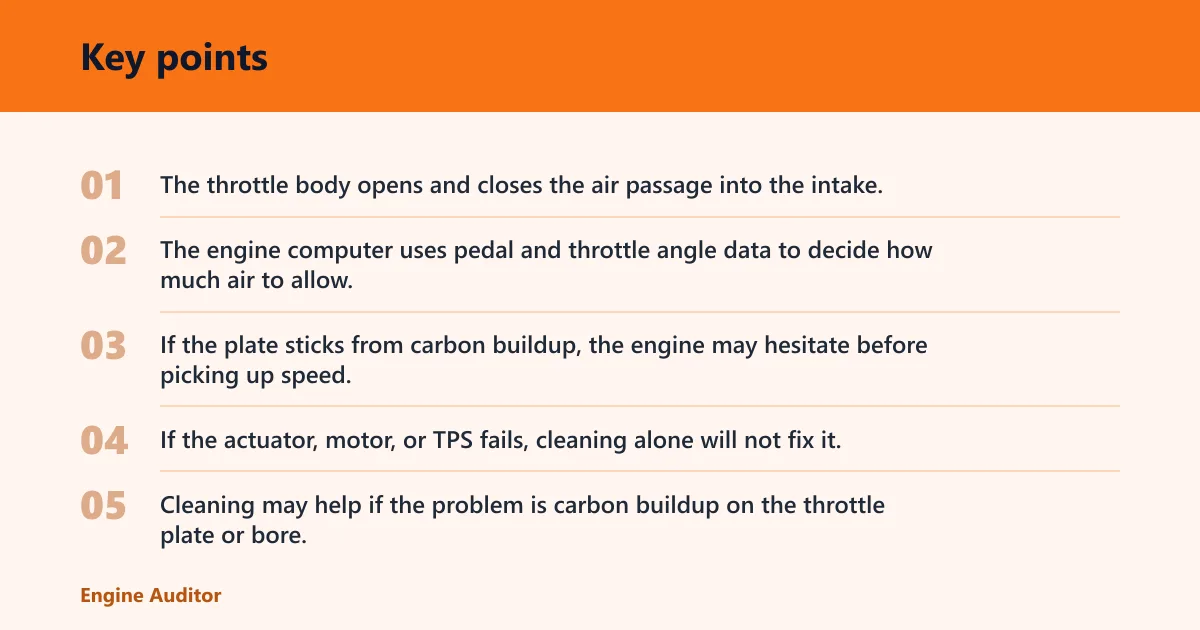
The throttle body opens and closes the air passage into the intake. The engine computer uses pedal and throttle angle data to decide how much air to allow. If the plate sticks from carbon buildup, the engine may hesitate before picking up speed. If the actuator, motor, or TPS fails, cleaning alone will not fix it.
When cleaning can help
Cleaning may help if the problem is carbon buildup on the throttle plate or bore. That is most useful when the symptom is mild hesitation, a rough idle, or a throttle that feels sticky but still responds. Cleaning should be paired with a scan of codes and live data, because dirt is only one possible cause.
When replacement is the better call
If the throttle body has a dead motor, damaged plate, or bad sensor signal, replacement is the better call. A throttle body fault can trigger a Check Engine light and affect cruise control operation. If the Ford has limp mode, inconsistent pedal response, or repeated codes after cleaning, do not keep chasing the same part.
Picture a Fusion that starts fine on a 20-degree morning, then falls into reduced power after two minutes of driving. If the same car behaves normally once warm, the fault may be temperature-sensitive wiring, a dirty throttle body, or a TPS that drops out intermittently. That pattern matters more than one idle flare.
What does a wrench light mean on a Ford with throttle problems?
The wrench light often indicates reduced power or limp mode on Ford models. That means the computer has seen a problem with throttle control, pedal input, or another powertrain input and limited output to protect the engine or drivability. It does not automatically mean the transmission has failed.
Limp mode and reduced power behavior
Limp mode limits speed and power so you can drive slowly to a safe place or facility. Ford uses this strategy when a throttle, sensor, or transmission input looks unsafe or unreliable. The vehicle may still move, but pedal response is weak, top speed is low, and acceleration can feel flat.
Throttle body and TPS faults
Bad throttle body readings, a dirty throttle plate, wiring faults, or a failing TPS can bring on the wrench light. The TPS reports throttle angle to the engine computer, so bad readings can trigger acceleration problems and warning lights. Failures may start intermittently before they turn into a constant no-throttle condition.
When the light points beyond the throttle
A wrench light is not exclusive to the throttle body. Transmission faults can also trigger reduced power, and a pedal sensor problem can look similar from the driver’s seat. If the light comes with engine shaking, misfire codes, or a rev-but-no-move symptom, the next check should move beyond throttle parts.
Other common causes of poor acceleration
If the throttle body is not the only clue, check fuel, ignition, air, and transmission systems in that order of symptom fit. A Ford that hesitates, sputters, or stalls may have a fuel delivery issue. A Ford that revs but does not move faster may be pointing to the transmission, not the engine.
Fuel pump and fuel filter checks
The fuel pump delivers fuel from the tank to the engine. A malfunctioning fuel pump can cause acceleration problems, sputtering, and stalling, and fuel pressure testing is used to confirm the diagnosis. A clogged fuel filter can restrict fuel flow to the engine and cause sluggish acceleration; it is commonly checked alongside the pump.
How do you know if the fuel pump is bad or the throttle body? Start with the symptom shape. A weak pump often shows up as hesitation under load, loss of power at higher demand, or a stall after a period of driving. A throttle issue more often shows obvious pedal delay, reduced throttle response, or wrench light behavior.
Spark plugs, misfire, and ignition faults
Worn spark plugs can cause misfiring and poor acceleration. Misfire can feel like a dead spot on takeoff, especially under load or on a hill. If the engine shakes, surges, or flashes the check-engine light, ignition work belongs in the diagnosis before any throttle replacement.
MAF sensor and vacuum leaks
The MAF sensor measures incoming air, so airflow faults can affect acceleration. Inspect it with the air filter and look for vacuum leaks around hoses and intake components. A vacuum leak can reduce air supply and cause poor acceleration, and it may appear alongside throttle-body symptoms rather than instead of them.
Transmission slip or overheating
Transmission issues can contribute to acceleration problems. Low fluid or overheating can reduce driveability, and a slipping transmission can mimic engine power loss. If the engine speed rises but the vehicle does not move faster, the transmission moves near the top of the list right away.
What to check first with an OBD-II scanner
An OBD-II scanner should come before parts replacement. It reads trouble codes and helps narrow fuel, ignition, sensor, or transmission faults. The most useful scan is not just the code number; it also includes freeze-frame data, live throttle angle, pedal input, and whether the fault is current or pending.
Codes that matter most
- Read all stored and pending codes, not just the first one shown.
- Save freeze-frame data, especially engine speed, throttle angle, vehicle speed, and load.
- Look for patterns: throttle or pedal codes, misfire codes, fuel trim clues, or transmission codes.
- Clear nothing until you have written down the data.
- Recheck after a short drive if the problem is intermittent.
Live data to note before parts are replaced
Capture commanded throttle angle, actual throttle angle, pedal position, engine load, and misfire counters if the scanner supports them. If actual throttle angle lags command, the throttle body or TPS becomes more likely. If throttle data looks normal but fuel trims are extreme or misfires appear, move toward fuel or ignition diagnosis.
What code patterns suggest throttle, fuel, or transmission trouble
Throttle-related codes often line up with the wrench light, limp mode, or unstable pedal response. Fuel-related clues include hesitation, sputtering, and codes that fit lean running or pressure loss. Transmission codes become more likely when the engine revs freely but the car fails to gain speed.
A common first-timer mistake is replacing a throttle body after seeing a wrench light, then finding the same symptom again because the real problem was a corroded connector. Another common one is assuming a fuel pump is bad because the engine hesitates, when the scan data points to a throttle signal that drops out only when cold.
Can you drive it or should you stop?
Drive only if the Ford is in limp mode, the power loss seems mild, and the vehicle still responds predictably. Limp mode lets you drive slowly to a safe place or facility. If the engine stalls, surges, loses power at speed, or the transmission slips badly, towing is the safer choice.
Limp mode with limited speed
Limited speed does not mean no risk. Reduced power can make merges, left turns, and highway traffic harder than they look. If the wrench light is on and the vehicle still reaches a repair shop without worsening symptoms, that is usually better than pushing it harder on the road.
Stalling, surging, or loss of power at speed
Stop driving if the Ford stalls at idle in traffic, cuts power while moving, or surges unpredictably. Those symptoms can point to throttle control, fuel delivery, or transmission faults that may get worse without warning. The safest move is to avoid a road test that adds risk.
When towing is the safer choice
Tow it if the engine will not respond consistently, the transmission slips, or the warning light is paired with repeated stalls. A low-cost scan and a throttle-body cleaning may fix a dirty unit, but replacement and professional diagnosis cost more when the fault is electrical or when the wrong part has already been changed.
Frequently asked questions
Why is my Ford not accelerating when I press the gas?
The most common causes are a throttle control fault, fuel delivery problem, misfire, air leak, or transmission slip. If the wrench light is on, start with the throttle body, TPS, pedal sensor, fuses, and wiring. If the engine revs but the vehicle does not move faster, move the transmission up the list immediately.
Can a dirty throttle body cause my Ford to lose power?
Yes. A dirty throttle body can cause hesitation, rough idle, and stalling, and when the throttle plate is dirty or sticking, the engine may hesitate before picking up speed. Cleaning may help if carbon buildup is the issue. It will not fix a failed sensor, damaged plate, or bad motor.
How do I know if my Ford fuel pump is bad or if it’s the throttle body?
Look at the symptom pattern and test data. A weak fuel pump often causes sputtering, stalling, and poor acceleration under load, and fuel pressure testing helps confirm it. A throttle-body problem more often brings reduced throttle response, limp mode, or a wrench light with odd pedal behavior.
Why does my Ford rev but not accelerate?
That pattern points strongly to the transmission. Slipping or worn internal parts can mimic engine power loss, and low fluid or overheating can make it worse. If the engine speed rises but road speed does not, do not focus only on the throttle body. Check transmission fluid condition and scan for transmission codes.
What should I check first if my Ford goes into limp mode?
Scan the codes first, then inspect the throttle body, accelerator pedal sensor, fuses, and wiring. Limp mode can come from throttle, sensor, or transmission faults, and it may still allow low-speed travel to a repair location. If the vehicle stalls, surges, or feels unstable, towing is the better choice.
Can a throttle position sensor cause a Ford to stall?
Yes. The TPS reports throttle angle to the engine computer, and bad readings can trigger acceleration problems, warning lights, and intermittent failure before complete failure. Dirt or wiring faults can interfere with the signal. If the stall happens at idle or just off idle, the TPS belongs in the diagnosis.
Should I clean or replace a Ford throttle body?
Clean it first only if the symptoms point to carbon buildup, sticky plate movement, or mild hesitation. Replace it when the actuator, motor, or TPS fails, or when cleaning does not change the codes and drivability. A scanner helps separate a dirty unit from an electrical fault before you spend on parts.
Products related to this article
Sponsored / affiliate links. As an Amazon Associate I earn from qualifying purchases. I may earn additional commission from eligible campaigns.