Ford maintenance cost by model: what owners should expect
Most Ford owners should budget $50-$125 a month for routine upkeep, then add more for trucks, turbo engines, towing, or anything over 75,000 miles. Skip that reserve and the result is surprise bills, deferred service, and a higher repair risk once warranty coverage is gone. This guide breaks down Ford maintenance cost by model, mileage, and duty so you can set a realistic monthly budget.
This guide is part of our Ford car maintenance guide series.
How much does Ford maintenance cost overall?



Ford vehicles average $1,059 per year to maintain and repair, according to RepairPal, while the industry average yearly maintenance and repair cost is $891 in the ConsumerAffairs comparison. That puts Ford above average overall, though the real bill still depends on model, age, mileage, and driving duty.
That average hides a lot. A commuter sedan on gentle highway miles can land near the low end, while a truck that tows, idles, and runs big tires can move far above the average. Once the factory warranty ends, the repair side of the budget matters more and the annual total can rise quickly.
Why model, mileage, and duty cycle change the number
Two owners can drive the same Ford and spend very different amounts. Short trips are hard on oil, batteries, and exhaust systems. City use adds brakes and tires. Towing, payload, and rough roads raise wear faster than highway miles.
Maintenance also changes with age. A newer vehicle may need mostly scheduled service, while an older one can need tires, pads, rotors, a battery, and a repair in the same year. That is why a single average number is useful, but not enough for budgeting.
Which Ford model is cheapest to maintain?

The Ford Fusion is usually the cheapest of the common nameplates listed here, because smaller sedans tend to need less tire, brake, and suspension spending than trucks and larger SUVs. The Ford Escape is often a middle-ground budget pick, while the Mustang usually costs more because performance parts and tire wear raise the bill.
If the goal is low-cost ownership, the cheapest model is usually the one with the lightest use case, the simplest tire and brake package, and the least hard driving. A sedan driven mostly on highways nearly always costs less than a truck used for towing or a sporty car driven aggressively.
Ford maintenance cost by model and body style
The model matters, but body style matters too. A smaller sedan generally needs less rubber, lighter brakes, and fewer expensive wear items than a full-size truck or large SUV. Here is the practical budget logic owners can use.
| Ford model or segment | Example annual maintenance view | Budget note |
|---|---|---|
| Ford Fusion | Lower than most Ford crossovers and trucks | Good benchmark for a sedan budget |
| Ford Escape | $600 per year for maintenance and repair | Common family-SUV budget point |
| Ford F-150 | $788 per year for maintenance and repair | Usually rises with towing and tire size |
| Ford Expedition | Higher-cost large SUV profile in older-model data | Big tires and brakes push the total up |
| Ford Mustang | Performance premium, varies by model year | Tires and brakes can move the budget fast |
Model-by-model cost examples
Ford Fusion: This is the cleanest sedan benchmark. It usually sits lower because its service parts and wear items are simpler than those on trucks or large SUVs. For a family car that mostly commutes, the Fusion is often easier to reserve for month by month.
Ford Escape: ConsumerAffairs lists the Escape at $600 per year for maintenance and repair. That number fits a compact SUV budget: still reasonable, but with a bit more tire, brake, and suspension cost than a comparable sedan.
Ford F-150: ConsumerAffairs lists the F-150 at $788 per year for maintenance and repair. The catch is use. A lightly used truck is one thing; a truck that tows, hauls, or idles in traffic will usually spend more on tires, brakes, and fluids.
Ford Expedition: Older-model data puts the Expedition toward the top of the Ford bill because it is large, heavy, and usually fitted with expensive tires and brakes. Big SUVs do not fail for one reason. They simply cost more to keep fresh.
Ford Mustang: The Mustang often carries a performance premium. Model year matters here, because powertrain choice, wheel size, and tire compound can change the annual bill a lot. A calm highway driver and an enthusiast can end up in different budget bands.

Why an F-150 usually costs more than an Escape
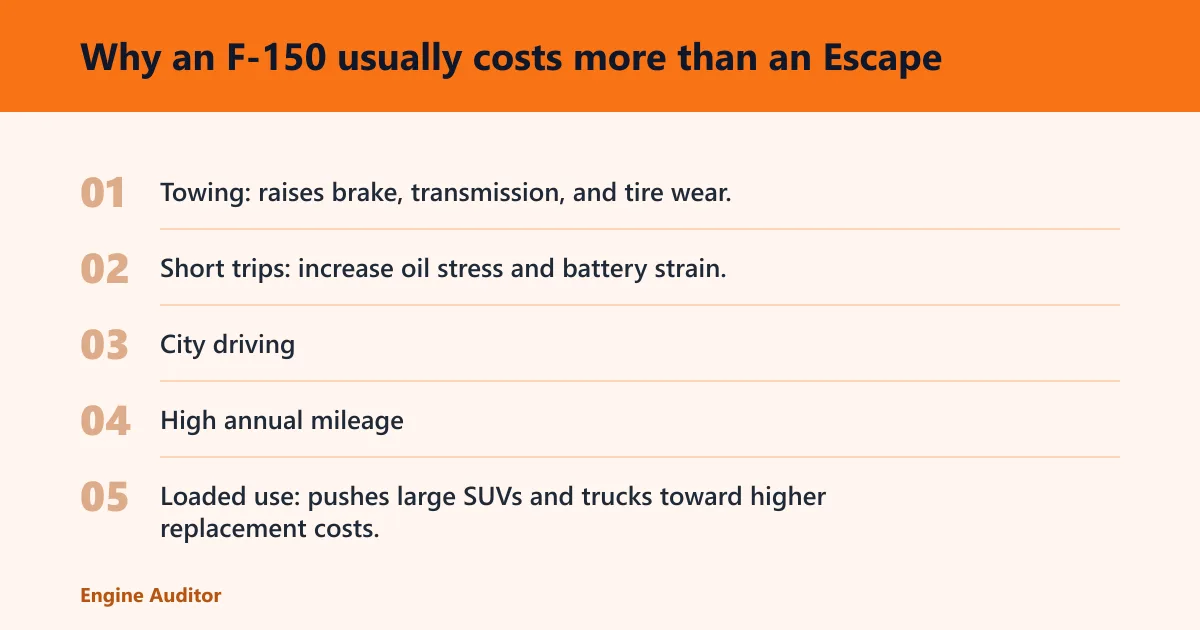
An F-150 usually costs more than an Escape because it works harder and wears larger, pricier parts. The truck has more mass, often bigger tires, and more brake demand when loaded or towing. Even when routine service looks similar, wear-item replacement usually is not.
Heavy-duty use changes the math fast. Towing adds heat and stress. Payload adds brake wear. Stop-and-go city use makes both brakes and fuel-related service show up sooner. A truck used as a truck should not be budgeted like a commuter crossover.
How ownership habits change the bill
- Towing: raises brake, transmission, and tire wear.
- Short trips: increase oil stress and battery strain.
- City driving: eats brake pads and front tires faster.
- High annual mileage: pulls service items forward on the calendar.
- Loaded use: pushes large SUVs and trucks toward higher replacement costs.
What routine Ford maintenance costs actually include
Routine Ford maintenance is more than one oil change. It usually includes scheduled oil service, tire rotations, fluid inspections, filter replacement, and condition checks tied to the maintenance minder or the owner’s manual. That is the predictable part of the budget.
Wear items are separate. Tires, brake pads, rotors, batteries, and filters do not fail on a neat schedule, but they do show up with mileage and age. That is where many owners underestimate the year.
Oil changes and interval basics
EngineAuditor states many Ford gasoline engines need oil service every few thousand to about ten thousand miles. ConsumerAffairs says minor maintenance is recommended every six months or 5,000 miles for some Ford vehicles. A 12,000-mile driver may need one to two oil changes per year.
Driving style changes the interval. Short trips, towing, hot weather, and lots of idle time usually mean more frequent service. Highway drivers often stretch toward the longer end, but they still need to follow the engine and use pattern, not guess.
Tire rotations, fluid inspections, and filters
Tire rotations help even out wear, especially on front-heavy vehicles and SUVs. Fluid inspections catch leaks and low levels before they turn into larger problems. Filters matter too, because clogged cabin, engine, or fuel filters can add cost and reduce performance.
These items are easy to postpone. That is a mistake. Skipping them may save a small amount this month, then force a larger repair later when the tire set wears unevenly or a fluid issue goes unnoticed.
Proof asset: model-type budget matrix and stacked-cost year
Here is the budgeting framework most owners need. The low, typical, and high ranges below separate routine service from wear-item replacement and repair risk, which is how the annual reserve should be built.
| Segment | Low annual budget | Typical annual budget | High annual budget |
|---|---|---|---|
| Sedan | $500 | $700 | $1,000 |
| Compact SUV | $600 | $850 | $1,200 |
| Midsize SUV | $700 | $1,000 | $1,500 |
| Full-size truck | $800 | $1,200 | $1,800 |
| Performance model | $900 | $1,300 | $2,000 |
| EV | $450 | $700 | $1,400 |
EngineAuditor says most Ford owners should budget $500-$1,200 a year for maintenance, and Ford maintenance can jump to a $2,000-plus year after wear items and post-warranty repairs. That is the clean way to think about it: one band for normal ownership, another for the year when several items land together.
One-year stacked-cost example
A normal year can become expensive fast when several routine and wear items line up. This example uses common budget items that many owners face in one twelve-month span.
| Item | Example cost |
|---|---|
| Oil service | $90 |
| Tire rotation | $30 |
| Brake wear service | $350 |
| Tires | $800 |
| Battery replacement | $200 |
| Total | $1,470 |
That total is why a “cheap year” is often a myth. Nothing above is unusual by itself. Put them together and the annual spend jumps well beyond the routine-service headline.
Do Ford maintenance costs go up after the warranty ends?
Yes. Ford’s factory warranty is 3 years or 36,000 miles bumper-to-bumper, and Ford powertrain coverage lasts 5 years or 60,000 miles. After that, the owner takes on more repair exposure, and the annual budget can pass $2,000 when wear items and actual repairs hit the same year.
Warranty coverage helps with defects and covered breakdowns, but it does not erase maintenance. Oil changes, tires, brakes, alignments, and batteries are still the owner’s job. A prepaid maintenance plan can make sense if it matches the planned mileage and the vehicle will be kept through the covered period.
When prepaid maintenance plans make sense
A prepaid plan makes sense when the owner keeps the vehicle long enough to use the included service and the price is lower than paying retail one visit at a time. It is less useful if the vehicle will be sold early, driven far more than average, or used in a way that burns through wear items quickly.
How much should I budget for Ford maintenance each year?
A practical Ford budget is often a few hundred to around a thousand dollars a year for many owners, which works out to roughly a few dozen to around a hundred dollars a month. Lightly used sedans can stay near the low end, while trucks, larger SUVs, turbo engines, and higher-mileage vehicles belong near the upper end or beyond it.
For owners who tow, drive mostly in town, or cross 75,000 miles, the reserve should be higher. The clean rule is simple: budget for scheduled service first, then add a second reserve for tires, brakes, batteries, and the kind of repair that shows up after warranty ends.
Are Ford EVs cheaper to maintain than gas models?
Usually, yes on routine service, because EVs do not need engine oil changes and have fewer regular fluid changes than gasoline models. But lower routine service does not mean a low total every year. Tires, brakes, suspension wear, and battery-related repairs still matter.
An EV can look cheap until a tire set or a high-voltage repair lands in the same year. That is why EV budgeting still needs a monthly reserve, even when scheduled service is lighter than on gas models.
Frequently asked questions
How much does Ford maintenance cost by model?
Ford maintenance cost by model varies widely. ConsumerAffairs lists the Escape at $600 per year and the F-150 at $788 per year, while Ford averages $1,059 per year according to RepairPal. Smaller sedans often budget lower, while large SUVs and performance models usually sit higher because of tire, brake, and repair exposure.
Which Ford model is cheapest to maintain?
The Ford Fusion is usually the cheapest among the models discussed here. Sedans tend to cost less because they use smaller tires, lighter brakes, and less expensive wear items than trucks or big SUVs. The final bill still depends on mileage, age, and how hard the car is driven.
Is an F-150 more expensive to maintain than an Escape?
Usually yes, especially when the truck is used for towing, hauling, or heavy city driving. ConsumerAffairs lists the F-150 at $788 per year and the Escape at $600 per year, but the real gap can widen once larger tires, brake wear, and heavier-duty use are added.
How much should I budget for Ford maintenance each year?
Most Ford owners should budget $500-$1,200 a year, or about $50-$125 a month. That range covers routine service and a normal amount of wear-item replacement. Owners of trucks, performance cars, and higher-mileage vehicles should plan for more, especially after the warranty ends.
Do Ford maintenance costs go up after the warranty ends?
Yes. Ford’s bumper-to-bumper warranty ends at 3 years or 36,000 miles, and powertrain coverage lasts 5 years or 60,000 miles. Once coverage ends, the owner absorbs more repair risk, and the annual total can pass $2,000 if tires, brakes, batteries, and repairs line up.
What routine services drive Ford ownership costs the most?
Oil changes, tire rotations, fluid inspections, and filter replacement make up the predictable service side. The bigger cost jumps usually come from wear items: tires, brake pads, rotors, and batteries. Those items do not hit every year, but when they do, the budget can move fast.
Products related to this article
Sponsored / affiliate links. As an Amazon Associate I earn from qualifying purchases. I may earn additional commission from eligible campaigns.