Truck Types Explained: Pickup, Chassis Cab, and Heavy-duty
Pickup trucks suit daily driving and light towing, chassis cabs suit upfits and body builders, and heavy-duty trucks suit higher towing and payload needs that go past half-ton limits. Pick the wrong truck and you can end up with poor towing control, payload overload, or a body that costs more to fit than the truck is worth. This guide explains what each truck type is built for and how to match it to towing, payload, and upfit jobs.
Truck classes by gvwr
Truck classes are grouped by GVWR, and that number sets the truck’s maximum rated weight. It also affects how the vehicle is classified for licensing, taxes, and what kind of work it can legally handle. A truck’s badge tells you less than its rating sticker. FMCSA class definitions use GVWR bands, and the buyer should always start with the certified label on the vehicle.
What GVWR means on a truck
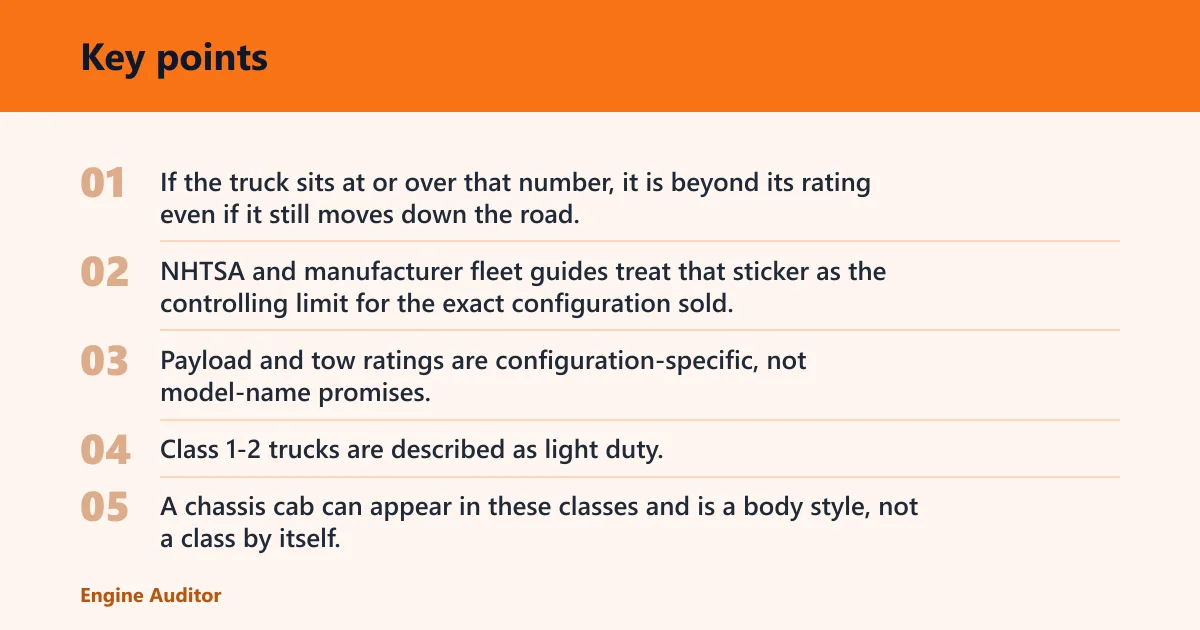
GVWR is the truck’s max rated weight. That includes the vehicle itself, passengers, fuel, cargo, and any body or trailer tongue weight that counts against the axle load. If the truck sits at or over that number, it is beyond its rating even if it still moves down the road. NHTSA and manufacturer fleet guides treat that sticker as the controlling limit for the exact configuration sold.
That is why buyer decisions start with the sticker, not the trim name. Two trucks with the same model badge can carry and tow very different amounts once cab style, drivetrain, bed length, axle ratio, and options change curb weight and available capacity. Payload and tow ratings are configuration-specific, not model-name promises.
How GVWR groups light, medium, and heavy duty
Class 1-2 trucks are described as light duty. Those are the compact and mid-size trucks most readers think of as daily drivers with work-friendly cargo beds. Class 3-5 trucks are usually treated as medium-duty commercial platforms, and they are work-focused chassis for service bodies, tow rigs, and small box trucks. A chassis cab can appear in these classes and is a body style, not a class by itself.
Class 6-8 trucks are heavy duty. That group includes big vocational rigs and highway tractors, so it sits in a different class from the pickup and chassis cab buyers most often compare. The split matters because the truck types are built around different jobs, not just different sizes.
Why GVWR changes the buying decision
GVWR helps separate a truck that can carry people and light cargo from one that is intended for sustained work loads. It also changes how easy the truck is to register, insure, and license in some uses. If the job calls for a body build or repeated heavy loading, the rating should lead the search. Manufacturer upfit and body-builder guidance also ties frame, axle, and body weights back to the final GVWR.
A common first-timer mistake is assuming a half-ton pickup can handle the same payload as a chassis cab just because the horsepower numbers look impressive. A strong engine does not fix a truck that is short on payload, axle rating, brake capacity, or frame strength for the job.
What each truck is built to do?

Pickup trucks are commonly used for daily driving and light towing, chassis cabs for upfits, and heavy-duty trucks for sustained commercial work. The right choice depends on whether the truck needs to stay flexible for family driving, accept a custom body, or carry a tougher load cycle day after day.
Pickup trucks for daily driving and utility
Pickup trucks are the light-duty option most buyers know best. They usually offer several cab and bed combinations, which makes them useful for commuting, hauling tools, and towing moderate trailers. Their strength is flexibility, not maximum body capacity. For most buyers, a pickup is the right answer when the truck still has to feel like a daily driver.
That flexibility comes with tradeoffs. A pickup with a high trim level, 4×4, and extra options can lose payload quickly compared with a simpler configuration. A buyer who plans to carry tools, passengers, and hitch weight on the same truck should check the door-sticker payload, not the brochure headline. Tow ratings also depend on axle ratio, cooling, hitch equipment, and the exact configuration on the label.
Chassis cabs for upfits and service bodies
Chassis cabs are sold for builders, not for bed shopping. The frame extends behind the cab so the truck can accept a service body, flatbed, tow rig, or other custom body. That is why class 3-5 trucks are often the work-focused middle ground between pickups and full heavy-duty rigs.
They make sense when the body matters more than the factory bed. If the truck needs enclosed tool storage, a crane body, a dump bed, or a specialized towing package, a chassis cab often fits the job better than a pickup with an aftermarket conversion. When comparing pickup versus chassis cab, the choice is usually about the final body, not the cab alone.
Heavy-duty trucks for commercial loads and duty cycles
Heavy-duty trucks are for higher loads, more demanding duty cycles, and commercial use cases that push beyond half-ton limits. In class 6-8 form, they are built for vocational work and highway freight. The chassis, brakes, axles, and frame are sized for that kind of abuse.
That does not mean every heavy-duty trim is the right answer for every buyer. Some versions are still personal-use friendly, but the core purpose is work under sustained load. If the truck will pull often, carry near its limit, or run a body that adds weight, the heavier platform can be the cleaner fit.
Truck comparison table
| Truck type | GVWR range | Typical cab and bed setups | Common body uses | Towing focus | Payload tradeoffs | Best use case |
|---|---|---|---|---|---|---|
| Pickup | Class 1-2 | Regular, extended, or crew cab; short, standard, or long bed | Open cargo bed, light tool hauling, family and weekend use | Moderate towing with configuration limits | Higher trims, larger cabs, and 4×4 reduce available payload | Daily driving |
| Chassis cab | Class 3-5 | Cab plus frame behind it; no factory pickup bed | Service bodies, flatbeds, tow rigs, small box trucks | Towing plus body weight management | Body choice and equipment weight can consume capacity fast | Fleet upfitting |
| Heavy-duty truck | Class 6-8 | Vocational cabs; chassis built for commercial bodies | Big vocational rigs, highway tractors, commercial haul bodies | High-capacity towing and commercial haul duty | Built for load, but often overkill for casual use | Commercial hauling |
The table shows the real split: pickups are the flexible daily option, chassis cabs are the upfit platform, and heavy-duty trucks are the commercial workhorses. If the intended body is not a factory pickup bed, the search often belongs in the chassis cab column instead of the pickup column. The deciding threshold is usually whether the final build needs a custom body or can stay with a factory bed.
How payload and towing differ
Payload is the weight you can add after curb weight and occupants. Towing capacity is how much the truck can pull under a specific configuration. They are related, but they are not the same number, and one does not guarantee the other. Payload is usually the first limit to check when the truck carries people, tools, or trailer tongue weight.
Why payload changes with trim and cab choice
Payload can drop as trim level rises because additional equipment adds curb weight. Crew cabs usually weigh more than regular cabs. 4×4 hardware also adds mass. Those changes eat into the amount left for people, tools, hitch weight, and cargo. Manufacturer fleet guides and payload labels reflect that reality, which is why the same model can have very different ratings.
Suppose a buyer chooses a crew cab with heavy leather seats, a sunroof, running boards, and 4×4 because it looks right for family duty. The truck may still tow well on paper, but payload can shrink enough that passengers, a toolbox, and trailer tongue weight push it too close to the limit.
Why towing depends on axle ratio, cooling, engine, and hitch
Tow rating depends on axle ratio, engine, cooling, hitch class, and configuration. It is not fixed by model name alone. Wheelbase matters too, because a longer wheelbase usually helps stability with a trailer, while a shorter truck is often easier to place in tight lots and job sites. OEM tow guides typically tie the rating to the exact drivetrain and equipment package.
That is why two trucks with the same badge can have different tow ratings. Axle ratio changes how hard the drivetrain works. Cooling keeps the powertrain from running out of thermal headroom. The hitch class, frame, and wheelbase all influence what the truck can manage safely and predictably.
Wheelbase, stability, and maneuverability tradeoffs
Longer wheelbase helps towing stability. The trailer has less leverage to nudge the truck around, especially at highway speed. The downside is reduced maneuverability in tight spaces, which matters on city streets, in work yards, and around parking garages.
Shorter wheelbase trucks turn and park more easily. That can matter more than outright tow numbers if the truck spends its day weaving through job sites or backing into crowded loading areas. The right answer depends on whether the job rewards stability or agility.
- Start with the heaviest load. Add up passengers, tools, cargo, tongue weight, and any body equipment you expect to carry at the same time. That total should fit under the truck’s payload after curb weight and occupants are accounted for.
- Check the rating sticker. Compare the truck’s GVWR and payload label against the planned use, not the marketing sheet. If the margin is thin before accessories are added, the configuration is wrong for the job.
- Match the body to the work. Choose a pickup bed for general utility, a chassis cab for a service body or flatbed, or a heavy-duty truck for commercial hauling. The body should solve the job, not create a second project.
- Confirm towing hardware. Verify axle ratio, engine, cooling package, and hitch class before trusting any tow figure. A tow rating only applies to the exact configuration on the truck, not the model name alone.
What cab and bed setup works best?
The best cab and bed setup is the one that leaves enough room for people, cargo, and the body you plan to use without overloading the truck. For work use, the decision is usually between passenger space, bed length, and how often the truck must tow or maneuver in tight places. The most practical setup is the one that fits the final use without wasting capacity.
Regular, extended, and crew cab tradeoffs
A regular cab plus long bed is presented as a workhorse setup. It gives the most straightforward cargo arrangement and can help preserve payload because there is less cab mass. That makes sense for a truck that carries gear more often than people.
Extended and crew cabs add passenger room. They also add weight and length. That can be the right choice for crews, but it is a poor fit if the truck already runs close to payload limits or needs the shortest possible wheelbase for job-site maneuvering.
Pickup beds versus chassis cab bodies
Pickup beds are fixed factory cargo boxes with familiar tie-down and access patterns. They are convenient, easy to live with, and good for mixed-duty use. Chassis cab bodies are more specialized, so they fit the work instead of forcing the work into a pickup bed shape.
If the plan is a service body with side compartments, a crane body, or a box that must hold tools securely, the chassis cab is usually the cleaner starting point. It avoids paying for a pickup bed that will be removed or left unused.
Long wheelbase setups for work and towing
Long wheelbase setups are helpful when the truck pulls frequently or carries a mounted body that benefits from stability. They keep the truck calmer with a trailer attached. The tradeoff shows up when turning around in tight lots or threading between obstacles.
For buyers who split time between towing and city driving, wheelbase is a compromise, not a bonus feature. A longer truck can be easier to control under load and harder to live with in confined spaces.
When should you choose a heavy-duty truck?
Choose a heavy-duty truck when the job regularly exceeds what a half-ton can carry or pull with comfortable margin. That usually means repeated towing, heavier payloads, more demanding brake and axle needs, or a commercial duty cycle that would wear out a lighter truck too quickly. The right threshold is not the biggest number in a brochure; it is the point where the light-duty truck starts running out of headroom.
Half-ton versus three-quarter-ton decisions
A half-ton pickup is usually the right starting point for daily use, occasional towing, and lighter cargo. A three-quarter-ton truck makes sense when payload headroom matters more than ride comfort or easy parking. The jump is often about margin, not just headline towing.
When the payload sticker is already tight with people and equipment aboard, moving up to a heavier platform can solve the problem more cleanly than trying to stay within a lighter class. That is especially true if trailer tongue weight is part of the load.
When a chassis cab beats a pickup
A chassis cab beats a pickup when the body will be custom-built anyway. If the truck needs a flatbed, service body, or other vocational setup, starting with a pickup can waste money and leave the truck less suited to the task. Chassis cabs are sold for that purpose.
They also make sense when the body weight and equipment package need to be planned from the start. That lets the buyer choose a frame and powertrain built for the final use rather than trying to adapt a pickup after the fact. In other words, choose the chassis cab when upfitting is part of the plan from day one.
Signs you need commercial-grade brakes, axles, and frame
If the truck will haul heavy tools every day, pull large trailers often, or carry a mounted body with real weight, it needs more than a light-duty chassis. Commercial-grade brakes help with repeated stops, stronger axles handle load better, and a heavier frame resists flex under work duty.
Those parts are not about bragging rights. They are about control, heat management, and durability when the truck is expected to work near its limits over and over again.
Frequently asked questions
What is the difference between a pickup, chassis cab, and heavy-duty truck?
A pickup is the flexible daily-use truck with a factory bed and light-duty focus. A chassis cab has a cab and frame designed for a custom body, which makes it better for service bodies, flatbeds, and tow rigs. Heavy-duty trucks sit in class 6-8 and are built for commercial loads and tougher duty cycles.
Is a chassis cab the same as a pickup truck?
No. A chassis cab is sold without a standard pickup bed, and its frame behind the cab is meant for an upfit. A pickup is built around a factory bed and broader personal-use versatility. If the truck needs a custom body, the chassis cab is usually the right starting point.
When should I choose a heavy-duty truck instead of a half-ton?
Choose heavy-duty when payload, towing, or duty cycle pushes past what a half-ton can handle with margin. If the truck carries heavy tools, pulls often, or needs commercial-grade brakes and axles, the heavier class gives more headroom and better durability for that workload.
What does GVWR mean on a truck?
GVWR is the truck’s max rated weight. It is the number that defines how much the vehicle can weigh with passengers, cargo, fuel, and added equipment. Because it affects licensing, taxes, and capacity limits, the sticker matters more than the badge on the fender.
How do payload and towing capacity differ on trucks?
Payload is what you can add after curb weight and occupants. Towing capacity is how much the truck can pull, and it depends on axle ratio, engine, cooling, hitch class, and overall configuration. A truck can be strong at towing and still run out of payload first.
What cab and bed setup is best for work use?
For pure work use, a regular cab plus long bed is often the simplest setup because it preserves cargo space and can help keep weight down. If the job needs crew seating or a custom body, extended or crew cab layouts may be better, but they usually reduce payload and add length.
Products related to this article
Sponsored / affiliate links. As an Amazon Associate I earn from qualifying purchases. I may earn additional commission from eligible campaigns.
 DALLUX Heavy Duty Vehicle Truck Bus Backup Camera System,Waterproof Night Vision Rear View Camera with 7 inch Monitor+66ft 4 PIN Camera Cable for Bus Truck Van Trailer RV Campers Motor Home(12V 24V)
 Heavy Duty Vehicle Truck Bus Backup Camera Kit,4 PIN Cab Cam with 7inch LCD Monitor Waterproof Night Vision Rear View Camera+66ft Extension Cable for Bus Truck Van Trailer RV Campers(12V 24V)