Clutch Pedal Feels Soft: Hydraulic or Clutch Wear?
A soft clutch pedal usually means the hydraulics are at fault if the pedal sinks, feels spongy, or changes after pumping. Clutch wear is more likely when the pedal feels normal but the car slips, drags, or grinds during shifts. Ignore it and you can lose shifting ability or damage the clutch and hydraulics. This guide separates pedal feel, temperature, and shift symptoms, and shows what to check first.
This guide is part of our Vehicle troubleshooting guide series.
Soft clutch pedal basics
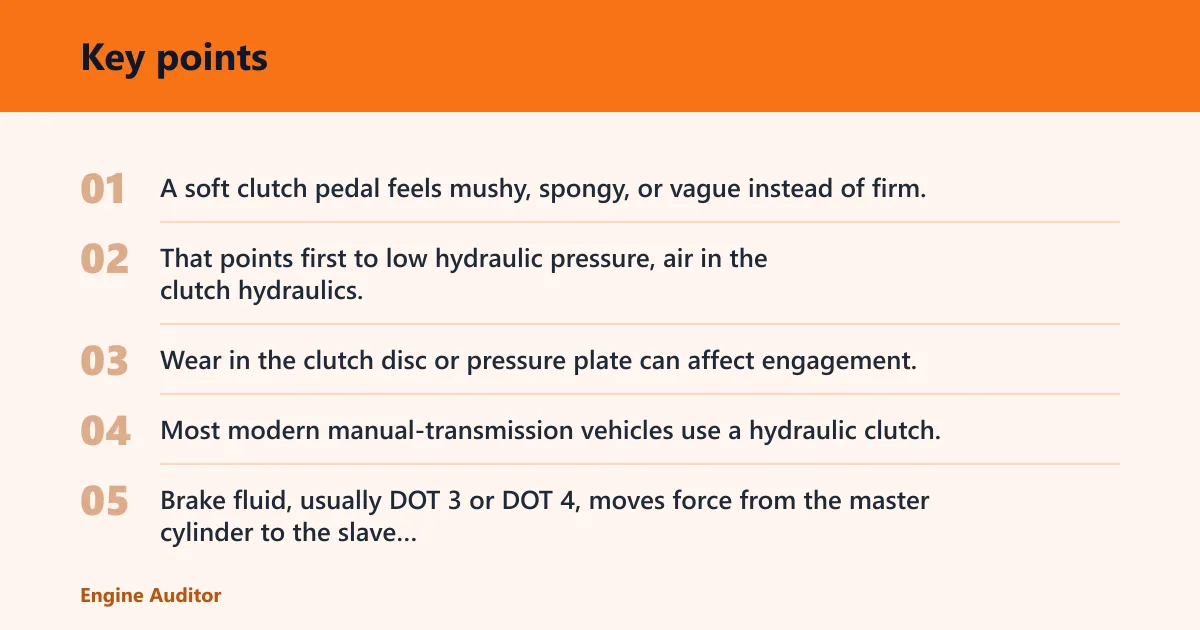


A soft clutch pedal feels mushy, spongy, or vague instead of firm. That points first to low hydraulic pressure, air in the clutch hydraulics, or a master or slave cylinder fault. Wear in the clutch disc or pressure plate can affect engagement, but it usually shows up more as slip, a high bite point, or poor release than a soft pedal by itself.
Most modern manual-transmission vehicles use a hydraulic clutch. Brake fluid, usually DOT 3 or DOT 4, moves force from the master cylinder to the slave cylinder. If that fluid cannot transmit pressure cleanly, the pedal feel changes fast. Air compresses. Fluid should not.
Clutch wear and hydraulic faults do different jobs in the diagnosis. Hydraulic faults change pedal feel first. Wear changes how the clutch engages the engine and transmission first. That is why a pedal that feels soft but still shifts cleanly can still be a hydraulic warning, while a pedal that feels normal but lets the engine flare under load points elsewhere.
How the hydraulic clutch works
The clutch pedal pushes the master cylinder. The master cylinder sends brake fluid through the line to the slave cylinder. The slave cylinder moves the release mechanism, which separates the clutch disc from the pressure plate so the gearbox can shift. Any leak, air pocket, or internal seal bypass weakens that force.
Low fluid, air in the system, and master or slave cylinder failure are the main hydraulic causes to check first. A failing master cylinder is a common reason for a soft clutch pedal. A bad slave cylinder can do the same and can also prevent full disengagement, which makes reverse or first gear harder to select.
Clutch hydraulic fluid should be checked like brake fluid. Color matters. Dark, dirty fluid can mean age, moisture, or contamination. Moisture contamination gets worse with heat, which is one reason a pedal can feel different after driving. Air in the hydraulic line often shows up after a leak or after service, and it usually needs bleeding to remove.
What should you check first?
Start at the reservoir, then check the most likely leak points. Look at fluid level and color, check the firewall and pedal area for wetness, and inspect the slave cylinder area and bellhousing. Then do a pedal-hold test and a pump test. Those checks separate a pressure loss from a clutch wear complaint faster than guesswork.
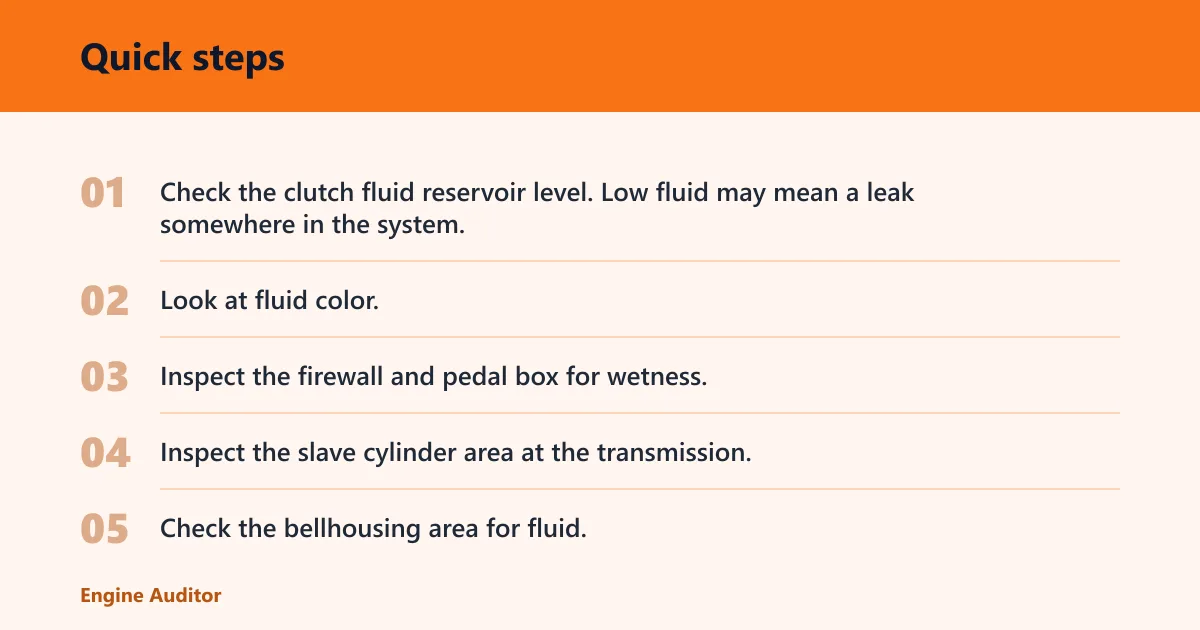
- Check the clutch fluid reservoir level. Low fluid may mean a leak somewhere in the system.
- Look at fluid color. Very dark or dirty fluid deserves attention even if the level is still up.
- Inspect the firewall and pedal box for wetness. A wet firewall often suggests master cylinder seepage.
- Inspect the slave cylinder area at the transmission. External wetness there usually points to the slave or the line.
- Check the bellhousing area for fluid. Wetness there can suggest a concentric slave cylinder leak in the transmission bellhousing.
- Hold the pedal down. If it slowly sinks, that points to hydraulic trouble, often the master cylinder.
- Pump the pedal a few times. If feel improves briefly, air in the hydraulic system is likely.
A common rookie mistake is to assume the master cylinder is fine just because the fluid level sits at the MAX line. Picture a car with a full reservoir, a pedal that sinks at stoplights, and no visible puddle under the car. That can still be an internal master cylinder bypass, which will not always leave an obvious external leak.
What does the pedal behavior tell you?
Pedal behavior is the fastest way to sort the fault category. A soft pedal alone points toward hydraulic trouble first. A pedal that sinks while held points more toward internal master cylinder bypass. A pedal that firms up after pumping often points to air in the line. Changes after the car warms up often point to fluid or seal issues that only show up hot.
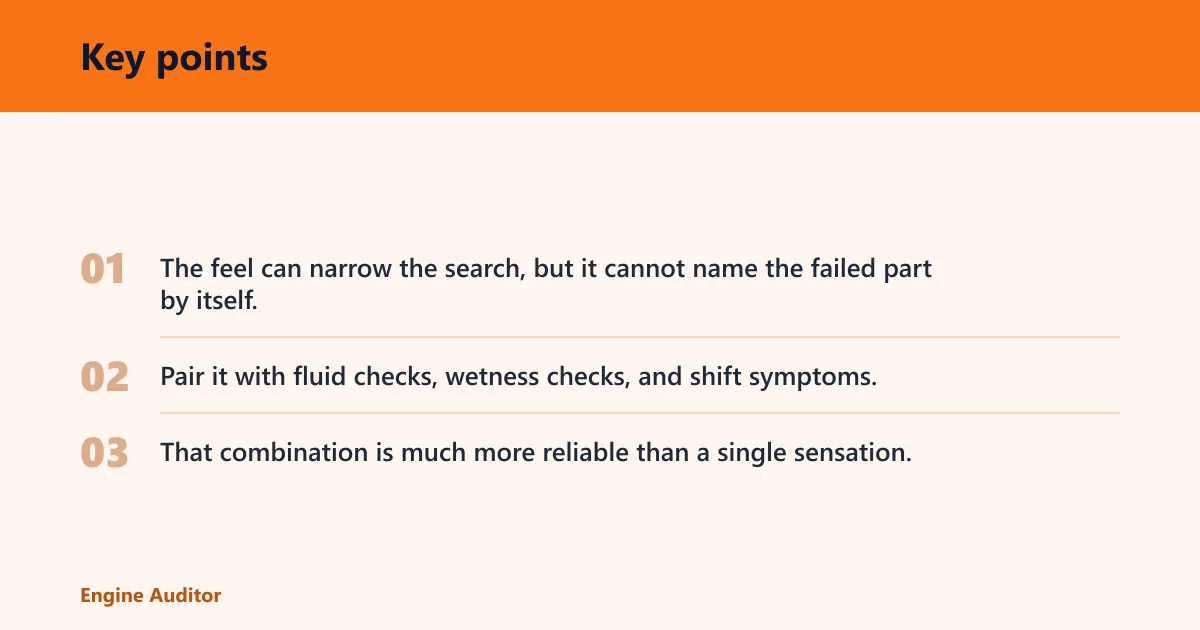
Use the pedal as a test, not a final answer. The feel can narrow the search, but it cannot name the failed part by itself. Pair it with fluid checks, wetness checks, and shift symptoms. That combination is much more reliable than a single sensation.
| Symptom combination | Likely cause | First inspection | Urgency |
|---|---|---|---|
| Soft only | Air in the hydraulics or early hydraulic pressure loss | Reservoir level, line and slave area, pedal feel before and after pumping | Drive only if shifting is still clean and the pedal is not getting worse |
| Sinks held | Master cylinder internal seal bypass | Pedal-hold test, firewall and pedal-box wetness | High urgency; plan repair before long trips |
| Improves when pumped | Air in the clutch hydraulic system | Reservoir level, signs of recent service or leak, pedal response after repeated pumps | Moderate to high; bleed the system and find the leak source |
| Worse hot | Moisture in fluid, weak seals, or leak that opens with heat | Fluid condition, master and slave wetness, pedal behavior after warm-up | Watch closely; heat sensitivity usually means the fault is progressing |
| Low fluid | Hydraulic leak somewhere in the system | Reservoir, firewall, slave cylinder, bellhousing | High urgency; low fluid can lead to loss of release |
| Wet firewall | Master cylinder leak or rear seal seepage | Pedal box, pushrod area, cabin-side firewall | High urgency; fluid near the pedal area usually means hydraulic failure |
| Wet bellhousing | Slave cylinder leak, often concentric on many cars | Transmission case, bellhousing seam, inspection opening if fitted | High urgency; internal leaks often worsen fast |
| Grinding into reverse | Poor clutch release from low hydraulic pressure, air, or slave/master fault | Hydraulic checks first, then release travel and engagement point | Stop and inspect soon; grinding means the clutch is not disengaging cleanly |
How to tell if the master cylinder or slave cylinder is bad
The master cylinder is more likely when the pedal sinks while held, the firewall area is wet, or the pedal-box side shows seepage. The slave cylinder is more likely when fluid appears at the transmission, bellhousing, or line connection. Both can create a soft pedal, but they leave different wet spots.
Master cylinder faults can happen with no visible external leak because the internal seal can bypass pressure. That is why a pedal-hold test matters. If the pedal slowly drops under steady pressure, the master cylinder is a strong suspect. If the pedal stays up but feels weak only at the end of travel, look harder at the slave and release travel.
Slave cylinders come in two practical forms. An external slave is visible on or near the transmission case, so leaks are easier to spot. A concentric slave sits inside the bellhousing, which makes it harder to inspect directly and more likely to show as fluid from the bellhousing area. Either design can reduce clutch release travel when it fails.
Can clutch wear cause a soft pedal?
Clutch disc or pressure plate wear by itself usually is not the only cause of a soft pedal. It more often causes slip under load, a high bite point, poor acceleration in a high gear, or drag that makes shifts rough. A worn release bearing can make noise when the pedal moves, but it is not the usual cause of a spongy pedal.
That said, wear can still change how the pedal feels indirectly. If the release mechanism is near the end of its range, the bite point can move, and the driver may describe the pedal as “different.” Use the clutch slip signs, bite point, and shift quality to separate wear from hydraulic trouble. Do not let a soft-feeling pedal push every diagnosis toward a clutch disc.
Suppose the pedal feels normal, but the car slips climbing a hill and the bite point is very high. That points more toward clutch wear than hydraulic failure. Now change only one thing: if the same car also needs a pump or two to get reverse, the hydraulic system deserves attention first.
Can you keep driving?
Short trips may still be possible if the pedal is soft but the car still shifts cleanly, fluid level is stable, and the pedal does not sink. Even then, the system needs inspection soon. If the pedal drops to the floor, shifting gets worse, or reverse starts grinding, stop driving. Those are signs that release travel is failing.
Driving on a failing hydraulic clutch can leave you unable to select gears, and forcing the shifter can damage synchros. A car that creeps at a stop with the clutch pedal fully down should be treated as unsafe to keep using. If the pedal feel changes after a few minutes of driving, that is a warning that the fault may be heat-sensitive and getting worse.
Use this rule of thumb: if the car still shifts normally and the pedal only feels a little soft, you may have time to move it for a repair. If it already grinds, refuses reverse, or will not disengage cleanly at a stop, do not plan on extended driving.
How do I bleed a clutch hydraulic system?
Bleeding can help when air is trapped in the clutch hydraulics, and a pump-friendly pedal is one clue that air is present. It will not cure a worn seal, a leaking master cylinder, or a leaking slave cylinder. If fluid keeps dropping, bleeding alone is a temporary fix at best.
Use the vehicle’s bleed points and keep the reservoir topped up with the correct brake fluid, commonly DOT 3 or DOT 4. If the pedal improves after bleeding but softens again soon after, the system still has a leak or a bypassing seal. The repair has not been solved yet.
Frequently asked questions
Why does my clutch pedal feel soft?
A soft clutch pedal usually means the hydraulic system is losing pressure, often from air, low fluid, or a master or slave cylinder problem. A worn clutch can affect engagement, but the pedal feel itself points first to hydraulics, especially if it changes after pumping or sinks while held.
Is a soft clutch pedal usually hydraulic or clutch wear?
It is usually hydraulic. Clutch wear more often causes slip, a high bite point, or poor disengagement rather than a mushy pedal. If the pedal feel changes with pumping or temperature, or if it sinks at a stop, start with the fluid path and cylinders.
Can I keep driving if my clutch pedal feels spongy?
Maybe for a very short trip if shifting is still normal and the pedal is not getting worse. Stop driving if the pedal drops to the floor, reverse grinds, or the car starts creeping with the clutch fully down. Those signs point to loss of release travel.
What does it mean if the clutch pedal sinks to the floor?
A pedal that slowly sinks while held usually means hydraulic trouble, often a failing master cylinder. Internal seal bypass is a common cause. Check the reservoir, firewall area, and pedal box, then inspect the slave side if the master area stays dry.
How do I tell if the master cylinder or slave cylinder is bad?
Look at where the fluid appears and how the pedal behaves. Wetness at the firewall or pedal box points toward the master cylinder. Wetness at the transmission or bellhousing points toward the slave cylinder. A pedal that sinks under steady pressure also leans toward the master cylinder.
Can air in the clutch hydraulics make shifting hard?
Yes. Air compresses, so the pedal feels mushy and the slave cylinder may not move far enough to release the clutch fully. That can make first gear or reverse hard to select and can cause grinding. If pumping helps, air is a strong suspect.
Products related to this article
Sponsored / affiliate links. As an Amazon Associate I earn from qualifying purchases. I may earn additional commission from eligible campaigns.