Car Light Switch Positions Explained for Beginners
Car light switches often have four main positions: off, parking or side lights, headlights, and auto; some cars may also have fog lights or a dimmer, and the right setting depends on daylight, rain, and how dark the road is. Using the wrong one can make you harder to see, invite a ticket, or drain the battery. This guide maps each common symbol and position to what turns on, when to use it, and the mistake to avoid.
Finding the exterior light switch on dials and stalks
The exterior light control switch may be a dial on the dashboard or a twist switch on the left steering-column stalk. In some cars it sits on the left side of the dash; in others it is on the left side control arm. The same functions can appear in different shapes, so look for the symbols, not just the hardware.
Common layouts include a rotary knob with icons, a pull-and-twist stalk, or a stalk with a rotating collar. If the dial or collar has symbols for a lamp, a headlamp, or AUTO, you are usually looking at the same control family even when the layout differs.
How to find the same function on different cars
Begin by finding the switch with the exterior lamp symbols. A first position may be marked as running light illumination, while another position may show a headlamp icon or AUTO. The shape varies by make and model, but the job stays the same: it controls the vehicle’s exterior lamps.
If your car has fog lights, they are often controlled by a separate ring, button, or pull function on the same stalk or near the main dial. That extra control does not replace the main positions for off, parking lights, low beams, or high beams.
Light switch positions cheat sheet
| Common control label | What lights illuminate | Typical use case | Dashboard indicator color | One beginner mistake to avoid |
|---|---|---|---|---|
| Off | Exterior lamps are switched off; some vehicles return to AUTO when turned back to off | When the vehicle is parked, or when the model automatically manages lighting | Usually none for exterior lamps | Assuming off behaves the same on every model |
| AUTO | The sensor switches lights on and off as ambient light changes | Day-to-night driving when the car is fitted with automatic lighting | Varies by model; the AUTO label may appear | Thinking AUTO is standard on every car |
| Parking lights / sidelights | Front position lights, rear tail lights, and number plate lights where fitted | Low-visibility parking or other situations where your local rules allow this setting | Often a small amber or green lamp symbol; symbol shape varies | Confusing these lights with full headlights |
| Low beams | Low beam headlights | Normal night driving and poor visibility | Usually a green headlamp symbol | Driving in darkness with only DRL or parking lights |
| High beams | High beam headlights | Dark, open roads with no approaching traffic | Always blue | Leaving them on for oncoming traffic or when following another vehicle |
What each position means at a glance
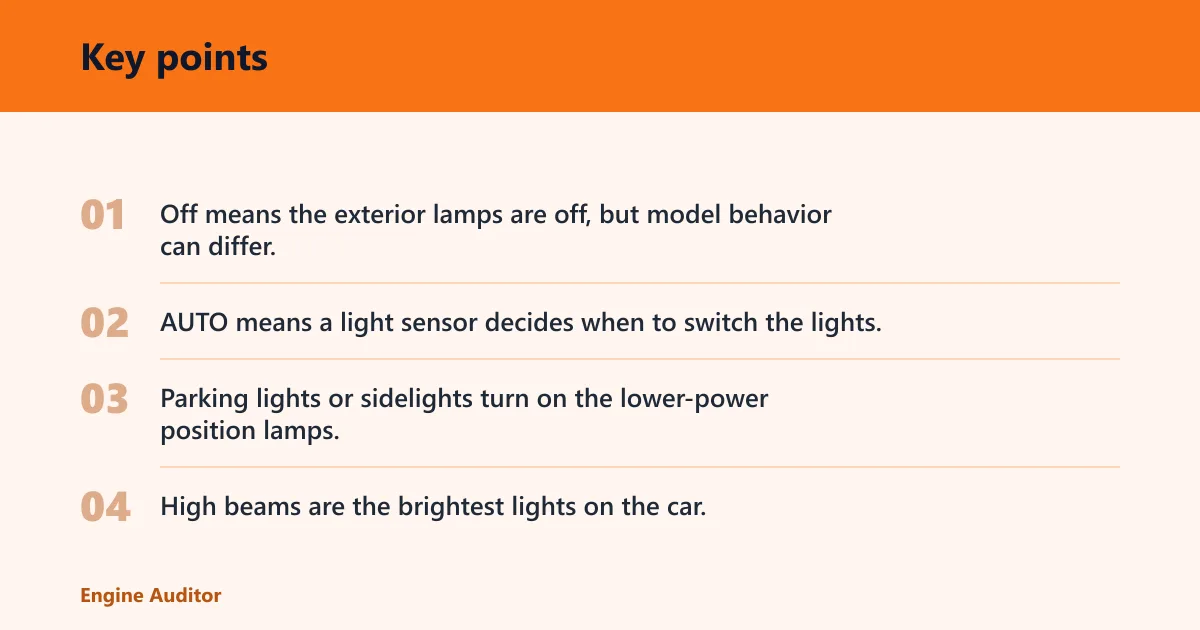
Off means the exterior lamps are off, but model behavior can differ. AUTO means a light sensor decides when to switch the lights. Parking lights or sidelights turn on the lower-power position lamps, while low beams are the normal night-driving setting. High beams are the brightest lights on the car.
What does AUTO mean on a car light switch?
AUTO means the vehicle uses a light sensor, often mounted on the upper dashboard, to decide when to switch the lights on and off. It reacts to ambient light, so entering a tunnel, parking garage, or dark road can trigger the lamps without driver input. Not every vehicle has this position.
On some models, turning the switch back to off may send it back to AUTO or behave differently from a simple manual dial. That is why the same knob can look familiar but act differently from car to car.
When AUTO is useful
AUTO is most useful when daylight changes quickly or when you move between bright and dark areas. It reduces the chance that you drive into dusk with no front lamps on. It is still worth checking the dashboard after the switch is set, because the instrument cluster should show the active light mode.
What AUTO does not guarantee
AUTO does not mean every light on the car is always active. Daytime running lights are separate from the headlights, and some vehicles may not light the tail lamps or the instrument panel in the same way as full low beams. That difference matters in rain, fog, and deep twilight.
What do sidelights and parking lights do?
Sidelights are also known as parking lights, though exact naming and function can vary by market and vehicle. In common use, this setting brings on low-powered exterior lights: front position lights, rear tail lights, and number plate lights where fitted. It is not the same as full headlights.
This is the setting many beginners confuse with “lights on.” The car is more visible than with off, but it is not using the main dipped or low beam headlamps. The lighting pattern is smaller and dimmer than the normal night-driving setup.
Why tail lights and number plate lights come on with sidelights
The rear lamps and number plate lights are part of the same visibility package on many vehicles. That way, the car can be seen from both directions and its plate can still be read where required. If you see front position lights but no rear glow, the vehicle may not be in the correct setting or the system may differ by model.
Say your hatchback is parked near a curb at dusk and the switch is on sidelights. The front corners glow white, the rear lamps glow red, and the plate is lit. If you expected full headlamps, the road ahead will still look dark because this is not the low-beam setting.
Low beam and high beam explained
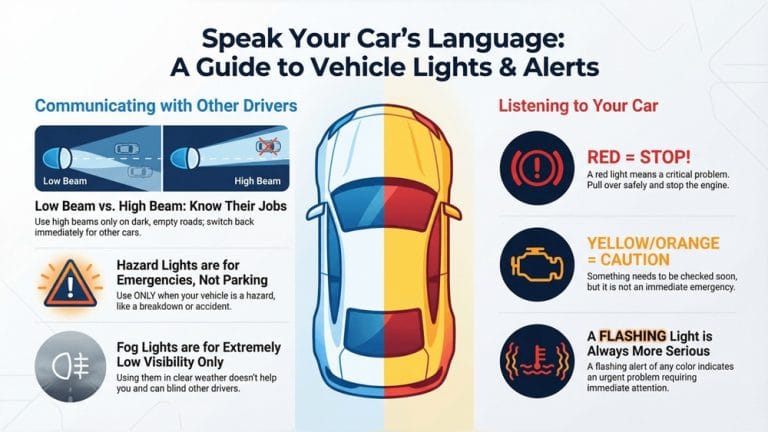
Low beams are the normal night-driving headlights. They are aimed downward to reduce glare for other road users and are used in darkness and poor visibility. High beams are brighter than low beams and are intended for dark open roads with no approaching vehicles, cyclists, or pedestrians.
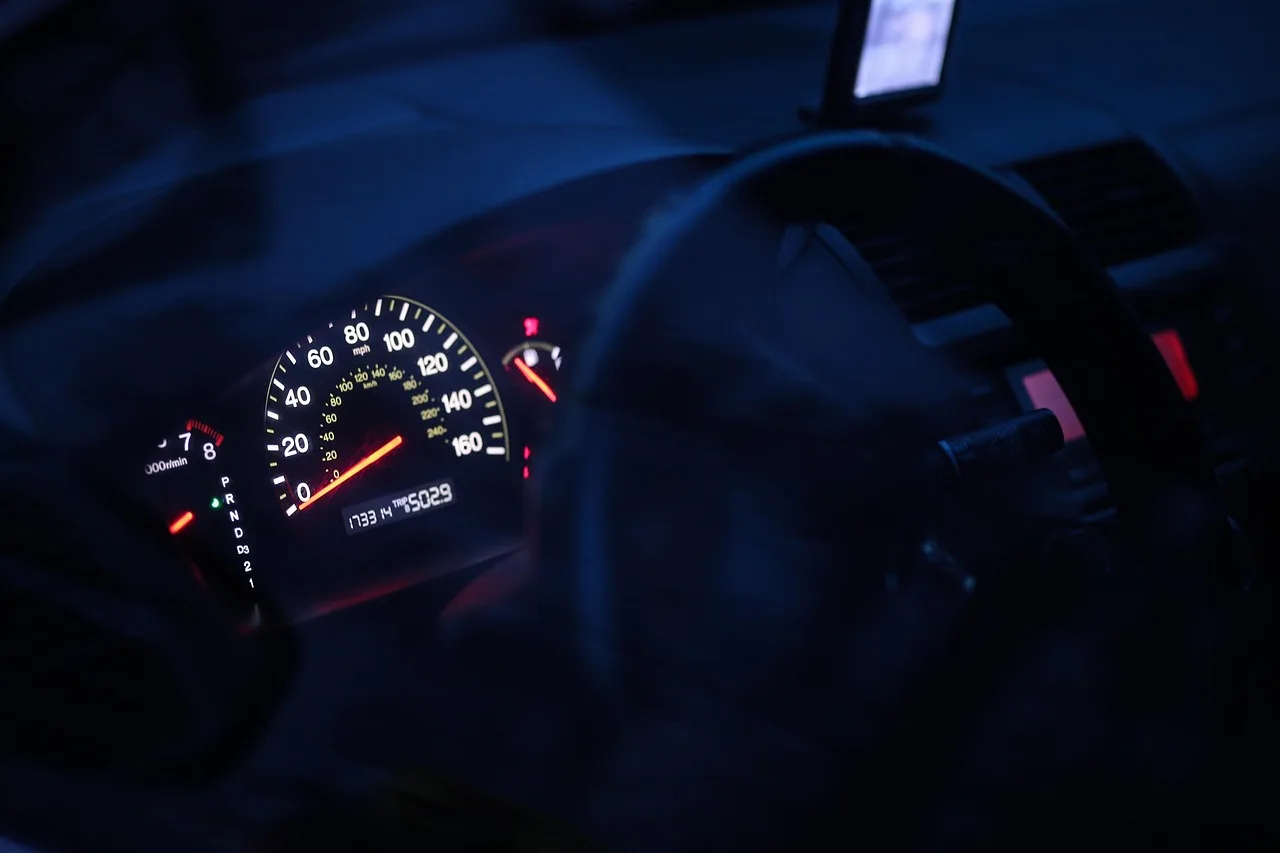
The instrument cluster confirms the selected mode. A high beam dashboard symbol is always illuminated in blue, and the symbol appears in the instrument cluster. Other lamp icons may be green or amber depending on the function, so color helps you identify what is active.
When to use low beams
Use low beams for regular night driving, rain, mist, and any situation where you need forward lighting but must avoid dazzling others. They are the default setting once daylight has faded. If the road is lit but visibility is poor, low beams are still the safer baseline than DRL alone.
When to use high beams
High beam headlights are the brightest lights on the car, but they should only be used on unlit roads and where there are no approaching vehicles, cyclists or pedestrians. Dip them as soon as another road user is near, because the extra reach comes with more glare for other people.
Picture a rural road with no streetlights and long straight stretches. High beams can help you see farther ahead there. The moment a car appears over the crest or in your mirror, switch back to low beams.
What the blue dashboard light means
The blue symbol in the instrument cluster is the high beam indicator light. If it is on, your high beams are active. If you see blue and did not expect it, check the stalk or dial immediately and dip the lights before you meet traffic.
How do you turn the lights on step by step?
Start from off or AUTO, then move the switch to the next position you need and confirm the dashboard symbol. The exact labels vary, but the sequence is usually easy to trace from the switch icons to the instrument cluster. If traffic is nearby, keep the beams dipped.
- Find the exterior light switch on the dash or left steering-column stalk.
- Look for the off position, AUTO, parking-light icon, low-beam icon, and high-beam control.
- Turn the switch to AUTO if your car has it and you want sensor-based lighting.
- If AUTO is not fitted, rotate or click to the parking-light or low-beam position as needed.
- Check the instrument cluster for the correct symbol and color.
- If high beams are on, dip them before any approaching vehicle, cyclist, or pedestrian.
Common beginner mistakes to avoid
One mistake is assuming daytime running lights mean the car is fully lit for night use. DRL systems are separate from the headlights, and they may not illuminate the tail lamps or instrument panel lights. Another mistake is leaving parking lights on when the car is parked for a long time, which can drain the battery.
A common first-timer mistake is using high beams on a road that is only partly dark. If another vehicle is coming toward you, or you are following closely, the blue symbol should go out. The dimmer setting is the correct one for shared roads.
Frequently asked questions
What do the positions on a car light switch mean?
Most car light switches move through off, parking lights or sidelights, low beams, high beams, and sometimes AUTO. Off disables the exterior lamps on many cars, AUTO uses a sensor, parking lights add low-power visibility lighting, low beams are the normal night setting, and high beams are for dark open roads.
Where is the light switch in my car?
The light switch may be a dial on the dashboard or a twist switch on the left steering-column stalk. Some cars place it on the left side of the dash or on the left side control arm. The easiest way to find it is to follow the exterior lamp symbols, not the exact location.
What is the difference between sidelights, parking lights, and headlights?
Sidelights and parking lights are commonly used for the same low-power visibility setting, but exact naming and lamp behavior can vary by market and vehicle. They usually light the front corners, tail lights, and number plate lights. Headlights are brighter, with low beams for normal night driving and high beams for dark roads.
When should I use high beam headlights?
Use high beam headlights only on unlit roads and only when there are no approaching vehicles, cyclists or pedestrians. They are the brightest lights on the car, so they improve long-range vision but can glare other road users. Dip them promptly whenever traffic appears or when you are following another vehicle.
What does the blue high beam symbol mean on the dashboard?
The blue symbol in the instrument cluster means the high beam headlights are on. It is the clearest dashboard confirmation that the brightest setting is active. If you see blue while driving near other traffic, switch back to low beams right away so you do not dazzle anyone.
Products related to this article
Sponsored / affiliate links. As an Amazon Associate I earn from qualifying purchases. I may earn additional commission from eligible campaigns.