Fuel Cost Calculator: How Much Will Your Trip Cost?
A fuel cost calculator estimates trip spend by multiplying distance, your vehicle’s real-world consumption, and local fuel or electricity prices; for a quick check, cost per mile usually equals price per gallon divided by mpg, or price per kWh divided by miles per kWh. A wrong input can shift the budget by more than the fuel stop itself. This guide shows how to compare petrol, diesel, EV, and carpool trip costs with practical inputs and examples.
How is this calculated?
Press Calculate to see the math with your numbers.
How does a fuel cost calculator work?
A trip calculator turns three inputs into one answer: route distance, vehicle economy, and local fuel price. It can estimate fuel cost according to distance, fuel efficiency, and gas price, and it supports trip distance in miles or kilometers, fuel efficiency in mpg, L/100 km, km/L, and liters per mile, plus gas or fuel price per gallon or per liter.
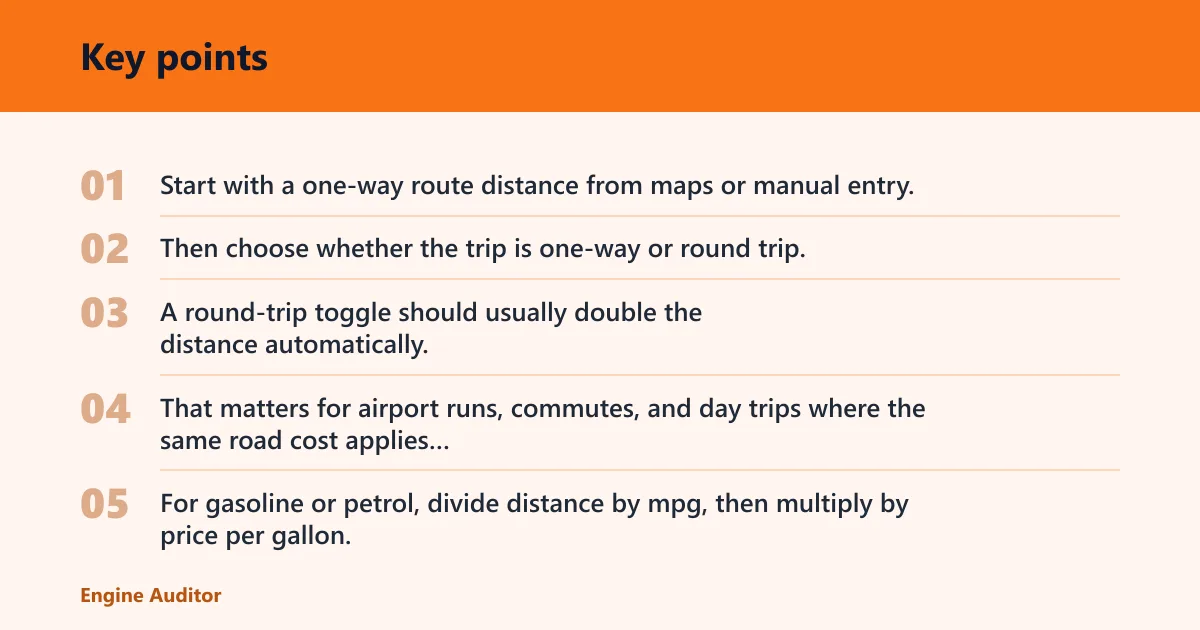
Start with a one-way route distance from maps or manual entry. Then choose whether the trip is one-way or round trip. A round-trip toggle should usually double the distance automatically, so the return leg is included without a second entry. That matters for airport runs, commutes, and day trips where the same road cost applies both directions.
For gasoline or petrol, divide distance by mpg, then multiply by price per gallon. For metric inputs, use the same approach with liters or kilometers per liter. The result should show gallons or liters needed, total trip cost, and cost per mile or per kilometer.
Trip distance, economy, and price inputs
Use the route distance you expect to drive, not a straight-line guess. For fuel economy, prefer a real-world figure rather than a brochure rating when the trip includes heavy traffic, hills, or winter driving. Local pump prices also matter because they vary by city, station, and state or region.
One-way versus round trip
A one-way airport ride and a round-trip airport ride can differ by a factor of two. The calculator should let you switch between those modes so the same route can answer both a single-leg errand and a full day outing.
Gallons, liters, and cost per mile
Cost per mile helps compare trips of different lengths. It also shows why a short drive can still feel expensive when the vehicle gets poor mileage, or when a local fuel price is high. For EVs, the same idea applies with price per kWh and miles per kWh.
Trip cost comparison table
The table below shows the same route logic under six common scenarios. The numbers are examples built to show how distance, fuel type, and local prices change the answer.
| Scenario | Distance | Assumed efficiency | Local price | Total cost | Cost per mile | What changes the result most |
|---|---|---|---|---|---|---|
| Short commute | 12 miles round trip | 30 mpg petrol | $3.90 per gallon | $1.56 | $0.13 | Traffic and stop-and-go driving lower real mileage. |
| Airport run | 38 miles round trip | 28 mpg diesel | $4.20 per gallon | $5.70 | $0.15 | Parking fees are separate; route length is the main fuel driver. |
| 200-mile road trip | 200 miles one way | 32 mpg petrol | $4.10 per gallon | $25.63 | $0.13 | Highway speed and payload matter more than short-trip idling. |
| Cold-weather trip | 100 miles round trip | 26 mpg petrol after a 15% drop | $3.95 per gallon | $15.19 | $0.15 | Cold starts and cabin heat reduce mileage the most. |
| Carpool split | 80 miles round trip | 25 mpg petrol, 4 passengers | $4.00 per gallon | $12.80 total, $3.20 per person | $0.16 total | Passenger split changes the per-person cost, not the vehicle cost. |
| EV versus petrol | 150 miles round trip | EV: 3.4 miles per kWh; petrol: 30 mpg | EV: $0.16 per kWh; petrol: $4.25 per gallon | EV $7.06; petrol $21.25 | EV $0.05; petrol $0.14 | Electricity rate, miles per kWh, and driving conditions drive the gap. Driving conditions can reduce EV range more than expected on this row, especially in cold weather, at highway speeds, or with strong wind. |
Say your commute is 14 miles round trip and your car gets 25 mpg, not 35 mpg as the brochure suggests. At $4.00 a gallon, the trip costs $2.24 instead of $1.60. That difference is small once, but it adds up across a five-day week.
How do you calculate trip fuel cost?
Use the vehicle’s consumption rate, the route distance, and the local fuel or electricity price. For gasoline or petrol, the standard formula is distance divided by MPG times price per gallon. For EVs, use distance divided by miles per kWh times electricity price per kWh. The calculator should also show gallons or liters needed.
Gasoline and petrol formula
For a 300-mile example, a calculator using the standard formula distance divided by MPG times price per gallon shows $46.61 one way under the listed default gas price of $4.35 a gallon. That same route can cost more or less depending on local pump price and the vehicle’s actual mileage.
Diesel and alternative fuel formula
Diesel uses the same distance-and-economy logic, but the pump price and the vehicle’s mileage are different. CNG and other alternative fuels also need a price-per-unit input, plus the correct consumption unit. If you compare petrol versus diesel, compare the same route and the same traffic mix, or the result will tilt in the wrong direction.
Electricity cost for EV trips
For an EV, the key inputs are trip distance and miles per kWh, then the local electricity rate. Home charging, public charging, and workplace charging often have different prices. Charging fees are separate from parking unless the station combines them into one posted rate.
What changes the result most?
Driving conditions can move the answer far more than the calculator’s rounding. City traffic, cold starts, hills, tire pressure, cargo weight, and maintenance all affect real mileage. Local pump prices and electricity rates also move quickly, so a nearby station can shift a trip budget even when the route stays the same.
City and highway mix
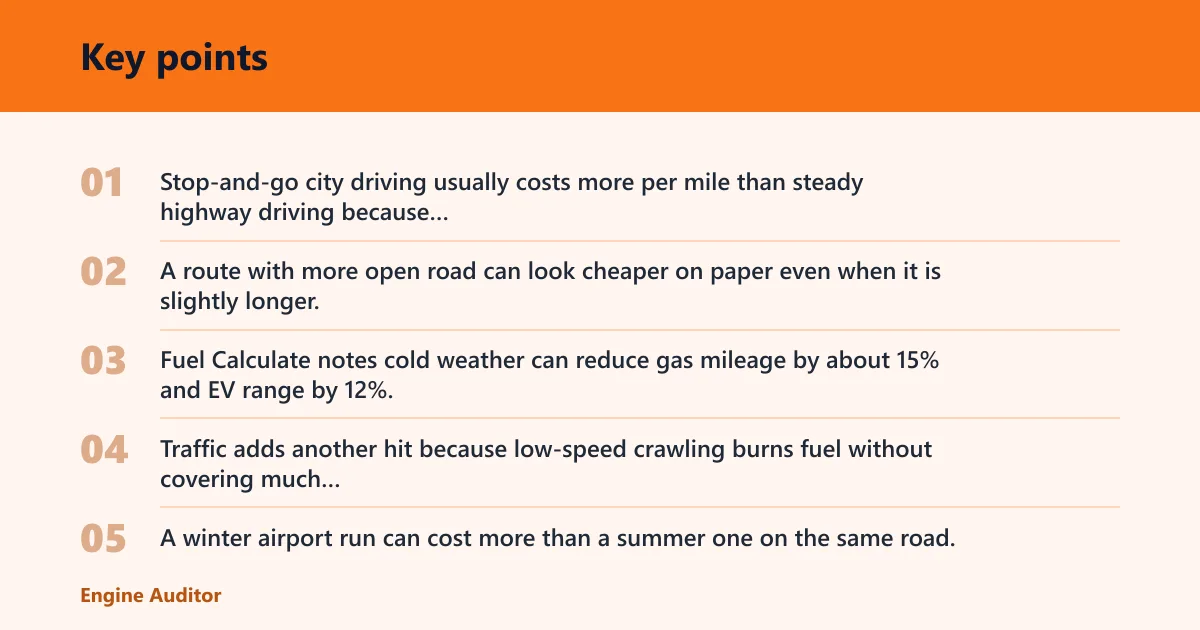
Stop-and-go city driving usually costs more per mile than steady highway driving because idle time and repeated acceleration waste fuel. A route with more open road can look cheaper on paper even when it is slightly longer.
Cold weather and traffic
Fuel Calculate notes cold weather can reduce gas mileage by about 15% and EV range by 12%. Traffic adds another hit because low-speed crawling burns fuel without covering much distance. A winter airport run can cost more than a summer one on the same road.
Terrain, tire pressure, and vehicle load
Hills, soft tires, roof boxes, and heavy cargo all raise consumption. A maintenance issue can do the same. If your estimate feels too optimistic, check whether the trip includes steep grades or extra weight that the base MPG figure does not capture.
A common first-timer mistake is using one fuel-economy number for every route. A 40-mile highway trip and a 40-mile urban trip rarely cost the same, even with the same car and the same station price.
Local pump prices and electricity rates
Nearby prices matter because fuel taxes and regional rates vary. EPA and AAA-style regional fuel price snapshots are more trustworthy than vague secondary references because they can be checked against current posted rates. Regional fuel tax differences can still be large, so a nearby station can shift a trip budget fast even when the route stays the same.
For tighter planning, build a nearby price table with a low, middle, and high price. That is better than pretending one station price will hold all week. It also helps when you are comparing petrol versus electric fuel cost calculator outputs across stations or charging networks.
Nearby Price
Use the closest station, the station you actually plan to visit, or a ZIP code range around your home or destination. Then compare the price rows side by side so the calculator reflects your real local market.
Fuel type comparisons
Fuel type changes the trip budget because energy price, efficiency, and refill pattern are different. A petrol car may look cheaper to fill than a diesel car, yet diesel can win on cost per mile if the route is long and the engine is efficient. EVs often win on energy cost, but the charging price needs to be realistic. If you are looking for a petrol vs electric fuel cost calculator, the key is to compare the route, charging location, and real-world efficiency together.
Petrol versus diesel
For petrol versus diesel fuel cost calculator use, compare the same distance with the same route. Diesel often gets better mileage, but the pump price can be higher or lower depending on region. If you are comparing a road trip, also separate fuel cost from tolls and parking so the picture stays clean.
Petrol versus EV
Fuel cost calculator vs EV comparisons usually turn on electricity price and miles per kWh. If electricity is cheap and the route is moderate, the EV often costs less to drive. If the trip depends on public fast charging, the price gap can narrow quickly.
Petrol versus CNG
For petrol versus CNG, the same formula still works, but the unit price and consumption format change. Use the correct fuel unit, then compare cost per mile or cost per kilometer. That keeps the comparison useful when one vehicle is daily use and the other is a backup or fleet unit.
When a route includes tolls, parking, or charging fees, keep them outside the fuel line unless you want an all-in trip budget. Mixing them into fuel cost can hide the real energy cost and make comparison charts hard to trust.
How much gas will you need?

Fuel needed comes from the same distance and economy inputs. Divide trip distance by MPG to get gallons needed, or use liters per 100 km, km/L, or liters per mile in metric form. The calculator should support miles and kilometers so you can enter the route in the unit your maps app gives you.
Miles and kilometers inputs
Some route planners show miles, others show kilometers. The calculator should accept either without forcing a manual conversion. That reduces entry errors on long trips and makes round-trip toggles easier to use.
MPG, L/100 km, and km/L
MPG is common in the U.S., while L/100 km and km/L are common in metric markets. A car that reports 7.0 L/100 km can be compared directly to another vehicle in the same unit, which is helpful when you are looking at petrol versus diesel fuel cost calculator results.
Real-world mileage versus rated mileage
Rated mileage is a starting point, not a promise. Highway speed, stoplights, weather, passengers, and tire pressure all change the answer. If the route includes winter mornings or heavy congestion, use a conservative real-world estimate instead of the best published figure.
- Enter the route distance in miles or kilometers.
- Choose one-way or round trip.
- Enter fuel economy in mpg, L/100 km, km/L, or liters per mile.
- Enter local fuel price per gallon or per liter, or the electricity rate for an EV.
- Review gallons or liters needed, trip cost, and cost per mile.
- Adjust for passengers, weather, or a different station price if needed.
Suppose a family plans a 120-mile round trip in a petrol car rated at 33 mpg, but the road includes steep hills and winter traffic. If you lower the real-world figure to 28 mpg, the trip cost rises immediately. That single change is often more useful than fine-tuning pennies on fuel price.
Frequently asked questions
How do I calculate fuel cost for a journey?
Multiply the route distance by the fuel used per mile, then multiply that by the local fuel price. In practice, that is distance divided by MPG times price per gallon, or the metric equivalent. A fuel cost calculator does that math for you and can switch between one-way and round-trip values.
How much fuel will my trip use?
Divide the trip distance by your vehicle’s fuel economy to get gallons or liters needed. If the route is about 180 miles and the car gets around 30 mpg, the trip needs about 6 gallons. If conditions are colder or traffic is heavier than usual, the real amount can be higher.
How much gas do I need for my trip?
Use the distance and MPG figures together, then add a little margin if the route is long or unfamiliar. A map route gives you the distance; your vehicle’s real-world MPG gives you the fuel use. For round trips, double the distance before calculating gallons needed.
How much gas will my car cost for a road trip?
Take the road-trip distance, divide by MPG, then multiply by the pump price you expect to pay along the route. If you cross state lines or pass through a high-tax area, the answer can change by several dollars. A local-price estimate is more useful than a national average.
Fuel cost calculator vs ev
Fuel cost calculator vs EV comparisons should use electricity price, not just battery size. EV cost depends on miles per kWh, charging location, and the route’s weather and speed pattern. Public charging can narrow the gap, while home charging usually keeps the EV cost lower for the same trip.
Petrol vs diesel fuel cost calculator
Petrol versus diesel comparisons work best when both vehicles are measured on the same route with the same passenger load. Diesel often has better economy, but the pump price can offset part of that advantage. The better choice is the one that lowers cost per mile on the route you actually drive.
Fuel cost calculator petrol vs cng
For petrol versus CNG, the calculator should let you enter the correct fuel unit and the right consumption rate. That matters because a good CNG vehicle can have a very different cost per mile than a petrol car, even on the same road. Compare only the same trip length and route type.
Products related to this article
Sponsored / affiliate links. As an Amazon Associate I earn from qualifying purchases. I may earn additional commission from eligible campaigns.