Which Chevy Models Are Most Reliable for High Mileage?
Among Chevy models, the Silverado 1500 with the 5.3L V8 and Tahoe/Suburban with that drivetrain are the safest high-mileage bets, with the Colorado 3.6L and Malibu 2.5L trailing. Pick the wrong one and repair bills can wipe out the savings quickly. This guide ranks Chevy models that are commonly considered capable of 150,000-plus miles and flags the engine, transmission, drivetrain, and maintenance details that matter.
Chevy high-mileage decision table
| Model | Expected longevity | Common expensive repairs | Maintenance sensitivity | Best mileage band to buy in | Buy if / avoid if |
|---|---|---|---|---|---|
| Silverado 1500 5.3L V8 | Very high; often a 200,000-mile candidate with care | Transmission service, AFM/valvetrain issues, cooling components, suspension wear | High | 90,000-160,000 miles | Buy if records show regular oil, transmission, and coolant service. Avoid if it tows hard with poor records or has lifter noise. |
| Tahoe 5.3L V8 | Very high; body-on-frame wear is usually slower than on crossovers | Suspension, cooling, transmission, AWD/4WD parts | High | 80,000-140,000 miles | Buy if it spent most of its life on family duty. Avoid if the rear suspension sags or the drivetrain shifts poorly. |
| Suburban 5.3L V8 | Very high, with the same strengths as Tahoe and more cargo use | Suspension, brakes, cooling, transmission, rear axle wear | High | 80,000-130,000 miles | Buy if the extra length fits your use and the chassis is clean. Avoid if it hauled heavy loads without documented service. |
| Impala V6 | High; a strong long-term sedan if the powertrain is healthy | Transmission wear, ignition or cooling issues on neglected cars | Moderate | 70,000-140,000 miles | Buy if you want low purchase cost and comfort. Avoid if the transmission shifts harshly or the cooling system history is thin. |
| Malibu 2.5L / 1.5T | Moderate to high, depending on engine and service history | Transmission, turbo-related repairs on 1.5T, oil leak or cooling issues | Moderate to high | 60,000-120,000 miles | Buy if the car has clean records and conservative use. Avoid if you cannot verify fluid changes or the turbo engine has warning signs. |
| Equinox 1.5T / 2.0T | Moderate; good ones can go far, but repair risk rises faster than on trucks | Turbo engine wear, AWD service, timing and cooling concerns, transmission issues | High | 50,000-100,000 miles | Buy if you find a well-documented FWD example. Avoid if it has neglected oil changes, AWD noise, or coolant loss. |
| Traverse V6 | Moderate; can last, but cooling and transmission risk matter at higher miles | Transmission, cooling system, timing-related repairs, suspension | High | 50,000-90,000 miles | Buy if service records are complete and the transmission feels clean. Avoid if the van-like use was heavy and undocumented. |
Which Chevy models last the longest over 200,000 miles?
The longest-lived Chevy picks are usually body-on-frame models with simple, well-serviced powertrains: Silverado 1500, Tahoe, and Suburban. A well-kept Impala can also cross 200,000 miles, but the margin for neglect is smaller on cars and crossovers. At 200,000 miles, records matter more than badge loyalty.
Body-on-frame durability
Silverado, Tahoe, and Suburban tend to age better because their frames, drivetrains, and suspension parts are built for load work. That does not make them cheap to own. It means the structure can survive mileage well while the wear items become the bill.
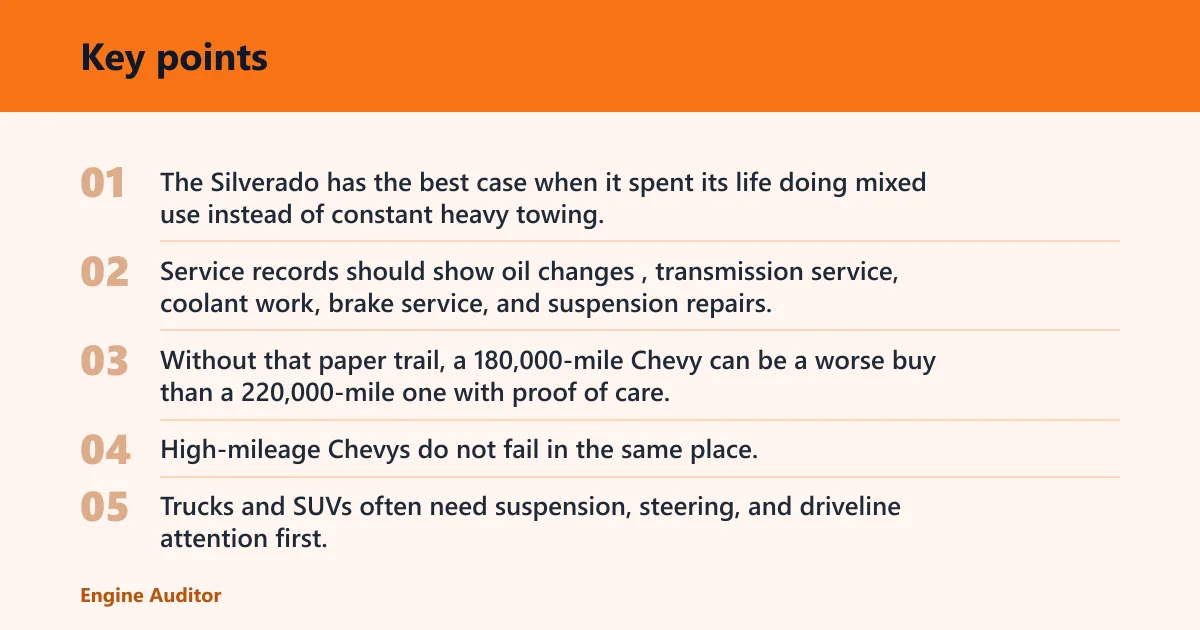
The Silverado has the best case when it spent its life doing mixed use instead of constant heavy towing. Tahoe and Suburban often last because family hauling is easier on them than commercial abuse, but the larger size adds more brake, tire, and suspension cost as miles climb.
Powertrain and cooling-system wear
Engine choice matters. The 5.3L V8 in trucks and large SUVs is usually the safest bet, while turbo four-cylinder crossovers often carry more risk once mileage rises. Cooling-system neglect is a repeated problem on high-mileage Chevys, and overheated engines can turn a decent buy into an expensive one fast.
Service records should show oil changes, transmission service, coolant work, brake service, and suspension repairs. Without that paper trail, a 180,000-mile Chevy can be a worse buy than a 220,000-mile one with proof of care.
Maintenance-sensitive parts
High-mileage Chevys do not fail in the same place. Trucks and SUVs often need suspension, steering, and driveline attention first. Cars and smaller crossovers more often need transmission, cooling, or turbo-related work before the chassis itself becomes the main issue.
Picture a clean 182,000-mile Tahoe with one-owner records, fresh transmission service, and no rust. Now compare it with a 124,000-mile Equinox that has no proof of oil changes and a coolant smell after a test drive. The lower odometer reading does not make the second one the safer buy.
What Chevy SUV is most reliable with high mileage?
The Tahoe is usually the best high-mileage Chevy SUV pick because it combines body-on-frame strength with a common, proven V8 drivetrain. The Suburban is close behind, with similar mechanical durability but more suspension and brake wear because of its longer body and heavier use. Traverse and Equinox are more sensitive to service history.
Tahoe
The Tahoe is a strong choice for long-term family hauling if it has the 5.3L V8 and a clean service history. Its frame and drivetrain can hold up well, but high-mileage ownership costs rise through suspension, brakes, cooling, and AWD or 4WD parts. It is reliable in the right spec, not automatically cheap.
Suburban
The Suburban uses the same basic logic as the Tahoe, with more cargo room and more mass to manage. That extra size helps with utility, but it also means more tire, brake, and rear suspension wear. Buy it when you need the space and the service records are complete.
Traverse
The Traverse can work as a family hauler, but it belongs lower on a high-mileage list because transmission and cooling-system problems matter more here. If the record shows regular fluid changes and the test drive is clean, it can still be a sensible buy. If not, risk rises quickly.
Equinox
The Equinox is a common used buy, yet it is less forgiving than a body-on-frame SUV. AWD examples can bring transfer case or rear-drive service, while turbo engines need clean oil history and careful cooling maintenance. A good one is fine. A neglected one can be expensive.
Is the Silverado still a smart buy after 150,000 miles?
Yes, the Silverado can still be a smart buy after 150,000 miles if the engine, transmission, and towing history all check out. The best versions are usually the 5.3L V8 trucks with documented service. The risk grows fast when the truck has heavy tow use, poor fluid changes, or drivetrain noise.
Best engine and drivetrain combinations
The 5.3L V8 is the safest broad recommendation because parts are common and the engine has a long track record in working trucks and SUVs. A clean 6-speed or 8-speed automatic with evidence of fluid service is better than a truck with unknown history, hard shifts, or delayed engagement.
A 150,000-mile Silverado can still have plenty of life left if it was used as a truck, not abused as a cheap tow rig. The 2500HD and other heavy-duty versions can also last well, but their larger components often make the repair bills bigger when something does wear out.
Towing and payload wear points
Towing and payload use stress transmissions, rear axles, cooling systems, brake hardware, and suspension bushings. A Silverado that hauled a boat every weekend may need more than one that only carried commuting miles. Pay close attention to hitch wear, fluid condition, and signs of overheating.
-
Check the service file first.
Look for oil changes, transmission fluid service, coolant service, brake work, and differential service. Gaps in those records matter more than a shiny wash. -
Test the drivetrain cold and warm.
Start the truck cold, then drive until fully warm. Watch for delayed shifts, flare between gears, or shudder under light throttle, since those signs often point to costly transmission work. -
Inspect the towing wear points.
Look at the hitch area, rear springs, shocks, tires, and cooling stack. Uneven tire wear or sagging rear height can signal hard use that was never corrected.
Buy if the Silverado has clean records, no rust on the frame, and no sign of hard abuse. Avoid if the seller cannot prove fluid changes, the transmission hesitates, or the truck shows heavy towing wear without repairs.
Which Chevy car is best for long-term ownership?
The Impala is the better long-term ownership bet, while the Malibu is the cheaper and more fuel-friendly option with a tighter risk window. If you want the safer high-mileage sedan, choose the Impala with strong records. If you want lower running costs and accept more drivetrain sensitivity, the Malibu can work.
Impala
The Impala is a solid used-market pick because it offers comfort, space, and a generally durable powertrain when maintained properly. It can reach high mileage with fewer surprises than many small crossovers, but transmission service and cooling-system condition still decide whether it is a bargain or a headache.
Malibu
The Malibu balances fuel economy and ownership cost better than the larger Chevy cars, but it is more dependent on exact engine and transmission history. The 2.5L versions are usually easier to judge than turbo versions, which need clean oil service and no sign of boost-related problems. Maintenance intervals matter here more than trim level.
High-mileage tradeoffs
The Impala usually costs less in risk at high miles, while the Malibu often costs less at the fuel pump. That tradeoff changes if the Malibu has a better service file or if the Impala has a worn transmission. At high mileage, condition beats model name.
What to check before you buy a high-mileage Chevy
Service history matters more than the badge alone. A well-kept Chevy can exceed 150,000 to 200,000 miles, but you should still check service records, get a pre-purchase inspection from a trusted mechanic, and avoid rust, neglect, and accident damage. Used-vehicle warranty coverage can reduce risk, but model-year differences still matter.
-
Verify service records.
Ask for invoices or a maintenance log that shows oil changes, transmission service, coolant service, brakes, and suspension work. Regular intervals matter more than a single fresh receipt. -
Inspect for rust and damage.
Check frame rails, rocker panels, lower doors, suspension mounts, and the underside around the spare tire area. Rust on body-on-frame vehicles is a bigger warning than a cosmetic chip. -
Confirm driveline behavior.
Test for smooth shifts, straight tracking, quiet wheel bearings, and no clunks over bumps. A high-mileage Chevy should not feel loose, even if it has age-related wear. -
Ask about warranty coverage.
Some used examples may still have powertrain warranty coverage, especially if the mileage and model year fit the term. Read the remaining terms carefully, because coverage differs by year and by seller.
A common first-timer mistake is choosing the lowest odometer reading and ignoring service gaps. A 138,000-mile Traverse with incomplete cooling records can be a worse buy than a 176,000-mile Tahoe with documented maintenance and a clean inspection. Mileage is a clue, not the verdict.
Another common mistake is overlooking body style. A Silverado can outlast a Malibu in hard use, but it will often cost more to refresh because tires, brakes, suspension parts, and driveline pieces are larger and pricier. That is the tradeoff to measure before you buy.
Frequently asked questions
Is the Chevy Silverado reliable after 150,000 miles?
Yes, especially with the 5.3L V8 and a clear service record. The main risks after 150,000 miles are transmission wear, towing-related stress, and neglected cooling components. If the truck shifts cleanly and the frame is rust-free, it can still be a strong buy.
What years of Chevy models are best to buy used for durability?
The best years vary by engine, transmission, and model update, so it is safer to shop by powertrain reputation and service history than by year alone. In practice, look for later-year examples with documented transmission service, cooling work, and no open recalls or chronic issue patterns.
How many miles can a Chevy realistically last?
A well-maintained Chevy can often go past 150,000 miles and may reach around 200,000 miles, especially in truck and SUV form. Some go farther. The real limit depends on maintenance history, rust, accident damage, load use, and whether major components were serviced on time.
Which Chevy models are cheapest to keep on the road at high mileage?
Impala and Malibu often cost less than trucks and full-size SUVs to fuel and insure, but they can still become costly if transmissions or cooling parts fail. The cheapest high-mileage Chevy is usually the one with the best records and the least rust, not the lowest sticker price.
What maintenance matters most on a high-mileage Chevy?
Oil changes, transmission service, cooling-system care, brakes, and suspension records matter most. Those items tell you whether the drivetrain was protected or neglected. If the seller cannot document them, assume extra repair risk and price the car as a project, not a bargain.
Products related to this article
Sponsored / affiliate links. As an Amazon Associate I earn from qualifying purchases. I may earn additional commission from eligible campaigns.