Can Electric Cars Go Through Car Washes Safely?
Yes. Most electric cars can go through automatic, touchless, conveyor, and hand car washes safely when you follow the vehicle’s wash instructions: use Neutral or free roll when required, disable auto wipers and hold features, fold mirrors if the manual says so, and close the charge port firmly. Miss one step, and you can create faults, trim damage, or a car that will not move as the wash expects.
The battery usually is not the issue; the setup is. EVs are built with weather sealing around openings and protected exterior seams, but the weak point is a bad match between the wash type and the vehicle’s settings or condition. A damaged seal, loose trim, or open charge port changes the risk immediately.
Matching wash type to your EV’s sensors and port
That is why the same EV can be fine in one wash and risky in another. A conveyor system may need Neutral or free roll. A rollover bay keeps the car still while the wash moves around it. A touchless wash limits contact, while brush-based systems add moving parts that can catch trim, residue, or sensor surfaces.
Which car wash type fits your EV?
Touchless wash bays are often the simplest fit for EVs with cameras and sensors because they limit physical contact. Brush-based automatic washes can still work on many vehicles, but they create more chance of paint marring, trim contact, and residue on sensor surfaces. Conveyor systems add one more requirement: the correct roll-away setup.
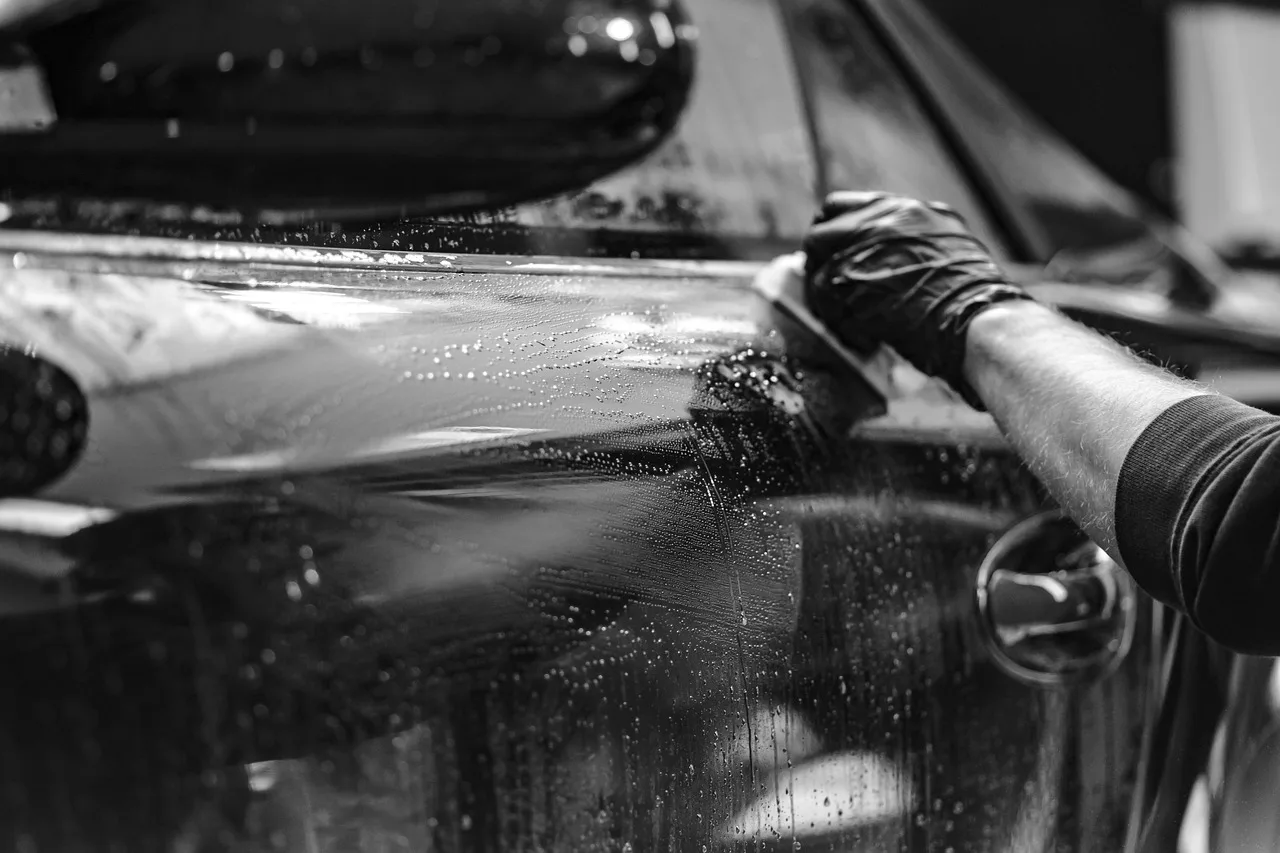
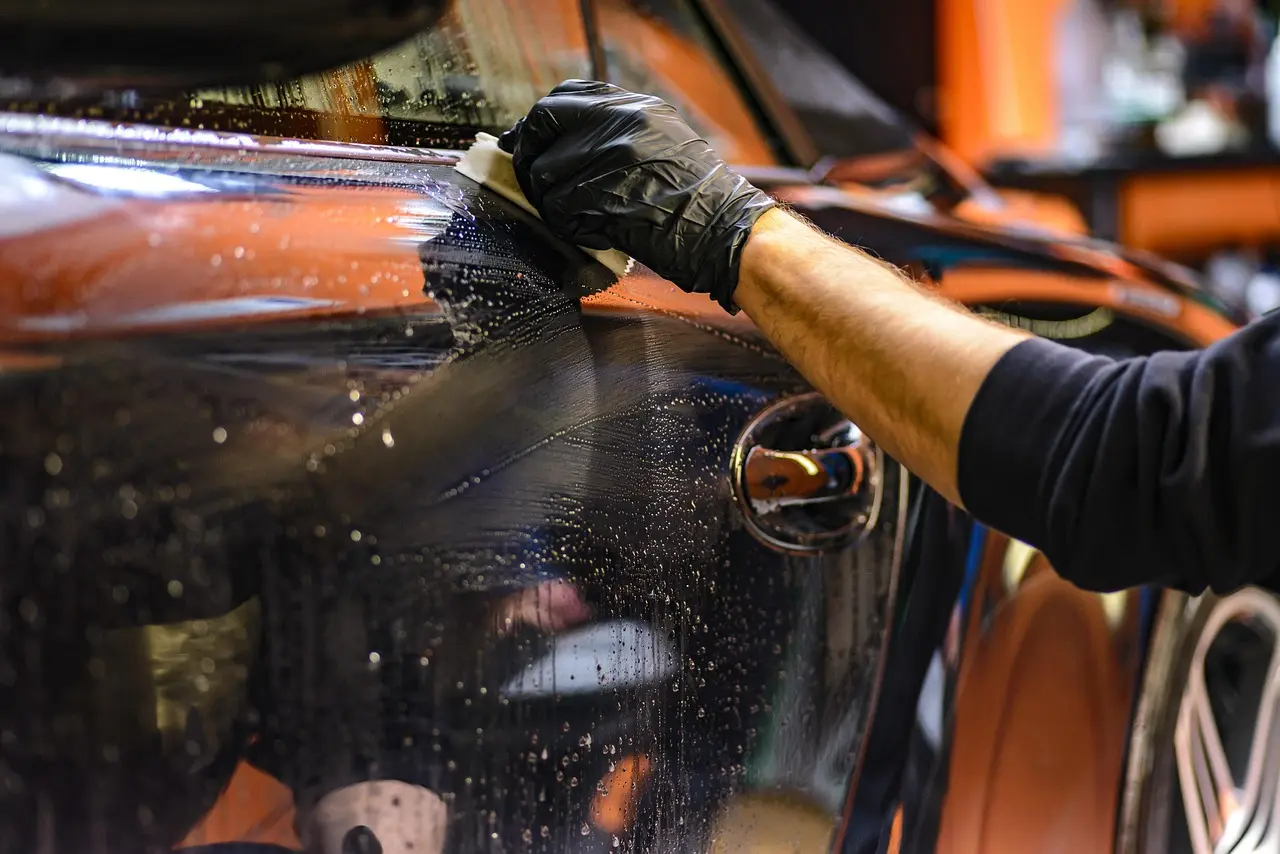
Hand washing is the least complicated on the vehicle itself if the process stays gentle and the openings are closed. It also lets you avoid brush contact, but it depends on careful technique, clean mitts, and enough rinsing before wiping. No wash type is likely to be safe if the charge port, windows, or sunroof are left open.
If an EV has a loose charge-port door and the wash uses high side sprays, that is a poor fit even if the rest of the car is fine. The door can lift, water can enter, and the seal may not recover properly afterward. The wash type is only part of the decision.
Do you need car wash mode or Neutral?
If your EV offers a dedicated car wash mode, use it before entering the wash. That mode usually reduces automated behavior that can interfere with washing, such as wipers, window movement, automatic locking, and some driver-assist features. For conveyor systems, you may also need Neutral or free roll so the car can move through correctly.
Tesla’s own guidance is a clear example: it places Car Wash Mode in Controls > Service, pairs it with a separate free-roll step for conveyor-style washes, and directs the driver to keep the car in Neutral during the wash. Other brands use different menus and different sequences, so the owner’s manual is the controlling reference.
If your vehicle has no wash mode, use the manual’s steps and mirror the same goals: keep windows closed, prevent the car from braking itself, keep the wipers from running, and keep the charge port closed and locked if possible. Some EVs need only a few changes. Others need a more specific procedure.
What car wash mode usually changes
Car wash mode is meant to reduce unwanted vehicle actions while the car is in the bay. It may close windows, lock the charge port, disable or alter windshield wipers, and turn off automatic locking. Some vehicles also quiet sensor behavior or driver-assist features so they do not react to spray, brushes, or nearby structures.
The exact behavior varies by brand and model. That matters because a wash that is harmless on one EV can create a fault on another if the car thinks it needs to protect itself. If the mode exists, use the manufacturer’s procedure rather than guessing at a generic setting.
When Neutral or free roll is required
Conveyor washes need the vehicle to move with the belt. If the car resists that motion, the wash can stop, the wheels can bind, or the operator may have to intervene. That is why some EVs require Neutral or free roll before entry, and why this step must be set before the car reaches the conveyor throat.
Do not assume every EV uses the same method. Some models keep roll-away behavior tied to a dedicated wash mode. Others separate the mode from the Neutral step. If the manual says one thing and the wash attendant says another, the manual wins unless the vehicle cannot be operated safely under that instruction.
What to do if your EV has no wash mode
Use the owner’s manual first, then match the same controls. Turn off auto wipers, confirm the charge port is closed, fold mirrors if the manual calls for it, and make sure any driver-assist or parking features that might brake the vehicle are not active. For a conveyor wash, verify the exact Neutral procedure before you enter.
If a non-Tesla EV has no special wash menu but the manual says the parking brake must not engage during a conveyor cycle, do not improvise. Follow the roll-away instructions in the manual or choose a touchless or hand wash that does not require conveyor movement.
EV wash checklist
Use this decision table to match the wash type with the right vehicle settings and to spot the cases that need a different plan. The red flags matter because a damaged seal, loose accessory, or nonstandard body part can change the risk even when the battery and drivetrain are fine. Check the last column after the wash, before you drive away.
| Wash type | Required vehicle settings | Red-flag situations |
|---|---|---|
| Conveyor | Use car wash mode if available; set Neutral or free roll exactly as the manual says; close windows, sunroof, and charge port door; disable auto wipers if the mode does not already do it. | Brake hold still active; unclear Neutral procedure; damaged charge-port door; loose trim; aftermarket hitch, racks, or accessories that could catch on the rail. |
| Rollover | Use car wash mode if available; keep the car stationary; close all openings; disable wipers and any feature that may wake the vehicle or move the windows. | Roof accessories, loose mirrors, peeling wrap, or recent paint repair that may react badly to brushes, pads, or drying equipment. |
| Touchless | Close all openings; use wash mode if offered; confirm the charge port is latched; disable wipers if they can trigger unexpectedly; fold mirrors if the manual recommends it. | Broken seals, an open or misaligned charge-port door, or sensor fault messages already showing before entry. |
| Hand-wash | Close all openings; keep the charge port closed; avoid forcing wipers or mirrors; use gentle washing around cameras, badges, and sensor surfaces. | Recent paint correction, a fresh wrap edge, loose trim, or a damaged sensor cover that should not be scrubbed. |
| Post-wash inspection | Check the charge port and seal, windows, wipers, mirrors, cameras, sensors, and warning lights before driving away. | Any moisture inside the charge area, a window not fully seated, a wiper that moved on its own, or a warning lamp that remains on. |
Yes/no decision flow: which wash should you choose?
Start with the wash type, then ask whether the car can meet the required setting changes without guesswork. If the answer is no for any step, switch to a simpler wash type or stop and read the manual. The cleanest path is the one that matches both the bay and the vehicle.
- Conveyor? Yes only if the manual clearly explains Neutral or free roll and the car can enter without brake hold, wheel bind, or control confusion.
- Rollover? Yes if the car can stay stationary with all openings closed and there are no roof or trim items likely to be struck.
- Touchless? Yes if the charge port, windows, and sunroof are fully closed and any wash mode instructions are easy to follow.
- Hand wash? Yes if you can keep pressure gentle around cameras, sensors, emblems, and wrap edges.
- Any red flag? If yes, use a different wash type or postpone until the problem is fixed.
What settings should you change before entry?
Close all windows, the sunroof, and the charge port door before the car reaches the wash. Then use car wash mode if the vehicle offers one, and switch off anything that can move or react unexpectedly. If the wash is conveyor style, confirm the Neutral or free roll step before the vehicle is accepted by the belt.
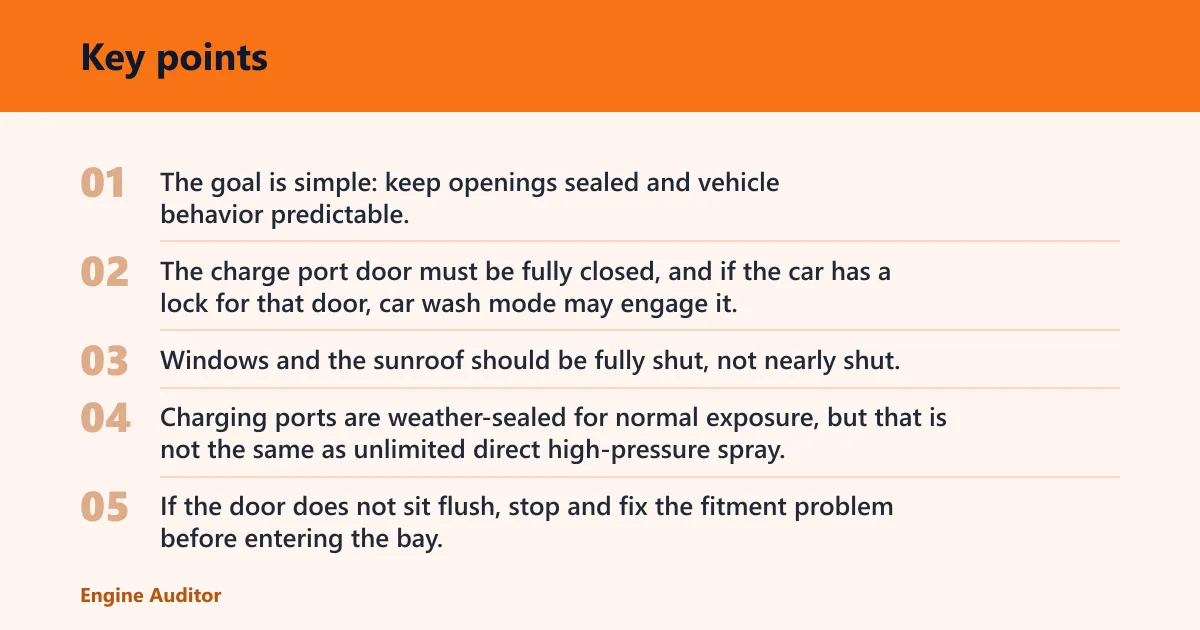
The goal is simple: keep openings sealed and vehicle behavior predictable. That means the windows should be fully closed, the roof opening should be shut, and the charge port should be latched. A charge port left open is a water ingress risk, and a partly closed window can turn a normal rinse into an interior cleanup job.
Windows, sunroof, and charge port door
These are the first items to check because they protect the cabin and charging hardware. The charge port door must be fully closed, and if the car has a lock for that door, car wash mode may engage it. Windows and the sunroof should be fully shut, not nearly shut.
Charging ports are weather-sealed for normal exposure, but that is not the same as unlimited direct high-pressure spray. “Mostly closed” is not enough. If the door does not sit flush, stop and fix the fitment problem before entering the bay.
Wipers, mirrors, cameras, sensors, and driver-assist features
Wipers should be disabled or controlled by the wash mode because they can start unexpectedly when spray or foam passes the windshield. Mirrors may need to be folded if the manual says so, especially in narrower bays. Cameras and sensors should be kept free of brush contact and heavy residue as much as the wash design allows.
Some EVs also turn off or alter driver-assist features during wash mode. That matters because those systems can interpret brushes, spray curtains, or side rails as obstacles. If the car offers a mode that quiets those systems, use it rather than relying on luck.
What to do when the operator’s instructions differ from the manual
Follow the owner’s manual first. If the operator asks for a step that conflicts with the manual, ask whether the wash has an EV-specific process or a conveyor requirement tied to the model. If the conflict remains, choose a different wash method rather than guessing.
That rule matters most with Neutral, auto-hold, and wiper settings. An attendant may give a quick instruction that works for many cars, but EVs vary by brand and model. The manual is the better source when the car’s drive state or parking logic could affect safety.
What can go wrong during the wash?
The main risks are not the battery pack. They are setup errors, open openings, and physical interference. Water can reach the charge port if the door is open or poorly seated. Brushes can scuff paint, catch trim, or leave residue on camera lenses and sensor surfaces. Wipers can move at the wrong time.
EVs can travel through car washes safely, but the more important issue is not “electric versus gas.” It is whether the vehicle is sealed, the controls are set correctly, and the wash type matches the car’s fitment. High-pressure water is not automatically dangerous by itself; the risk rises when it is aimed at an opening, a weak seal, or a damaged part.
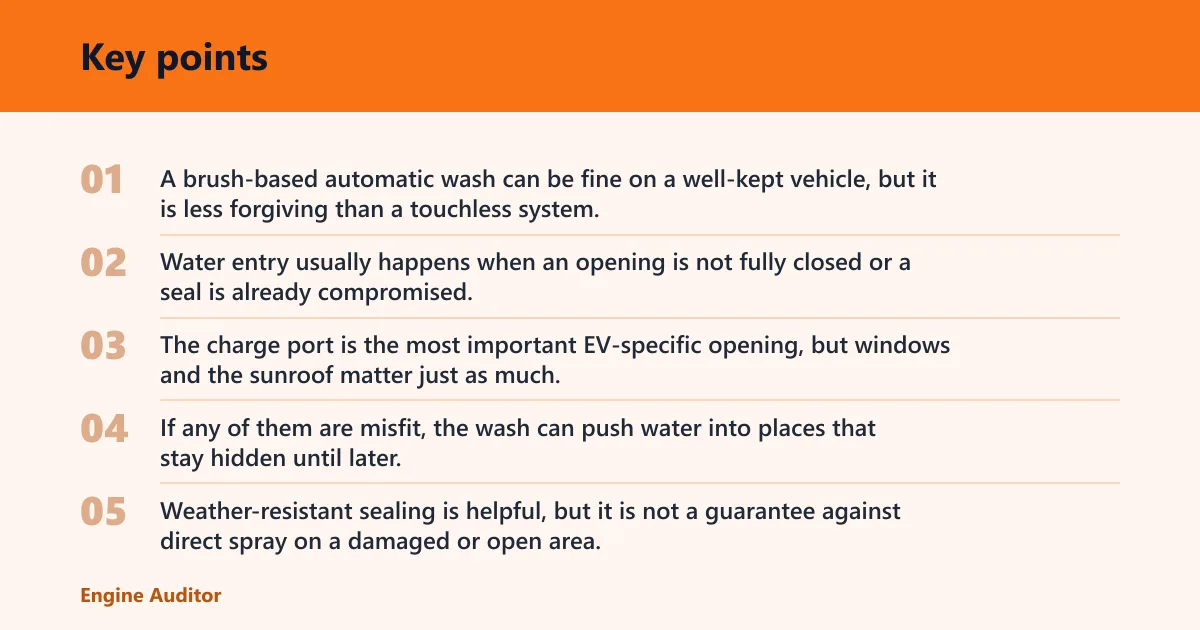
A brush-based automatic wash can be fine on a well-kept vehicle, but it is less forgiving than a touchless system. If the car has loose trim, a fresh wrap, recent paint repair, or an accessory that protrudes, the chance of contact damage rises. Those cases deserve extra caution.
Water entry at the charge port, seals, or windows
Water entry usually happens when an opening is not fully closed or a seal is already compromised. The charge port is the most important EV-specific opening, but windows and the sunroof matter just as much. If any of them are misfit, the wash can push water into places that stay hidden until later.
Weather-resistant sealing is helpful, but it is not a guarantee against direct spray on a damaged or open area. A door that is not flush, a window that is not fully seated, or a worn seal changes the answer immediately.
Brush contact, residue, and trim damage
Brushes and rollers can rub against paint, chrome, emblems, loose trim, or edge-sealed wraps. They can also leave residue on camera housings and sensor areas that matters for driver-assistance functions. Touchless systems reduce that risk because they rely more on water and detergent than on physical contact.
The key issue here is contact, not the battery. If the vehicle has fresh body work, a wrap edge lifting at the corner, or a loose mud flap, a brush system is the one most likely to make the issue worse.
Problems with cameras, sensors, and wipers
Cameras and sensors can be disrupted by soap film, water spots, or brush residue. That can trigger warnings, reduce driver-assist accuracy, or leave the system unsure about nearby objects after the wash. Wipers can also start unexpectedly if the vehicle does not enter the right mode.
These parts matter more on EVs because many models lean heavily on camera-based and sensor-based features. If a wash leaves any fault light or function warning behind, do not assume it will clear on its own. Inspect first.
What should you inspect after the wash?
Check the charge port, windows, wipers, mirrors, cameras, sensors, and warning lights after the wash. Look at the charge port area, windows, wipers, mirrors, cameras, sensors, and the instrument panel for warning lights. If anything looks wet where it should not be, or if a warning appears after the wash, stop and investigate before the next drive.
-
Check the charge port.
Make sure the door is fully closed and flush, and look for moisture around the seal. If the flap is stuck, misaligned, or wet inside, do not plug in until it is dry and visibly intact. -
Inspect the glass openings.
Confirm that every window and the sunroof stayed sealed. A half-open glass panel can leave a wet headliner, fogged glass, or water on the seat bolsters even if the wash looked normal from outside. -
Confirm the wipers and mirrors.
Make sure the wipers are parked correctly and the mirrors are not folded, loose, or out of position. A wiper that moved during the wash can catch at the next rain or smear the windshield. -
Scan cameras and sensors.
Look for residue, streaks, or blocked lenses around front, rear, and side sensor areas. If the car uses driver-assist features, clear any visible film before relying on them again. -
Review warning lights.
Check the dash or center display for brake, drivetrain, charging, or driver-assist warnings. If a warning stays on after the wash, use the owner’s manual to decide whether the car needs a reset or a service visit.
Often, the fix is simple: dry the charge area, wipe the cameras, and reset the settings you changed for the wash. But a warning that remains after a proper post-wash check deserves attention. That is especially true if the car was in Neutral for a conveyor wash and something about the roll-away procedure felt wrong.
Frequently asked questions
Can electric cars go through automatic car washes safely?
Yes, most electric cars can go through automatic car washes safely when the vehicle is prepared correctly. The main limits are not the battery, but the wash layout, the car’s mode settings, and the condition of openings, trim, and sensors. Touchless systems are usually the easiest fit.
Do high-pressure water sprays damage EVs?
High-pressure water is usually not the problem by itself. The risk is when spray is aimed at an open, damaged, or poorly seated area such as the charge port, a window, or a weak seal. A properly closed vehicle is far less likely to be affected.
Are electric cars more vulnerable than gas cars in a car wash?
Usually no. The main risks are similar to gas cars: open windows, loose trim, bad seals, and contact from brushes or rollers. EVs add one extra point to check: the charge port door. That makes setup more important, not the vehicle type itself.
Do Tesla vehicles need special settings before a car wash?
Yes. Tesla’s wash process is more explicit than many brands: use Car Wash Mode, follow the free-roll or Neutral steps as required, and make sure the car is set up so wipers, windows, and the charge-port door do not create a problem during the wash.
Do I need to put my EV in a special mode before a car wash?
If the vehicle offers a car wash mode, use it. That mode often changes wipers, locking, and other automated functions so the wash does not trigger them. If there is no special mode, use the owner’s manual and duplicate the same goals with manual settings.
Should I use touchless or brush car washes for an electric car?
Touchless is generally the safer default because it reduces contact with paint, cameras, and trim. Brush-based systems can still work, but they create more chance of contact damage or residue. If the vehicle has fresh paint, a wrap, or loose trim, touchless is the better choice.
Do I need to close the charge port before a car wash?
Yes. The charge port door should be fully closed before entering any wash, and locked if the vehicle’s wash mode does that automatically. A closed port reduces the chance of water entry, especially in systems that use strong side sprays or overhead jets.
Is it safe to use a car wash if my EV has cameras and sensors?
Usually yes, but those features make wash choice and preparation more important. Use a mode that quiets the vehicle’s automation if it offers one, and prefer touchless when possible. Afterward, check the lenses and sensor areas for residue that could affect driver-assist performance.
Should I keep an EV in Neutral during a conveyor car wash?
Often yes. Many conveyor washes require Neutral or free roll so the belt can move the vehicle correctly. The exact procedure varies by brand and model, so use the owner’s manual before entering the conveyor. Do not assume every EV uses the same sequence.
Products related to this article
Sponsored / affiliate links. As an Amazon Associate I earn from qualifying purchases. I may earn additional commission from eligible campaigns.