What Causes Road Force Imbalance in Tires?
A road-force imbalance is often linked to radial force variation in the tire, wheel, or mounting, and a road-force machine may flag readings above about 15 lb for correction or replacement. Ignore it, and you can keep chasing the same highway shake, wear tires unevenly, and replace parts that were never the main problem. This guide shows how to separate tire, wheel, mounting, and suspension causes with a practical diagnosis tree.
What road force imbalance means
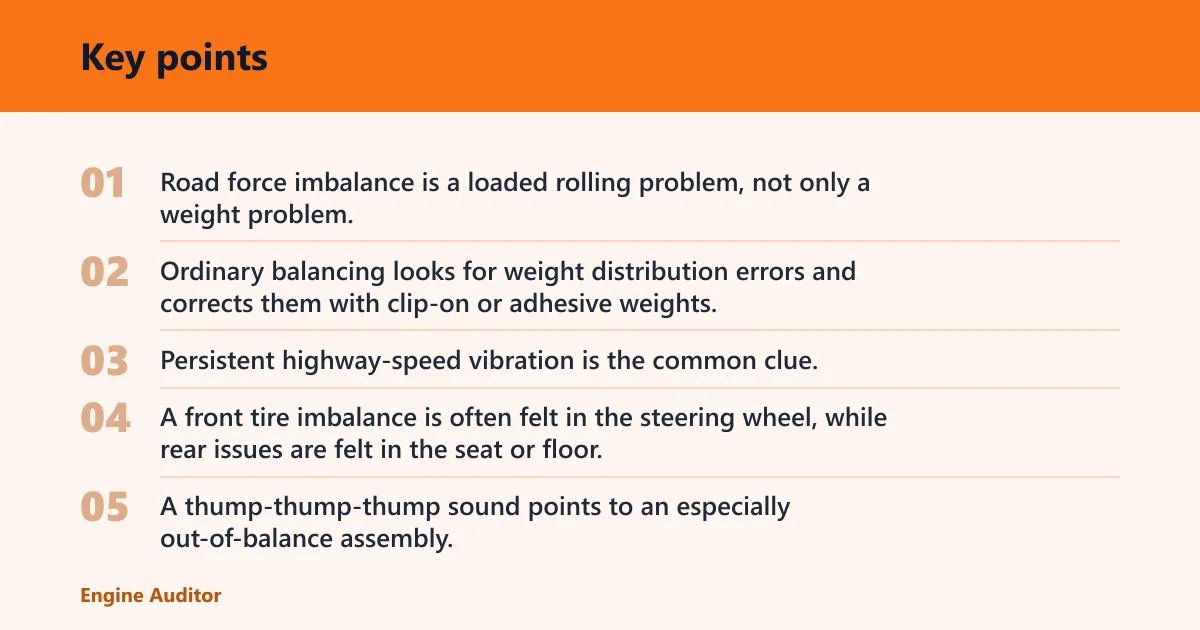


Road force imbalance is a loaded rolling problem, not only a weight problem. A road force balancer uses a load roller to regulate the force of the road on the tire and measures force variation and runout in the wheel-and-tire assembly. Standard wheel balancing corrects static and dynamic weight imbalance, but it does not fully diagnose loaded rolling defects.
That difference matters. A tire can balance on a spin machine and still make the car shake at highway speed if the tire has stiffness variation, an out-of-round condition, or if the wheel has runout.
Road force versus ordinary wheel balance
Ordinary balancing looks for weight distribution errors and corrects them with clip-on or adhesive weights. Road force testing adds load, which exposes how the tire and wheel behave under pressure, the same condition that happens on pavement. That is why a tire can pass a spin balancer and still shake the car at speed.
Common symptom patterns at freeway speed
Persistent highway-speed vibration is the common clue. It often shows up around freeway speeds, and vibration often shows up at 60 to 70 kilometers per hour when a wheel is out of balance. A front tire imbalance is often felt in the steering wheel, while rear issues are felt in the seat or floor. A thump-thump-thump sound points to an especially out-of-balance assembly.
Say your steering wheel shudders at 100 km/h after a normal balance, but the seat stays calm. That pattern points more toward a front tire, wheel, or mounting issue than a rear suspension fault.
What causes road force imbalance in tires?
The tire itself can create excess road force when its stiffness, shape, or wear is uneven around the circumference. Excessive road force is mostly due to wheel run-out or uneven tread or sidewall stiffness, and run-out can happen when a tire or rim is out of round when rolling. Low-profile and performance setups tend to expose these issues sooner.
Tire stiffness variation
Tire stiffness variation means the sidewall or carcass is not equally firm all the way around. Under load, one section deflects differently from another, which creates force variation. This is easier to feel in low-profile tires because there is less sidewall to absorb the mismatch.
That kind of tire may look round at a glance. Under a load roller, it can still show a high-force spot that repeats once per revolution.
Out-of-round tires and flat spots
An out-of-round tire or wheel can create hop, shake, or thump at speed, and it may need match mounting or replacement. Flat spots can come from hard braking, storage, or a tire that sat with low pressure. A flat can send the wheel-tire assembly out of balance.
Suppose a tire thumps for the first mile after pulling out of a driveway, then calms down as it warms. That often points to a flat spot, not a missing wheel weight.
Uneven wear and manufacturing variation
Uneven wear changes how the tread meets the road, which changes rolling force. Manufacturing variation can also leave one section stiffer or taller than the rest, so the tire passes spin balance but still pushes and pulls under load. That is why the same tire may feel acceptable in town and annoying on the highway.
What causes road force imbalance in the wheel and fitment?
The wheel and how it centers on the hub can create the same complaint. Wheel runout is radial or lateral deviation from a perfect round shape or true rotation, and it may come from a bent rim or manufacturing variation. A bent wheel can mimic balance problems and create vibration even when weight balance is correct.
Wheel runout and bent wheels
Runout is a shape problem. Radial runout means the wheel does not roll perfectly round; lateral runout means it wobbles side to side. A bent wheel may create vibration, a hop, or a repeatable rise in road force readings.
Road force balancing can help solve wheel vibration due to tire and rim run-out and wheel-mounting error, but it cannot straighten damaged metal. If the wheel is bent enough, replacement or repair is the real fix.
Hub-centric rings and centering problems
Some aftermarket wheels may need hub-centric rings to center the wheel properly on the hub. If the wheel is centered by the lug nuts instead of the hub, the assembly can sit slightly off-center and create a vibration complaint that looks like a tire problem. That issue can survive a normal balance.
This matters most when the complaint appears right after wheel changes, rotation, or tire service. The tire may be fine, but the mounting path is wrong.
Mounting errors that mimic balance issues
Improper mounting can leave the wheel slightly skewed, especially if a ring is missing, damaged, or the wheel face is not seated correctly. That can create a false balance complaint because the symptom feels like imbalance even though the root cause is fitment.
-
Confirm the complaint location. Note whether the shake is in the steering wheel, seat, or floorboard, because front problems usually show in the wheel and rear problems in the body. That gives the tester a direction before the car goes on the machine.
-
Check for visible damage. Look for curb rash, bent lips, missing hub rings, and uneven tread wear before blaming the tire. Everyday driving can cause imbalance, especially after hitting a curb or pothole.
-
Measure road force. Use a road force balancer, not only a spin balancer, to load the tire and wheel assembly. The machine measures force variation and runout, which helps separate a weight problem from a loaded rolling defect.
-
Inspect the pattern. Compare the high spot on the tire to the high spot on the wheel. If the peaks line up badly, match mounting may reduce the force variation.
-
Rule out other systems. If the road force numbers look normal yet the vibration stays, check brakes, wheel bearings, and suspension parts. Alignment is a separate check, and it does not replace balancing or road-force testing.
How technicians separate the cause
A road force balancer shows more than a simple weight issue. It can point to tire stiffness variation, out-of-round behavior, wheel runout, or a mounting problem. The tester is looking for the force pattern, the amount of runout, and whether the symptom fits the wheel location.
When the reading is high on one tire, a common next step is to rotate the tire on the rim to align high and low spots. That is match mounting. If the problem remains after remounting, the better answer may be replacement.
Sometimes the machine finds little wrong with the tire and wheel, yet the vibration stays. That is when a suspension or brake issue becomes more likely, since worn control arm bushings, sticking brakes, or a bad bearing can create false positives during diagnosis.
Why alignment is different
Alignment changes the angles that guide the tires. Balance changes how mass and load behave as the wheel spins. They address different problems, so a straight-ahead pull or tire wear pattern can call for alignment while a shake calls for balance or road-force testing.
Road force diagnostic matrix
| Symptom | Likely cause | What the tester sees | The usual fix |
|---|---|---|---|
| Steering wheel shake at freeway speed | Bent wheel | Runout on the wheel, sometimes with a heavy spot that repeats each revolution | Repair or replace the wheel, then rebalance |
| Thump-thump-thump at speed | Stiff spot | One section shows higher force under the load roller | Match mount if possible; replace if the force stays high |
| Hop or shake after a recent tire install | Out-of-round tire | Radial force variation tracks with a high or low spot in the tire | Match mounting or tire replacement |
| Shake that fades after the first few miles | Flat spot | Temporary shape change that becomes less obvious as the tire warms | Drive it to see if it clears; replace if it does not |
| Vibration plus uneven shoulder wear | Uneven wear | Force variation rises where tread depth or shape is no longer uniform | Repair the wear cause and replace the tire if needed |
| Vibration after aftermarket wheel install | Hub-centric fit issue | Wheel does not center properly on the hub, even if the balance is correct | Install the correct rings or correct the wheel fitment |
| Road force reading looks odd, but tires look normal | Suspension-related false positives | Play in joints or bearings distorts the result during inspection or road test | Inspect suspension, bearings, and brakes before retesting |
When road force balancing helps and when it does not
Road force balancing helps when the problem is in the tire, wheel, or how the two sit together. It is the right next step when a normal balance fails and the car still vibrates. It is less useful when the tire is damaged beyond correction or when the vibration comes from brakes or suspension.
Match mounting is often the next step after measurement. The tire is rotated on the rim so the high spot on one part lines up with the low spot on the other, which can reduce force variation. That works for some tires. It does not rescue a tire with serious damage.
Replacement is the better outcome when the tire remains out of round, the stiff spot stays high, or the wheel is bent beyond serviceable repair. If the machine shows a repeatable problem and the vibration does not improve after remounting, replacement usually ends the cycle of repeat visits.
Frequently asked questions
What is road force balancing a tire?
Road force balancing is a test and correction process that uses a heavy load roller to simulate road pressure while the wheel turns. It measures force variation and runout, then helps the technician decide whether to rebalance, match mount, repair, or replace the tire or wheel.
Why does my car still vibrate after a tire balance?
If the car still vibrates after a normal balance, the cause may be road force variation, wheel runout, a bent rim, or a fitment problem such as a missing hub-centric ring. It can also be a brake, bearing, or suspension issue, which is why the next diagnosis should not stop at weights.
Can a bent rim cause road force issues?
Yes. A bent rim can create wheel runout and vibration even when the wheel is correctly balanced by weight. It can also make the road force reading look worse because the assembly no longer rolls true, so repair or replacement may be needed before the shake goes away.
Does road force balancing fix out-of-round tires?
Sometimes, but not always. Match mounting can reduce the effect of a minor out-of-round tire by aligning high and low spots, yet a tire with severe shape error or damage may still need replacement. Road force balancing is a diagnostic and correction step, not a cure for every defect.
When should tires be road force balanced instead of spin balanced?
Use road force balancing when a normal spin balance does not solve persistent highway-speed vibration, especially after a tire change, curb hit, pothole impact, or when the car feels a thump at speed. It is also the better choice for sensitive vehicles and low-profile setups that reveal loaded defects more readily.
Products related to this article
Sponsored / affiliate links. As an Amazon Associate I earn from qualifying purchases. I may earn additional commission from eligible campaigns.