What Happens When the Accelerator Pedal Goes Bad? (Real Effects Explained)
It’s a weird feeling, isn’t it? You press the gas pedal, expecting a smooth surge of power, but instead, something just feels… off. Maybe the car lurches, or it doesn’t respond right away.
That can be super frustrating and even a little scary. Many drivers don’t think much about their accelerator pedal until it acts up. It’s a crucial part of your car, connecting you directly to the engine’s speed.
So, when it starts misbehaving, it’s important to understand what’s going on.
When your car’s accelerator pedal goes bad, you might notice strange driving behaviors. These can include sudden acceleration, a lack of response when you press the pedal, or the engine revving unexpectedly. It can affect your ability to control your speed safely.
Understanding the Accelerator Pedal System
Your car’s accelerator pedal is more than just a simple lever. In modern cars, it’s part of a complex electronic system. This system tells the engine how much fuel and air to mix.

NewYall
NewYall Accelerator Gas Pedal Assembly with Position…
- For Cadillac Escalade 2007-2011; Escalade EXT 2007-2011
- For Chevrolet Avalanche 2007-2011; Silverado 1500 2007-2011; Silverado 2500 HD 2007-2011; Silverado 3500 HD 2007-2011; Suburban 15…
- For GMC Sierra 1500 2007-2011; Sierra 2500 HD 2007-2011; Sierra 3500 HD 2007-2011; Yukon 2007-2011; Yukon XL 1500 2007-2011; Yukon…
As an Amazon Associate I earn from qualifying purchases.
This controls how fast your car goes. Older cars used a physical cable. This cable directly linked the pedal to the engine’s throttle body.
But most cars made in the last 15 to 20 years use a “drive-by-wire” system.
In a drive-by-wire setup, the pedal itself has a sensor. This sensor measures how far you push it down. It’s called the accelerator pedal position sensor (APPS).
This sensor sends an electrical signal to the car’s computer. The computer then tells the throttle body how to open. This controls the airflow to the engine.
This system allows for more precise control. It also helps with things like cruise control and traction control.
The throttle body is a valve. It’s located between the air intake and the engine’s cylinders. When you press the gas pedal, the signal from the sensor tells this valve to open up.
The more the valve opens, the more air gets into the engine. More air means the engine can burn more fuel. This makes the car go faster.
So, when something goes wrong with the accelerator pedal, it’s usually the sensor or the wiring connected to it. Sometimes, the issue can be with the throttle body itself. But the pedal sensor is a common culprit.
It’s the first step in telling the car what you want it to do. When that first step is broken, the whole process gets messed up.
My Own Brush with a Dodgy Pedal
I remember one particularly awful evening. I was driving home from a friend’s house, the sky was a deep, bruised purple, and my mind was miles away, replaying a silly conversation. I eased off the gas to slow down for a red light.
Suddenly, my car seemed to forget I wanted to stop. It just kept… going. Not fast, but definitely not slowing down.
My foot wasn’t even on the pedal!
A wave of pure panic washed over me. My heart hammered against my ribs. I instinctively slammed on the brakes.
The car slowed, but it felt jerky, like it was fighting me. I pulled over to the side of the road, my hands shaking on the steering wheel. I just sat there for a minute, catching my breath and trying to figure out what had just happened.
Was I imagining it? No, it felt too real.
I tried gently pressing the accelerator again. Nothing. Then, after a moment, the engine suddenly roared to life, revving way higher than I’d intended.
It was like a wild animal I couldn’t control. I quickly lifted my foot, and it settled down. But the fear lingered.
I limped home the rest of the way, driving extra cautiously, my eyes glued to the speedometer and the gas pedal, terrified it would happen again.
Later, I learned that a faulty accelerator pedal position sensor was the likely cause. It was sending incorrect signals to the car’s computer. This made the car think I was pressing the pedal when I wasn’t, or not pressing it when I was.
That experience really hammered home how important these seemingly simple parts are. They’re critical for our safety on the road.
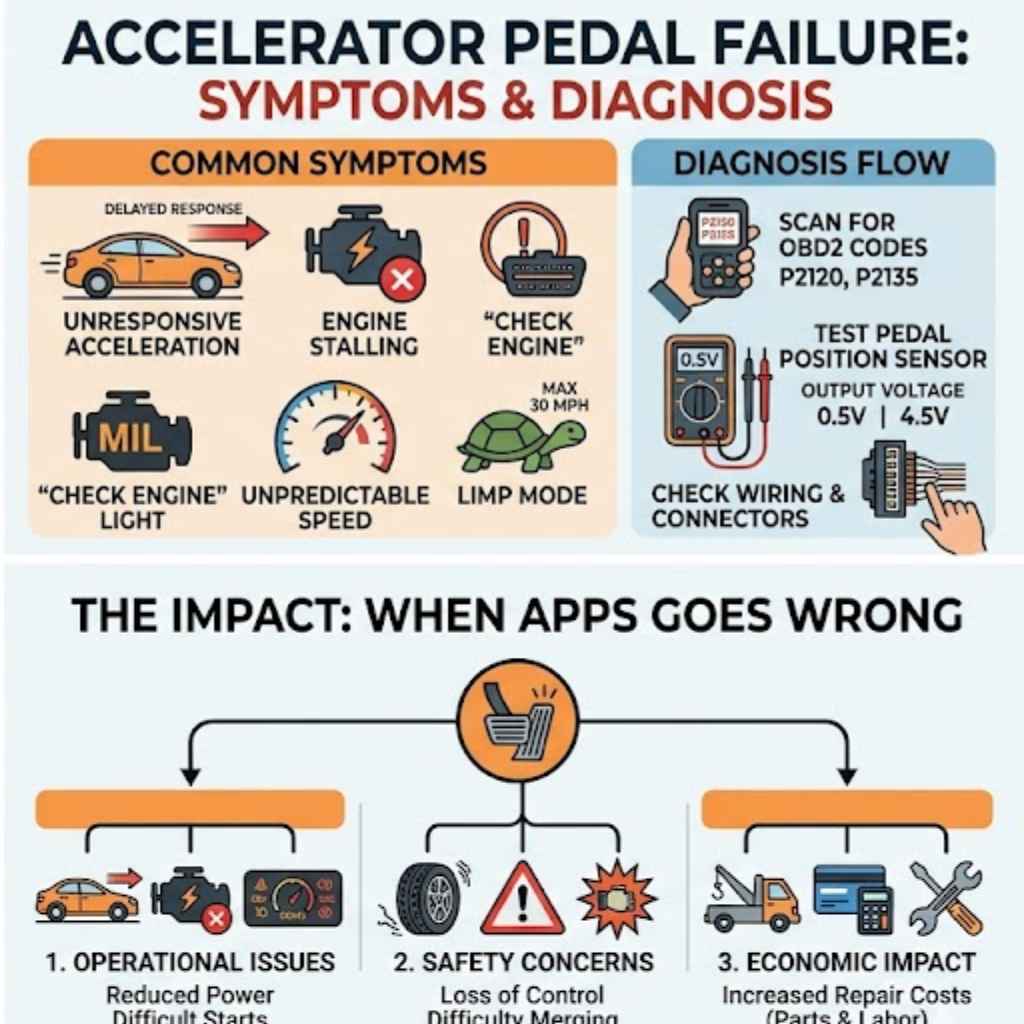
Common Symptoms of a Failing Accelerator Pedal
No Response: You press the pedal, but nothing happens. The car won’t speed up.
Sudden Acceleration: The car suddenly speeds up without you pressing the gas. This can be very dangerous.
Jerky Acceleration: The car doesn’t speed up smoothly. It might lurch or hesitate.
Check Engine Light: Often, a fault in the pedal system will trigger your car’s “Check Engine” light. This is your car telling you something is wrong.
Stalling: The engine might cut out unexpectedly, especially at idle.
Cruise Control Issues: If your cruise control stops working, it could be a sign of a pedal problem.
Why Does the Accelerator Pedal Go Bad?
Several things can cause an accelerator pedal to fail. The most common issues happen with the accelerator pedal position sensor (APPS). This sensor is a small electronic component.
It can wear out over time. Like any part that gets used constantly, its internal parts can degrade. This leads to faulty signals being sent.
Another common problem is with the wiring. The wires connecting the sensor to the car’s computer can become damaged. This might happen due to friction, corrosion, or if something pinches them.
Damaged wires mean the signal can’t get through correctly. Or it might get interrupted.
The pedal itself can also have mechanical issues. The spring that returns the pedal to its resting position can weaken. This might make the pedal feel loose or sticky.
While less common, the actual connection point where the sensor attaches to the pedal assembly can also fail.
In some cases, the problem isn’t the pedal at all. It could be the throttle body. The throttle body is controlled by a motor.
If this motor fails or gets dirty, it won’t open and close properly. This can mimic the symptoms of a bad pedal sensor. The car’s computer tries to control the throttle, but the physical part isn’t responding as it should.
Environmental factors can also play a role. Extreme temperatures, moisture, and road salt can all contribute to the wear and tear of electronic components and wiring. If you live in an area with harsh weather, your car’s parts might fail sooner.
Causes of Accelerator Pedal Failure
- Sensor Wear: The electronic components inside the pedal position sensor wear out over time from constant use.
- Wiring Damage: Wires can fray, corrode, or be pinched, interrupting the electrical signal.
- Mechanical Problems: The pedal’s return spring can weaken, or the connection to the sensor can loosen.
- Throttle Body Issues: A faulty motor or dirt buildup in the throttle body can cause similar symptoms.
- Environmental Factors: Extreme heat, cold, moisture, and road salt can accelerate wear and tear on electronic parts.
The Mechanics Behind the Malfunction
When the accelerator pedal position sensor starts to go bad, it’s usually not a sudden, complete failure. It often begins subtly. You might notice a slight hesitation when you first press the pedal.
Or perhaps the engine revs a bit higher than usual when you ease off the gas. These small changes can be easy to overlook at first.
The sensor typically has two or three separate circuits. These circuits send signals to the car’s computer. If one circuit starts to fail, the computer can sometimes compensate using the other.
This is why you might not get a “Check Engine” light right away. The computer sees conflicting information. It knows something isn’t quite right.
As the sensor degrades further, the signals become more erratic. The computer might receive a signal that says the pedal is pressed down halfway when you’ve only touched it lightly. Or it might get no signal at all.
This is when you start seeing more dramatic symptoms like unexpected acceleration or a complete lack of response.
The car’s computer, often called the Powertrain Control Module (PCM) or Engine Control Unit (ECU), is programmed to detect these discrepancies. When the signals from the APPS are outside the expected range or inconsistent with other sensor readings (like vehicle speed), it triggers a diagnostic trouble code (DTC). This code is stored in the computer’s memory and illuminates the “Check Engine” light on your dashboard.
A technician can read these codes to help diagnose the problem. However, sometimes the sensor is failing intermittently. This means it works fine sometimes and poorly at others.
This can make it tricky to diagnose. The problem might not be present when the car is scanned.
How a Faulty Sensor Affects Driving
Inconsistent Signals: The sensor sends signals that don’t match the actual pedal position.
Conflicting Data: The car’s computer receives mixed information from the sensor.
Erratic Throttle Control: This leads to unpredictable engine response.
Diagnostic Codes: The car’s computer detects the fault and stores a code.
Check Engine Light: The dashboard warning light turns on to alert the driver.
Real-World Scenarios and What to Watch For
Imagine you’re driving on a busy highway. You want to change lanes. You signal, check your mirrors, and start to move over.
Just as you begin to accelerate into the new lane, the car suddenly hesitates. It feels like it loses power for a second. You might have to push the pedal harder to get it to respond.
This is a classic sign of a sensor problem.
Or think about merging onto the freeway. You need to pick up speed quickly. You floor the accelerator, but the car just doesn’t go.
It feels sluggish, unresponsive. You might be stuck in traffic, trying to make progress, and the pedal feels heavy or sticky. You push it, and it takes a long time for the engine to react, if it reacts at all.
Another common situation happens when you’re stopped at a traffic light. You release the brake, ready to go. You gently press the accelerator, and the car lurches forward aggressively.
You didn’t intend to accelerate that quickly. This can be startling and makes you feel like you have less control over your vehicle.
In some instances, the car might enter a “limp mode.” This is a safety feature. When the computer detects a serious problem with a critical system, like the accelerator pedal, it can limit the engine’s power. This allows you to drive the car slowly and safely to a repair shop.
You’ll likely notice a significant loss of power, and the “Check Engine” light will definitely be on.
I recall a friend mentioning their car would randomly surge forward at low speeds. They were driving through a parking lot, very slowly, and the car suddenly accelerated on its own. They managed to brake in time, but it was a terrifying moment.
It turned out to be a faulty pedal sensor that was intermittently sending a “pedal pressed” signal.
Everyday Driving Situations Affected
Highway Merging: Hesitation or lack of power when trying to speed up to merge.
Freeway Driving: Sluggishness or poor response when maintaining or increasing speed.
City Traffic: Lurching forward unexpectedly at low speeds or after stopping.
Parking Lots: Sudden, unintended acceleration when moving slowly.
Stalling at Idle: The engine might cut out when the car is stopped.
What This Means for Your Driving Safety
A malfunctioning accelerator pedal is not just an inconvenience; it’s a serious safety concern. The ability to control your car’s speed is fundamental to safe driving. When that control is compromised, the risk of accidents increases significantly.
Sudden, unintended acceleration is particularly dangerous. Imagine this happening when you’re in heavy traffic or near pedestrians. It can lead to collisions with other vehicles or running off the road.
The unpredictability of the car’s response makes it difficult to react appropriately.
Conversely, a lack of response can be just as hazardous. If you need to accelerate quickly to avoid a dangerous situation, and your pedal doesn’t work, you could be putting yourself and others in harm’s way. This is especially critical when merging onto highways or navigating intersections.
The erratic behavior can also confuse other drivers. If your car is constantly accelerating and decelerating unexpectedly, it can disrupt the flow of traffic and create confusion, potentially leading to rear-end collisions or other accidents.
It’s also important to consider the psychological impact. Driving a car that feels unreliable can cause a lot of stress and anxiety. This can further impair your focus and decision-making while driving.
You might find yourself constantly worrying about when the next problem will occur, rather than concentrating on the road.
For these reasons, it’s crucial to address any suspected accelerator pedal issues immediately. Don’t ignore the warning signs, even if they seem minor at first. Your safety and the safety of others on the road depend on your car functioning as it should.
Safety Implications of a Faulty Pedal
- Increased Accident Risk: Unpredictable acceleration or lack of response makes driving dangerous.
- Loss of Control: You might not be able to control your car’s speed when you need to most.
- Confusion for Other Drivers: Erratic car behavior can cause traffic disruptions and accidents.
- Psychological Stress: Driving an unreliable car can lead to anxiety and reduced focus.
- Emergency Situations: Inability to react quickly in critical moments.
When to Seek Professional Help
If you notice any of the symptoms we’ve discussed, it’s time to get your car checked by a professional. Don’t try to ignore it or hope it goes away on its own. These issues rarely fix themselves and can often worsen over time.
The “Check Engine” light is your car’s way of telling you it needs attention. Even if the problem seems intermittent, the diagnostic codes stored in the computer can give a mechanic valuable clues. They can also use specialized tools to monitor the accelerator pedal sensor’s signals in real-time.
A qualified mechanic will be able to diagnose whether the issue is with the accelerator pedal sensor, the wiring, the throttle body, or something else entirely. They have the experience and equipment to pinpoint the exact cause of the problem.
Trying to fix accelerator pedal issues yourself can be risky if you’re not experienced. Incorrectly diagnosing or repairing these systems can lead to further damage or create new safety hazards. It’s best to leave this to the experts.
They know the specific requirements for your car’s make and model.
If your car enters “limp mode,” it’s an even stronger signal that you need immediate professional attention. Don’t drive your car extensively in this mode. Get it to a service center as soon as possible to prevent further damage to the engine or transmission.
Signs You Need a Mechanic
Illuminated Check Engine Light: This is the most obvious indicator.
Inconsistent Pedal Response: The car doesn’t react the same way every time you press the pedal.
Unusual Noises: Strange sounds coming from the pedal area or engine when accelerating.
Sudden Loss of Power: The car feels weak or sluggish unexpectedly.
Car Enters Limp Mode: Engine power is severely reduced as a safety measure.
Can I Drive with a Bad Accelerator Pedal?
The short answer is: it’s not recommended, and in some cases, it can be extremely dangerous.
If the “Check Engine” light is on, but the car seems to be driving mostly normally, you might be able to drive it for a short distance to get to a mechanic. However, you should do so with extreme caution. Be aware that the problem could worsen at any moment.
If the car is experiencing sudden, unintended acceleration, or if the pedal is completely unresponsive, you should not drive the vehicle. Driving in such a condition puts you and others at severe risk of a serious accident. In these cases, it’s best to have the car towed to a repair shop.
If the car has gone into “limp mode,” you can typically drive it, but at a significantly reduced speed and power. This mode is designed to get you to safety or a repair facility without causing further damage. However, you should avoid any driving that requires quick acceleration or high speeds.
Ultimately, the decision to drive depends on the severity of the symptoms. If there’s any doubt about your car’s ability to be controlled safely, err on the side of caution. It’s better to pay for a tow than to risk an accident.
Driving with Pedal Issues: A Quick Guide
Minor Symptoms (e.g., slight hesitation): Drive with extreme caution to a mechanic. Avoid long trips.
Moderate Symptoms (e.g., jerky acceleration, intermittent response): Avoid driving if possible. If you must, drive slowly and carefully.
Severe Symptoms (e.g., sudden acceleration, no response, limp mode): Do NOT drive the vehicle. Arrange for a tow.
What to Expect During Repair
When you take your car to a mechanic for an accelerator pedal issue, they will typically follow a diagnostic process.
First, they’ll connect a diagnostic scanner to your car’s computer. This will read any stored trouble codes. These codes will point them towards the specific system that’s having problems.
Next, they will perform a visual inspection. They’ll check the wiring harness connected to the accelerator pedal sensor for any obvious signs of damage, corrosion, or loose connections. They’ll also inspect the pedal assembly itself.
If the codes and visual inspection don’t give a clear answer, they might use a multimeter. This tool can test the electrical resistance and voltage signals from the pedal position sensor. They can compare these readings to the manufacturer’s specifications.
If the sensor is confirmed to be faulty, it will need to be replaced. This is usually a straightforward job. The mechanic will remove the old sensor and install a new one.
Depending on the car model, this might be done from under the dashboard or by removing some trim panels.
Sometimes, the wiring harness might need repair or replacement if it’s significantly damaged. In rare cases, the throttle body might be the source of the problem and will need servicing or replacement.
After the repair, the mechanic will clear the diagnostic codes from the computer. They will then take the car for a test drive. This is to ensure the accelerator pedal is functioning correctly and that all symptoms have been resolved.
They will also check that the “Check Engine” light stays off.
The cost of repair can vary. It depends on the make and model of your car and the specific part that needs replacing. Replacing just the sensor is usually less expensive than replacing the entire pedal assembly or a throttle body.
The Repair Process Explained
Scan for Codes: A computer reads error codes from the car’s system.
Visual Inspection: Mechanic checks pedal wiring and assembly for damage.
Electrical Testing: Using tools to test sensor signals and voltage.
Part Replacement: If faulty, the sensor, wiring, or throttle body is replaced.
Clearing Codes: Diagnostic trouble codes are removed from the computer’s memory.
Test Drive: Mechanic verifies the repair and ensures normal operation.
Preventive Measures and Maintenance
While you can’t entirely prevent an electronic component like an accelerator pedal position sensor from eventually wearing out, there are things you can do to help maintain its longevity and catch issues early.
Regular maintenance is key. This includes keeping up with your car’s scheduled service intervals. During routine check-ups, a mechanic can often spot potential issues before they become major problems.
They can check for loose connections or signs of wear.
Keeping the interior of your car clean can also help. Avoid spilling liquids near the pedal area. Moisture and contaminants can get into the sensor and cause corrosion over time.
If you do spill something, clean it up promptly and ensure the area dries completely.
Be mindful of how you use your car. While modern cars are built tough, excessively aggressive driving can put more stress on all components, including the pedal assembly. Driving smoothly can contribute to the overall health of your vehicle.
Pay attention to your car’s behavior. Don’t ignore small changes. If you notice a slight hesitation, a bit of roughness, or anything unusual with how the pedal feels or responds, get it checked out.
Early detection often leads to simpler and less expensive repairs.
Finally, if you live in an area with harsh weather conditions, like extreme cold, heat, or heavy road salt use, be extra vigilant. These conditions can accelerate wear on automotive components. Regular checks are even more important.
Tips for Pedal Longevity
- Follow Scheduled Maintenance: Regular check-ups can reveal early signs of trouble.
- Keep Interior Clean: Avoid spills near the pedal area to prevent contamination.
- Drive Smoothly: Gentle acceleration and braking reduce stress on components.
- Address Minor Issues Promptly: Don’t ignore small changes in pedal feel or car response.
- Be Aware of Climate Effects: In harsh weather, pay extra attention to your car’s performance.
When Is It Normal for an Accelerator Pedal to Feel Different?
It’s important to distinguish between a problem and normal operation. Sometimes, the way your accelerator pedal feels can change slightly for reasons unrelated to a fault.
For example, if your car has different driving modes (like “Eco,” “Normal,” or “Sport”), the accelerator pedal’s responsiveness will change. In “Eco” mode, the pedal might feel less sensitive, requiring a firmer press to get the same acceleration. In “Sport” mode, it will likely feel much more responsive, with even a light touch causing a significant surge.
Also, after certain software updates or if the battery has been recently disconnected, the car’s computer might need a short “re-learning” period for the pedal’s input. During this time, you might notice slightly unusual behavior for a few miles. This usually resolves itself quickly.
Cold weather can sometimes make rubber components feel stiffer, which might slightly alter the pedal feel. However, this is usually a minor change and doesn’t affect the car’s performance.
The key difference between normal variation and a problem is that a faulty pedal system will lead to unpredictable or inconsistent behavior. The car won’t respond reliably. Driving modes provide consistent, predictable changes in responsiveness.
Normal fluctuations are usually minor and don’t cause issues like sudden acceleration or a complete lack of power.
Normal Pedal Behavior vs. Faulty Behavior
Normal: Consistent response based on selected driving mode (Eco, Sport).
Normal: Slight stiffness in very cold weather, but performance is unaffected.
Normal: Brief adaptation period after battery disconnect or software update.
Faulty: Unpredictable surges or hesitations regardless of driving mode.
Faulty: Complete lack of response or extremely jerky acceleration.
Faulty: Check Engine light illuminated with specific pedal-related codes.

Frequently Asked Questions
Can a bad accelerator pedal cause my car to stall?
Yes, a faulty accelerator pedal position sensor can cause the engine to stall. If the sensor sends incorrect signals to the car’s computer, it might not be able to properly manage the air and fuel mixture needed to keep the engine running, especially at idle or low speeds.
How much does it cost to replace an accelerator pedal sensor?
The cost can vary depending on your car’s make and model, and your location. Generally, replacing the accelerator pedal position sensor itself can range from $150 to $400. This includes the cost of the part and labor.
If the entire pedal assembly needs replacement, it could be more expensive.
Is it safe to drive with the Check Engine light on due to a pedal issue?
It depends on the severity of the issue. If the car is driving somewhat normally but the light is on, you might be able to drive it cautiously to a mechanic. However, if you notice sudden acceleration, loss of power, or jerky movements, it is not safe to drive and the car should be towed.
What’s the difference between an accelerator pedal sensor and a throttle position sensor?
The accelerator pedal position sensor (APPS) is located in the pedal assembly and measures how far you push the pedal. The throttle position sensor (TPS), on the other hand, is usually located on the throttle body and measures how far the throttle plate is open. In a drive-by-wire system, the car’s computer uses the APPS signal to control the throttle body, which is then monitored by the TPS.
Can a bad gas pedal affect my car’s fuel economy?
Yes, a faulty accelerator pedal can negatively impact your fuel economy. If the sensor is sending incorrect signals, it can cause the engine to receive too much fuel or operate inefficiently. This means you might burn more gas than usual, leading to worse mileage.
How often should the accelerator pedal be replaced?
The accelerator pedal and its sensor are not typically on a fixed replacement schedule. They are designed to last the life of the vehicle. Replacement is usually only needed if the component fails or shows signs of wear and tear, which can happen at any mileage or age.
Conclusion
The accelerator pedal is a vital link between you and your car’s performance. When it malfunctions, it can create a range of unsettling and dangerous driving conditions. Recognizing the symptoms of a failing pedal system is key to ensuring your safety on the road.
From sudden surges of speed to a complete loss of power, the signs can be varied. But they all point to a critical system that needs attention. Don’t delay in seeking professional help if you suspect a problem.
Addressing these issues promptly can prevent accidents and costly further damage to your vehicle.
See also here’s what happens.
Related pick: Check today's price on Amazon See also best way to put velcro on pedals so they actually stay.