How to Tell If Your Pedal Sensor Is Failing
If the pedal sensor signal jumps, freezes, or disagrees with a second track, the accelerator pedal sensor may be failing; if the signal is steady, look at wiring, the throttle body, or a stuck pedal instead. Ignoring it can leave you with no throttle, limp mode, or reduced power. This guide shows the symptom checks, scan data clues, and simple tests that separate pedal sensor failure from wiring, throttle-body, and stuck-pedal problems.
What the pedal sensor does
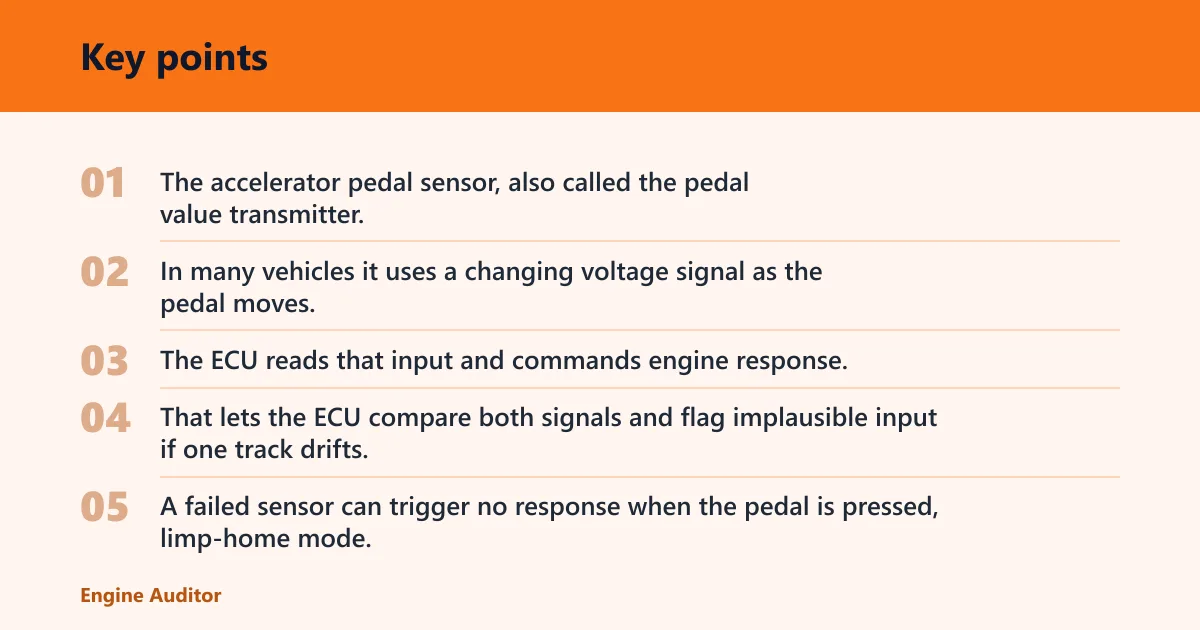


The accelerator pedal sensor, also called the pedal value transmitter, reports pedal position to the engine control unit. In many vehicles it uses a changing voltage signal as the pedal moves. The ECU reads that input and commands engine response.
Many pedals use dual redundant tracks. That lets the ECU compare both signals and flag implausible input if one track drifts, sticks, or drops out. A failed sensor can trigger no response when the pedal is pressed, limp-home mode, and a check engine light.
What a failing signal looks like
A healthy pedal signal should change smoothly as the pedal moves. A bad sensor often shows a jump, dead spot, freeze, or mismatch between tracks. If the ECU sees a value that does not fit the other channel, it may store fault codes and cut power as a failsafe. Example P-codes can include correlation or circuit faults, and live data often shows one track moving smoothly while the other follows in step, with no sudden dropouts.
How to tell if your accelerator pedal sensor is bad
The quickest clue is pattern, not a single symptom. A bad accelerator pedal sensor often causes delayed throttle response, intermittent hesitation, or no response at all, but those same complaints can come from a stuck pedal, wiring fault, or throttle-body problem. The key is to separate mechanical, electrical, and control faults before replacing parts.
No throttle response
If the engine idles normally but the pedal does little or nothing, the ECU may not be receiving a valid pedal signal. That can happen with a failed sensor, missing supply voltage, bad ground, damaged wiring, or a connector that is not seated fully.
Intermittent hesitation
Intermittent throttle lag points to a signal that drops in and out. That often means a loose connector, corrosion, broken wire strands inside the wiring loom, or an internal sensor fault that appears only when the pedal is moved a certain way.
Limp-home mode
Can a bad accelerator pedal sensor cause limp mode? Yes. The ECU may limit power if the pedal signal is implausible or missing. Limp-home mode is meant to let the vehicle be moved carefully, not driven normally, so treat it as a scan-now warning.
Check engine light with drivability issues
A check engine light can appear with pedal sensor faults, but it does not prove the sensor is bad. Read fault codes first. Codes that point to pedal input, correlation, or supply issues help separate sensor failure from throttle-body or circuit faults.
Pedal sensor checklist
Use this checklist to sort the most likely cause before you replace anything. Keep the checks simple, and stop if the vehicle shows an unsafe throttle behavior, repeated limp mode, or a warning light with no pedal response.
| Symptom observed | Likely cause | First safe check |
|---|---|---|
| No throttle response | Pedal sensor signal lost, bad ground, missing supply voltage, or connector fault | Check the pedal area for mat interference, then read fault codes |
| Intermittent hesitation | Loose plug, damaged cable, internal sensor dropout, or corroded terminal | Inspect the connector and wiring loom for fit, corrosion, or rub damage |
| Limp-home mode | ECU sees implausible pedal input or a related throttle control fault | Scan for codes before touching parts |
| Check engine light plus poor response | Pedal sensor, wiring, throttle body, or ECU input issue | Read codes, then do a visual check of the pedal and wiring |
| High idle or odd throttle flare | Faulty pedal signal or a related control fault | Stop driving and scan now |
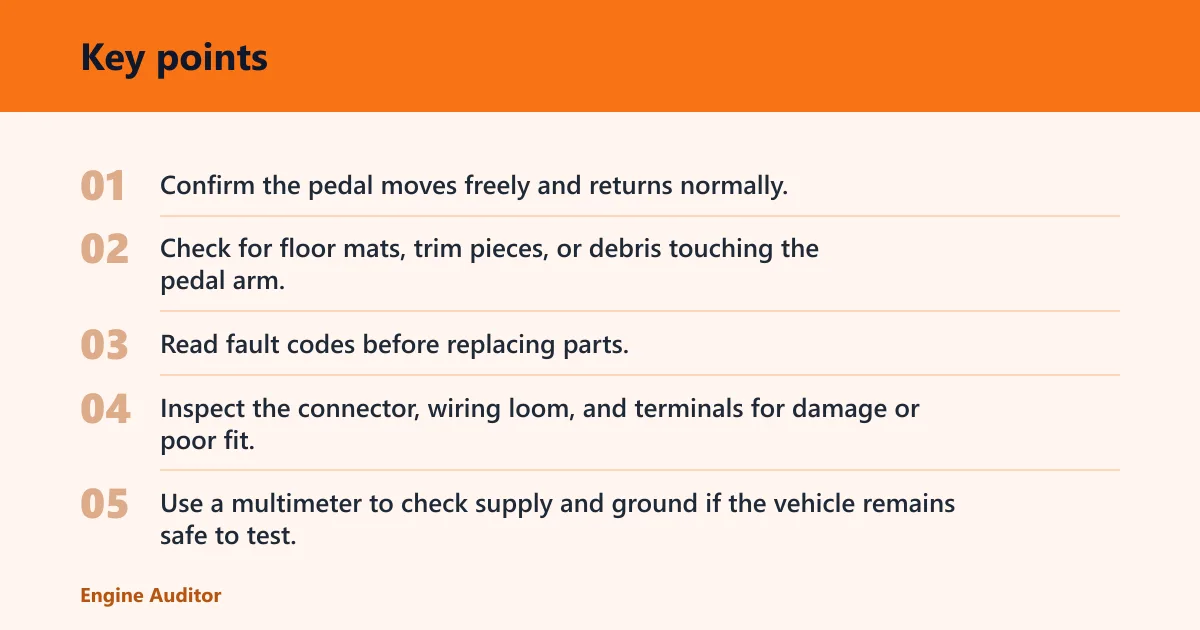
- Confirm the pedal moves freely and returns normally.
- Check for floor mats, trim pieces, or debris touching the pedal arm.
- Read fault codes before replacing parts.
- Inspect the connector, wiring loom, and terminals for damage or poor fit.
- Use a multimeter to check supply and ground if the vehicle remains safe to test, and use a wiring diagram with back-probing method for the specific circuit.
- Use an oscilloscope in workshop testing if the signal must be verified under pedal travel.
Could the pedal be stuck or binding?
Yes. A pedal that feels heavy, slow to return, or physically obstructed can mimic a bad sensor. Floor mats, loose trim, debris, bent pedal trim, or a binding linkage can limit travel before the sensor itself has any problem. That is why the mechanical check comes first.
Floor mat and trim checks
Look for a mat slid under the pedal, a thick heel pad pressed into the pedal path, or broken trim near the pedal arm. A common first-timer mistake is to assume electronic failure when the pedal is partly trapped by a mat edge.
Debris or damage around the pedal arm
Check for coins, packaging, shoestrings, or a bent pedal bracket. The pedal should move smoothly and return without sticking. If the movement is rough or blocked with the ignition off, the problem is mechanical rather than electronic.
What normal pedal feel should tell you
A normal pedal should move through its travel evenly and spring back cleanly. If the pedal feels normal but throttle response is still missing, the fault shifts toward wiring, supply, ground, ECU input, or the sensor itself.
Say your compact SUV drops into limp-home mode on a wet commute, but the pedal moves freely and the floor mat is clear. That points away from a simple obstruction and toward a signal, power, or connection fault that needs codes and electrical checks.
Could wiring be the fault?
Yes. Damaged cables or connections are a common failure point, and missing voltage or ground supply can make a good sensor look bad. Wiring faults often cause intermittent symptoms because vibration, heat, and pedal movement change the contact condition.
Connector looseness or corrosion
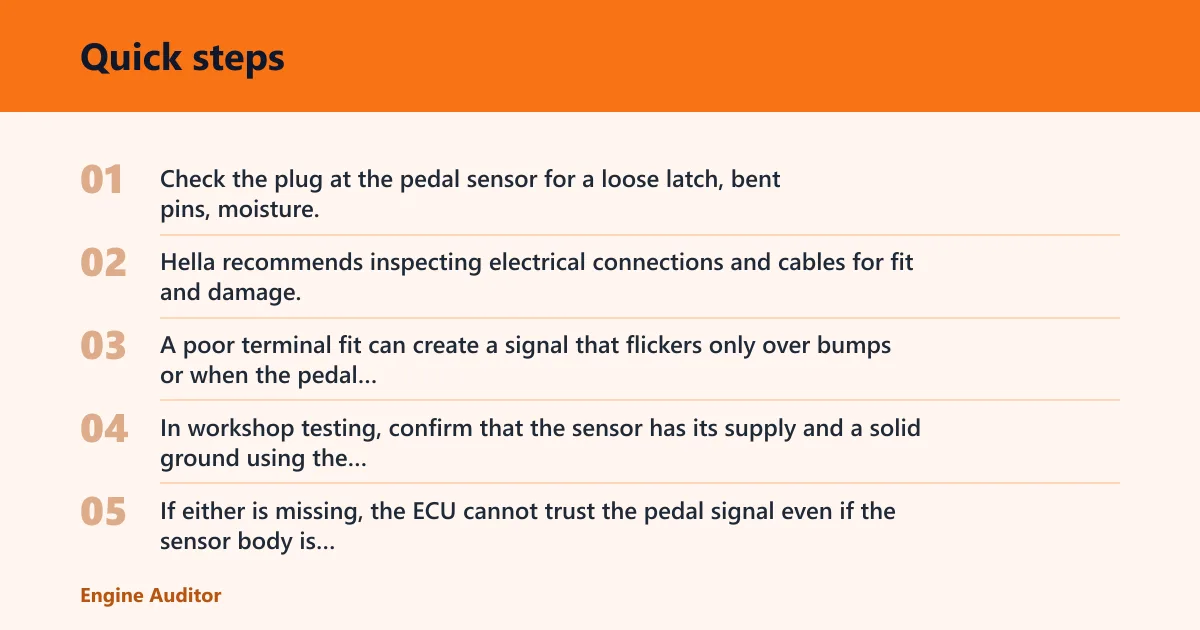
Check the plug at the pedal sensor for a loose latch, bent pins, moisture, or green corrosion. Hella recommends inspecting electrical connections and cables for fit and damage. A poor terminal fit can create a signal that flickers only over bumps or when the pedal is pressed hard.
Power and ground checks
A multimeter is useful here. In workshop testing, confirm that the sensor has its supply and a solid ground using the wiring diagram and back-probing method for the specific circuit. If either is missing, the ECU cannot trust the pedal signal even if the sensor body is fine. That is a wiring or circuit problem, not proof of sensor failure.
Why intermittent faults are common
Broken wire strands can open and close as the wiring loom moves. That is why a fault may appear as a brief hesitation, then vanish, then return with no clear pattern. If the issue comes and goes with vibration, wiring moves higher on the list.
Picture a sedan that only loses throttle after a hard left turn. That pattern fits a wiring loom, connector, or pin fit issue more than a dead pedal sensor, because the fault appears when the cable shifts.
Could the throttle body be the problem?
Yes. A throttle-body fault can mimic pedal sensor failure because the ECU still has to command engine response through the throttle control system. If the throttle body sticks, the ECU may limit power even when the pedal sensor signal is normal.
How throttle faults can mimic pedal faults
When the ECU sees a throttle position problem, it may reduce power, raise idle, or block normal acceleration. That can feel like a bad pedal sensor from the driver’s seat. Fault codes matter most here because they can separate input faults from throttle control faults.
Why the ECU may limit power
The ECU watches pedal input for plausibility. If the signal is missing, implausible, or mismatched against the other track, it may command limp-home mode. That behavior protects the engine and driveline, but it also means you should not guess at the bad part.
When code reading matters most
Read fault codes first if the check engine light is on, limp mode is active, or the car will not respond normally to the pedal. That is the fastest way to separate pedal sensor fault codes from throttle-body, supply, or circuit codes.
Is it the pedal sensor?
Use this path if you need a fast decision. No response usually points to a missing signal, power, ground, or connector issue. Intermittent throttle usually points to wiring or an internal sensor dropout. Limp mode and warning-light cases should be scanned before further driving, because the ECU may already have stored the clue you need.
| Situation | Likely direction | Next step |
|---|---|---|
| No response when pressing the pedal | Sensor signal missing, or supply/ground fault | Stop, check for obstruction, then scan for codes |
| Throttle comes and goes | Loose connector, wiring damage, or failing track | Inspect the connector and wiring loom, then test voltage and ground |
| Limp-home mode | ECU found implausible input or related throttle fault | Read codes before replacing parts |
| Check engine light with poor acceleration | Pedal sensor, throttle body, or circuit issue | Scan now and follow the code path |
Safe checks versus scan now
You can do a few basic checks at home if the vehicle is safe to move and the symptom is mild. Stop driving and scan now if the throttle is dead, the warning light is paired with limp-home mode, or the engine suddenly changes idle or response in traffic.
| Safe DIY checks | Stop driving and scan now |
|---|---|
| Look for floor mat interference and pedal obstruction | No throttle response at all |
| Inspect the pedal area for debris or trim contact | Limp-home mode with reduced power |
| Check the connector fit and obvious wiring loom damage | High idle, flare-up, or sudden throttle oddities |
| Read stored fault codes if a scan tool is available | Repeated warning light with drivability loss |
| Use a multimeter to check supply and ground if you know the circuit | Any condition that makes the car unsafe in traffic |
For workshop testing, a multimeter checks supply and ground, while an oscilloscope shows whether the signal shape changes smoothly over pedal travel. That matters on dual redundant pedals, where the ECU compares tracks and may flag a mismatch even when the pedal still moves. On live data, both tracks should usually rise and fall smoothly and stay correlated, rather than freeze, spike, or disagree in an obvious way.
Frequently asked questions
How to tell if my accelerator pedal sensor is bad
Look for a pedal signal that jumps, freezes, or disagrees with its second track, plus symptoms such as hesitation, no response, limp-home mode, or a check engine light. Read fault codes first, then check the pedal for obstruction and the connector for damage before replacing anything.
What are pedal position sensor symptoms?
Common symptoms include delayed throttle response, intermittent power loss, no response when the pedal is pressed, limp-home mode, and a warning light. These signs can overlap with wiring, throttle-body, or mechanical pedal problems, so the symptom alone is not enough.
Can a bad accelerator pedal sensor cause limp mode?
Yes. If the ECU sees implausible pedal input or loses the signal, it may limit power and enter limp-home mode. That behavior is meant to let the vehicle be moved carefully. A scan tool is the next step, not part replacement by guesswork.
Can a bad pedal sensor make the car not respond to the gas pedal?
Yes. A failed sensor can make the vehicle not respond when the pedal is pressed. But the same result can come from missing voltage, bad ground, damaged wiring, a loose connector, or a throttle-body fault, so the first check should still be fault codes and basic inspection.
How do you know if your accelerator pedal sensor is bad?
You know it is likely bad when the pedal signal is unstable or implausible, the ECU logs related fault codes, and the mechanical pedal path is clear. If the signal is steady, that does not prove the sensor is good; the problem may be wiring, connector fit, throttle control, or the ECU input side.
How to tell if your brake pedal position sensor is bad
Brake pedal sensors can create different symptoms, such as brake light faults, cruise-control issues, or stability-control warnings. They are a separate circuit from the accelerator pedal sensor, so do not use accelerator pedal symptoms to diagnose the brake switch or sensor.
Products related to this article
Sponsored / affiliate links. As an Amazon Associate I earn from qualifying purchases. I may earn additional commission from eligible campaigns.
 MecXora 13584094 Accelerator Pedal Sensor Connector Wiring Harness Compatible with Chevy Silverado 1500-3500 Equinox,GMC Sierra 1500-3500,Yukon,Buick Enclave,Cadillac Escalade & More Replaces 645-595
 Ftoghe Accelerator Pedal Position Sensor 53032456AE fits for Dodge Ram 1500 2500 3500 5.7L V8 5.9L L6 2003-2004