How to Read Winter Oil Labels and SAE Ratings
Read the viscosity first: a label like 5W-30 means the oil flows as a 5W winter grade and a 30 hot grade, and your owner’s manual must allow that exact SAE grade. Pick the wrong grade and cold-start flow, oil pressure, and warranty compliance can all be affected. This guide shows how to decode SAE winter ratings, API categories, and vehicle approvals on the bottle.
What the numbers on oil labels mean
On a multigrade bottle, the first number before the W is the winter rating, and the second number is the hot operating viscosity grade. SAE J300 sets the viscosity limits for each grade. It is a classification standard, not an oil quality score, so you still need the API category and any OEM approval on the label.
Winter and hot grades
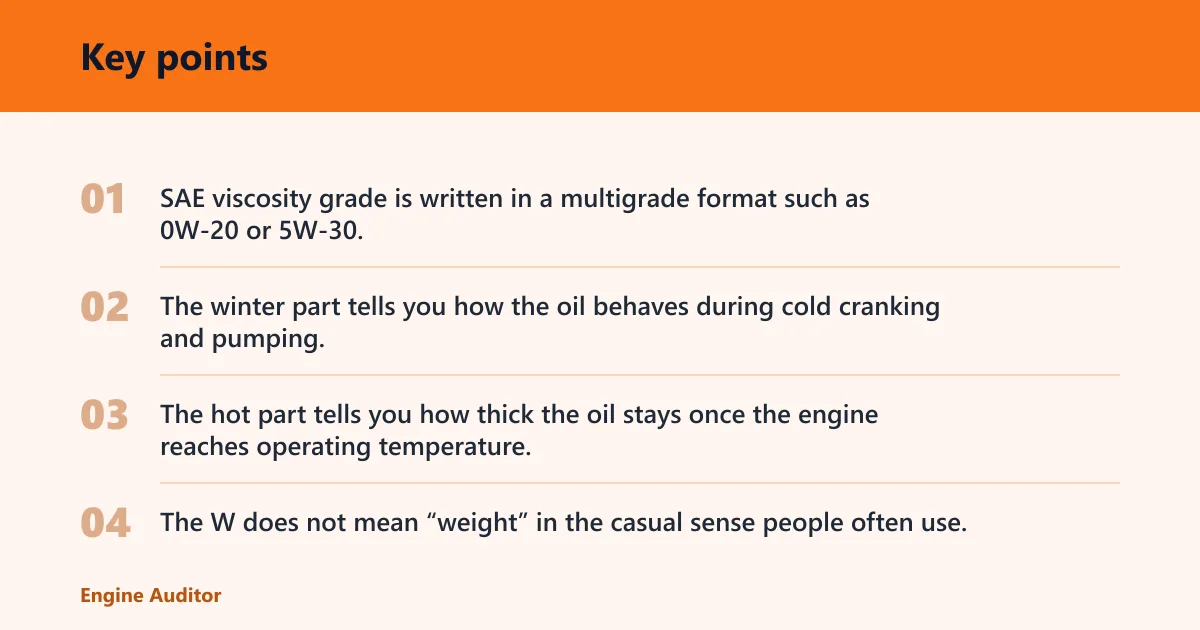
SAE viscosity grade is written in a multigrade format such as 0W-20 or 5W-30. The winter part tells you how the oil behaves during cold cranking and pumping. The hot part tells you how thick the oil stays once the engine reaches operating temperature.
The W does not mean “weight” in the casual sense people often use. It marks the low-temperature part of the SAE grade, and lower winter numbers usually move more easily in cold conditions. That helps the starter turn the engine and helps oil reach bearings faster after start-up.
Winter label decoder
| Label element | What it means | What to ignore | Decision rule |
|---|---|---|---|
| 0W, 5W, 10W, 15W | Winter rating for low-temperature cranking and pumping performance | Do not treat it as a quality score | Use the lowest W grade your manual allows for your lowest expected startup temperatures |
| 20, 30, 40 | Hot operating viscosity grade at engine temperature | Do not change this number just for winter weather | Keep the hot grade exactly within the manual’s approved list |
| SAE J300 | The standard that defines the test limits for each grade | Do not read it as a brand or performance claim | Use it to compare labels, not to rank one oil as “better” by itself |
| API service category | Engine protection category printed separately from viscosity | Do not assume a good viscosity grade means the right performance spec | Match the API category and any OEM approval the manual asks for |
| OEM approval mark | Vehicle-maker approval for specific engines or service needs | Do not skip it if the manual requires one | Choose only bottles that list the exact approval required by the manual |
How SAE winter ratings work
The winter rating reflects test limits for cold cranking and pumping, not a vague promise that the oil is “thin.” Lower W numbers usually perform better in cold starts, because the oil must move through the pump and into passages while the engine is still cold. SAE J300 sets the limits for each grade.
Cold cranking and pumping
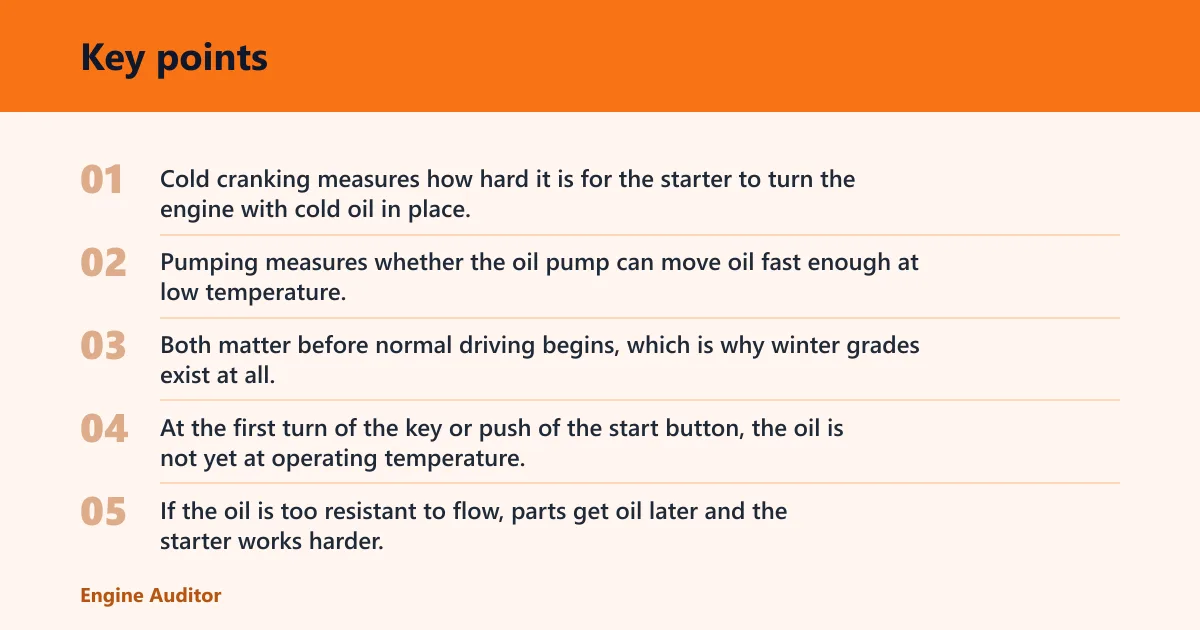
Cold cranking measures how hard it is for the starter to turn the engine with cold oil in place. Pumping measures whether the oil pump can move oil fast enough at low temperature. Both matter before normal driving begins, which is why winter grades exist at all.
A 0W grade is generally rated for colder low-temperature limits than a 5W grade, and a 5W grade is generally rated for colder limits than a 10W grade. That does not make 0W “better” in every way. It only means the oil is rated for colder start-up conditions.
Why lower W numbers help at startup
At the first turn of the key or push of the start button, the oil is not yet at operating temperature. If the oil is too resistant to flow, parts get oil later and the starter works harder. A lower winter rating reduces that risk within the range SAE defines.
If a car is parked outdoors overnight and expected to start at about -18°C, that is a cold-start condition where the listed oil grade matters. If the manual lists 0W-20 and 5W-20, the 0W-20 option gives more cold-start margin. The hot-side 20 still matters, so a 0W-16 is not a substitute unless the manual allows it.
What your owner’s manual is really telling you
The owner’s manual is the first filter, because it ties viscosity grade to the engine design, the temperature range, and any API or OEM requirement. Some manuals list one exact grade. Others list more than one acceptable grade, usually with a temperature chart or footnote that explains when each one applies.
Single-grade and multi-grade listings
A single-grade listing is straightforward: use the exact SAE grade the manual names, plus the API category or OEM approval it requires. A multi-grade listing gives you a range, but not total freedom. The allowed grades still depend on temperature and approval marks on the bottle.
Picture a manual that allows 0W-20 for very cold weather and 5W-30 above a certain minimum temperature. That does not mean both oils are interchangeable all year. It means the engine can accept different cold-flow and hot-viscosity targets under different conditions.
What to read on the page
-
Find the viscosity line.
Look for the exact SAE grade, such as 0W-20 or 5W-30. If the manual lists several grades, note any temperature limits beside them, because those limits decide which grade fits your climate and start-up conditions. -
Check the performance spec.
Find the API service category or OEM approval. A bottle can match the viscosity and still miss the required service category, which makes it the wrong oil for that engine. -
Match the bottle line by line.
Read the bottle’s front and back labels together. The correct choice needs the right SAE grade, the right API category, and any required vehicle-maker approval.
API and OEM approvals matter
API certification or service category sits beside viscosity on many consumer oil labels. It is separate from the SAE grade. That means a 5W-30 bottle with one API category is not the same thing as a 5W-30 bottle with another category, even though the viscosity line matches.
Some engines, especially turbocharged or newer designs, call for an OEM approval mark in addition to the SAE grade and API category. Ignore that mark and you can end up with the correct thickness but the wrong formulation package for the engine’s needs.
0W-20, 5W-30, and 10W-30 compared
0W-20 usually gives better cold-start flow than 5W-30 or 10W-30, but that does not make it the right choice for every engine. The hot-side grade has to match the engine design, and the owner’s manual decides whether the lower winter rating is allowed.
Cold-start and hot-side comparison
| Grade | Cold-start focus | Hot operating grade | Common manual use |
|---|---|---|---|
| 0W-16 | Very strong cold-flow target | 16 | Only if the manual lists it |
| 0W-20 | Better cold flow than 5W grades | 20 | Common in newer engines that specify it |
| 5W-20 | Good winter performance for many climates | 20 | Often one of several allowed grades |
| 5W-30 | Balanced winter performance and protection | 30 | Common in many gasoline engines |
| 10W-30 | Less cold-flow margin than 5W grades | 30 | Usually for milder cold-start conditions |
How to choose between listed grades
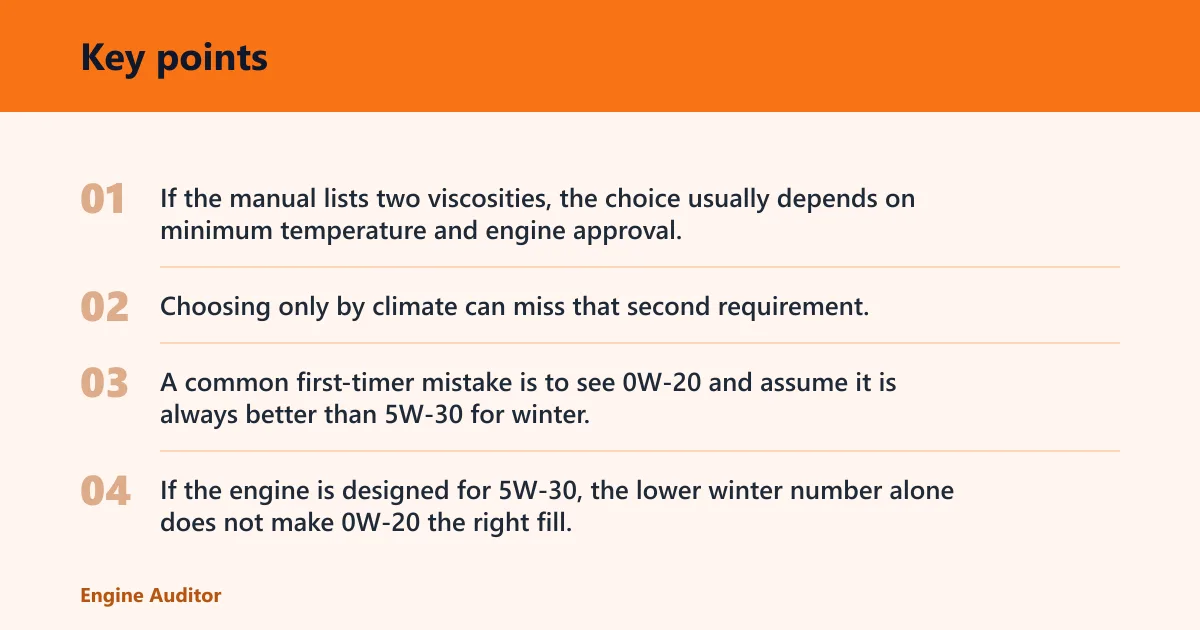
If the manual lists two viscosities, the choice usually depends on minimum temperature and engine approval. A lower winter number helps cold starts, but the hot grade must still fit the engine’s clearances and oil-pressure targets. Choosing only by climate can miss that second requirement.
A common first-timer mistake is to see 0W-20 and assume it is always better than 5W-30 for winter. That is only true when the manual allows 0W-20. If the engine is designed for 5W-30, the lower winter number alone does not make 0W-20 the right fill.
Does synthetic oil help in winter?
Synthetic motor oil often flows better in cold weather than conventional oil with the same SAE grade, and it can help with cold cranking. That still does not let it override the required viscosity grade, API category, or OEM approval. Formulation helps only inside the label rules.
Where synthetic oil helps
Synthetic base oil formulations can keep low-temperature flow more stable, which helps during start-up. That can be useful when the manual allows more than one grade and the vehicle sees cold mornings often. The benefit is in cold-weather behavior, not in replacing the required SAE number.
Where people get confused
People often mix up “synthetic” with “thinner.” Those are not the same thing. A synthetic 5W-30 still has to meet 5W-30 limits, and a conventional 5W-30 still has to meet the same SAE limits. The formulation type and the viscosity grade are separate checks.
If the bottle says synthetic but the bottle’s SAE grade does not match the manual, skip it. Better cold flow cannot fix the wrong hot-side grade or a missing OEM approval. The engine still needs the label the manual asks for.
Oil label mistakes to avoid
Most errors come from reading only one part of the bottle. Viscosity is not the same as quality, synthetic is not a substitute for the correct grade, and the winter rating does not replace the hot operating grade. The manual, API category, and OEM approval all need to line up.
- Do not read viscosity as quality. SAE 0W-20, 5W-30, and 10W-30 are thickness grades, not a ranking system. A bottle can have the right grade and still fail the API or OEM requirement.
- Do not pick by climate alone. Cold weather matters, but the hot side of the grade still has to fit the engine. The manual’s approved list should lead the choice.
- Do not ignore approval marks. If the manual requires an API category or OEM approval, match it exactly. A correct SAE grade without the required approval can still be the wrong oil.
- Do not swap grades casually. Mixing in a different grade to “help winter” can blur the bottle’s label intent. Only use a different grade if the manual lists it as acceptable.
Frequently asked questions
What do the numbers on engine oil labels mean?
The first number before the W is the winter rating, which covers low-temperature cranking and pumping. The second number is the hot operating viscosity grade. Together they describe how the oil behaves in cold start and at operating temperature, but the owner’s manual still decides which grade is allowed.
What does SAE mean on oil bottles?
SAE refers to the viscosity classification standard used on consumer oil labels. It tells you how the oil’s flow is graded, not whether the oil is high quality or low quality. For engine oil, SAE J300 is the standard that sets the limits for each viscosity grade.
Is 0W-20 better than 5W-30 for winter?
0W-20 usually flows better at cold start than 5W-30, so it can help in low temperatures if the manual allows it. But “better for winter” is not the same as “right for the engine.” The manual’s approved grade list and temperature guidance still control the decision.
What is the difference between winter rating and viscosity grade?
The winter rating is the number before the W and covers cold-start performance. The viscosity grade is the full label, such as 5W-30, which includes both the winter part and the hot operating part. One tells you about cold flow, the other tells you about the complete SAE grade.
Can I use a lower winter weight oil in cold weather?
Only if the owner’s manual allows that grade. A lower winter number can improve cold cranking and pumping, but the hot-side grade must still match the engine’s design. If the manual lists 0W-20 and 5W-30, either may be acceptable only within the stated conditions.
What oil should I use if my owner’s manual lists two viscosities?
Use the grade that matches both the temperature range and the required API or OEM approval. If the manual gives two choices, the lower winter grade is usually the better pick for colder starts, while the hotter or heavier listed grade may fit warmer conditions or a different approval path.
Does synthetic oil flow better in cold weather?
Often, yes. Synthetic motor oil can have better low-temperature flow than conventional oil with the same SAE grade, which helps cold cranking. That said, it still has to match the exact SAE grade, API category, and any OEM approval the vehicle requires.
Products related to this article
Sponsored / affiliate links. As an Amazon Associate I earn from qualifying purchases. I may earn additional commission from eligible campaigns.
 ECOGARD X10023 Cartridge Engine Oil Filter for Conventional Oil - Premium Replacement | Fits 2018-2023 Volkswagen Atlas 3.6L; 2020-2023 Atlas Cross Sport 3.6L
 ECOGARD X10040 Cartridge Engine Oil Filter for Conventional Oil - Premium Replacement | Fits 2011-2026 Jeep Grand Cherokee, Dodge Durango 3.6L; 2012-2026 Wrangler 3.6L; 2014-2022 Cherokee 3.2L