How to Identify Carburetor Vacuum Leaks Quickly
To identify carburetor vacuum leaks quickly, start with the biggest leak points first: base gasket, throttle-shaft bushings, intake gasket, brake-booster hose, and vacuum ports, because one leak can sometimes show up as about a 5 to 10 in-Hg idle vacuum change or an rpm rise during spray testing. Skip that order and you can chase false positives, mask a lean condition, or keep replacing parts that do not fix the idle. This guide gives a fast triage sequence, the leak points that matter most, and spray-testing cautions for carbureted engines.
What you’ll need


- Flashlight and small mirror
- Vacuum gauge
- Carburetor cleaner, brake cleaner, or propane for spray testing
- Soapy water in a spray bottle
- Mechanic’s stethoscope
- Basic hand tools for hose clamps, carb nuts, and linkage checks
- New vacuum caps, hose, and a carb base gasket if needed
- Fire extinguisher and a ventilated work area
Start with the gauge and the light. Save chemicals for after the visual check. A hot exhaust manifold and an open spray can turn a quick diagnosis into a fire risk.
How do you spot the leak fast?
Start with the easiest checks: loose hoses, missing caps, obvious cracks, and base-gasket clues. Then move to the throttle shaft, spacer, and intake manifold joint. If idle changes immediately when you touch one area, that spot gets priority. If nothing obvious shows up, confirm with a vacuum gauge before pulling the carb.
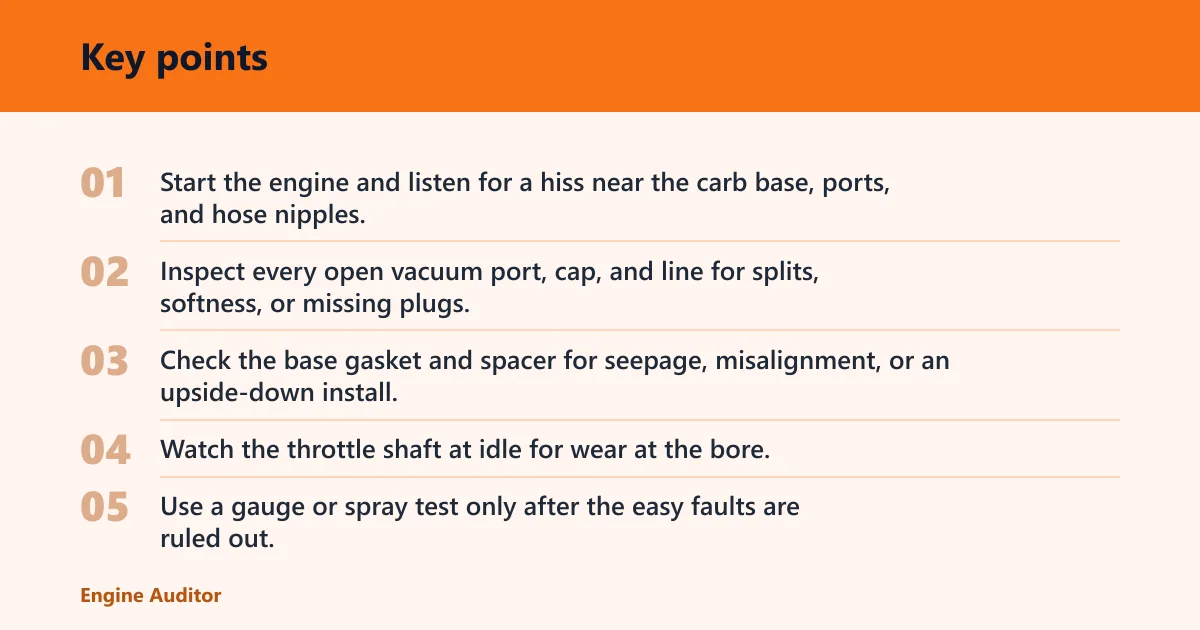
- Start the engine and listen for a hiss near the carb base, ports, and hose nipples.
- Inspect every open vacuum port, cap, and line for splits, softness, or missing plugs.
- Check the base gasket and spacer for seepage, misalignment, or an upside-down install.
- Watch the throttle shaft at idle for wear at the bore; leaks show up most at closed throttle.
- Use a gauge or spray test only after the easy faults are ruled out.
Stop and go deeper if the leak is obvious at the hose, cap, or base gasket. If the engine only reacts when you spray around the carb throat or shaft area, the next step is disassembly or a rebuild, not more idle screw adjustment.
Say your 350 idles at 900 rpm with the choke partly on, then drops to 650 rpm and starts surging as the choke opens. That pattern points toward a leak or a clogged idle circuit, not a mixture screw that needs a half-turn more.
10-minute diagnostic order
- Minute 1-2: Check the easy stuff with a flashlight, including capped ports, split hoses, and loose clamps.
- Minute 3-4: Inspect the base gasket and spacer for uneven seating or fuel staining.
- Minute 5: Move the throttle linkage by hand and look for excess play at the shaft.
- Minute 6-7: Compare idle quality with and without the choke enriched.
- Minute 8-10: Use spray or a vacuum gauge to confirm the suspect area.
Go/no-go rule: if two or more checks point to the same area, stop and repair that part first. If the gauge is unstable but no external leak is found, pull the carb and inspect the gasket, spacer, and throttle bore before chasing fuel delivery.
Which leak points matter most?
On carbureted engines, the fastest leak points are the base gasket, throttle shaft, vacuum ports, intake gasket, and brake-booster hose. Those areas sit close to idle airflow, so small leaks show up there first. Higher throttle openings can hide a small leak, which is why a driveway rev test is a weak answer.
Base gasket and spacer plate
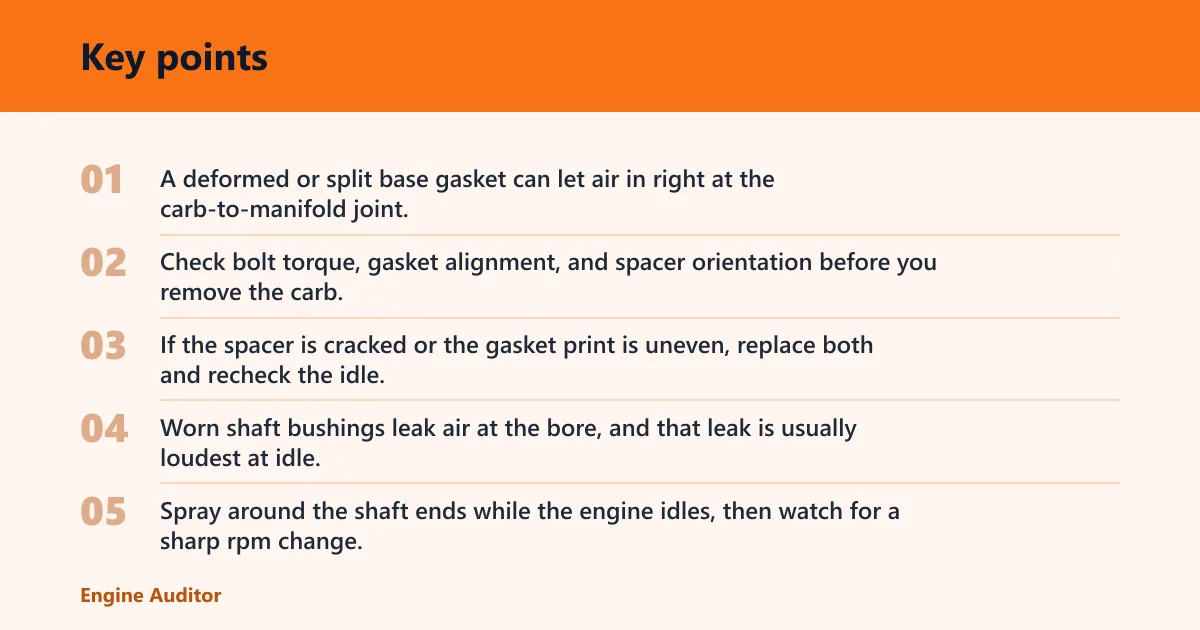
A deformed or split base gasket can let air in right at the carb-to-manifold joint. Check bolt torque, gasket alignment, and spacer orientation before you remove the carb. If the spacer is cracked or the gasket print is uneven, replace both and recheck the idle.
Throttle shaft and throttle bore
Worn shaft bushings leak air at the bore, and that leak is usually loudest at idle. Spray around the shaft ends while the engine idles, then watch for a sharp rpm change. If the throttle plate is loose in the bore, a rebuild or replacement is usually the correct fix.
Vacuum ports, caps, and hoses
Open vacuum advance ports, missing caps, and brittle hoses are fast wins. Common leak locations include hoses and lines, and older carburetors often have extra ports that get left unplugged after a swap or tune-up. Check every nipple against the routing diagram on the hood or service label.
Intake manifold gasket
An intake manifold gasket can wear out over time, especially after heat cycling or a poor install. A leak here often acts like a general lean idle that does not improve with mixture screw changes. Torque verification matters before replacement, because a loose manifold can mimic gasket failure.
Booster hose and related connections
The brake-booster hose is a large leak path, so inspect the hose, check valve, and grommet as one set. A cracked hose can create a big idle problem fast. Pinch the hose briefly only if the service procedure allows it and the engine is idling smoothly enough to judge the change.
Suppose the idle stumbles only after the choke opens, and spraying the booster hose does nothing. That makes the booster less likely and puts the throttle shaft or base gasket higher on the list.
How do you avoid false positives?
Spray tests can help, but they do not prove a leak by themselves. A carbureted engine may react to carb cleaner, brake cleaner, or propane because the mixture changes, not because the spray found a hole. A real leak usually creates a repeatable idle change at the same point every time.
When spray changes idle for the wrong reason
Use short bursts and keep the spray light. If rpm changes only when the spray hits the throttle blades or idle discharge area, the engine may be reacting to added fuel, not leak sealing. Bubbles are more convincing with soapy water, and smoke machines show leaks by filling the intake path with smoke that escapes at the leak point. The smoke test makes the leak visible.
How choke position changes the result
Cold-start enrichment can mask a leak, then expose it as the choke opens. That is why a carb that sounds fine cold may idle badly warm. Idle mixture screws cannot cure a leak, and they should not be used to hide one by turning the screws too far out.
Why a vacuum gauge helps interpret symptoms
A vacuum gauge helps confirm unstable or low manifold vacuum and separates a leak from a fuel-delivery problem. A steady but low reading often points somewhere else; a hunting needle often supports a leak or valve issue. Use the gauge with symptom behavior, not by itself.
Mechanic’s stethoscope helps pinpoint leaks by amplifying sound, which is useful when the hiss is too faint to find by ear. A flashlight, mirror, soap and water solution, and a vacuum gauge are the basic tools that get the job done fastest.
Carburetor leak triage table
| Symptom clue | Fastest check | Likely leak point | Confidence level |
|---|---|---|---|
| Hiss at idle, rpm rises when spraying base | Look for gasket seepage and torque loss | Base gasket / spacer | High |
| Lean idle only, worse warm than cold | Check shaft play at closed throttle | Throttle shaft / throttle bore | High |
| Idle drops after cap or hose inspection | Trace every open port and plugged line | Vacuum ports / caps / hoses | High |
| Surging after heat soak | Inspect manifold-to-head joint | Intake manifold gasket | Medium |
| Hard brake pedal plus rough idle | Pinch and inspect the large hose | Booster hose / check valve | High |
| RPM change during spray, but only at one screw | Repeat with short bursts and a gauge | Possible false positive | Low |
Common mistakes
One common mistake is treating every lean idle as a vacuum leak. A clogged idle circuit, weak fuel delivery, or choke problem can look similar. Another is changing mixture screws first and then losing the symptom trail. That can make a small leak harder to separate from a fuel fault.
- Do not ignore the idle circuit and choke; check them before you richen the mixture.
- Do not skip torque and gasket checks at the carb base and intake flange.
- Do not trust spray testing alone if the engine response is weak or inconsistent.
- Do not spray near hot exhaust parts, ignition sources, or a fuel seep.
Why is my carburetor leaking gas from the bottom? If fuel is wetting the lower body, look beyond vacuum leaks and inspect the float level, needle and seat, bowl gasket, and accelerator-pump seal. Fuel on the outside of the bowl is a different fault from air entering at the intake.
If that did not work, try this next: remove the carb, replace the base gasket and spacer if they show any distortion, and verify every vacuum port is sealed before reinstalling. If the throttle shaft has noticeable slop or the bore is worn, rebuild the carb or replace it instead of chasing another round of adjustments.
Prevention: after repairs, recheck manifold and carb fasteners after a short heat cycle, because gasket compression can change once the engine warms and cools.
Frequently asked questions
How do I identify a carburetor vacuum leak quickly?
Work the fastest path first: inspect hose caps, the brake-booster line, the carb base gasket, and the throttle shaft. Then confirm with a gauge or short spray bursts. A repeated idle change at the same spot is stronger evidence than a one-time rpm flutter.
How can I tell if my carburetor is leaking or just running lean?
A leak usually changes the idle when you spray or press on a joint, while a lean condition from fuel delivery often reacts to choke position and load. Check for low, unstable vacuum and compare cold behavior to warm behavior before you replace parts.
How do I check carburetor vacuum lines?
Inspect each line from the carb nipple to the device it feeds, then bend it gently to find cracks near the ends. Replace any hardened hose and any cap that does not grip tightly. Keep the routing matched to the under-hood diagram.
What are the signs of a vacuum leak on a carburetor?
Common signs include rough idle, poor acceleration, increased fuel consumption, hissing noise, and a higher-than-normal idle. A carbureted engine may also start poorly when cold and then act different once the choke opens, which is a useful clue.
How do I find a vacuum leak without special tools?
Use a flashlight, a mirror, and soapy water. Look for bubbles at suspect joints, then listen for hiss changes as you move a hose or cap. A mechanic’s stethoscope is helpful, but a careful visual check catches many of the common faults first.
How do I know if the carburetor is bad or just clogged?
If the engine only needs enrichment to stay running, the idle circuit may be clogged. If the throttle shaft is loose, the base gasket is split, or the bowl is leaking fuel, the carb has a mechanical fault. In those cases, cleaning alone will not fix it.
Products related to this article
Sponsored / affiliate links. As an Amazon Associate I earn from qualifying purchases. I may earn additional commission from eligible campaigns.