How to Compare Compact SUVs for Value and Space
Score compact SUVs on two axes: value and usable space, each on a 10-point scale, then compare the combined 20-point total against your real needs. Skip that split, and you can pay for trim content you will not use or buy a cabin too small for passengers and cargo. This guide shows how to weigh price, fuel economy, safety tech, rear-seat room, cargo volume, and trim tradeoffs without overpaying.
Compact SUV comparison matrix
The matrix below uses the same evidence for every model: starting MSRP, trim spread, rear-seat room, cargo space, safety tech, driveline options, and estimated five-year ownership cost. The point is not to pick a single paper winner. It is to show which models are cheap to buy, which are cheap to live with, and which spend your money on space instead of trim fluff.
| Model | Starting MSRP | Trim range | Rear-seat legroom | Cargo space | Safety tech | Powertrain choice | AWD availability | 5-year ownership cost note | Value / space note |
|---|---|---|---|---|---|---|---|---|---|
| Hyundai Tucson | $28,705 | Up to $47,440 | 41.3 in | 38.7 cu ft behind second row | Strong standard driver-assist bundle on most trims | Gas, hybrid, plug-in hybrid | AWD available | Higher-trim hybrid and PHEV versions can raise depreciation and insurance, but fuel savings can offset part of that gap | One of the most spacious cabins in the class; strong for rear passengers and family cargo |
| Kia Sportage | $28,690 | Up to $44,390 | 41.3 in | 39.6 cu ft behind second row | Comfortable interior with a long list of standard features | Gas, hybrid, plug-in hybrid | AWD available | Usually competitive on purchase price; hybrid trims can improve fuel cost, while higher trims push the total higher | Good if you want cabin room and equipment without jumping to a premium badge |
| Mazda CX-5 | $28,770 | Up to $40,800 | 39.6 in | 29.1 cu ft behind second row | Good standard safety tech, but equipment can climb quickly by trim | Gas only | AWD available | Often easier on sticker price than pricier rivals, but smaller cargo volume can limit space value | Balanced, stylish, and fun to drive, but not the roomiest choice |
| Honda CR-V | $30,100 | About mid-$30,000s to low-$40,000s | 41.0 in | 39.3 cu ft behind second row | Broad standard safety suite on most trims | Gas, hybrid | AWD available | Strong resale often helps long-term value, even when the entry price is a little higher | One of the safer bets for buyers who want space without paying luxury prices |
| Toyota RAV4 | $29,250 | About low-$30,000s to low-$40,000s | 37.8 in | 37.6 cu ft behind second row | Good standard driver-assist coverage on most versions | Gas, hybrid, plug-in hybrid | AWD available | Often strong on depreciation and fuel economy in hybrid form | Good value if you want broad trim choice and efficient powertrains |
| Subaru Forester | $29,695 | About low-$30,000s to high-$30,000s | 39.4 in | 28.9 cu ft behind second row | Standard all-wheel-drive focus with a solid safety package | Gas, hybrid | AWD standard | AWD is built in, which can help buyers who would otherwise pay extra for winter traction | Useful if bad weather matters more than cargo bragging rights |
| Nissan Rogue | $29,230 | About high-$20,000s to high-$30,000s | 38.5 in | 36.5 cu ft behind second row | Good standard safety tech on many trims | Gas | AWD available | Can be a value play when discounted, but trim choice matters a lot | Better for buyers who want a lower entry price than a premium-feeling cabin |
| Ford Escape | $29,495 | About high-$20,000s to high-$30,000s | 42.4 in | 37.5 cu ft behind second row | Standard safety tech varies by trim, so check carefully | Gas, hybrid, plug-in hybrid | AWD available | Hybrid and PHEV versions can cut fuel use, but trim content changes the value math quickly | Strong rear-seat room for the price if you pick the right trim |
| Chevrolet Equinox | $29,995 | About $30,000s to low-$40,000s | 39.9 in | 29.9 cu ft behind second row | Standard safety tech is usually competitive, but trim bundles matter | Gas | AWD available | Often priced near the center of the segment, so incentives can decide the deal | Average space numbers, so the price has to do more of the work |
| Volkswagen Tiguan | $30,305 | About low-$30,000s to mid-$30,000s | 37.6 in | 38.7 cu ft behind second row | Standard driver-assist content is a selling point on lower trims | Gas | AWD available | Three-row versions can blur the value picture, so compare only the configuration you need | Useful cargo volume, but rear legroom is merely average |
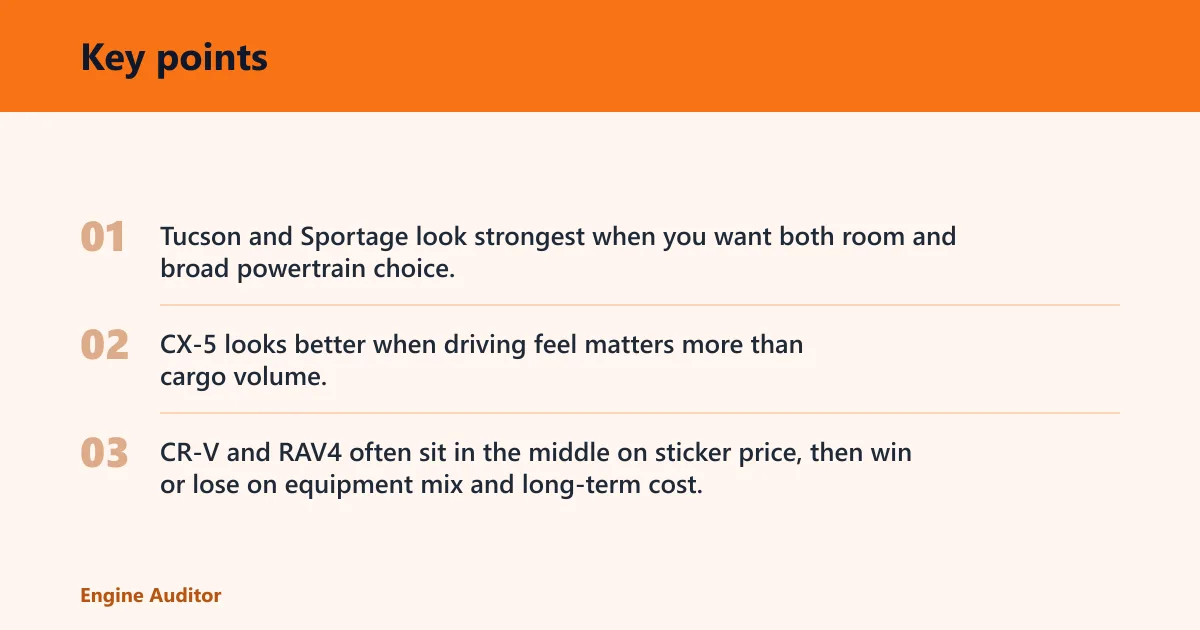
The fastest read from this table is simple. Tucson and Sportage look strongest when you want both room and broad powertrain choice. CX-5 looks better when driving feel matters more than cargo volume. CR-V and RAV4 often sit in the middle on sticker price, then win or lose on equipment mix and long-term cost.
Why compact SUVs are compared by value and space
Compact SUVs are cross-shopped so often because they sit between small crossovers and larger family SUVs. They usually cost less than midsize SUVs, yet they offer more cargo room and ride height than many sedans and hatchbacks. That still leaves a wide spread in trim content, efficiency, and usable cabin space.
Value is more than the base sticker price. A low starting MSRP can hide a sparse standard equipment list, while a slightly pricier model can be better value if it includes safety tech, a useful transmission, or an efficient hybrid without forcing you into a top trim.
What shoppers usually pay
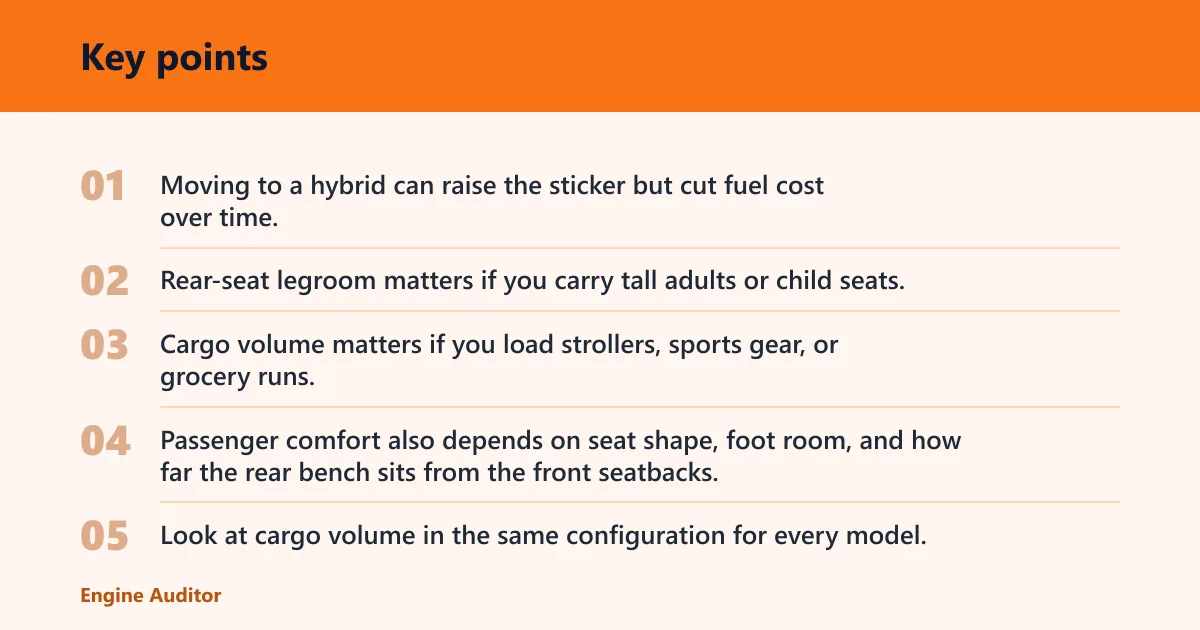
Most buyers are paying for one of four things: a lower monthly payment, all-weather traction, better fuel economy, or a cabin that works for kids and cargo. Those priorities often compete with one another. Adding AWD can raise price and fuel use. Moving to a hybrid can raise the sticker but cut fuel cost over time.
Which space figures matter most?
Rear-seat legroom matters if you carry tall adults or child seats. Cargo volume matters if you load strollers, sports gear, or grocery runs. Passenger comfort also depends on seat shape, foot room, and how far the rear bench sits from the front seatbacks.
Look at cargo volume in the same configuration for every model. Compare behind-the-second-row figures with the seats up, then check how flat the floor becomes when the seats fold. That keeps the comparison honest.
How do you compare compact SUVs by value?
The best value compact SUV is the one that gives you the features you need at the lowest realistic five-year cost, not the lowest sticker alone. Start with base price and trim range, then ask whether the standard equipment already covers your must-haves. After that, compare fuel, insurance, maintenance, and depreciation.
Starting MSRP and trim range
Base price matters because it sets the entry point, but trim spread tells you how fast the model gets expensive. The Tucson runs from $28,705 to $47,440, and the Sportage runs from $28,690 to $44,390. The CX-5 starts at $28,770 and tops out at $40,800. Those ranges show how far a compact SUV can move from practical to pricey.
Standard features versus options
Compare the equipment you get before adding packages. Standard safety tech, a good automatic transmission, and useful infotainment matter more than a flashy trim name. A model with strong standard driver assistance can beat a lower sticker price that requires you to add options just to match rival features.
Say your daily commute is short and your budget is tight. A base trim with automatic emergency braking, lane keeping, and adaptive cruise may be the right buy even if it lacks leather or a panoramic roof. The money stays where it matters: fuel, tires, and insurance.
Five-year ownership cost
Five-year cost should include fuel, insurance, maintenance, and depreciation. Hybrid and plug-in hybrid models often reduce fuel cost, but a higher purchase price can erase part of that gain. AWD can also raise tire wear and fuel use. If two models are close on sticker price, the one with stronger resale and lower fuel use may be cheaper to own.
-
Set your budget ceiling.
Pick the maximum monthly payment or out-the-door price first. That keeps you from drifting into a higher trim just because the feature list looks attractive. -
Compare trim content.
Check which safety tech, wheel size, seating material, and infotainment features are standard on the trim you would actually buy. A value score should reward models that include more of your must-haves without extra packages. -
Estimate five-year cost.
Compare fuel economy, insurance, maintenance, and expected depreciation. That gives you a better read on value than MSRP alone.
How do you compare compact SUVs by space?
Space comparison works best when you separate usable space from brochure size. Rear-seat legroom tells you whether adults fit without knee pressure. Cargo volume tells you how much luggage or gear the SUV can swallow. Packaging efficiency tells you how well the cabin uses its footprint.
Rear-seat legroom
Rear legroom is the first number to check for tall drivers and child seats. Tucson and Sportage both list 41.3 inches, while the Escape lists 42.4 inches. That does not mean the Escape is automatically roomier everywhere, but it does show why rear passengers should be part of the buying test.
Picture a 6-foot rear passenger sitting behind a 6-foot driver. In a model with limited knee room, the front seat has to move forward more than you expect. That affects comfort for both rows, and it can make the SUV feel smaller than the cargo number suggests.
Cargo volume and load floor
Cargo volume behind the second row is the number that most buyers will use every week. Sportage at 39.6 cubic feet and Tucson at 38.7 cubic feet sit near the top of this group. CX-5 at 29.1 cubic feet is noticeably smaller, which matters if you regularly load a stroller or several suitcases.
Also check the load floor. A lower, flatter cargo floor is easier for bulky boxes and pet crates. A split or stepped floor can reduce practical space even when the published volume looks acceptable.
Tall-driver and child-seat checks
For tall drivers, check whether the front seat can slide far enough back without making the rear bench unusable. For child seats, check whether the rear door opening is wide and whether the LATCH anchors are easy to reach. A model can post a decent legroom number and still be awkward for rear-facing seats.
-
Measure the front seat first.
Set the driver seat for your normal driving position, then sit behind it. If knees touch the seatback or your feet cannot slide under the front seat, the SUV is too small for that use. -
Check cargo with seats up.
Focus on the published behind-second-row cargo figure first, then fold the rear seat only if your routine really needs it. That avoids overvaluing a fold-flat number you may rarely use.
How do powertrain and driveline choices change the result?
Powertrain choice changes price, fuel use, and straight-line performance at the same time. Gas versions usually cost less up front. Hybrid versions usually cost more up front but use less fuel. Plug-in hybrid versions cost even more and make the most sense if you can charge regularly.
Gas, hybrid, and plug-in hybrid choices
The Tucson offers gas, hybrid, and plug-in hybrid powertrains. The gas model makes 187 horsepower and 178 lb-ft of torque. The Sportage hybrid makes 227 horsepower and 258 lb-ft of torque. The CX-5 uses a 2.5-liter turbocharged inline-four with 250 horsepower. Those figures help explain why some compact SUVs feel calm and others feel stronger in passing.
Are hybrid compact SUVs worth it for everyday driving? They often are if you drive enough miles to recover the higher price through fuel savings. They make less sense if your mileage is low or if the hybrid trim forces you into a much higher purchase price than the gas version.
FWD versus AWD availability
FWD is usually cheaper, lighter, and slightly more efficient. AWD helps on snow, wet pavement, gravel driveways, and steep launches, but it can raise sticker price and running cost. Many compact SUVs offer AWD as an option, while Subaru makes AWD standard across the Forester line.
Do not buy AWD just because it sounds safer. For many shoppers, winter tires on FWD deliver better traction than all-season tires on AWD. Choose AWD when your use case really needs it, not as a default.
Transmission and efficiency impact
Transmission type changes both feel and efficiency. The Sportage gas engine uses an 8-speed automatic, which is aimed at smooth daily driving and efficient gearing across speeds. A well-matched automatic can help a smaller engine feel less strained, while a hybrid’s transmission pairing often matters as much as the engine itself.
-
Match power to use.
Choose gas if you want the lowest entry price, hybrid if fuel savings matter, and plug-in hybrid only if you will charge often enough to use the electric range. -
Choose traction by climate.
Pick FWD if you live in mild weather and want lower cost. Pick AWD if snow, mud, or steep access roads are part of your routine. -
Check transmission pairing.
Read the spec sheet for the exact gearbox and engine combination. That pairing affects acceleration feel, highway passing, and fuel economy.
Which safety and efficiency data should you check?
EPA fuel economy is the official efficiency baseline. Use the city, highway, and combined figures, since daily driving can lean heavily toward one type of use. Safety should include both IIHS and NHTSA results, plus the standard driver-assist features on the trim you plan to buy.
EPA fuel economy figures
EPA ratings are the cleanest apples-to-apples fuel check because manufacturers publish them in the same format. Compare combined MPG first, then look at city and highway numbers if your commute is mostly one or the other. Hybrids usually gain most of their advantage in city driving.
IIHS and NHTSA ratings
Top safety scores matter, but only if you compare the same model year and body style. A model with a strong crash rating and a good standard safety suite can be a better value than a rival that only reaches the same equipment level on upper trims.
Standard safety tech
Look for automatic emergency braking, lane departure warning, lane keeping assistance, blind-spot monitoring, and adaptive cruise control. Some brands include more of these features on the base trim than others. That is one reason the Sportage stands out for buyers who want a comfortable interior and a long list of standard features.
A common first-timer mistake is comparing two models by horsepower alone. A 250-horsepower engine does not automatically make a compact SUV the better buy if the cargo area is small, the fuel economy is poor, and the safety tech is buried in expensive trim levels.
What a compact SUV comparison table should include
Use seven data points every time: starting MSRP, trim range, rear-seat legroom, cargo volume, standard safety tech, powertrain choice, and five-year ownership cost. If a model offers AWD, note whether it is standard or optional. If it offers hybrid or plug-in hybrid versions, note where those trims sit in the price stack.
The easiest way to spot trim-level traps is to compare the exact version you would buy, not the brochure starting price. A base model may look like a bargain until you add the options needed to match another brand’s standard equipment. That is how value gets distorted.
-
List the exact trim.
Write down the trim name you would actually buy. Then compare only that trim’s price, equipment, and drivetrain. -
Separate needs from wants.
Mark which features are required, such as AWD or rear air vents, and which are optional, such as larger wheels or a panoramic roof. -
Score the two axes.
Give value and usable space each a score out of 10, then add them. If two models tie, pick the one with lower five-year cost or better packaging for your cargo.
Frequently asked questions
Which compact SUV gives the best value for the money?
The best value depends on what you count as value. If you want the broadest mix of price, room, and powertrain choice, Tucson and Sportage are hard to ignore. If driving feel matters more than cargo volume, the CX-5 can be better value even with less space.
What compact SUV has the most interior space?
Among the models here, the Tucson and Sportage are the strongest room-first picks, with 41.3 inches of rear-seat legroom each. The Sportage also lists 39.6 cubic feet of cargo space behind the second row, which helps it stand out for family duty and weekend hauling.
How do I compare compact SUV cargo space and passenger room?
Compare rear-seat legroom and cargo volume separately, then decide which matters more. A model can be generous for passengers and average for cargo, or the reverse. If you carry adults in the back, legroom comes first. If you haul gear, cargo volume matters more.
Which compact SUVs are the cheapest to buy new?
On starting MSRP, the Sportage at $28,690 and Tucson at $28,705 are near the bottom of this group. The CX-5 at $28,770 is close behind. Still, the cheapest base price is not always the cheapest usable trim once safety tech and AWD are added.
Are hybrid compact SUVs worth it for everyday driving?
They often are if you drive enough miles to benefit from lower fuel use. The payoff is strongest in stop-and-go commuting, where hybrids tend to save more fuel than gas versions. If your mileage is low, the higher purchase price can be harder to justify.
Suv vs compact suv
A compact SUV usually costs less, uses less fuel, and is easier to park than a larger SUV. A larger SUV buys you more cargo room, more third-row potential, or more towing capacity, but it also raises price and running cost. Choose the smallest size that meets your space needs.
Products related to this article
Sponsored / affiliate links. As an Amazon Associate I earn from qualifying purchases. I may earn additional commission from eligible campaigns.