Ford Brake Warning Light Meaning: What to Do Next
If your Ford’s brake warning light stays on, stop driving. Check that the parking brake is fully released, and do not keep going if the pedal feels soft, the fluid is low, or the red brake light flashes with a warning chime. Ignoring it can mean reduced braking assist, longer stopping distances, or a sudden no-brake failure. This guide sorts parking brake, fluid, ABS, and tow-now warnings fast.
Brake warning triage table


Use this table as a first-pass decision aid. It separates the common Ford brake warning patterns that call for a simple parking brake check from the ones that point to hydraulic trouble, ABS faults, or a tow.
| Symptom pattern | Likely cause | Next action |
|---|---|---|
| Brake light stays on after the parking brake is released | Parking brake not fully released, misadjusted switch, or electronic parking brake fault | Recheck the parking brake, then inspect the switch or electronic brake system if the light remains on |
| Brake light on with low reservoir level | Low brake fluid, worn pads, or a leak | Check the reservoir, look for leaks, and do not assume topping up is the final fix |
| Pedal feels low or spongy, or you must pump it repeatedly | Hydraulic failure or air loss in the brake system | Do not drive; arrange a tow |
| Brake and ABS lights are both on | ABS fault plus a brake system warning | Treat as unsafe until inspected; a scan tool may be needed for ABS codes |
| Light comes on after pad service | Brake fluid level shift, worn pad sensor issue, contamination, or service mistake | Inspect the work, fluid level, and brake hardware before driving far |
| Light returns after topping up fluid | Leak in hoses, lines, calipers, wheel cylinders, or the master cylinder | Do not rely on the refill; find the leak and repair it |
What the brake warning light means on a Ford
On some vehicles, the brake warning light can mean the parking brake is still applied, the fluid level is low, or the brake hydraulics have lost pressure. Warnings may appear as a red light, an amber message, or both, and the meaning can vary with the symptom pattern. If the warning stays on after release, treat it as a fault.
Red light versus amber light
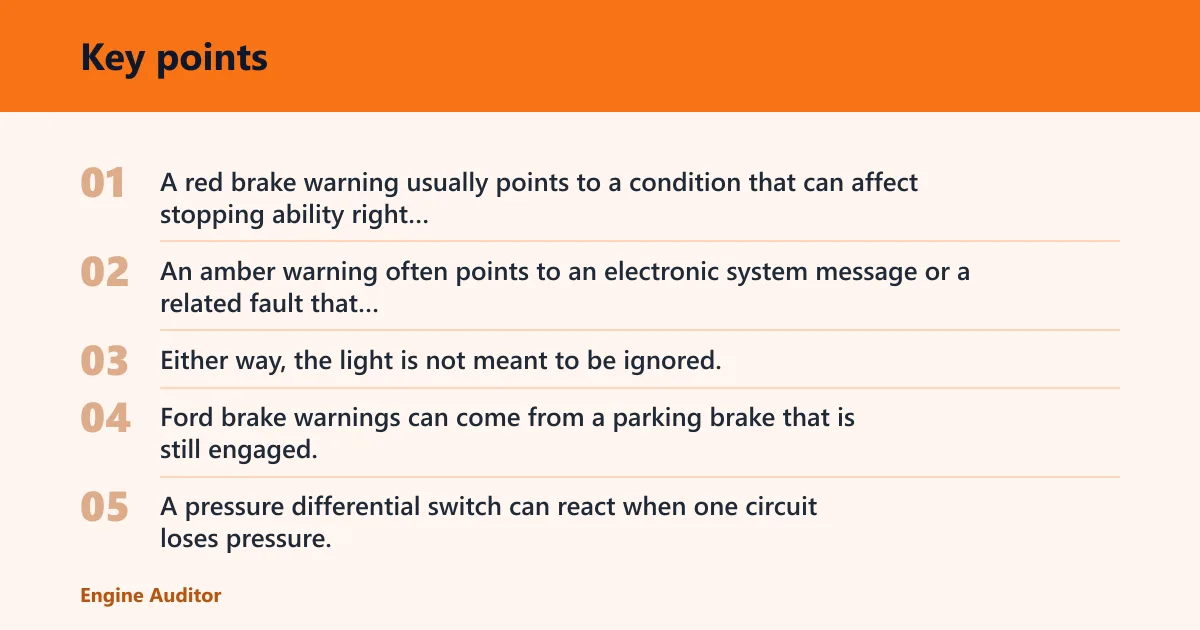
A red brake warning usually points to a condition that can affect stopping ability right away. An amber warning often points to an electronic system message or a related fault that still needs attention. Either way, the light is not meant to be ignored, and a red warning with poor pedal feel deserves the fastest response.
Parking brake, fluid, and hydraulic fault meanings
Ford brake warnings can come from a parking brake that is still engaged, a low fluid reservoir, or a pressure loss in one side of the dual-circuit brake system. A pressure differential switch can react when one circuit loses pressure, so the warning may appear even before total brake loss. That makes the light a safety signal, not a cosmetic reminder.
When the warning needs immediate action
If the light stays on after the parking brake is released, if the pedal is low or spongy, or if the light comes with a chime and obvious braking change, stop driving. A warning that appears while moving and stays on after a fluid top-up can point to an active leak. That is not a “drive home and watch it” situation.
Say your Fusion leaves the driveway with the parking brake fully down, but the red brake light stays on at the first stop sign. If the pedal still feels firm, the next check is the fluid reservoir and the parking brake switch, not a long drive to see whether the light clears.
Brake warning light triage for Ford owners
Most drivers need one fast question answered: can the car move safely, or should it stay parked? These checks give you that answer without guessing. Start with the parking brake, then move to fluid level, pedal feel, and any ABS warning that appears with it.
- Release the parking brake fully and confirm the warning light changes.
- Check the brake fluid reservoir level.
- Press the pedal once, then again, and note whether it feels firm or sinks.
- Look for any wet spots, drips, or fresh fluid near each wheel and under the master cylinder.
- Check whether the ABS light is on at the same time.
- If the pedal is soft, the light returns after topping up, or both brake and ABS lights stay on, stop driving.
Check the parking brake first
The first check is simple: make sure the parking brake is fully released. If the brake warning light stays on after release, something is wrong. A misadjusted parking brake switch can keep the light on, and electronic parking brake systems can create their own fault messages if the system does not release correctly.
Mechanical parking brake checks
On a cable-operated parking brake, confirm that the pedal or lever has returned fully and that there is no partial engagement. A weak return spring or a switch that sits out of adjustment can keep the warning on even when the brake is off. If the light changes when you move the lever slightly, the switch deserves inspection.
Electronic parking brake edge cases
Ford models with electronic parking brakes can show a warning if the system does not complete its release cycle. That can look like a brake warning problem, but the cause may be in the switch, actuator, or control logic. If the parking brake system feels normal and the warning still stays on, the fault is no longer a simple “left it on” issue.
Parking brake switch faults
Yes, a bad parking brake switch can cause the brake warning light. If the switch is misadjusted, damaged, or electrically open, the car may report the brake as applied when it is not. That is why the first decision point is always a full release check, followed by a closer look if the light does not clear.
Is it safe to drive with the light on?
It is only reasonable to drive a short distance if the pedal feels normal, the parking brake is fully released, the fluid level is correct, and the warning appears to be a switch or minor service issue. If the pedal is low, spongy, or needs repeated pumping, or if the light stays on after a fluid refill, do not drive it.
Short drive versus tow-now signs
A short, careful trip to a shop may be acceptable when the warning is limited to a parking brake switch issue and the brakes feel normal. Tow it now if the pedal sinks, the car pulls under braking, fluid is visibly low, or the warning returns right after topping up. That pattern points to a real hydraulic problem.
Pedal feel checks that change the decision
If the brake pedal is low or you must pump it repeatedly, the brakes may be failing. That is the clearest driver-level sign that the system may not stop the vehicle reliably. A firm pedal is not a guarantee of safety, but a soft one is enough reason to stop driving.
When to stop driving immediately
Stop immediately if the brake light comes on with the ABS light and the pedal feel changes, or if the vehicle needs extra distance to stop. A warning that appears during motion after normal braking starts to feel different can mark a pressure loss in one side of the system. That is tow-now territory.
Brake fluid and hydraulic pressure
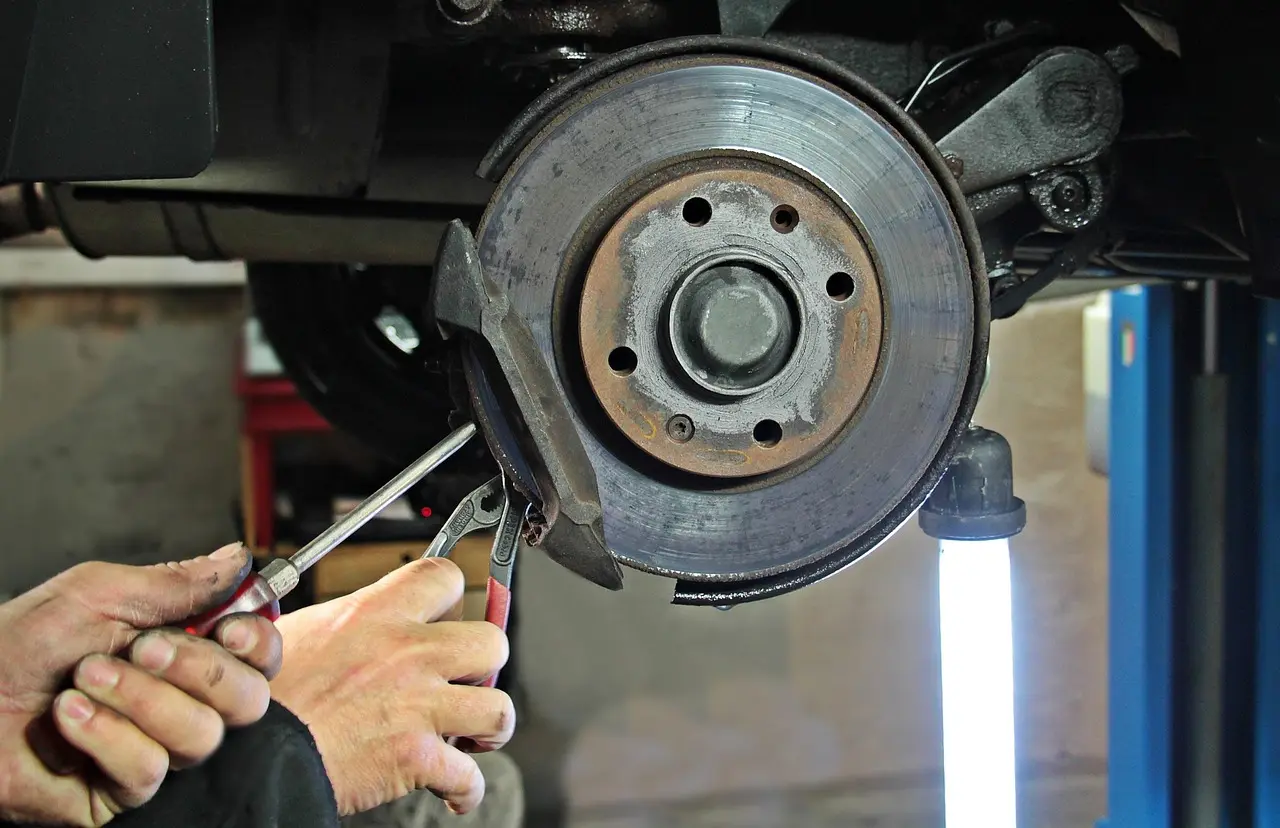
Low brake fluid can trigger the brake warning light. That low level may mean worn pads, but it can also mean a leak. A leak is the bigger concern because the fluid may hold the system together for a while, then fail without much warning. Topping up can hide the clue, not fix the cause.
Reservoir level check
Check the brake fluid reservoir on the master cylinder with the vehicle level and the engine off. If the level is below normal, do not stop at the refill. Low fluid is a reason to inspect for worn pads, a leak, or a master cylinder problem. FixMyCar also lists low brake fluid as the most likely reason for the warning.
Low-level sensor behavior
Some Ford brake systems use a low-level sensor in the reservoir. That sensor can trigger the warning before the fluid is completely gone, which is the point. A false alert is possible, but the safer assumption is that the reservoir is low for a reason until proven otherwise.
Dual-circuit safety design and pressure loss
Ford brake systems use dual circuits so one side can still provide limited stopping if the other loses pressure. A brake warning light can mean hydraulic pressure has been lost in one side of the brake system. That design buys time, not a free pass to keep driving as if nothing changed.
Why topping up is not the final fix
FixMyCar warns that brake fluid leaks are dangerous because you do not know how long the brakes will continue working. A leak may temporarily improve after topping up, but the light can return. Brake fluid leaks can occur in hoses, lines, calipers, wheel cylinders, or the master cylinder, so a refill without diagnosis can delay the real repair.
Suppose the reservoir is low, you add fluid, and the light goes out for ten minutes. If it returns on the same trip, the refill only bought time. That pattern fits an active leak or a deeper hydraulic issue, and it should be inspected before the car goes back into regular use.
Brake pads, service, and wear clues
Worn brake pads can trigger the warning light, especially if the fluid level drops as the caliper pistons move farther out. Recent brake work can also leave a warning on if the system was not reset correctly, the fluid level changed, or a wear indicator or sensor was damaged during service.
Worn pads as a trigger
Overly worn brake pads are a possible cause of the warning light. That matters because low fluid can be the first visible clue of pad wear, not just a leak. A quick look through the wheel openings can sometimes show thin pads, uneven wear, or signs of contamination on the rotor face.
Recent brake work and reset issues
If the light appeared after pad replacement, the service itself becomes part of the diagnosis. The reservoir may have been overfilled, a sensor may have been unplugged, or the electronic parking brake may not have been reset correctly. A warning that starts right after brake work should be checked against the service steps, not brushed off as coincidence.
Contamination or rotor damage to inspect
Brake fluid on pads, grease on friction surfaces, or a damaged rotor can change pedal feel and stopping performance. Those problems do not always set off a warning lamp by themselves, but they often travel with the kind of service error that does. If the car shakes, squeals, or pulls under braking, inspect the hardware promptly.
What if the brake warning light and ABS light are both on?
When both lights stay on, treat the car as unsafe until it is checked. The ABS warning light may come on while driving if a fault occurs in the ABS system, and the ABS module often stores a trouble code. A scan tool is usually required to read those codes, so this is not always a driveway fix.
What the ABS lamp adds
The ABS lamp tells you the anti-lock system has seen a fault. That does not always mean the base brakes are gone, but it does mean the anti-lock function may be disabled. If the brake and ABS lights are both on, the vehicle may not be safe to drive, especially if the pedal feel is also off.
Why the ABS system may disable itself
ABS is designed to shut itself down when it cannot trust wheel-speed or control inputs. The brakes may still work in a basic sense, but anti-lock control may be unavailable when you need it most. That is why the dashboard can warn you before a full failure, not after.
When a scan tool is needed for codes
Most ABS faults store a trouble code in the ABS module’s memory. A scan tool is usually required to read ABS trouble codes. If the brake warning light is joined by the ABS lamp and the fix is not obvious, code retrieval is the next diagnostic step, not guesswork.
Frequently asked questions
What does the brake warning light mean on a Ford?
On a Ford, the brake warning light usually means the parking brake is applied, brake fluid is low, or the system has detected a hydraulic fault. If it stays on after the parking brake is released, something is wrong and the car needs a closer check before it is driven much farther.
Is it safe to drive with the brake warning light on?
Only if the pedal feels normal, the parking brake is fully released, the fluid level is correct, and the warning appears tied to a switch or service issue. If the pedal is soft, low, or needs pumping, or if the light returns after topping up, do not drive it. Tow it instead.
Can low brake fluid turn on the brake warning light?
Yes. Low brake fluid in the master cylinder can trigger the warning light. That low level may come from worn pads, but it may also point to a leak in hoses, lines, calipers, wheel cylinders, or the master cylinder. Topping up is only a temporary check, not a repair.
What should I check first when the brake light stays on after releasing the parking brake?
Check the parking brake again first, then look at the brake fluid reservoir and the pedal feel. If the light stays on after the brake is fully released, the issue may be a misadjusted switch, a low-fluid condition, or a hydraulic fault. A firm pedal matters, but it does not end the diagnosis.
Does a brake warning light mean my brakes are failing?
Not always, but it can. The light may be caused by the parking brake switch or a low fluid level from pad wear, yet it can also mean a hydraulic failure or pressure loss in one side of the system. If the pedal is low or spongy, treat it as a brake failure warning.
What are the most common causes of a brake warning light coming on while driving?
The most common patterns are low brake fluid, a parking brake that is not fully released, a leak, worn pads, or a hydraulic pressure loss. If the ABS lamp joins the brake light, the fault may also involve the anti-lock system. A scan tool may be needed to sort that out.
Products related to this article
Sponsored / affiliate links. As an Amazon Associate I earn from qualifying purchases. I may earn additional commission from eligible campaigns.