Best Ford for towing a trailer: top models compared
For most trailers, the best Ford is the F-150; choose an EcoBoost V6 for campers up to about 8,000 pounds, an F-250 for heavier travel trailers, and an Expedition only for lighter loads. Pick too little truck and you get sway, strained brakes, and white-knuckle hills. I break this down by trailer size, weight, terrain, and family use.
Top Ford picks by trailer type
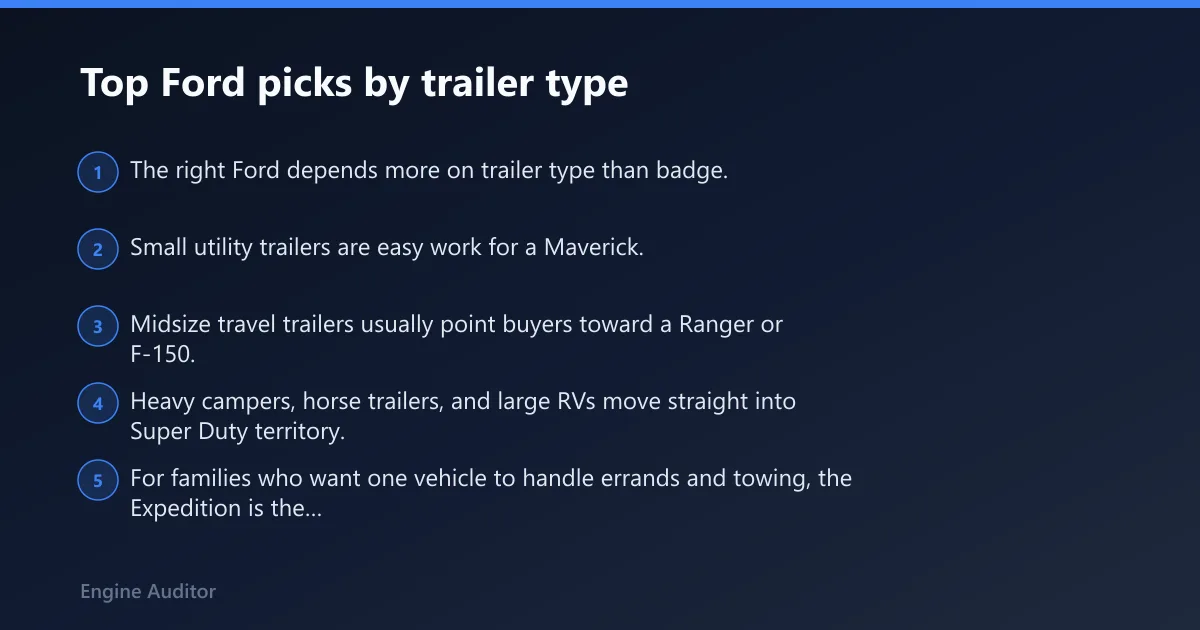
The right Ford depends more on trailer type than badge. Small utility trailers are easy work for a Maverick. Midsize travel trailers usually point buyers toward a Ranger or F-150. Heavy campers, horse trailers, and large RVs move straight into Super Duty territory. For families who want one vehicle to handle errands and towing, the Expedition is the SUV I would inspect first.
Best for small utility trailers: Ford Maverick
The Maverick fits owners who tow lawn equipment, small cargo boxes, or a lightweight utility trailer a few weekends a month. It is the least expensive-sized answer in this lineup, and that matters if the trailer is short, light, and used mostly around town.
Best for midsize travel trailers: Ford Ranger or F-150
The Ranger works for moderate trailers when the load is controlled and the payload math checks out. The F-150 is the safer all-around pick once the trailer gets larger, heavier, or more affected by wind, pass-through cargo, and passengers.
Best for heavy campers and RVs: Ford Super Duty
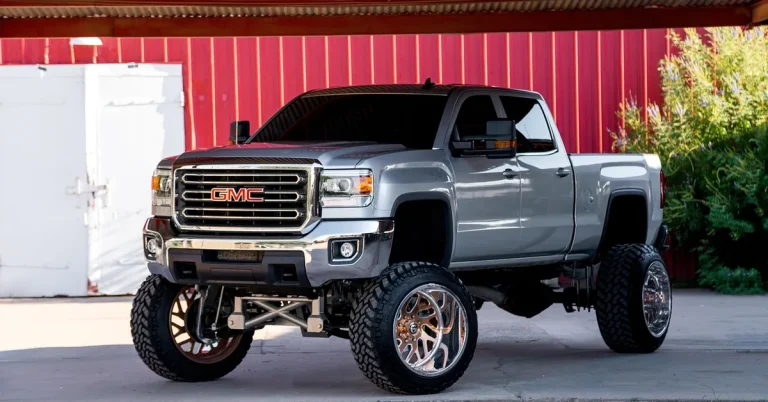
When the trailer moves past “vacation rig” and into serious weight, the Super Duty line is the right starting point. Ford says the Super Duty has a best-in-class maximum available towing rating of 40,000 lbs, with F-250, F-350, and F-450 variants available for different trailer and chassis needs.
Best SUV pick for family towing: Ford Expedition
The Expedition is the better buy when the trailer is moderate and the rest of life is school runs, road trips, and cargo space for people. Properly equipped, it gives families a tow-capable SUV without stepping into pickup-bed compromise.
According to ford.com — Ford says the Super Duty has a best-in-class maximum available towing rating of 40,000 lbs.
How much Ford can tow?
Ford’s tow number is never one number for every truck. It changes with engine, axle ratio, cab and bed, payload, passengers, and towing equipment. Ford’s towing page also points buyers to the right vehicle-specific maximum tow data and the equipment needed to use it correctly.
What Ford towing guides tell you
Ford provides RV & Trailer Towing Guides, and the archive runs from model year 1996 to present. Those guides are the place to confirm the exact trailer rating for a specific configuration, not a vague trim family or marketing headline.
Why engine, axle ratio, cab, and equipment change the number
Two F-150s can look alike and tow very differently. A different axle ratio, cab style, or tow package changes the usable number. Trailer brake controllers, mirrors, cooling, hitch hardware, and package content all affect whether the truck is ready for the load.
How to read vehicle-specific tow ratings
Use the guide for the exact year and configuration, then check the sticker-based weight ratings on the vehicle itself. Ford says to make sense of GVWRs, GCVWRs, and GAWRs, and that advice matters because the brochure tow rating means little if the truck runs out of payload before the hitch is loaded.
Ford Maverick: best for light-duty towing
The Maverick is the compact option for small trailers, yard gear, and light weekend hauling. It makes sense when the trailer is small enough that the driver cares more about convenience, fuel use, and parking than max tow bragging rights.
What it can do well with small trailers
For small open utility trailers, lightweight cargo trailers, and a tiny camper, the Maverick is a practical match. It gives buyers a truck bed and the ability to tow without stepping into a full-size footprint.
Where it runs out of room
The Maverick runs out of room when tongue weight, passengers, tools, and camping gear start stacking up. That is usually the point where towing capacity is no longer the only limit; payload and rear axle load become the real wall.
Who should skip it
Buyers planning midsize travel trailers or anything with big frontal area should skip the Maverick. It is not the right answer for cross-country RV use, frequent mountain grades, or long-distance towing with a family on board.
Ford Ranger: the mid-size trailer choice
The Ranger fits buyers who want a smaller truck than an F-150 but still need real towing hardware. It is described as having a high-strength steel frame and a solid rear axle, which are useful traits when the trailer is heavier than a compact truck is meant to handle.
Why the frame and rear axle matter
A stronger frame and a solid rear axle help stability under load. That does not make the Ranger a Super Duty substitute, but it does make it a more credible tow tool than a soft-use vehicle when the trailer is in the mid-range.
Best trailer sizes for the Ranger
The Ranger is best for smaller travel trailers, pop-ups, single-horse setups that stay within weight limits, and compact cargo trailers. It is a reasonable step up from the Maverick when the trailer is no longer “light duty.”
When to step up to an F-150
Step up when the trailer is long, the tongue weight is high, or the truck will carry people and gear at the same time. The Ranger can tow, but the F-150 gives more cushion for payload, braking margin, and future trailer growth.
Ford F-150: the all-around tow truck
The F-150 is the benchmark for many trailer buyers because it spans daily driving, jobsite work, and serious towing without forcing a jump to heavy-duty size. Ford’s towing guide is built around this kind of configuration-based decision, which is exactly how the truck should be bought.
Why it is the benchmark for many buyers
The F-150 usually lands in the middle of the decision tree. It can be a commuter, a family truck, or a tow rig, depending on engine and equipment. That flexibility is why it fits so many trailer owners better than a smaller or heavier truck.
How trim and equipment change towing ability
Tow ratings on the F-150 are built from the specific engine, axle ratio, body style, and tow hardware. A properly equipped truck may tow very differently from a similar-looking trim with more luxury content and less payload left over for the hitch.
Best trailer types for the F-150
The F-150 is a strong fit for midsize travel trailers, family campers, boat trailers, utility trailers, and many work trailers. For buyers who want one truck that can daily-drive comfortably and still tow most common RVs, this is usually the first stop.
Ford Super Duty: for the heaviest trailers
The Super Duty is the answer when the trailer is large enough that the decision is no longer about convenience, but about control and rating headroom. Ford says the Super Duty has a best-in-class maximum available towing rating of 40,000 lbs, and lists maximum available diesel torque at 1,200 lb-ft.
F-250, F-350, and F-450 differences
The F-250 is often the entry point for serious fifth-wheel and large travel trailer buyers. The F-350 adds more capability margin. The F-450 is for buyers who know they are moving into the heaviest, most demanding trailers in the Ford lineup.
40,000-lb diesel towing and where it fits
That 40,000-lb figure belongs to the far end of the towing market, not the average camper shopper. It is the kind of number that matters for large gooseneck and fifth-wheel work, where the trailer, hitch, and truck are part of one weight system.
High-Capacity Gooseneck Tow Package and brake controller needs
Ford’s High-Capacity Gooseneck Tow Package belongs in the discussion when the trailer is truly heavy. The F-250 is reported to offer an available trailer brake controller, which can matter because larger trailers often benefit from dedicated brake control rather than only a receiver hitch.
Ford Expedition: the SUV answer for towing
The Expedition makes sense when the buyer wants people space first and towing second, but still needs real trailer ability. It is the SUV choice for families who do not want a pickup bed, provided the trailer stays within the properly equipped rating.
When an SUV makes more sense than a pickup
Choose the Expedition when daily use is mostly family hauling, parking in tight lots, and carrying gear in a covered cabin rather than an open bed. It gives up some truck flexibility, but it can be the better fit for owners who do not want a pickup all year for a trailer used a few times a month.
Properly equipped towing limits
Ford’s towing page makes clear that proper equipment is required for max ratings. That warning matters more on an SUV, because payload, passengers, and cargo can eat away at the margin faster than many shoppers expect.
Family travel tradeoffs
The Expedition’s tradeoff is simple: more enclosed comfort, less cargo flexibility than a pickup. For families towing a moderate camper, that can be the right compromise. For big trailers, it is usually the wrong vehicle class.
How to choose the right Ford for your trailer
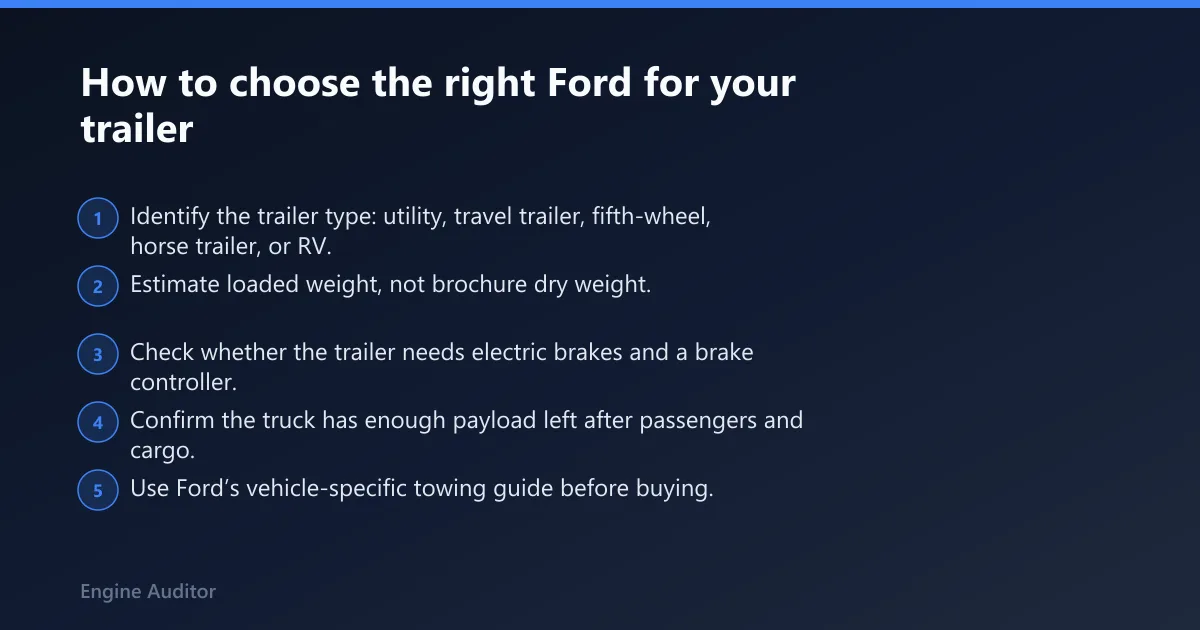
Start with the trailer, not the trim. Then account for passengers, tools, fuel, water, coolers, and hitch gear. Payload matters as much as tow rating because the truck has to carry the tongue weight and still stay inside its ratings.
Match trailer weight to vehicle class
- Identify the trailer type: utility, travel trailer, fifth-wheel, horse trailer, or RV.
- Estimate loaded weight, not brochure dry weight.
- Check whether the trailer needs electric brakes and a brake controller.
- Confirm the truck has enough payload left after passengers and cargo.
- Use Ford’s vehicle-specific towing guide before buying.
Payload, passengers, and cargo
Payload is what the vehicle can carry. Towing capacity is what it can pull. A half-ton truck can run out of payload before it runs out of tow rating, especially with a family in the cab and a loaded trailer on the hitch.
Hitch type, trailer brakes, mirrors, and backup aids
A receiver hitch is not enough for every setup. Big trailers benefit from trailer brake controllers, PowerScope trailer tow mirrors, BLIS with Trailer Coverage, Pro Trailer Hitch Assist, and Pro Trailer Backup Assist. Ford lists BLIS with Trailer Coverage on the F-250 XLT, Pro Trailer Hitch Assist and Pro Trailer Backup Assist on the F-250 King Ranch, and PowerScope trailer tow mirrors on the F-250 Lariat.
Sway control and maneuvering in tight spaces
Trailer sway, poor rear visibility, and awkward backing are where tow aids pay off. BLIS with Trailer Coverage helps blind-spot awareness with the trailer attached. Pro Trailer Backup Assist helps when backing into a site or driveway. Those systems do not replace driver judgment, but they reduce avoidable mistakes.
Decision matrix: match trailer, hitch, and Ford model
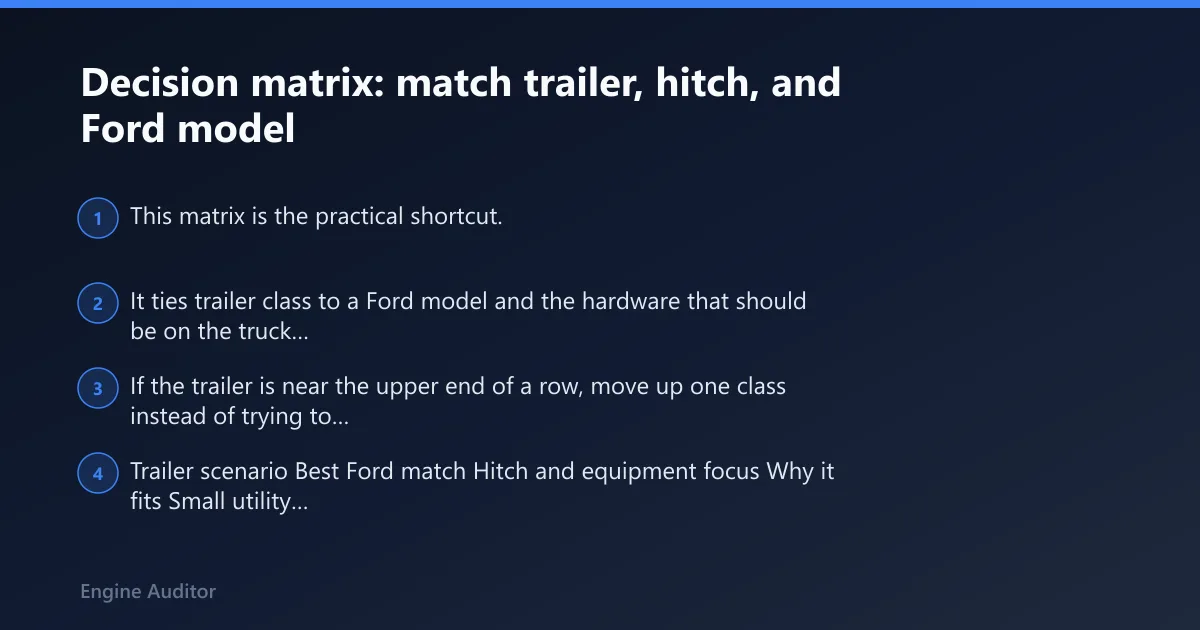
This matrix is the practical shortcut. It ties trailer class to a Ford model and the hardware that should be on the truck before the key is turned. If the trailer is near the upper end of a row, move up one class instead of trying to make the lower class do more.
| Trailer scenario | Best Ford match | Hitch and equipment focus | Why it fits |
|---|---|---|---|
| Small utility trailer, light cargo trailer | Ford Maverick | Basic receiver hitch, trailer lights, payload check | Best for short, light, local towing |
| Compact camper or small travel trailer | Ford Ranger | Trailer brakes if required, tow mirrors if visibility is tight | Better frame and rear axle for mid-light loads |
| Midsize travel trailer, family camper | Ford F-150 | Tow package, brake controller, mirror upgrade, sway awareness | Strong middle ground for daily use and towing |
| Large travel trailer, fifth-wheel, work trailer | Ford Super Duty F-250 | Trailer brake controller, heavy-duty hitch, tow mirrors | More payload and trailer control margin |
| Heavy horse trailer, large RV, gooseneck work trailer | Ford Super Duty F-350 or F-450 | High-Capacity Gooseneck Tow Package, brake controller, towing mirrors | Built for higher load demands and tougher duty cycles |
| Light family camper, occasional towing | Ford Expedition | Proper tow package, trailer brakes, visibility aids | Best when passengers matter as much as the trailer |
Frequently asked questions
What is the best Ford for towing a travel trailer?
For most travel trailers, the F-150 is the best Ford because it balances tow capacity, payload, daily drivability, and equipment choices. Smaller trailers can fit a Ranger or even a Maverick, while larger campers usually push buyers into Super Duty territory for margin and control.
How much can a Ford F-150 tow compared with a Ranger or Super Duty?
The F-150 sits in the middle of Ford’s towing lineup. It is generally the better all-around tow truck than a Ranger, while Super Duty trucks are the right answer when the trailer gets much larger, heavier, or more demanding on brakes, axle load, and hitch setup.
Which Ford SUV has the highest towing capacity?
The Expedition is the Ford SUV to look at first for towing because it is the brand’s family-hauling SUV with real trailer capability. It fits buyers who want enclosed cargo space and passenger comfort, but it still needs the proper equipment and a trailer that stays inside its ratings.
Do I need a diesel to tow a trailer with a Ford?
No, not for most trailers. A diesel matters when the trailer is heavy, frequent, or steep-route towing is part of regular use. Ford’s Super Duty diesel figures, including the 40,000-lb maximum available towing rating and 1,200 lb-ft maximum available diesel torque, are aimed at that upper end.
What tow package do I need for a Ford trailer setup?
The right tow package depends on the trailer size and brake setup. For heavier trailers, look for a trailer brake controller, tow mirrors, and Ford’s towing guides for the exact configuration. Ford says proper equipment is required for max ratings, so the package matters as much as the badge.
What is the difference between payload and towing capacity?
Towing capacity is how much the vehicle can pull. Payload is how much it can carry in the cab, bed, and on the hitch. A truck can hit its payload limit before it hits its tow limit, especially once passengers, gear, and tongue weight are all on board.
Can a Ford Maverick tow a small trailer safely?
Yes, if the trailer is genuinely small and the total loaded weight stays within the vehicle’s ratings. The Maverick is best for light utility or compact cargo trailers. It is not the right choice for larger travel trailers, long-distance mountain towing, or heavy tongue weight.
What towing features does Ford offer, like trailer brake controllers or Pro Trailer Assist?
Ford offers several useful towing aids, including a trailer brake controller, BLIS with Trailer Coverage, Pro Trailer Backup Assist, Pro Trailer Hitch Assist, and PowerScope trailer tow mirrors. These features improve control, visibility, hitching, and backing, especially on larger trailers and tighter sites.
Products related to this article
Sponsored / affiliate links. As an Amazon Associate I earn from qualifying purchases. I may earn additional commission from eligible campaigns.