Ford extended warranty worth it? Pros and cons for buyers
Ford Protect is worth buying if you plan to keep your Ford past the factory warranty and the quoted plan costs less than one major repair or about 10% to 15% of the vehicle’s current value. Skip it and one out-of-pocket repair can wipe out years of savings. This guide breaks the buy-or-skip call into repair risk, ownership horizon, and dealership-only service friction.
Verdict: is Ford extended warranty worth it?

Ford Protect makes sense for owners who will keep the vehicle long enough to face a likely repair, drive enough miles to raise exposure, and can live with dealer-only service rules. It is a weaker buy for short ownership, low-mileage use, or vehicles you plan to modify or service far from a Ford store.
Quick buy-or-skip rule
Buy if you expect to keep the Ford beyond the factory warranty, want a capped repair cost, and the plan price is lower than the likely cost of one major covered repair. Skip if you can set aside the same money in a repair fund and you are unlikely to file a claim.
Who usually benefits
Owners of higher-risk models, high-mileage commuters, towers, and people who keep a vehicle for many years usually get the most out of Ford Protect. That group often values coverage for engine, transmission, drivetrain, and electronics repairs after the factory warranty ends.
Who should skip it
Skip it if you trade vehicles often, drive very little, or want the freedom to use any repair shop. It also loses value if you routinely skip maintenance, plan heavy modifications, or live so far from a Ford dealership that claim handling would be a burden.
Pros and cons
- Pros: a fixed repair bill after factory coverage ends.
- Pros: dealer-backed claims, plus possible roadside assistance, rental car reimbursement, and trip interruption coverage.
- Pros: remaining coverage can help resale if you sell before the term ends.
- Cons: oil changes, tire rotations, brake pads, and other wear items are excluded.
- Cons: repair rules can force dealer visits and delay service for remote owners.
- Cons: the premium can exceed the cost of the repairs you actually have.
Who it’s for
This fits Ford owners who want a simple ceiling on repair risk and expect to keep the vehicle long enough for the plan to matter. It is less attractive for people who drive lightly, keep a repair reserve, or prefer independent shops and aftermarket parts.
📊 Ford says Mustang is the #1 sporty car for new-vehicle quality. Source: Ford® – New Hybrid & Electric Vehicles, SUVs, Crossovers ….
What Ford Protect covers after factory warranty ends
Ford Protect Extended Service Plan is a service contract that typically begins after the factory warranty ends. The factory warranty is the baseline; Ford Protect extends some of that protection into later ownership, but only for the parts and terms in the contract.
Factory warranty vs Ford Protect
The factory warranty is the original coverage period on a new Ford. Ford Protect begins after that coverage expires. That matters because owners sometimes assume the extended plan is a copy of the factory warranty, when the contract may add some protections and exclude others.
Coverage tiers and PremiumCARE
Ford Protect includes coverage tiers, and PremiumCARE is often the higher-level plan many buyers compare first. PremiumCARE is aimed at broader component coverage, including many electronics and advanced systems. Lower tiers generally focus more narrowly, so the exact contract language matters.
Common benefits
Ford Protect can include roadside assistance, rental car reimbursement, and trip interruption coverage. Those benefits can help if a covered breakdown strands you or keeps the vehicle in a shop, but they are contract benefits, not automatic features on every plan.
Suppose a 2026 Maverick throws a transmission warning light while you are 180 miles from home. If the plan covers the failure, roadside assistance and trip interruption coverage can reduce the cost and hassle of getting both the truck and the driver back.
Ford extended warranty pros and cons

The main advantage of Ford Protect is cost control on expensive repairs after factory coverage ends. The main drawback is that the contract can be narrower than buyers expect, especially if maintenance is missed, the vehicle is modified, or the repair falls outside the covered list.
Pros: predictable repair costs and dealer-backed claims
Ford dealerships and approved locations handle covered repairs under the contract terms, with factory-trained technicians and genuine Ford parts. That can make claims more straightforward than a loosely written third-party contract, especially on newer vehicles with complex electronics.
Pros: transferability and added resale appeal
Ford Protect can be transferable if you sell the car, and remaining term can support resale value. The amount of value depends on how much time is left, whether a transfer fee applies, and whether the next buyer sees real protection instead of just paperwork.
Cons: exclusions, service rules, and coverage caps
Routine maintenance is excluded. Oil changes, tire rotations, brake pads, and other wear-and-tear items are not what Ford Protect is for. Claims can also fail if maintenance records are missing or if the repair involves an excluded part or unauthorized modification.
Cons: costs may exceed expected repairs
If the premium is higher than the likely repair bill, self-insuring with a repair fund is smarter. A contract pays off only when the total of covered repairs, fees, and convenience benefits beats the price you paid for protection.
A common first-timer mistake is buying coverage because one repair sounds scary, then forgetting that several years of premiums may equal the same money. The breakeven test is simple: compare the quoted price to one likely major repair, not to the price of an oil change.
Which Ford models are most likely to pay off?
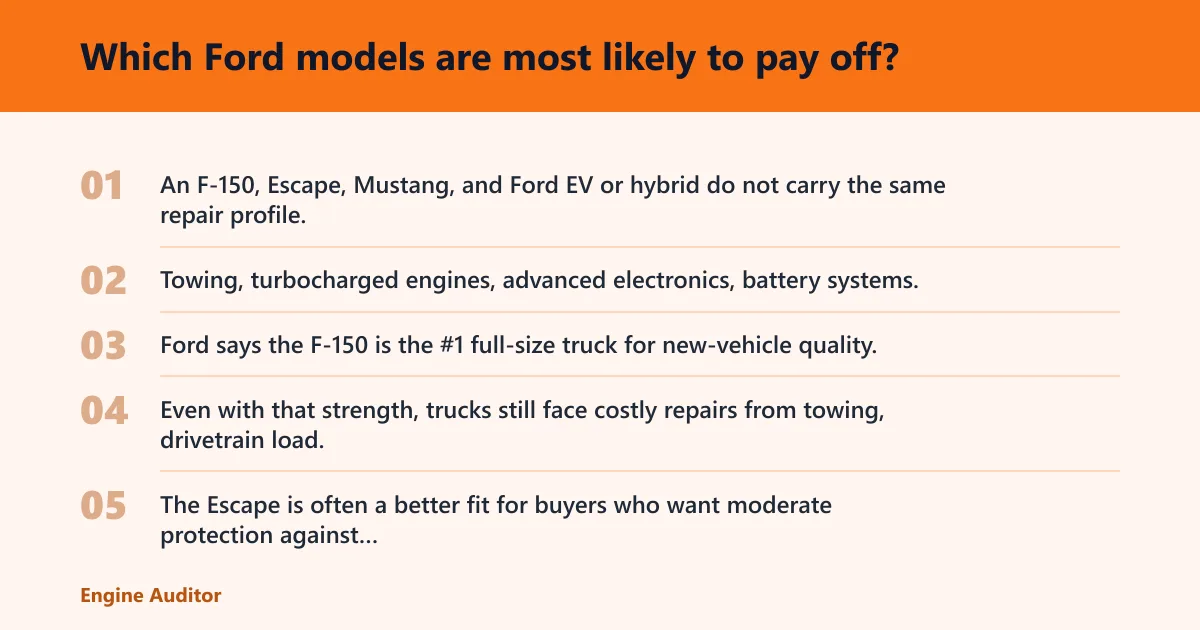
Ford model matters. An F-150, Escape, Mustang, and Ford EV or hybrid do not carry the same repair profile. Towing, turbocharged engines, advanced electronics, battery systems, and long ownership all change the odds that Ford Protect will return more than it costs.
Model-by-model decision table
| Ford segment | Repair exposure | Best fit if you plan to keep it | Usage that raises value | Dealership access | Keep-skip threshold |
|---|---|---|---|---|---|
| F-150 and other trucks | High on towing wear, powertrain load, and electronics | 5+ years | Annual mileage above 12,000, towing, work use | Good if a dealer is nearby | Keep if you tow often or plan long ownership; skip if you trade early and drive lightly |
| Escape and other compact SUVs | Moderate, with more focus on electronics and sensors | 4+ years | High mileage commuting, frequent family use | Moderate | Keep if you will exceed factory coverage and want capped repair costs; skip for short ownership |
| Mustang and performance cars | Moderate to high, depending on use and driving style | Long-term ownership | Hard driving, track use avoidance, higher mileage | Good in metro areas | Keep if the car is a long-term keeper; skip if modified or used in ways the contract may restrict |
| Ford EV and hybrid models | High on electrical systems, software, and battery-related complexity | Long-term ownership | Heavy daily use, cold-weather charging cycles, high tech dependency | Variable by region | Keep if you want coverage for complex electronics; skip if you have poor dealer access |
Trucks: F-150 and Super Duty
Ford says the F-150 is the #1 full-size truck for new-vehicle quality, and Ford says Super Duty is the #1 heavy-duty truck for new-vehicle quality. Even with that strength, trucks still face costly repairs from towing, drivetrain load, and long-mileage use, so extended coverage can make sense for hard-working owners.
Compact SUVs: Escape and similar models
The Escape is often a better fit for buyers who want moderate protection against electronics and sensor repairs. It is less likely than a tow-heavy truck to rack up abuse, but the plan can still help if you plan to keep it well past the factory warranty.
Performance cars: Mustang
Ford says Mustang is the #1 sporty car for new-vehicle quality. That helps the case for some buyers, but performance cars often see harder use and more expensive components. If you plan to keep a Mustang stock and long-term, Ford Protect may be useful; modified cars are riskier.
EV and hybrid models
Ford EV and hybrid buyers should pay close attention to electronics, onboard computers, and battery-adjacent systems. Those parts can be expensive and complicated, which is why PremiumCARE-style coverage may matter more on an EV than on a simpler gas model.
How much does a Ford extended warranty cost?
Ford Protect pricing depends on model, term length, mileage limits, and the coverage tier you choose. Newer, more expensive, and more complex vehicles usually cost more to cover, especially if you want longer terms or higher mileage allowances.
What affects price
Higher repair exposure raises the quote. Trucks, EVs, and loaded trim levels often cost more than a basic compact model. Dealer location, vehicle age, and whether the plan is bought near new or later in ownership can also change the bill.
How term length and mileage limits change the bill
Longer time limits and higher mileage caps usually increase cost. That is logical: the plan is on the hook for more months and more wear. If you drive a fairly high number of miles each year, a short low-mileage plan may not fit your use.
When a repair fund may be cheaper
If the quote is close to the likely repair total, a reserve fund may be the better move. Put the same money aside, keep it liquid, and use it only for repairs. That avoids exclusions, transfer fees, and claim rules.
Do you have to use a Ford dealership for repairs?
Yes, Ford Protect often requires repairs at authorized Ford dealerships or other approved locations, depending on the contract terms. That rule can help with factory-trained technicians and genuine Ford parts, but it can also create friction for owners who live far from a dealer.
Authorized repair requirement
The service contract is not the same as having free choice of any neighborhood shop. If the contract demands dealer or approved repair work, that affects where the vehicle can go, how fast it gets repaired, and how convenient the claim feels.
Dealer network friction for remote owners
Far-from-dealer ownership changes the value equation. A plan that looks cheap on paper can become costly in time if you need to drive hundreds of miles, wait for approval, or arrange transport for a covered repair.
Say your Escape needs a sensor replacement and the nearest Ford store is a long drive away. The coverage may still pay, but the trip, wait time, and scheduling friction can erase part of the benefit. That is why location matters as much as the quote.
Ford Protect vs third-party vehicle service contracts
Ford Protect gives you manufacturer-backed coverage and dealer repair requirements. Third-party vehicle service contracts may offer broader shop choice, but they can also use aftermarket parts, add authorization restrictions, and charge transfer fees that make resale less clean.
Shop choice and parts differences
Third-party plans often let you use more repair shops, which is a real advantage if you live far from a Ford dealer. The tradeoff is that they may allow aftermarket parts or require pre-approval before work begins, which can slow down a claim.
Claim rules and exclusions
Both plan types can deny claims for neglected maintenance, wear items, or excluded systems. The difference is that manufacturer-backed plans often feel more predictable inside the brand network, while third-party plans vary more in claim handling and contract language.
Transfer fees and resale considerations
Ford Protect transferability can help resale if the remaining term is meaningful. Third-party plans can be transferable too, but fee structures and paperwork vary widely. A long remaining term with a clear transfer process is more useful than a cheap plan with awkward terms.
What repairs are most likely to make an extended warranty pay off?
The repairs that matter most are the expensive ones: engine, transmission, drivetrain, and major electrical systems. On many Ford models, those are the claim types that can justify the premium, especially if the vehicle is kept long enough to move well past factory coverage.
Powertrain components
Engine and transmission repairs are the most obvious value drivers because they can be expensive fast. Drivetrain work can also be costly, especially on trucks and higher-mileage vehicles that see towing or heavy commuting.
Electrical systems and infotainment
Modern vehicles depend on sensors, onboard computers, and infotainment units. PremiumCARE is designed to reach more of those systems than a lower tier. If your Ford is loaded with tech, this is where an extended plan can make more sense.
Frequently asked questions
Is Ford extended warranty worth it for a Ford F-150 or Escape?
It can be, but for different reasons. An F-150 often faces higher repair exposure from towing, mileage, and hard use, while an Escape may justify coverage mainly for electronics and longer ownership. If you trade early, the plan is less compelling for either model.
What does Ford Protect cover that the factory warranty does not?
Ford Protect extends coverage beyond the factory warranty period, which is the biggest difference. Depending on the tier, it can also include roadside assistance, rental car reimbursement, and trip interruption coverage. The exact covered parts depend on the contract, especially with PremiumCARE.
How much does a Ford extended warranty cost?
There is no single price, because model, mileage, term length, and coverage tier all affect the quote. Higher-mileage owners and buyers of more complex models usually pay more. A good comparison is the plan price versus one major covered repair, not a vague monthly budget.
Does Ford extended warranty cover electronics and infotainment systems?
Often yes, especially on higher-tier plans such as PremiumCARE, which reaches more electronics and advanced systems. That said, coverage depends on the exact contract language. Buyers should read the parts list carefully, since some electronics-related failures may still be excluded.
Can I buy Ford extended warranty after I buy the vehicle?
Yes, Ford Protect can often be purchased after vehicle purchase, as long as the vehicle and timing fit the plan rules. Waiting usually does not improve the price, though. Buying later may also reduce the remaining term available or limit your plan options.
Is Ford extended warranty transferable if I sell the car?
Often yes, and that can help resale if the vehicle still has meaningful coverage left. The value depends on the remaining term, transfer paperwork, and whether a fee applies. A short remainder usually adds less value than a long, clean transfer.
What are the main drawbacks of buying Ford Protect?
The main drawbacks are exclusions, dealer-only service rules, and the chance that you never use the plan enough to recover the premium. Neglected maintenance, modified vehicles, and wear items are common claim-denial triggers. Far-away dealer access can also make the plan feel less useful.
Do I have to use a Ford dealership for repairs?
Usually yes, or at least an authorized Ford dealership or approved location under the contract terms. That helps with factory-trained technicians and genuine Ford parts, but it also creates inconvenience for remote owners. Shop access is part of the value equation, not a side note.
Is third-party coverage better than Ford Protect?
Not automatically. Third-party coverage can offer broader shop choice and more flexibility, but it may also rely on aftermarket parts and stricter claim authorization rules. Ford Protect is usually cleaner for owners who want brand-backed repairs and do not mind dealership service requirements.
What repairs are most likely to make an extended warranty pay off?
Engine, transmission, drivetrain, and major electrical repairs are the strongest candidates. Those are the claims that can quickly exceed the cost of the plan. If your Ford has lower exposure and you plan short ownership, self-insuring can be the better financial choice.
What to check before you buy
- Confirm how long you plan to keep the vehicle.
- Estimate annual mileage and towing or load use.
- Check how far you live from a Ford dealership.
- Read the maintenance requirements and keep records.
- Review exclusions for wear items, electronics, and modifications.
- Ask whether the plan is transferable and whether a fee applies.
- Compare the quote with a repair fund set aside for one major failure.
One more practical note: Ford Mobile Service can handle oil and filter changes, brakes, batteries, and tire rotation, and Ford Pickup & Delivery lets the dealer pick up and return the vehicle. Those services can reduce friction, but they do not change what the contract covers.
Ford also says BlueCruise works on 97% of controlled access highways in the U.S. and Canada. That does not affect warranty value directly, but it is a good reminder that modern Ford ownership often includes expensive electronics, software, and hardware that deserve careful contract review.
Products related to this article
Sponsored / affiliate links. As an Amazon Associate I earn from qualifying purchases. I may earn additional commission from eligible campaigns.