What Happens When Electric Car Runs Out of Battery: Essential Guide
When you drive an electric car, the battery is like the heart of the vehicle. It stores all the energy needed for your daily trips, long journeys, and unexpected detours. But what actually happens if your electric car runs out of battery?
This is a common worry for both new and experienced electric vehicle (EV) owners. Many people have heard stories or rumors, but the reality might surprise you.
Imagine you are driving on a highway or through a quiet neighborhood, and you notice the battery indicator dropping lower and lower. Maybe you are far from a charging station, or perhaps you misjudged the distance. What will the car do?
Will it just stop suddenly in the middle of the road, or is there a warning? How can you prepare to avoid this stressful situation? These are real questions people have as EVs become more popular around the world.
This article explores what actually happens when an electric car runs out of battery. You’ll learn about the warning signs, how the car responds, what to do if it happens, and how to prevent it. We’ll look at the technical side, real-world stories, and the differences compared to traditional cars. By the end, you’ll have a clear understanding and practical tips to make your EV experience safer and less stressful.
The Early Warning Signs
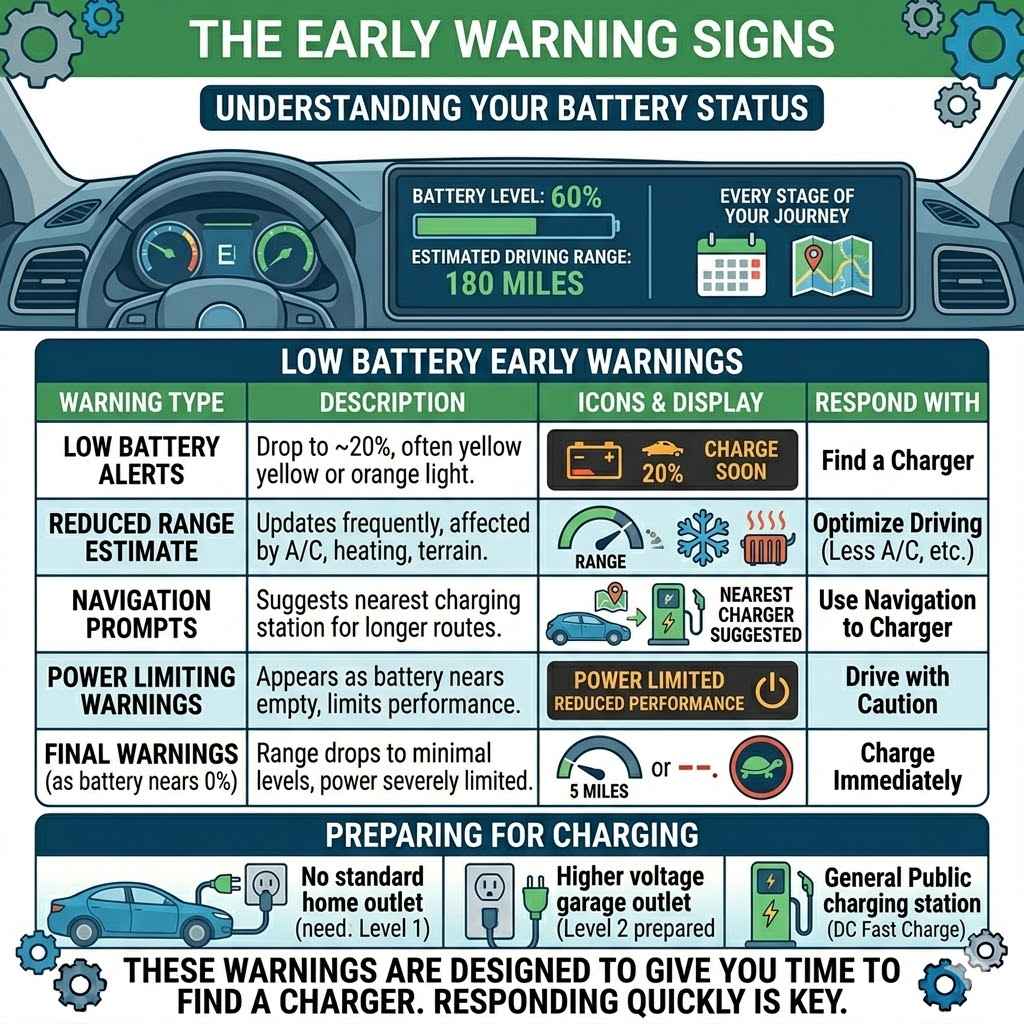
Most electric cars are designed to keep you informed about your battery level at every stage of your journey. The dashboard or digital display shows the remaining battery percentage and the estimated driving range. As the battery gets low, the car will start giving you warnings.
- Low Battery Alerts: When your battery drops to around 20%, you will usually see a yellow or orange warning light. Some cars also show a message like “Low Battery” or “Charge Soon.”
- Reduced Range Estimate: The car may start updating the range estimate more frequently, especially if you are using power-hungry features like air conditioning or heating.
- Navigation Prompts: Many EVs have built-in navigation that suggests the nearest charging station if your route is longer than your remaining range.
- Power Limiting Warnings: As the battery gets closer to empty, a message may appear saying, “Power Limited” or “Reduced Performance.”
These warnings are designed to give you time to find a charger or change your plans. They are not just simple notifications; they are part of the car’s strategy to help you avoid getting stranded.
How Electric Cars Respond To Low Battery
When the battery drops to a critical level, electric cars do not just stop suddenly. They enter a sequence of protective steps. This process helps to keep you safe and protect the battery from damage.
Step-by-step: What Happens As Battery Drains
- Power Reduction: At around 10% battery or less, the car may reduce the power to the motor. This means you might notice slower acceleration, and the car feels less responsive.
- Disabling Non-Essential Features: Features like seat heaters, entertainment systems, and strong climate control might turn off automatically to save energy for driving.
- Turtle Mode: Some EVs display a “turtle” icon, meaning the car is in its lowest power mode. Speed may be limited to as low as 15-20 km/h (10-12 mph). This gives you a small window to find a safe place to stop.
- Final Warning: A red warning light or loud alert signals that the battery is nearly empty. The car may also tell you to “Stop Safely” or “Find Charging Now.”
Complete Stop
If you continue driving and the battery is fully drained, the car will eventually stop. However, this does not happen instantly. The car’s systems are designed to give you time to pull over safely. The steering and brakes will still work for a short while, powered by the battery’s last reserve.
What To Do If Your Electric Car Runs Out Of Battery
Running out of battery in an electric car can be stressful, but knowing what to do can make a big difference.
Stay Calm And Safe
First, stay calm. The car will not stop suddenly in the middle of traffic. Use the remaining power to pull over to the side of the road or into a parking lot if possible.
Switch On Hazard Lights
Turn on your hazard lights to alert other drivers. This is especially important if you have stopped in a place with traffic or low visibility.
Assess Your Location
Are you in a safe area? If you are on a busy highway, it is best to stay inside the car with your seatbelt on until help arrives. If you are in a safe place, you can exit the vehicle.
Call For Assistance
You have several options:
- Roadside Assistance: Most EVs come with a roadside assistance plan. Call the number provided by your car manufacturer or insurance.
- Mobile Charging Services: In some cities, there are mobile charging vans that can give your battery enough power to reach a charging station.
- Tow Truck: If mobile charging is not available, a tow truck can take you to the nearest charging station. Most EVs must be towed on a flatbed to avoid damage.
Avoid Common Mistakes
- Do not try to push the car unless it is safe and legal.
- Do not attempt to jump-start the high-voltage battery with another car; this is dangerous and will not work.
- Avoid leaving the car in a dangerous spot; always prioritize your safety.
Comparing Electric Cars Vs. Gasoline Cars When They Run Out
People often wonder if running out of battery in an electric car is more serious than running out of fuel in a traditional gasoline car. Let’s compare.
| Situation | Electric Car | Gasoline Car |
|---|---|---|
| Early Warnings | Multiple, clear dashboard alerts | Fuel gauge low, warning light |
| Power Reduction | Yes, automatic to save energy | No, runs until engine stops |
| Final Stop | Slowdown, then complete stop | Engine stalls suddenly |
| Getting Moving Again | Needs towing or mobile charger | Can add fuel from a can |
| Recovery Time | Can take longer (charging) | Usually quick (refuel in minutes) |
Non-obvious insight: In an electric car, “topping up” is not as simple as pouring fuel from a can. The car must be plugged into a charger, and even mobile chargers take time to deliver enough power.
What Happens To The Battery When It’s Fully Drained?
Modern EV batteries are protected by advanced software. When the display shows “0%,” there is usually still a small reserve left. This reserve is not accessible for driving but helps keep the battery healthy and protects essential systems.
Battery Management System (bms)
The battery management system controls charging, discharging, and temperature. If you completely drain the battery, the BMS will shut down the car to avoid permanent damage. This is important because over-discharging can cause the battery to wear out faster or fail.
Deep Discharge Risks
- Permanent Damage: Letting the battery drain to zero repeatedly can shorten its lifespan.
- Bricking: In rare cases, if a battery is left at zero for a long time, it might not accept a charge at all. This is called “bricking,” and repairing it can be expensive.
Tip: Try to keep your battery above 10% whenever possible, and never leave your car at zero for long periods.
Real-world Stories: What Drivers Experience
Many drivers have faced the anxiety of a low battery. While rare, running out of battery does happen, and their experiences can teach us a lot.
Urban Vs. Rural Differences
In cities, there are often many charging options nearby. If you run out, help is usually close. In rural areas or on highways, charging stations may be far apart. Planning is more important in these places.
Cold And Hot Weather Effects
Extreme temperatures can make the battery drain faster. In winter, using the heater and driving in cold weather can reduce range by up to 40%. In hot weather, air conditioning also uses more energy.
Real example: In Norway, some EV drivers have reported running out of battery after underestimating how much winter cold would affect their range. They were forced to call for a tow or wait for mobile charging.
Long-distance Travel
On long trips, range anxiety is common. Some drivers tell stories of arriving at charging stations with just 1% battery left. Careful planning, using apps to locate chargers, and driving slower to conserve power are all part of the experience.
Practical insight: Most EV drivers learn to “think ahead” and always know the location of the next charger.
How To Prevent Running Out Of Battery
Prevention is the best way to avoid the stress of running out of battery. Here are some strategies:
- Plan Your Route: Use apps and in-car navigation to map out charging points before you start your trip.
- Monitor Your Range: Keep an eye on the battery and estimated range, especially if you are using features that use extra energy.
- Charge Regularly: Do not wait until you are nearly empty to charge. Top up whenever you can, especially before long trips.
- Use Eco Mode: Most EVs have an “Eco” or “Efficiency” mode. This limits power use and extends range.
- Avoid High Speeds: Driving fast uses more energy. Slower speeds can add extra kilometers to your range.
- Prepare for Weather: If it’s very cold or hot, expect to lose some range. Charge more often in these conditions.
- Stay Informed: Use mobile apps to check the status of charging stations and avoid surprises.
Non-obvious insight: The “last 10%” of battery can disappear faster than expected, especially if you speed up, climb hills, or use the heater or A/C. Always have a backup plan.
Emergency Charging Options
If you do run out, there are a few ways to get back on the road.
Mobile Charging Services
In some cities, companies offer a mobile charging van that can come to you. These vans can add 10-30 kilometers of range in about 30 minutes, enough to reach the nearest station. This service is growing as more people drive EVs.
Portable Chargers
Some EV owners carry a portable charger that can plug into a regular wall outlet. While slow, this can add a few kilometers after an hour or two. It is mainly for emergencies, not regular use.
Towing To A Charger
If no other option is available, a tow truck can take you to the nearest charging station. Always request a flatbed tow—towing with two wheels on the ground can damage the electric motor.
How Running Out Of Battery Affects Your Car’s Health
One common worry is whether running out of battery will damage your car. The answer depends on how often it happens and how you handle it.
Occasional Vs. Repeated Draining
- Occasional: If it happens once or twice, the battery management system protects the car. No long-term harm is likely.
- Repeated: If you regularly drain the battery to zero, this can reduce the battery’s lifespan and performance.
12-volt Battery Risks
Many electric cars also have a small 12-volt battery to run accessories and start the main systems. If both batteries run out, you may not be able to open the doors or turn on the car, even after recharging the main battery.
Software Updates
Some manufacturers release updates to improve battery protection and add features like better range estimates or smarter warnings.
Tip: Always keep your car’s software updated for the best battery health.
Insurance And Warranty Considerations
If your EV runs out of battery, it is usually not covered by warranty as a “defect. ” However, some roadside assistance plans include free towing or mobile charging if you are stranded.
Check your policy: Some insurance companies see running out of battery as “driver error,” while others treat it like running out of fuel.
Warranty Tip: If your battery is damaged due to repeated over-discharge, the repair may not be covered. Always follow the manufacturer’s guidelines.
Myths And Misunderstandings
There are many myths about what happens when an electric car runs out of battery. Let’s clear up some common misunderstandings.
- Myth 1: The car just stops instantly.
- In reality, the car slows down gradually and gives you time to pull over safely.
- Myth 2: You can “jump start” an EV like a gas car.
- The high-voltage battery cannot be jump-started with another car. You need a proper charger.
- Myth 3: Running out of battery ruins the car.
- One incident is not likely to cause permanent damage, thanks to battery management systems.
- Myth 4: It happens all the time.
- Most EV drivers rarely, if ever, run out of battery. Careful planning and good infrastructure make it rare.
The Role Of Charging Infrastructure
Charging stations are growing in number every year. In 2023, there were over 2. 7 million public charging points worldwide, and the number is increasing rapidly. Better infrastructure means fewer people get stranded.
Data: In countries like the Netherlands and Norway, there is a charging station for every 10-20 EVs. In other regions, the ratio is still low, so planning is more important.
Long-term trend: As charging becomes faster and stations are everywhere, running out of battery will become as rare as running out of gas.
Comparing Ev Models: How Do They Handle Low Battery?
Different electric cars handle low battery in slightly different ways. Here’s a look at how three popular models respond:
| Car Model | Low Battery Warning | Power Limiting Mode | Final Steps |
|---|---|---|---|
| Tesla Model 3 | At 20%, then frequent reminders | Yes, turtle mode at 5% | Slows to a stop, steering & brakes remain active |
| Nissan Leaf | At 17% and 8% | Yes, severe power reduction at 3% | Stops, asks to plug in |
| Hyundai Kona Electric | At 10% with audio alert | Yes, eco mode enforced | Stops, displays “Charge Battery” |
Non-obvious insight: Some cars have more “hidden” reserve than others. For example, Teslas often have a small “buffer” even after showing 0%.
The Future: Will Running Out Of Battery Become Obsolete?
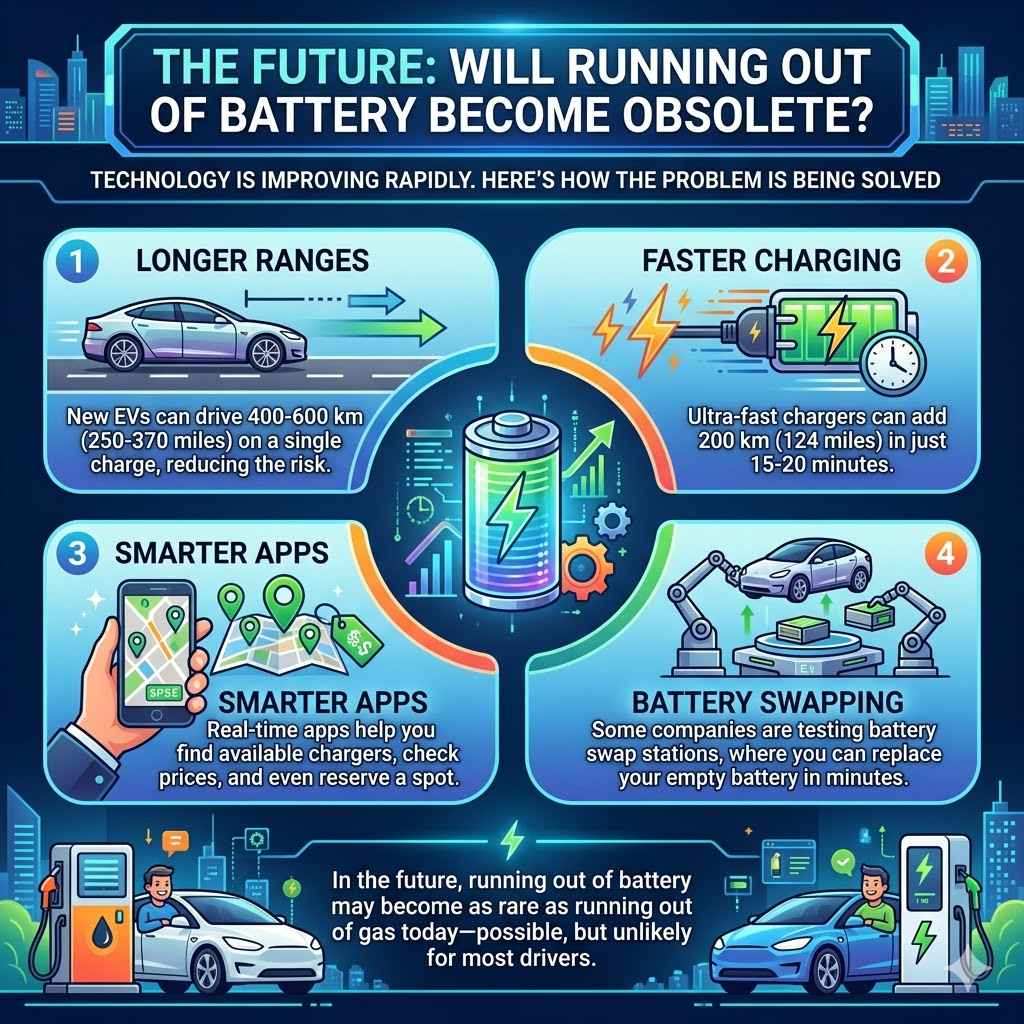
Technology is improving rapidly. Here’s how the problem is being solved:
- Longer Ranges: New EVs can drive 400-600 km (250-370 miles) on a single charge, reducing the risk.
- Faster Charging: Ultra-fast chargers can add 200 km (124 miles) in just 15-20 minutes.
- Smarter Apps: Real-time apps help you find available chargers, check prices, and even reserve a spot.
- Battery Swapping: Some companies are testing battery swap stations, where you can replace your empty battery in minutes.
In the future, running out of battery may become as rare as running out of gas today—possible, but unlikely for most drivers.
Frequently Asked Questions
What Should I Do First If My Electric Car Runs Out Of Battery?
Stay calm and use the remaining power to move to a safe spot. Turn on your hazard lights and call for roadside assistance or a mobile charging service. Do not leave the car in a dangerous place.
Can I Use A Portable Generator To Charge My Electric Car?
Most EVs cannot be charged directly from a typical portable generator. The generator must have the right voltage and connector. It is safer to use official charging equipment or wait for professional help.
Does Running Out Of Battery Damage The Electric Car?
Occasional incidents are not likely to cause damage, thanks to the battery management system. Repeatedly draining the battery to zero can reduce its lifespan. Always try to keep some charge left.
How Long Does It Take To Recharge After Running Out?
It depends on the charger type. A mobile charging van can add enough power for 10-30 km in 30 minutes. Fast chargers at stations can give you 100-200 km in 20-40 minutes. Home charging is much slower.
Where Can I Learn More About Electric Car Charging And Battery Care?
You can find more information on the official websites of car manufacturers or trusted sources like Wikipedia’s Electric Car Use by Country.
—
Electric cars are becoming a normal part of daily life, but running out of battery is still a concern for many drivers. The good news is that modern EVs are designed to keep you safe and informed, with plenty of warning before the battery is empty.
With a little planning, smart driving habits, and an understanding of how your car works, you can reduce the risk of getting stranded. As technology and infrastructure improve, the worry about running out of battery will continue to fade. For now, being prepared and staying informed is the best way to enjoy the benefits of electric driving.