Ford TPMS Light on: Reset and Fix Guide
A Ford TPMS light usually means one tire is low, but a flashing light for about 60 to 90 seconds before staying on usually points to a sensor or system fault. First, set all tires to the driver-side door placard pressure and check for visible damage; if the light is solid and pressure is off, keep driving only far enough to correct it, but if the light is blinking or a tire is losing air fast, stop and inspect the tire before continuing. This guide shows how to check pressure, reset the warning after tire service, and separate inflation problems from TPMS sensor issues.
What the TPMS light means
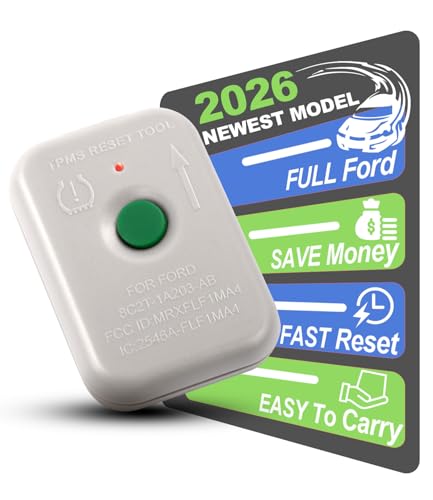


TPMS stands for tire pressure monitoring system. On Ford vehicles, the warning behavior can vary by model and year, but the light is commonly used to flag low tire pressure, and a flashing pattern is commonly associated with a TPMS fault rather than a simple inflation issue. Some systems use direct wheel sensors, while Ford owner-manual procedures can also vary by model family and year range. (Thedrive)
Solid light versus blinking light
A solid TPMS light usually means at least one tire pressure is out of range. A blinking light that stays visible after the first 60 to 90 seconds usually points to a bad sensor or another system malfunction rather than a simple inflation issue. That difference changes the next step completely.
Do not clear a pressure warning before checking every tire. A reset cannot fix a puncture, a damaged sensor, or a tire that is not set to the placard pressure.
Check tire pressure first
Start with a tire pressure gauge, not a visual check. Tires can look normal and still be several pounds low, especially after a temperature drop or a slow leak. The Ford driver-side door placard lists the recommended cold tire pressure for the exact model and trim.
-
Park the vehicle cold.
Let the tires cool before measuring. Cold tire pressure means the reading taken when the tires are cool, because ambient temperature changes can alter pressure enough to trigger the light. -
Read the door placard.
Find the driver-side door placard and note the listed cold pressure for the front and rear tires. Use that figure as the target, not the sidewall maximum. -
Measure every tire.
Check all four tires with a gauge, including the spare if the Ford uses a system that monitors it. Do not rely on appearance alone. -
Adjust to spec.
Add air if a tire is low, or release air if it is overinflated. Pressure outside the placard number can still trigger the warning, so the goal is the listed cold pressure, not simply “close enough.”
Say your Explorer’s placard calls for 35 psi cold and the left front reads 31 psi. That difference can be enough to trigger a solid light even if the tire looks fine from the curb.
Suppose a tire sits at 39 psi after a hot afternoon fill-up, but the placard lists 35 psi cold. After the tire cools, the reading may still be wrong for the vehicle, and the light can remain on until pressure is corrected to the placard value.
Why the light stays on after inflation
If the light stays on after you add air, the fix may still be simple. The system may need time to update, the pressures may still be off, or a rotation, repair, or replacement may have changed which wheel the sensor belongs to. A reset does not repair a leak.
Cold weather changes
Temperature changes can cause tire pressure to shift enough to trigger the light. A cold snap lowers pressure, and the warning may come on even though no tire is damaged. In that case, check the tires cold and bring each one back to the placard number. Tire-industry guidance also notes that pressure naturally drops in colder weather, which is why a warning can appear after an overnight temperature change.
If the warning appears after an overnight drop, recheck pressure before assuming a sensor fault. A few pounds can matter.
After tire rotation or tire repair
After a rotation, wheel swap, or tire repair, the TPMS may need a relearn or reset so the vehicle can identify each sensor correctly. If the wrong wheel position is stored, a Ford can report a warning even after the tires are inflated properly. Tire replacement can also disturb a sensor or valve stem.
After a patch or plug, inspect the repaired tire again if the light returns. A reset should not hide a slow leak.
After a spare tire or wheel transfer
A spare tire or transferred wheel set can confuse the system when the original sensor locations change. Some Ford models accept an in-cabin relearn from the vehicle menu, but the exact pattern varies by model family and year range. If the system does not relearn after a rotation or wheel change, the light may return.
Ford TPMS reset procedure
Some vehicles can reset the TPMS light from inside the cabin, but Ford reset paths are not universal across every model. The exact sequence depends on the model family, year range, and whether the vehicle uses a direct sensor system or another setup. Use the owner manual for the exact sequence after pressure is corrected. For Ford in-cabin TPMS reset steps, follow the vehicle-specific procedure rather than assuming one button sequence fits every model.
-
Correct all tire pressures.
Set every tire to the driver-side door placard pressure before any reset attempt. If one tire is still low or high, the warning can stay on. -
Use the right next step for the symptom.
- If the light is solid after airing up, recheck all tires cold and then complete the relearn or reset if the pressure is correct.
- If the light is blinking, do not keep resetting; treat it as a sensor or system fault and move to diagnosis.
- If the warning began after rotation or service, run the relearn sequence after pressure is confirmed.
-
Cycle to the setup menu.
Use the vehicle’s information display or settings menu if the model has an in-cabin reset path. Many Ford systems use a stored procedure rather than a generic button under the dash. -
Start the relearn.
Follow the model-specific prompt to begin TPMS relearn or reset mode. Some systems ask for a horn chirp, display message, or ignition sequence. -
Drive and verify.
After the reset, drive normally long enough for the system to update and then recheck the pressure display or warning lamp. If the light returns, the issue is still present.
Ford TPMS troubleshooting table
Use this table to separate inflation problems from sensor faults. The point is to check the symptom, confirm the likely cause, and choose the next action without guessing.
| Symptom | Likely cause | Exact check | Next action | Reset, repair, or shop? |
|---|---|---|---|---|
| Solid TPMS light | One or more tires underinflated or overinflated | Check all tires cold with a gauge against the driver-side door placard | Adjust pressure to placard spec, then reset if the light remains | Reset first; repair or shop if pressure keeps falling |
| Blinking light | Sensor or system malfunction | Watch whether the lamp flashes for about 60 to 90 seconds before staying on | Inspect for damaged sensor, failed valve stem, or relearn issue | Visit a shop if the blink continues |
| Cold-weather trigger | Pressure dropped with ambient temperature | Recheck cold tire pressure after an overnight temperature swing | Top up to placard pressure | Reset after pressure is corrected |
| One-tire leak | Puncture or slow leak | Find the low tire, inspect tread and sidewall, and listen for hissing or look for wet spots | Repair the leak and reinflate to spec | Repair or shop |
| Overinflation | Too much air added during fill-up | Compare the gauge reading with the door placard; do not use the sidewall maximum | Release air until the tire matches placard pressure | Reset after adjustment |
| After tire rotation | Relearn needed or sensor location mix-up | Confirm all tires are at correct pressure, then run the Ford relearn sequence | Complete the model-specific reset and verify the light stays off | Reset first; shop if relearn fails |
| Suspected sensor failure | Bad Ford TPMS sensor or system fault | Check for a rapid blink and persistent light after correct pressure | Have the sensor scanned, and inspect for damage after tire replacement or wheel transfer | Visit a shop |
Is the TPMS sensor bad?
A rapid blink followed by a steady light is the strongest clue that the sensor or system is at fault. If every tire matches the placard pressure and the warning still blinks, the problem may be a failed Ford TPMS sensor, a damaged valve stem, or a relearn failure after service.
Rapid blinking light
When the light flashes for about 60 to 90 seconds and then stays on, it is commonly treated as a sensor or system malfunction until proven otherwise. That pattern does not fit a simple low-pressure warning. It often appears after a wheel change, tire replacement, or sensor battery failure.
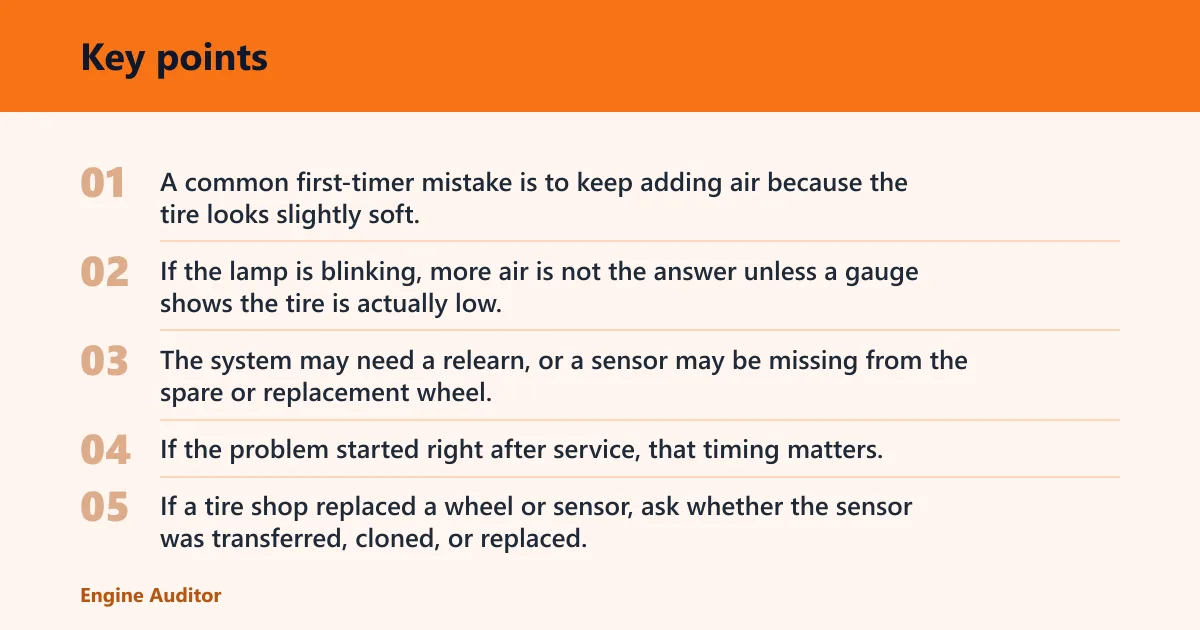
A common first-timer mistake is to keep adding air because the tire looks slightly soft. If the lamp is blinking, more air is not the answer unless a gauge shows the tire is actually low.
Spare tire and wheel swaps
Spare tires and swapped wheel sets can confuse the vehicle if the stored sensor positions no longer match the wheels on the car. The system may need a relearn, or a sensor may be missing from the spare or replacement wheel. If the problem started right after service, that timing matters. If you need help with how to diagnose a failed TPMS sensor, start with the warning pattern, then check pressure and service history before replacing parts.
If a tire shop replaced a wheel or sensor, ask whether the sensor was transferred, cloned, or replaced. That detail often explains the warning.
Can you drive with the light on?
You can usually drive a short distance with a solid TPMS light if the tires are confirmed at the correct cold pressure, but you should not ignore it. If the light is blinking, if one tire is visibly damaged, or if pressure keeps dropping, stop and check the tire before continuing. The warning is there for a reason.
Drive only as far as needed to get home or to a tire shop when the pressure issue is confirmed and minor. If the tire is losing air fast, the answer changes from caution to stop and check immediately.
Frequently asked questions
Why is my Ford TPMS light on even though my tires look fine?
Tires can look fine and still be low enough to trigger the warning. A gauge check matters more than appearance. If all pressures match the door placard and the light is still on, the cause may be a sensor fault, a rotation relearn issue, or a slow leak that is not visible yet.
How do I reset the TPMS light on a Ford after airing up the tires?
First set every tire to the driver-side door placard pressure while cold. Then use the Ford model’s Ford in-cabin TPMS reset steps or relearn sequence if it has one. If the light returns, recheck pressure and look for a tire repair issue or sensor problem instead of repeating the reset blindly.
Can I drive with the TPMS light on in my Ford?
Yes, for a short distance, if you have already confirmed the tires are at the correct pressure and there is no visible damage. Do not keep driving if the light is blinking, the pressure is dropping, or the tire shows a cut, bulge, or puncture. That needs immediate attention.
How do I know if a Ford TPMS sensor is bad?
A bad sensor often shows up as a blinking light that turns solid, especially after a tire replacement, wheel swap, or rotation. If all tires are at the placard pressure and the warning still returns, a scan at a tire shop or service station can confirm sensor or system failure.
What tire pressure should my Ford have in cold weather?
Use the pressure listed on the driver-side door placard and check it when the tires are cold. Cold weather can lower pressure enough to trigger the light, so do not guess by season. If the reading is low, add air to the placard value, not to the sidewall maximum.
Why does the TPMS light come on when temperatures change?
Temperature changes can shift tire pressure enough to cross the warning threshold. A cold night can drop pressure, while a warm afternoon can raise it. The system is responding to pressure change, not necessarily a damaged tire, so check cold pressure before assuming a bigger fault.
Do I need a new TPMS sensor or just a tire pressure adjustment?
Start with pressure adjustment if the light is solid and one or more tires are low or high. If pressure is correct and the light blinks, the fix may be a sensor, a relearn, or another system fault. A tire shop can inspect for punctures, leaks, and how to diagnose a failed TPMS sensor.
How do I check Ford tire pressure correctly before resetting the light?
Check pressure when the tires are cold, use a gauge on every tire, and compare the readings with the driver-side door placard. Do not use the sidewall maximum as the target. Correct any low or overinflated tire first, then reset only if the warning remains on.
Products related to this article
Sponsored / affiliate links. As an Amazon Associate I earn from qualifying purchases. I may earn additional commission from eligible campaigns.