Carburetor Choke Problems and How to Fix Them
If a choke only fails when cold, check three things first: the plate must close fully, open fully, and the fast-idle cam must release. If one of those three does not happen, the fault is usually the linkage, pull-off, or vacuum supply, not the carburetor body itself. Skip that split, and you can waste time on jets, screws, or a full carburetor swap while the engine still floods, stalls, or idles too high. This guide shows how to separate choke faults from linkage, pull-off, fast-idle, and fuel or vacuum problems before you turn an adjustment screw.
How a carburetor choke works

- Restores cold-start choke release
- Controls choke plate opening
- Resists fuel vapors, heat, and vibration
A carburetor choke closes down the air horn during a cold start, which raises fuel concentration and helps fuel vaporize while the engine and intake are still cold. On a sound setup, the choke plate starts mostly closed, then opens in stages as heat, vacuum, and engine motion take over. The fast-idle cam then holds idle speed up during warm-up, and steps down as the choke opens.
Manual chokes use a cable or lever. Pull the control, and the plate closes for cold start. Push it in, and the plate opens for normal running. Electric chokes use a thermostatic housing with a heating element. Most designs begin from a more closed cold position, then the spring relaxes the plate toward open as keyed power heats the housing. Exact motion and index marks vary by carburetor family and engine application. For wiring and terminal layout, follow the carburetor maker’s service instructions; common references include Holley and Edelbrock electric choke guides and OEM service manuals for the specific vehicle application.
The choke pull-off, also called a vacuum break, typically cracks the plate open slightly right after start. That small opening prevents an over-rich flare, fuel smell, and black smoke. If the pull-off does not move the plate immediately, the engine can load up even if the rest of the choke is set correctly. Service manuals and recognized carburetor references generally call for an immediate, small opening on startup rather than a delayed response.
Cold-start sequence
- Cold engine starts with the choke plate mostly closed.
- Initial vacuum acts on the pull-off and opens the plate slightly.
- The fast-idle cam raises curb idle during the warm-up period.
- Heat or manual release opens the plate fully.
- The fast-idle cam steps down to normal idle.
Common choke symptoms and what they point
Use the symptom pattern before touching any screw. A hard cold start can point to an over-open choke, a cable that does not close the plate, no electric choke heat, or a vacuum leak. Flooding, black smoke, or raw fuel smell can point to a choke that stays too closed, a pull-off that does not crack the plate, or a fast-idle cam that does not release. High cold idle often means the fast-idle cam is hanging up, while stalling right after start can mean the choke opens too quickly or the engine has an unrelated lean fault.
Picture a 350 V8 with a manual choke that starts only with throttle pumping and then clears up after 30 seconds. If the plate is almost vertical even when the cable is pulled to cold-start position, the problem is cable travel or linkage motion, not the main metering system. Restore full plate movement first, then reassess mixture.
A common first-timer mistake is to set the electric choke index richer because the engine stalls cold, then find the real issue was a vacuum leak at the base gasket. The choke was reacting to a lean condition, not creating it. For lean symptoms that persist after warm-up, see related guidance on vacuum leak diagnosis and carburetor idle adjustment.
Choke diagnostic matrix

| Symptom | Likely manual choke failure | Likely electric choke failure | Likely pull-off/vacuum break failure | Likely fast-idle failure | First test | Confirms | Exact fix |
|---|---|---|---|---|---|---|---|
| Hard cold start, no flare | Cable slack or misadjustment leaves plate too open | No keyed 12V or poor ground keeps heater from reaching its normal warm-up rate | Plate may still be fine | Cam may not be on a high step | Watch plate position before cranking | Plate never reaches a true cold-start position; fast-idle arm does not pick up the cam | Set cable free play or restore electric power and ground; verify cam engagement after a cold start |
| Flooding, black smoke, fuel smell | Cable binds and keeps plate too closed | Housing adjusted too rich or heater never opens plate far enough | Pull-off does not open plate slightly after start | May hold speed high but is not the root cause | Check immediate plate movement after start | Choke plate stays nearly shut too long; wet plugs or raw fuel odor appear quickly | Free the linkage, repair pull-off, or reset housing index leaner per spec |
| Starts, then dies within seconds | Control not holding the plate in the right cold position | Housing opens too fast or is indexed too lean | Leak in vacuum break circuit | Fast-idle cam not staying on step | Observe plate and cam during the first 15 seconds | Plate opens too far too soon, or fast idle drops off before the engine accepts curb idle | Adjust choke setting, check pull-off hose and diaphragm, and verify fast-idle step-down |
| Very high cold idle | Fast-idle screw or cam misadjusted | Fast-idle side effect, not usually the heater itself | Not primary | Cam hangs on a high step | Tap the throttle and see whether the cam drops | Cam does not release from the high step after a throttle blip | Reset fast-idle cam and curb idle per the carburetor spec; inspect return spring and linkage |
| Cold idle too low | Control does not close plate fully | Thermostatic housing set too lean | Pull-off over-opens the plate | Cam not engaging | Check plate closure with engine cold | Plate never reaches full choke; cam never catches the fast-idle screw | Repair cable, reset housing, or inspect pull-off travel and fast-idle engagement |
| Choke plate stuck open | Broken cable, bent rod, or loose clamp | Heater may be stuck in warm position or housing index is wrong | Pull-off not the main cause | Not the main cause | Move the linkage by hand with the engine off | Plate has no meaningful cold-start closure even with full cable pull or cold thermostat setting | Free the linkage, repair cable, or replace the housing if it will not respond |
| Choke plate stuck closed | Cable sheath or inner wire binds | Housing stuck or misindexed rich | Pull-off weak or inoperative | May mask the issue at idle | Check whether the plate opens with manual movement | Plate opens only when forced by hand or never cracks open after start | Free the choke, restore pull-off action, or reset the housing index; test vacuum break per manual |
| Stumble only as it warms | Release too fast | Electric choke opens too soon | Vacuum break may be fine | Cam steps down too early | Watch the transition from fast idle to curb idle | Choke plate is nearly open, but the engine falls flat when fast idle drops | Correct the choke index and fast-idle step-down; recheck curb idle and mixture |
Is the choke really the problem?
Use the symptom pattern to separate choke faults from vacuum leaks, fuel delivery issues, and general carburetor wear. A vacuum leak often creates a lean cold start that looks like an over-open choke. A dirty idle circuit can also mimic choke trouble by making the engine stall when cold and recover as soon as the throttle is held open. If the choke plate and fast-idle cam behave normally but the symptoms persist, look beyond the choke first.
Start with the choke plate, linkage, and pull-off before replacing the carburetor. If the plate moves freely by hand, the cable or housing is suspect. If the plate moves correctly but the engine still behaves badly, look at vacuum leaks, base gasket seals, intake leaks, and fuel level before you adjust the choke richer to hide the real fault. Also check fuel height and sight glass behavior on carburetors that use them; a fuel-level fault can mimic a choke fault by enriching or leaning the mixture at the wrong time. For related symptoms, see carburetor rebuild symptoms.
Say the engine starts only with the throttle held open, yet the choke plate closes and opens normally by hand. That pattern points away from the choke and toward a lean condition, often a vacuum leak or low fuel delivery. Replacing the choke assembly would not fix that. A lean condition is especially likely if the engine improves when a small amount of extra fuel is introduced or if idle quality changes when vacuum hoses are moved.
Visual checks that matter
- Engine off and cool, inspect the choke plate for carbon, varnish, or a bent edge.
- Move the plate by hand. It should travel smoothly without sticking at mid-stroke.
- Check that the linkage rod is aligned and not rubbing the air horn or air cleaner base.
- Verify that the fast-idle cam steps freely as the throttle is opened and released.
- Look for cracked vacuum hoses or loose fittings before changing settings.
- Observe choke plate clearance: when the pull-off applies vacuum, the plate should crack open slightly and evenly, not jump wide or remain fully shut.
How do I fix a manual choke?
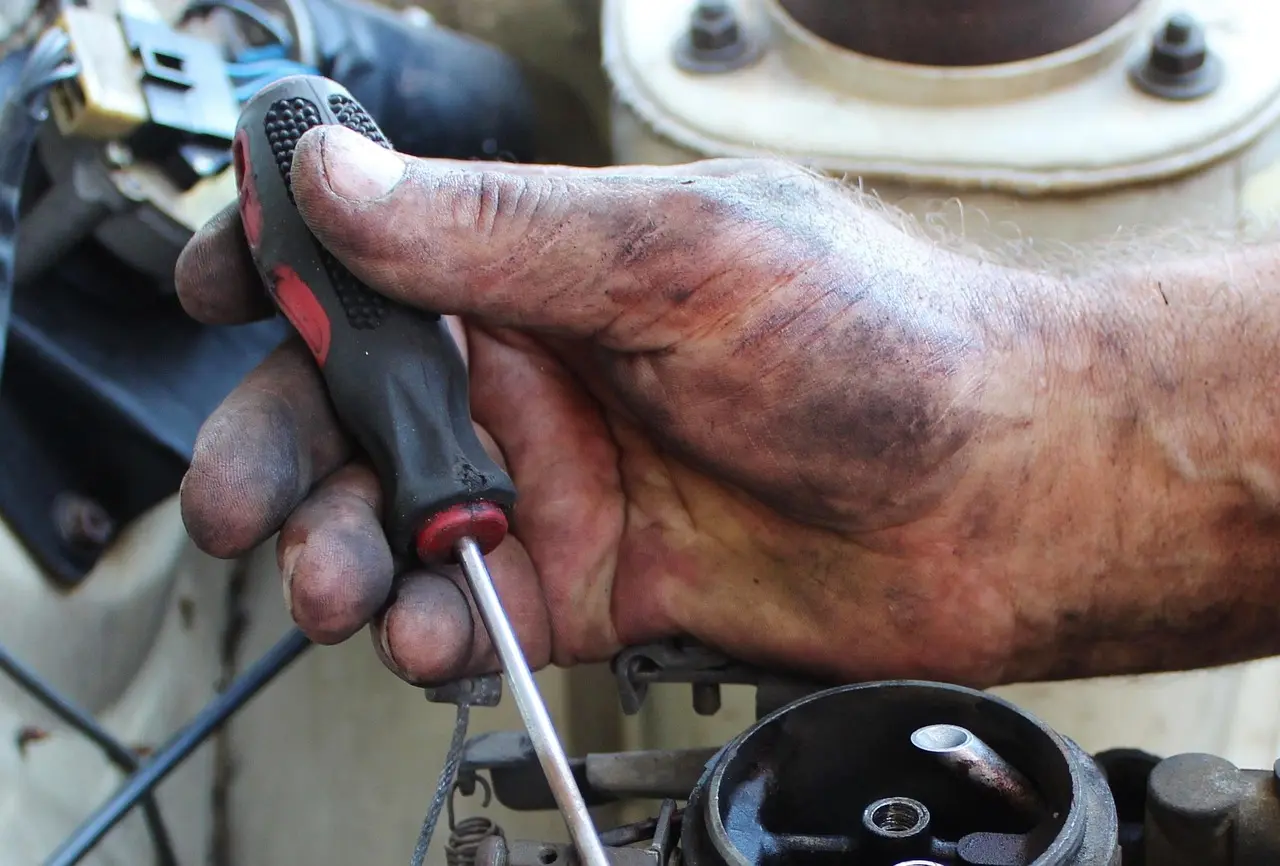
Adjust a manual choke by restoring full cable travel first, then setting the plate so it closes for cold start and opens fully when the control is pushed in. If the cable has slack, kinks, frayed strands, or a loose clamp, the plate will not reach the same position every time. Clean the linkage, verify smooth motion, then set the final free play according to the carburetor family and engine application.
Do not force the cable to compensate for a bent rod or binding shaft. The cable should move the choke, not fight it. If the plate still will not reach full closed or full open after the cable is corrected, the rod, lever, or shaft may need repair before any final adjustment will hold. If the plate closes but the engine still stumbles warm, confirm that the pull-off and fast-idle cam are not masking a vacuum leak or low fuel level.
Manual choke adjustment steps
- Inspect the cable sheath and inner wire for kinks, fraying, or a loose anchor clamp.
- With the control released, confirm the plate opens fully.
- Pull the control to the cold-start position and confirm the plate closes fully.
- Set a small amount of free play so the cable does not preload the lever.
- Tighten the clamp and retest cold start, fast idle, and warm-up opening.
How to remove a choke cable
When a cable is damaged, seized, or routed incorrectly, removal is usually the cleanest fix before reinstallation or replacement. Keep the routing gentle and avoid sharp bends, because a cable that binds at the dash end or carburetor end can mimic a bad choke every time the engine is cold.
Tools: screwdrivers, small wrench set, needle-nose pliers, trim tool if the dash control is retained with clips.
- Disconnect the battery if the cable passes near wiring or a heated choke terminal.
- Release the carburetor-end clamp or anchor screw and free the inner wire from the choke lever.
- Remove any brackets, clips, or retaining nuts at the dash control or firewall pass-through.
- Withdraw the cable carefully, noting the original routing and any heat shields or grommets.
- Inspect the sheath, wire, and end fittings for fraying, heat damage, or corrosion before reusing.
Common mistakes: yanking the cable through a tight bulkhead hole, forgetting the heat shield, or bending the inner wire at the lever. What to verify after reassembly: the cable moves smoothly end to end, the choke plate closes and opens fully, and the lever does not preload the shaft at rest.
How to connect a choke cable
Connecting the cable is mostly about routing and free play. The choke lever should reach full close at the cold-start pull and full open at release, with no constant tension on the mechanism. If the cable is too tight, the plate may never fully open; if it is too loose, the plate may never fully close.
Tools: screwdrivers, small wrench set, side cutters, light lubricant for the cable sheath if allowed by the manufacturer.
- Route the cable away from exhaust heat, sharp edges, and throttle linkage interference.
- Seat the sheath in its bracket and align the inner wire with the choke lever hole or clamp.
- Attach the inner wire without preloading the lever, then tighten the clamp just enough to hold position.
- Set the dash control to full release and confirm the plate opens fully.
- Pull to cold-start and confirm the plate closes fully without cable drag.
Common mistakes: routing too close to the manifold, setting no free play, and clamping the wire before verifying both endpoints. What to verify after reassembly: full sweep, smooth return, no cable rub, and proper cold-start flare followed by controlled opening.
How do I test an electric choke?
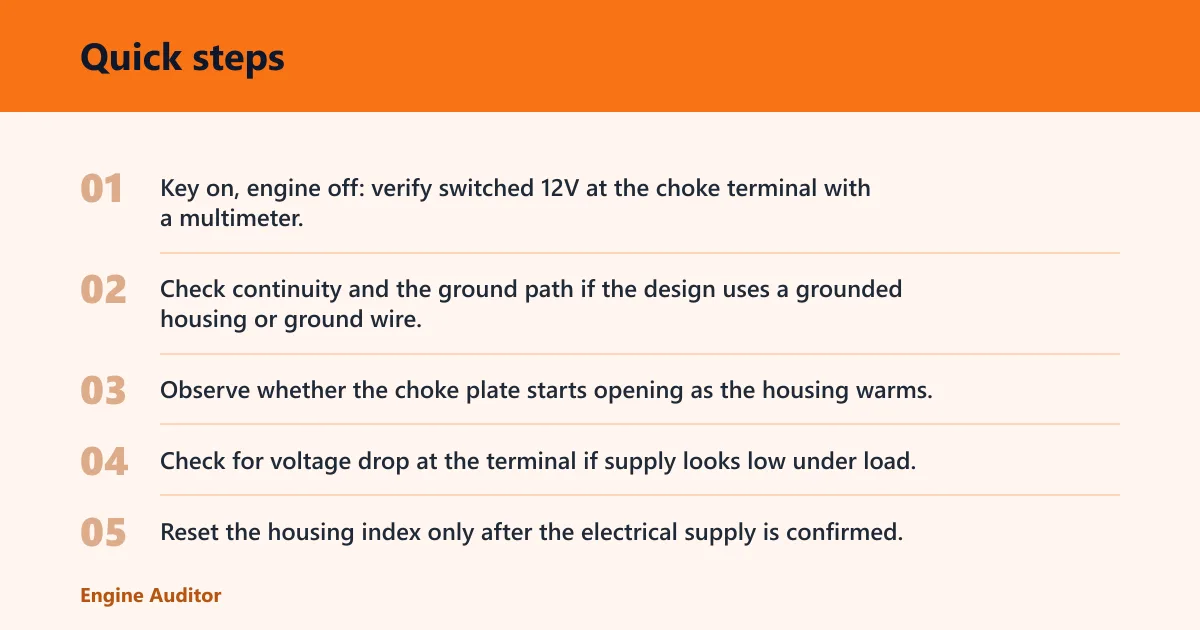
Test an electric choke with a multimeter before turning the housing. The heater needs keyed 12V on the proper terminal and a good ground path, depending on design. If voltage is missing, the spring may stay in its cold position and hold the plate too closed. If power is present but the choke does not open at the expected warm-up rate, check the housing index, ground path, and heater continuity. Manufacturer guides commonly specify switched ignition power only, not full-time battery power, so verify the circuit with the vehicle wiring diagram before making changes.
Use eye protection around carb cleaner and keep ignition sources away from fuel vapors. Do not spray or blow debris into open passages unless the area is safe and the vehicle manual allows it. Follow the vehicle and product manuals for electrical tests and any adjustment procedure specific to the carburetor family. For wiring examples and terminal guidance, use the carburetor maker’s manual or OEM service information rather than guessing at generic colors or fuse locations.
Electric choke test points
- Key on, engine off: verify switched 12V at the choke terminal with a multimeter.
- Check continuity and the ground path if the design uses a grounded housing or ground wire.
- Observe whether the choke plate starts opening as the housing warms.
- Check for voltage drop at the terminal if supply looks low under load.
- Reset the housing index only after the electrical supply is confirmed.
Electric choke setup notes
The thermostat housing usually indexes rotationally. A richer setting keeps the choke closed longer; a leaner setting opens it sooner. Small changes matter, and the correct position varies by carburetor family and engine application. If the heater works but the warm-up rate is wrong, the index may be off even though the parts are good.
Installation should start with the carburetor cold and the choke plate fully closed or at the manufacturer’s specified starting index. Then the housing is rotated to the index mark that matches the application, the screws are secured, and the keyed power source is verified. If the carburetor manufacturer calls for a spacer, insulator, or specific wire routing, install those parts exactly as specified.
How to install an electric choke
Installing an electric choke is a matter of correct seating, correct power feed, and correct initial index. An incorrect source wire can keep the choke hot all the time, while an incorrect index can make the engine rich or lean during cold start even when the heater works properly.
Tools: screwdrivers, small wrench set, multimeter, wiring connector tools, gasket if the housing requires one.
- Confirm the carburetor family and obtain the correct choke housing or service kit.
- Remove the old housing and inspect the choke shaft, plate, and linkage for binding.
- Install the new housing with the specified gasket or seal, aligning the tang with the choke lever correctly.
- Connect the keyed 12V source to the correct terminal and secure the ground path if the design requires one.
- Set the initial index per the service manual or carburetor reference, then tighten the retaining screws.
Common mistakes: connecting to constant battery power, omitting the ground where required, and setting the index without confirming the plate and cam are free. What to verify after reassembly: with key on, the heater warms, the plate opens gradually, the pull-off cracks the plate after start, and the fast-idle cam steps down cleanly.
Choke linkage and pull-off checks
Choke linkage and the vacuum break deserve separate checks because either one can mimic a bad carburetor. The linkage and rod must move freely without binding, and wear or a slight bend can change travel enough to stop the plate short of full open or full close. The pull-off should move the plate slightly right after start, not later after the engine has already loaded up.
Check the pull-off by watching the choke plate immediately after startup. A healthy pull-off opens the plate a small amount at once; if there is no visible movement, the engine may flood rich before the choke begins to open on its own. If the movement is excessive, the plate may open too far and create a lean stumble. A practical test is to apply vacuum to the pull-off with a hand pump or the vehicle’s supplied vacuum source, then observe for smooth, immediate travel without leakage or drift. If vacuum bleeds off and the rod relaxes, the diaphragm or hose is suspect. For related adjustment procedures, see fast-idle adjustment and electric choke wiring.
Pull-off vacuum test method
- Engine off, locate the pull-off diaphragm and its vacuum hose or fitting.
- Disconnect the hose if needed and connect a hand vacuum pump.
- Apply vacuum steadily and watch the choke plate crack open slightly.
- Hold vacuum and confirm the rod does not bleed back or flutter.
- Release vacuum and verify the linkage returns smoothly without sticking.
Fast-idle engagement and release checks
- With the engine cold, open the throttle enough to let the fast-idle cam step onto its high notch.
- Release the throttle and confirm the fast-idle screw rests on the cam, not beside it.
- Blip the throttle and verify the cam steps down one notch at a time rather than sticking.
- Warm the engine enough for the choke to begin opening and confirm the cam drops to curb idle cleanly.
- If the cam hangs, inspect the return spring, throttle shaft, and carbon buildup before changing choke settings.
What to repair first
- Free sticky linkage and clean the pivot points.
- Repair a bent rod or worn connection that changes travel.
- Restore pull-off action if the plate does not crack open after start.
- Only then fine-tune the choke setting.
Frequently asked questions
How do I adjust a carburetor choke?
Adjust it only after you confirm that the plate, linkage, pull-off, and fast-idle cam all move correctly. For a manual choke, set cable free play so the plate closes for cold start and opens fully when released. For an electric choke, set the housing index per the carburetor family and verify keyed power first.
How do I adjust a manual choke on a carburetor?
Set the control so the cable does not preload the lever, then verify two positions: plate closed at cold start and plate fully open when the control is pushed in. If travel is short, look for cable slack, a loose clamp, a kinked sheath, or a bent linkage before changing any other setting.
How does a choke work on a carburetor?
It closes the air opening during a cold start so the mixture becomes richer and the engine can fire more easily. As the engine warms, the plate opens, the pull-off cracks it slightly right after start, and the fast-idle cam steps down until normal curb idle takes over.
How do I wire an electric choke carburetor?
Most electric chokes need keyed 12V and a proper ground path, but the exact terminal layout can vary by carburetor family. Use a multimeter to verify switched power at the choke lead with the key on, then confirm continuity or ground where the design requires it. Follow the carburetor manual for the exact connection point and do not rely on wire color alone.
Why is my carburetor choke stuck open or closed?
A choke stuck open usually points to a broken or misadjusted manual cable, bent rod, or an electric housing that is indexed too lean or not receiving the right power and ground. A choke stuck closed usually points to binding linkage, a failed pull-off, or a housing that never warms and never opens the plate.
What symptoms show a bad choke vs a bad carburetor?
A bad choke usually changes only the cold-start phase: hard start, flooding, black smoke, or high cold idle that improves warm. A bad carburetor or vacuum leak often shows broader lean or rich problems that continue after warm-up. If the plate and cam move correctly, look deeper into vacuum, fuel level, or carburetor wear.
Products related to this article
Sponsored / affiliate links. As an Amazon Associate I earn from qualifying purchases. I may earn additional commission from eligible campaigns.