Best Cars for Learning to Drive: Forgiving Models
The best cars for learning to drive are simple, light, small hatchbacks with clear sightlines and calm controls. A learner-friendly car should make junctions, parking, and hill starts feel manageable, while keeping the cost of a scrape or stall low. This guide ranks options by the mistakes they forgive best, so you can match a first car to weak spots like clutch control, visibility, or low-speed steering.
What makes a car easy to learn in?
Visibility and sightlines
Clear visibility matters because new drivers spend much of their attention on mirrors, lane position, and the distance to kerbs, posts, and bay lines. A low beltline, thin front pillars, and a seating position that lets you see the bonnet edges all reduce guesswork. That is especially useful when you are learning where the car ends, and where the space begins.
Steering, pedals, and throttle response
Beginners usually do better with light but not nervous steering, pedals that move in a predictable way, and a throttle that does not lurch from a small press. Overly sensitive controls can make smooth driving harder than it needs to be. The aim is not speed. It is calm responses at 10 mph, 20 mph, and every stop between.
Parking ease and low-speed control
Small hatchbacks and city cars are easier to place in tight spaces because they are short, narrow, and quick to correct if you turn in too far. Tight turning circles help. So does a car that stays settled when you creep forward or reverse into a bay. For a learner, low-speed manners matter more than outright power.
Why small mistakes should be cheap
Learning drivers make small errors. A kerbed wheel, a clipped mirror, or a stalled hill start should not turn into a large bill. That is why lower-priced used cars often make more sense than new ones, especially when insurance, replacement parts, and repair anxiety all matter. Cheap mistakes help build confidence. Expensive ones do the opposite.
Learner car fit matrix
This matrix uses five pain points and a weighted score out of 100. Visibility counts for 25 points, clutch or throttle friendliness for 20, parking ease for 20, low-speed stability for 15, and the cost of small mistakes for 20. Each car is scored from 1 to 5 in each column, then converted to a weighted total using this method: score ÷ 5 × weight.
Scoring criteria: 1 = poor fit, 2 = below average, 3 = acceptable, 4 = strong, 5 = excellent. Visibility uses bonnet-edge view, pillar thinness, seating height, and known visibility proxies where available; parking uses length, width, turning circle, and rear visibility; low-speed stability uses wheelbase, track, and settled low-speed behaviour; small-error cost uses used-price range, insurance grouping, and likely repair exposure.
| Model | Visibility /25 | Clutch or throttle /20 | Parking /20 | Low-speed stability /15 | Small-error cost /20 | Total /100 |
|---|---|---|---|---|---|---|
| Volkswagen up! / SEAT Mii / Skoda Citigo | 20 | 18 | 20 | 13 | 18 | 89 |
| Ford Fiesta Mk6 | 18 | 17 | 16 | 13 | 16 | 80 |
| Skoda Fabia Mk3 | 18 | 17 | 17 | 14 | 17 | 83 |
| Toyota Aygo / Citroen C1 / Peugeot 108 | 19 | 17 | 20 | 12 | 17 | 85 |
| Kia Picanto Mk3 | 18 | 16 | 19 | 13 | 17 | 83 |
| Volkswagen Polo | 18 | 17 | 17 | 14 | 16 | 82 |
| Honda Civic | 16 | 16 | 12 | 13 | 14 | 71 |
| Subaru Impreza | 15 | 15 | 11 | 14 | 13 | 68 |
How to read it: higher totals suit nervous learners and tight urban use. Lower totals are not bad cars; they are just more likely to ask for extra confidence, extra space, or extra budget.
For a learner who fears parking scrapes, the up!/Mii/Citigo trio and the Aygo/C1/108 trio forgive the most. For a learner who wants more space without moving into SUV size, the Fabia and Polo are the calmer step up. For a learner who needs driver aids and a bigger cabin, the Civic and Impreza make sense only if the tradeoff is acceptable.
Which small cars are easiest for new drivers?
The easiest small cars are the ones that shrink the car around the driver: short length, clear edges, light controls, and cheap minor damage. The Volkswagen up! / SEAT Mii / Skoda Citigo, Toyota Aygo / Citroen C1 / Peugeot 108, Kia Picanto, and Skoda Fabia all fit that brief in different ways. Each suits a different weak spot.
Volkswagen up! / SEAT Mii / Skoda Citigo
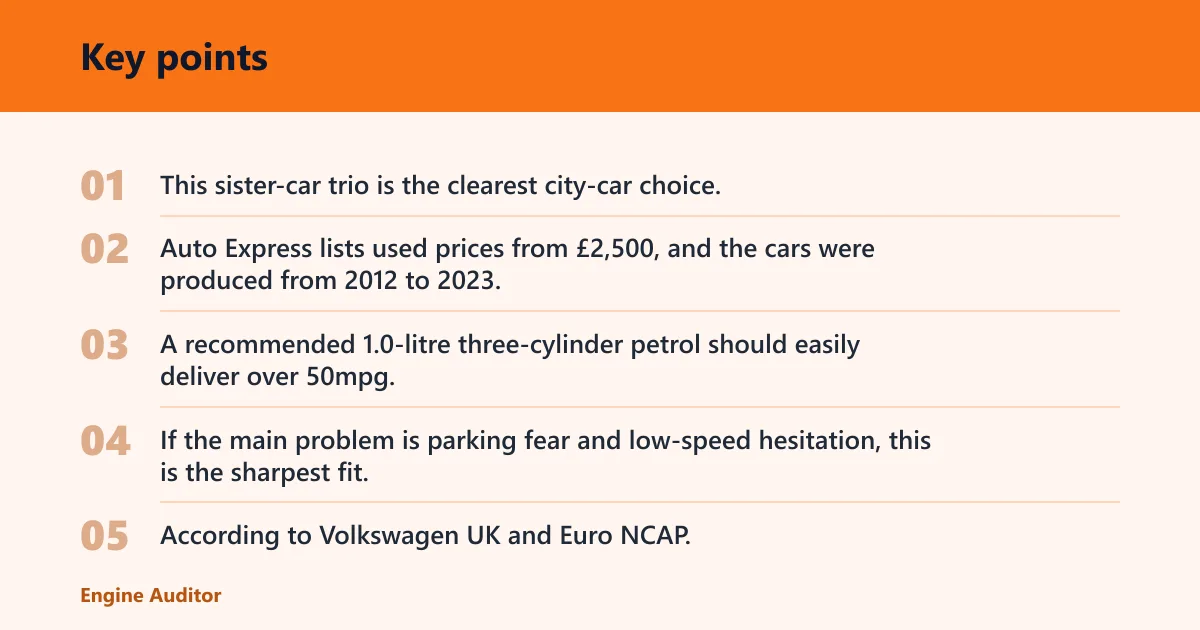
This sister-car trio is the clearest city-car choice. Auto Express lists used prices from £2,500, and the cars were produced from 2012 to 2023. A recommended 1.0-litre three-cylinder petrol should easily deliver over 50mpg, and at least one variant sits in insurance group 1. If the main problem is parking fear and low-speed hesitation, this is the sharpest fit.
According to Volkswagen UK and Euro NCAP, the wider 2011-2020 city-car platform brought strong safety structure, while the short overall length and tight turning circle make it a practical urban tool; UK licensing guidance also treats compact cars as easier for low-speed manoeuvres than larger vehicles because they are simpler to position in space.
These cars are small enough to place in tight gaps without feeling overfaced. They suit urban learners who want easy manoeuvrability more than extra space. A common first-timer mistake is over-correcting in a narrow bay; a compact city car gives you less car to correct. The up! is especially useful for beginners because its small footprint keeps steering inputs and mirror checks easier to judge.
Toyota Aygo / Citroen C1 / Peugeot 108
This shared-platform triplet is another strong city option, with used prices from about £2,500 and production from 2014 to 2022. The 1.0-litre engine keeps the cars simple, they can return over 55mpg, and some versions include optional active safety features. They suit learners who spend most of their time in town and want parking to feel less like a test.
Parkers and manufacturer data put these cars among the shortest mainstream hatchbacks in the class, with a tiny footprint that helps in supermarkets and narrow streets; Euro NCAP also documented the availability of city-focused active safety equipment on later versions. For beginner drivers, that mix of length, width, and visibility is the main advantage.
The main strength here is size. The main tradeoff is that the cabin can feel basic compared with larger hatchbacks. For a short commute, though, that simplicity helps. It keeps the attention on road position rather than on menus, modes, or unnecessary extras.
Kia Picanto Mk3
The Picanto Mk3 suits learners who want a newer-feeling small car with an easy spec structure. Used prices start from £4,000, production ran from 2017 to 2023, and trim levels 1, 2, and 3 keep the range easy to understand. That simple trim ladder also explains why it has appeal on finance.
Parkers lists the Picanto as one of the shortest and narrowest cars in its class, while manufacturer dimensions and turning-circle figures support why it feels easy to park in tight urban spaces. The benefit for learners is less about power and more about the way the car’s proportions reduce uncertainty during bay parking and low-speed turns.
This is a good pick if the buyer wants straightforward equipment choices rather than a long options list. It is less about the cheapest possible purchase and more about low-stress ownership. If spec confusion is part of the problem, the Picanto removes some of it.
Skoda Fabia Mk3
The Fabia Mk3 is the step-up small hatch for learners who need a little more cabin and road stability. It has used prices from £3,500, production from 2014 to 2021, and underpinnings shared with the Volkswagen Polo. A non-turbocharged 1.0 mpi petrol sits in insurance group one, and that engine can return more than 55mpg.
Parkers and Skoda’s dimension data show a longer wheelbase and broader body than the tiniest city cars, which helps stability without making the car unwieldy. That makes the Fabia a sensible middle-ground choice for learners who want a little more composure and rear-seat space than a pure city car.
It suits taller drivers better than the tiniest city cars, and it is a sensible answer to the learner who wants extra room without giving up simple controls. If your weak spot is confidence at speed rather than parking alone, the Fabia is one of the better middle-ground choices.
Which hatchbacks suit manual learners best?
Manual learners often want light clutch action, predictable take-up, and a car that does not punish slow hand-foot coordination. The Ford Fiesta Mk6 and Volkswagen Polo are strong matches for that. Manuals can also give broader licence access in many places and often cost less to buy, but the stick-shift learning curve is real.
Ford Fiesta Mk6
The Fiesta Mk6 is the classic all-rounder for a reason. The same source lists used prices from £2,000, and production ran from 2008 to 2016. It has a reputation for light steering, a practical size, and multiple trim levels, which makes it easy to find one that suits a learner’s budget and equipment needs.
Ford’s published dimensions and Parkers data show compact exterior proportions and a relatively tight turning circle for the class, which helps in town and on test-route style manoeuvres. That is why the Fiesta remains such a common learner recommendation: it is small enough to place, but not so tiny that it feels fragile.
It is a strong choice for the learner who wants a normal-feeling hatch that does many things well rather than one that excels in a single area. If the fear is not parking but everything around town feeling unfamiliar, the Fiesta’s easy manners help.
Volkswagen Polo
The Polo is a quieter, more polished manual learner choice. It is known for learner-friendly manners, clear instruments, and predictable handling, and newer examples can bring more assistance tech. It is also a cost-effective used choice for buyers who want a small hatch that feels settled without becoming complicated.
Parkers and Volkswagen model data show that the Polo is larger than a city car but still compact enough for everyday parking, and Euro NCAP results on later versions support the availability of strong safety systems. The tradeoff is that its size and price can make it feel less forgiving than an up! or Aygo when the driver is still building confidence.
Choose the Polo if you want a more composed feel than a basic city car and if the driver values straightforward controls over sporty responses. It suits learners who want a small car that does not demand much adaptation between driving lessons and private practice.
Manual transmission and automatic learning
Manual cars can be cheaper to buy and can widen licence access in many places. They also teach clutch control, hill starts, and gear choice in a way that some learners value. The downside is the extra work at junctions and the chance of stalling when a learner is already under pressure.
In the UK, DVSA guidance means a driver who takes the test in an automatic receives an automatic-only licence, while a manual test can be used to drive both transmission types. That is the main licensing rule to understand before choosing a car. If the goal is future flexibility, manual still matters.
Automatic learning is usually easier at the start because there is no clutch to coordinate. That can help anxious drivers focus on steering, mirrors, and judgement. If the main issue is panic at stops, automatic may be the calmer route. If broader licence access matters more, a manual still has a place.
Why dual controls or an instructor car can help
A dual-control instructor car feels safer because the instructor can intervene if a learner misjudges a pedal or junction. That extra layer of backup often makes people braver sooner. It is especially useful when the learner is still learning braking pressure, mirror checks, and moving off cleanly.
For private practice, start with a simple car and a quiet route. That keeps the early mistakes smaller. The goal is to make each drive predictable enough that the learner can focus on one problem at a time.
When does a larger car make sense?
A larger hatch makes sense when the driver needs more support from the car itself: better outward vision, more cabin room, or assistance features that reduce stress. The Honda Civic and Subaru Impreza fit that brief better than most. They are not the simplest learner cars, but they can suit the right driver.
Honda Civic
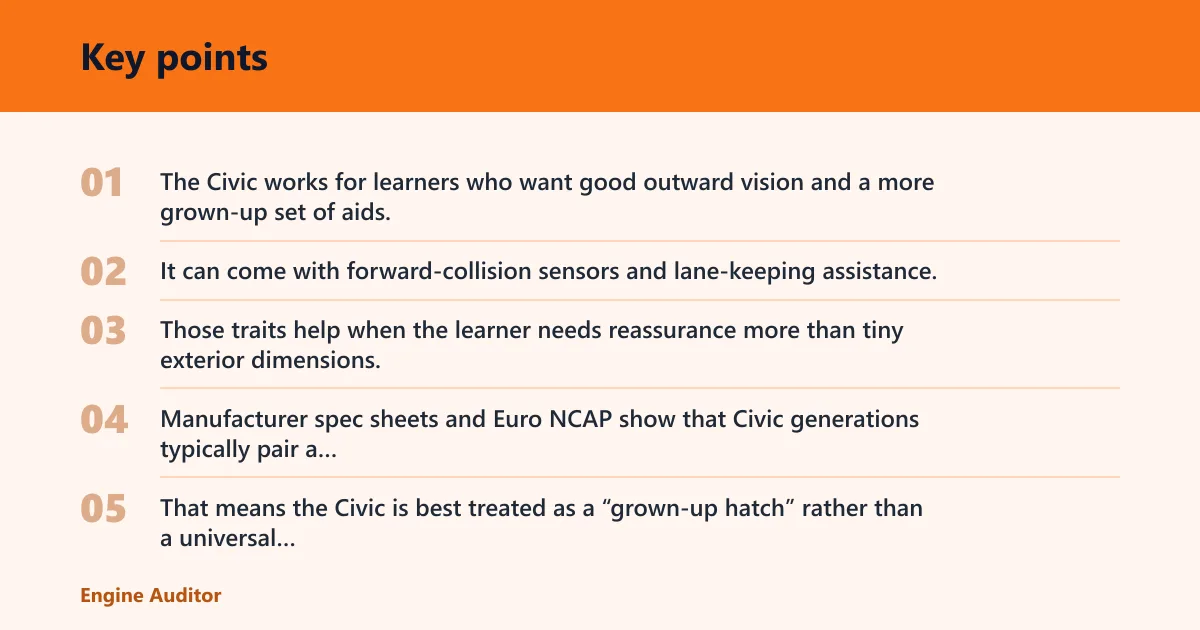
The Civic works for learners who want good outward vision and a more grown-up set of aids. It can come with forward-collision sensors and lane-keeping assistance, and it is also known for light controls and reasonable running costs. Those traits help when the learner needs reassurance more than tiny exterior dimensions.
Manufacturer spec sheets and Euro NCAP show that Civic generations typically pair a wider body with good safety equipment, but it is worth hedging model-by-model because trim, year, and market affect both driver aids and dimensions. That means the Civic is best treated as a “grown-up hatch” rather than a universal beginner answer.
It is not the easiest car to place in a cramped bay, and it is not the smallest option here. That is why it suits learners who are already comfortable with basic control but want a car that feels steady and helpful on longer routes.
Subaru Impreza
The Impreza is the steadier, weather-friendly option. It brings dependability, comfort, blind-spot monitoring, collision-avoidance help, and a planted ride, plus better stability in poor conditions. That can help learners who expect wet roads, steep starts, or variable grip.
Subaru’s model information and local market listings show that the Impreza tends to be broader, heavier, and more expensive to run than a typical supermini, so the “better in bad weather” case needs to be weighed against cost and size. In some markets it also comes with all-wheel drive as standard, which can help traction but does not make parking any easier.
The tradeoff is size, cost, and all-wheel-drive complexity. Those are real drawbacks for a first car. If the learner mainly drives in town and wants the easiest ownership path, a smaller hatch is still the better answer. The Impreza suits a narrower group of buyers.
Tradeoffs versus small hatchbacks
Small hatchbacks remain the default recommendation because they are easier to see out of, easier to place, and usually cheaper to repair after minor mistakes. Larger cars can add comfort and driver aids, but they also add bulk. For most new drivers, bulk is the thing that slows confidence most.
On width, turning circle, and parking visibility, the difference is tangible: city cars and small hatches are usually easier to fit into tight gaps, while SUVs and larger hatches can make the mirrors, bonnet, and rear corners harder to judge. Repair costs also tend to rise with size because wheels, tyres, bumpers, and sensors are more expensive on larger vehicles.
Say your learner is tall and needs more knee room, but still struggles with parking. The Fabia or Polo usually makes more sense than jumping straight to a Civic or Impreza. You get extra space without giving up the simple shape that helps in tight places.
Hatchback vs SUV for beginners
A hatchback is usually the better beginner choice because it is narrower, easier to see around, and simpler to park than most SUVs. SUVs can give a higher seat and a better view over traffic, but that does not automatically improve close-quarters control. For new drivers, width and turning circle matter more than ride height.
Parking visibility also favours hatchbacks: the lower body and shorter rear overhang make kerb and bay-line judgement easier, while many SUVs have thicker pillars and larger blind spots around the rear corners. Repair bills can also be higher on SUVs because of larger body panels, taller tyres, and costlier sensors or bumpers.
Who should skip these and stay with a city car?
Skip the larger hatch if the learner is nervous about kerbs, narrow lanes, or reversing into a space. A city car reduces the penalty for those errors. It also tends to be simpler to insure and cheaper to keep on the road, which matters when the car is still part of the learning process.
Used cars, insurance, and running costs
Used cars usually make more sense for learners because the purchase cost is lower and the fear of damage is smaller. That combination matters when the driver is still building habit and judgement. A new car can be easier to fund only if the buyer can absorb faster depreciation and is comfortable with that risk.
Cheap insurance and low running costs
Insurance group 1 variants appear in the up!/Mii/Citigo trio and the Fabia 1.0 mpi petrol, which is exactly why those cars stay attractive to first-time buyers. The Aygo/C1/108 triplet can also deliver over 55mpg, and the up!/Mii/Citigo 1.0-litre three-cylinder petrol should easily deliver over 50mpg. Those numbers matter when every lesson, commute, and practice run adds up.
Parkers, Auto Express, and manufacturer specs all support the same broad point: small, simple cars tend to be cheaper to run, while low-insurance trims reduce the overall cost of learning. Because used-price ranges and fuel economy change by age, transmission, and trim, buyers should check the exact registration rather than the badge alone.
For a learner, the cheaper the running costs, the less pressure there is to avoid every mile. That can improve confidence. It also makes supervised practice more realistic for families budgeting for insurance, tax, fuel, and the occasional repair.
What to check in the listing before you buy
- Check the exact trim and engine, especially if insurance group or fuel economy matters.
- Look for signs of parking damage on bumpers, wheels, and mirrors.
- Confirm the safety kit on that exact car, since driver aids can vary by version.
- Ask whether the car has been serviced on time and whether the clutch feels smooth.
- Make sure the seating position gives the driver clear view of the bonnet and mirrors.
One useful rule: if the car already feels awkward to place in a dealership bay or on a quiet street, it will probably feel worse in daily use. Choose the shape that reduces stress at low speed, not the one that photographs best.
Frequently asked questions
What is the best car for learning to drive?
The best learner car is usually a small hatchback or city car with clear sightlines, calm controls, and cheap minor repairs. Among the models here, the Volkswagen up! / SEAT Mii / Skoda Citigo trio is the strongest all-round fit for parking fear and low-speed control. The Fabia and Polo are good step-up choices.
What makes a car easy for a beginner to drive?
Easy learner cars combine visibility, predictable pedals, light steering, simple controls, and a size that does not overwhelm the driver in traffic or car parks. Cheap insurance and low running costs matter too. If the car is forgiving after a small mistake, the learner can focus on judgement instead of worry.
Should I learn to drive in a manual or automatic car?
Manual makes sense if you want broader licence access in many places and are willing to accept the learning curve. Automatic is often easier at the start because there is no clutch to coordinate. If stalling anxiety is high, automatic helps. If budget and licence flexibility matter more, manual still works.
Which small cars are easiest to park for new drivers?
The easiest parkers are the smallest cars with short bodies and clear edges. The up!/Mii/Citigo and the Aygo/C1/108 are the simplest in this group, with the Picanto close behind. They help because a learner can see the car’s corners more easily and has less length to judge in tight spaces.
Are used cars better than new cars for learner drivers?
Used cars usually make more sense because they cost less to buy and cause less damage anxiety. That matters when the learner is still making mistakes that are normal for the stage. New cars can bring newer safety tech, but the price gap often makes a used hatch the wiser first step.
Which learner cars are cheap to insure?
The clearest low-insurance answers in this guide are the Volkswagen up! / SEAT Mii / Skoda Citigo trio, with at least one variant in insurance group 1, and the Skoda Fabia Mk3 1.0 mpi petrol, which also sits in insurance group one. Low insurance is one reason both cars stay popular with first-time buyers.
Is a hatchback better than an SUV for learning to drive?
Yes, for most learners. A hatchback is usually easier to see out of, easier to park, and cheaper to repair after small mistakes. SUVs can offer height, but that does not automatically make them easier for beginners. For first-time drivers, a small hatch or city car is the safer default choice.
Products related to this article
Sponsored / affiliate links. As an Amazon Associate I earn from qualifying purchases. I may earn additional commission from eligible campaigns.