Best Cars for Low Fuel Consumption: Real-world Efficiency Picks
For lower real-world fuel bills, choose a hybrid that returns about 45 mpg or better in your driving pattern; plug-in hybrids are most likely to pay off if you charge daily. Pick wrong, and a car that looks efficient on paper can burn far more fuel in city traffic, short trips, or steady highway miles. This guide ranks the best cars for low fuel consumption by city, highway, mixed commuting, and short-trip use, then shows how to turn MPG into annual fuel cost.
Real-world MPG basics
EPA ratings can be a useful apples-to-apples baseline because they list city MPG, highway MPG, and combined MPG under one test cycle. Real-world fuel use can still move up or down with weather, hills, traffic, cargo, tire choice, and the length of each trip.
EPA ratings as the comparison baseline
Use EPA city MPG for stop-and-go driving, highway MPG for steady-speed use, and combined MPG for mixed driving. Combined MPG is the best starting point for broad comparisons, but it can hide a weak city number or a weak highway number that matters in your commute.
Why owner-reported MPG can differ
Owner-reported MPG often changes because the official test cycle cannot fully match heat, cold, wind, grades, roof racks, or stoplight-heavy routes. Short trips hurt fuel economy most because the engine, transmission, and cabin spend more time warming up before the car reaches steady efficiency.
How to read city, highway, and combined MPG
City MPG matters most if your route has frequent stops, low speeds, and short errands. Highway MPG matters more when the car cruises for long stretches. Combined MPG sits between them, but it should not be treated as a promise for every commute.
Best low-fuel cars by driving pattern
The best low-fuel car depends on how you actually drive. A hybrid can lead in the city and only average on the interstate, while a compact sedan can post strong highway numbers and lose ground in repeated cold starts and congestion.
City commuting winners
For current U.S. market shoppers, full hybrids are usually the safest city choice because regenerative braking helps in repeated stop-and-go traffic. Subcompact hatchbacks can also work well when easy parking and a small footprint matter, but they usually need the commute to be short, slow, and predictable to keep fuel use down.
- Toyota Corolla Hybrid. Strong choice for dense commuting because hybrid assist helps at low speed and in repeated braking.
- Honda Civic Hybrid. A compact sedan option that suits stop-and-go routes and still keeps highway use practical.
- Toyota Prius. Often the benchmark for city efficiency, especially when traffic is slow and frequent.
- Hyundai Elantra Hybrid. A compact sedan pick when you want good MPG without moving up to a crossover.
Highway commuting winners
For highway-heavy commuting, a compact sedan can be the better fit because lighter weight and cleaner shape help at steady speed. That said, trim and drivetrain matter, and a hybrid is not automatically the winner if most of your miles are long, warm, and consistent on the interstate.
- Mazda3 sedan. Often chosen for efficient highway travel and a low purchase price compared with many hybrids.
- Honda Civic sedan. A practical highway commuter with strong fuel economy and modest running costs.
- Hyundai Elantra. A light compact sedan that usually stays efficient when cruising at a steady pace.
- Toyota Corolla sedan. A low-fuel option for drivers who want simple ownership and good highway MPG.
Mixed commuting winners
Mixed routes call for cars that keep the city penalty small while still holding up at highway speed. Full hybrids are often the safest pick here because they cover both stop-and-go and open-road use without requiring charging.
- Toyota Prius. Best known for balanced mixed-use efficiency.
- Toyota Corolla Hybrid. Strong if your route includes city errands plus longer stretches.
- Honda Civic Hybrid. A good fit when you want a compact car that does not feel overly specialized.
- Hyundai Elantra Hybrid. Worth a look when you want efficient daily use with sedan packaging.
Short-trip use winners
Short-trip driving is where many efficient-looking cars lose their edge. A plug-in hybrid can be the best answer if you can charge at home and keep most daily miles within EV-only range; otherwise a full hybrid usually wastes less fuel than a gas car that never fully warms up.
- Plug-in hybrids. Best when the commute is short, charging is easy, and the battery covers most daily miles.
- Full hybrids. Better than gas-only cars when short trips are frequent but charging is not available.
- Subcompact hatchbacks. Useful when the route is short and low-speed, but the savings are smaller than with a hybrid.
Fuel economy decision matrix
This chooser ties the right vehicle type to your commute pattern, annual miles, charging access, winter severity, and cargo needs. It also shows the tradeoffs that can make a smart-looking purchase fail in real life, such as weak cold-weather MPG, limited cargo space, or poor results when a plug-in hybrid is rarely charged.
| Driving situation | Charging access | Winter severity | Cargo need | Recommended vehicle type/model | Tradeoffs and failure cases |
|---|---|---|---|---|---|
| Stop-and-go city commuting | Not required | Mild to moderate | Light to moderate | Full hybrid such as Toyota Prius, Toyota Corolla Hybrid, Honda Civic Hybrid, or Hyundai Elantra Hybrid | Strong city savings; weaker value if most miles are high-speed highway cruising |
| Mixed commuting with errands | Not required | Mild to moderate | Moderate | Full hybrid compact sedan | Balanced efficiency; can be outpaced by a gas sedan on a mostly highway route |
| Short daily commute | Home charging available | Any, but easier in mild weather | Light to moderate | Plug-in hybrid | Best if charged often; poor value if charging is inconsistent or unavailable |
| Highway-heavy driving | Not required | Mild to moderate | Light | Compact sedan such as Mazda3 sedan or Toyota Corolla sedan | Lower purchase price can offset weaker city MPG; not ideal for short-trip traffic |
| Cold winters and frequent short trips | Not required | Severe | Light to moderate | Full hybrid | Still loses MPG in winter warm-up periods, but usually less than a gas-only car |
| Cargo-first household use | Not required | Any | High | Small crossover | Extra room and seating height come with higher fuel use than a sedan or hatchback |
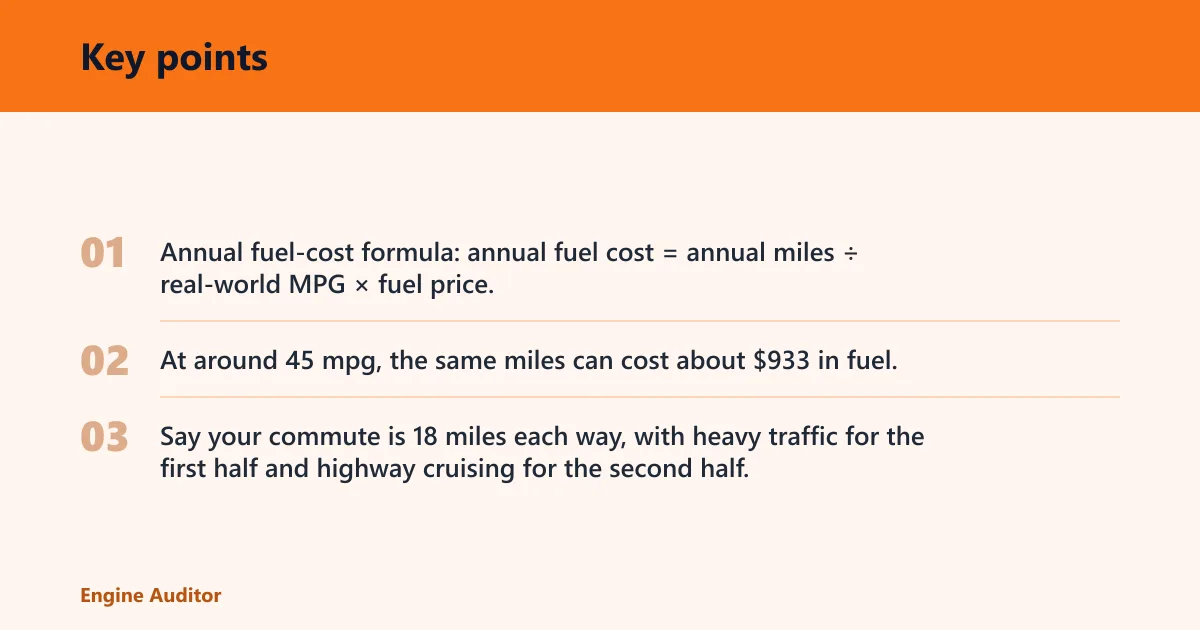
Annual fuel-cost formula: annual fuel cost = annual miles ÷ real-world MPG × fuel price.
For example, at about 12,000 annual miles and around $3.50 per gallon, a car that returns about 30 mpg costs about $1,400 a year in fuel. At around 45 mpg, the same miles can cost about $933 in fuel. That gap is $467 per year before maintenance, tires, or insurance.
Say your commute is 18 miles each way, with heavy traffic for the first half and highway cruising for the second half. A hybrid that loses little in city traffic can beat a gas sedan with better highway MPG on paper, because the commute spends more time where hybrid assist matters.
Which body styles use less fuel?
Body style matters because size, weight, and shape affect fuel use before engine type even enters the picture. Compact sedans and subcompact hatchbacks usually use less fuel than crossovers because they are lighter and create less drag at speed.
Compact sedans
Compact sedans often give you the best mix of low fuel use, lower purchase price, and easy highway efficiency. They are a strong answer if you want a small car that still feels normal on long drives.
Look for models with strong combined MPG and a clean body shape. A lighter sedan usually needs less energy to accelerate, and that helps every time you stop and go.
Subcompact hatchbacks
Subcompact hatchbacks are good for city use because their short length makes parking easier and their small footprint cuts fuel use. The hatch also gives more cargo flexibility than a sedan with the same basic size.
The tradeoff is space. Rear-seat room and cargo volume are usually tighter, and some models sacrifice ride comfort or road noise control to stay small and cheap.
Crossovers and small SUVs
Do SUVs ever make sense if you want low fuel consumption? Yes, but only when cargo space, seating height, or winter utility matters enough to accept higher fuel use. Even small SUVs usually trail similar sedans and hatchbacks in MPG.
If you need the extra room, choose the smallest crossover that fits your cargo and passenger needs, then compare its highway MPG and combined MPG against a compact sedan before buying.
How do hybrid systems change the result?
Hybrid systems change fuel use more than engine size alone because they control where energy goes. A gas-electric system can save much more fuel in traffic than a slightly smaller gasoline engine with no electric assist.
Full hybrid powertrains
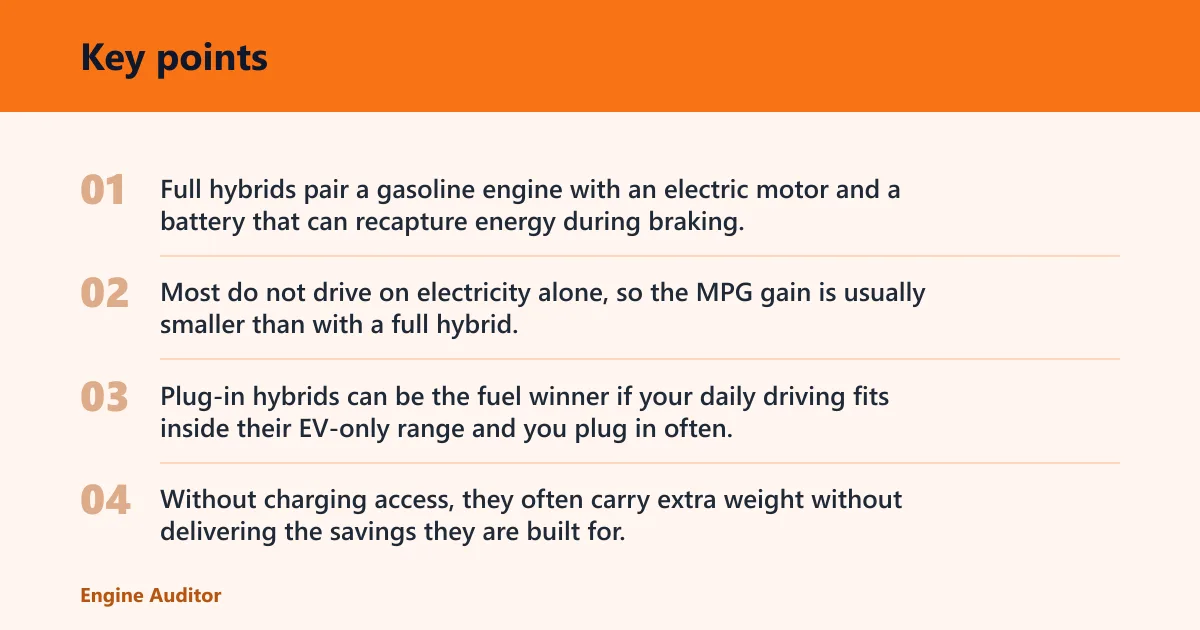
Full hybrids pair a gasoline engine with an electric motor and a battery that can recapture energy during braking. That makes them strongest in stop-and-go traffic, where regenerative braking and engine shutoff at idle save fuel.
They usually cost more up front, and some parts can be pricier to replace. Still, for drivers who spend a lot of time in city traffic, the fuel savings often matter more than the extra purchase price.
Mild hybrid systems
Mild hybrid systems use a starter-generator and a small battery to smooth engine restart, assist acceleration, or let the engine shut off sooner. Most do not drive on electricity alone, so the MPG gain is usually smaller than with a full hybrid.
This setup can still help with fuel use, especially in mixed driving, but it is best treated as a modest efficiency boost rather than a city-fuel-economy leader.
Plug-in hybrid electric vehicles
Plug-in hybrids can be the fuel winner if your daily driving fits inside their EV-only range and you plug in often. Their combined gas/electric MPG equivalent looks very high when charging is frequent, but that figure drops quickly if you do not recharge.
They make the most sense for short daily commutes, errands near home, and drivers with a garage or dedicated charging spot. Without charging access, they often carry extra weight without delivering the savings they are built for.
What changes MPG besides the engine?
Engine choice matters, but tires, drag, and load can move MPG enough to change the ranking. A well-shaped car on efficient tires can beat a more powerful one with a roof box, underinflated tires, and winter tread.
Tire choice and rolling resistance
Low rolling resistance tires can improve fuel economy, especially on long commutes, because they waste less energy as heat. Seasonal tires often reduce MPG compared with low rolling resistance all-season tires, and soft winter compounds can add more drag in cold weather.
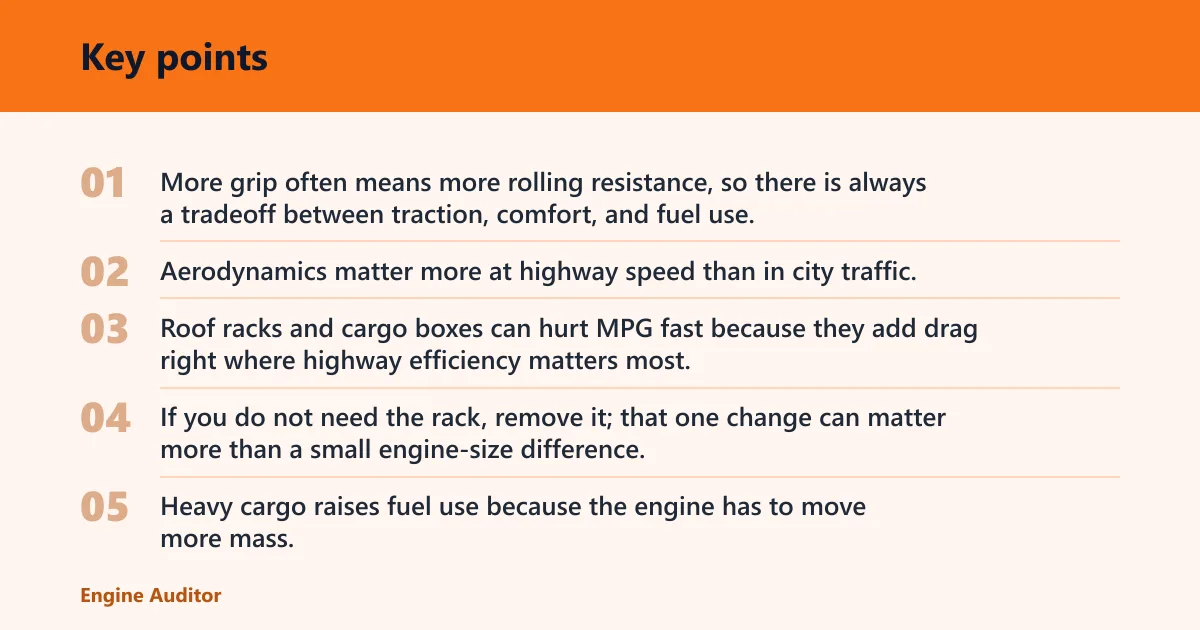
Pressure matters too. Underinflated tires increase rolling resistance and can trim MPG, while the correct pressure helps the car coast more easily. More grip often means more rolling resistance, so there is always a tradeoff between traction, comfort, and fuel use.
Aerodynamics and roof rack drag
Aerodynamics matter more at highway speed than in city traffic. A lower drag coefficient generally means less fuel burned to maintain speed, while a blunt body shape needs more energy as speed rises.
Roof racks and cargo boxes can hurt MPG fast because they add drag right where highway efficiency matters most. If you do not need the rack, remove it; that one change can matter more than a small engine-size difference.
Pressure, load, and short trips
Heavy cargo raises fuel use because the engine has to move more mass. That effect is smaller at steady speed than during repeated starts, but it still adds up over a year.
A common first-timer mistake is judging MPG from one warm highway drive and then expecting the same number on cold five-mile errands. Short trips keep the engine in warm-up mode longer, so the same car can look efficient one day and wasteful the next.
Choose hybrids if… / Choose gas cars if…
Choose hybrids if your driving is stop-and-go, your annual miles are moderate to high, and fuel cost matters more than the extra purchase price. Choose gas cars if most of your mileage is steady highway driving, your route is long and predictable, and you want the lower upfront cost.
Choose hybrids if your driving is stop-and-go
Hybrid assist works best when traffic forces repeated slowing and braking. If your commute has lots of lights, congestion, and short errands, a full hybrid usually returns the strongest real-world fuel savings.
Choose gas cars if your mileage is mostly highway
Highway-only drivers can do well with a compact sedan that has strong highway MPG. In that case, a hybrid may save less fuel than its higher price suggests, especially if the route is long, steady, and warm-weather only.
Choose plug-in hybrids if you can charge at home
Plug-in hybrids make sense when home charging is easy and daily driving is short. If you can finish most trips within EV-only range, the gas engine may run only occasionally, which changes the fuel-cost math more than any small MPG difference.
Frequently asked questions
What are the best cars for low fuel consumption?
For most shoppers, the best low-fuel cars are full hybrids in compact sedan or hatchback form. They balance city MPG, highway MPG, and annual fuel cost better than most gas-only crossovers. Plug-in hybrids can beat them only when daily charging is part of the routine.
Which cars get the best real-world gas mileage?
Cars that combine a light body, clean aerodynamics, and hybrid assist usually post the best real-world gas mileage. Prius-type hybrids, Corolla Hybrid-type sedans, and some efficient compact hatchbacks are common leaders, but the winner depends on whether your miles are city-heavy or highway-heavy.
Are hybrids better than gas cars for fuel savings?
Yes, if your driving includes stop-and-go traffic, cold starts, or short trips. Full hybrids often beat similar gas cars in those conditions. If most of your miles are steady highway cruising, the gap narrows, and some gas sedans can come close on fuel cost.
Which small cars have the best MPG without feeling too cheap?
Compact sedans usually hit the best balance here. They are often quieter and more settled than subcompact models, yet still efficient. A hybrid compact sedan is a strong choice if you want MPG without giving up too much seat comfort, highway stability, or trunk space.
What car is best for city driving and fuel economy?
A full hybrid compact sedan or hatchback is usually the best city choice. Regenerative braking and engine shutoff help in traffic, and the small body keeps fuel use down. If charging is easy, a plug-in hybrid can do even better for short urban trips.
How much can I save with a fuel-efficient car?
Savings depend on annual miles, fuel price, and the MPG gap versus your current car. At 12,000 miles and $3.50 per gallon, moving from 25 mpg to 45 mpg cuts fuel cost from about $1,680 to about $933, a savings of about $747 a year.
What matters more for MPG: engine size, hybrid system, or driving style?
The hybrid system often matters most because it changes how the car recovers energy and uses the engine. Driving style comes next, especially in city traffic and on short trips. Engine size matters, but it is usually less important than hybrid type, tire choice, and aerodynamics.
Products related to this article
Sponsored / affiliate links. As an Amazon Associate I earn from qualifying purchases. I may earn additional commission from eligible campaigns.