Why Your Car Light Stays on After Shutdown Causes
A light that stays on after shutdown is usually a timed-delay lamp, a stuck switch, or a body-control fault. Start by identifying whether it is interior, parking, brake, or headlight-related. If you ignore it, the battery can go flat overnight, and a wiring fault can spread. This guide shows how to identify the light, tell a normal delay from a fault, and check the switch, relay, and control module.
Start by identifying the light
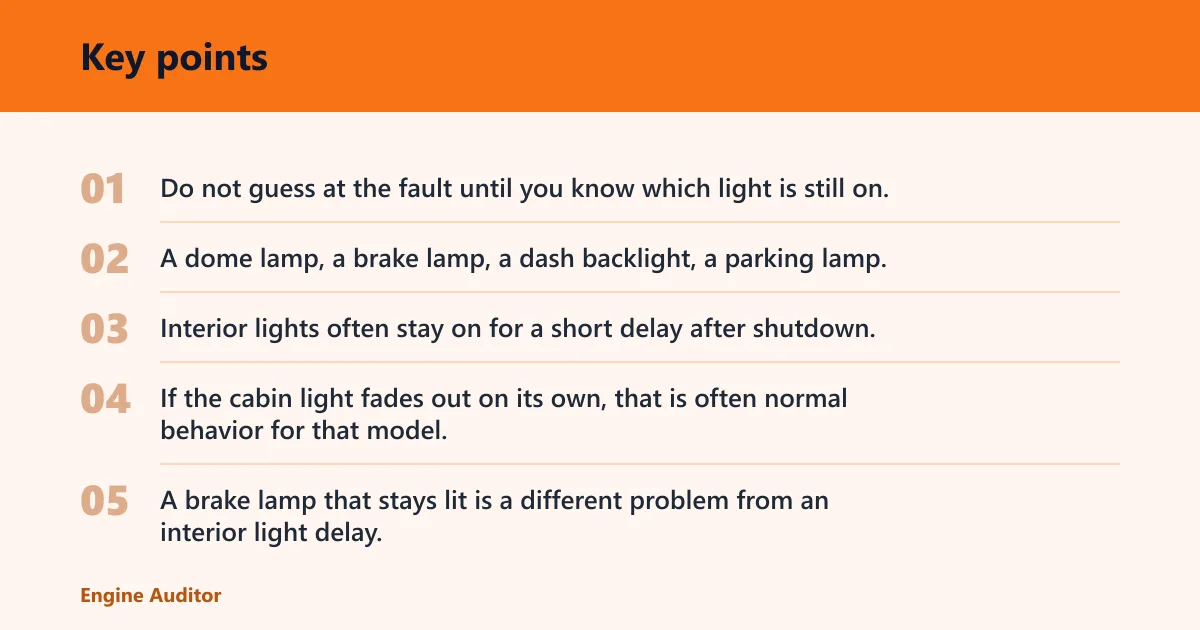


Do not guess at the fault until you know which light is still on. A dome lamp, a brake lamp, a dash backlight, a parking lamp, and an accessory circuit do not fail the same way, and they do not point to the same parts.
Interior or dome light
Interior lights often stay on for a short delay after shutdown, especially when a door is opened or a smart-key system is still reading door and presence signals. If the cabin light fades out on its own, that is often normal behavior for that model.
Brake light
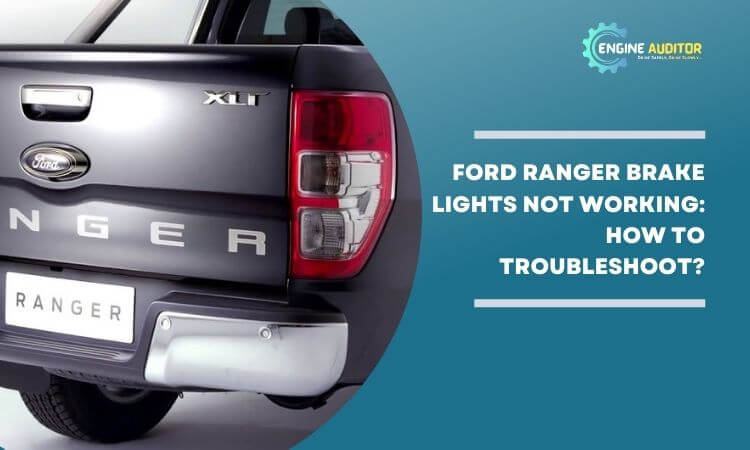
A brake lamp that stays lit is a different problem from an interior light delay. The brake light switch sits close to the brake pedal, pressing the pedal triggers the switch and turns the lights on, and when pressure is released the switch opens and the light goes off. If that chain does not reset, the stop lamps can stay on after shutdown.
Dashboard warning or backlight
Some dash lights remain on briefly during shutdown, but a warning lamp or backlight that stays bright for longer than expected can point to retained accessory power, an ignition fault, or a control-module issue. That is especially true if several displays remain awake together.
Parking light or accessory power
Parking lights, radio power, power outlets, and other accessory loads may stay active briefly on some vehicles. That can be normal. If they remain on past the expected delay, or if the vehicle acts as if the key is still in the run position, move to the ignition, relay, or BCM checks.
Is it normal for your model?
Some shutdown behavior is built in. A brief interior-light delay, a short accessory-retained-power period, or a push-button-start sequence that needs a firm press-and-hold can be normal. The key question is whether the light turns off on its own within the time your model expects.
Timed interior-light delay
Many vehicles keep the dome or courtesy lights on for a short period after the car is switched off. Vehicles may also leave the radio, displays, or power outlets active briefly during shutdown. If those lights and loads go dark on their own, that behavior is usually normal.
Accessory-retained power
Retained accessory power is meant to give you a short window to finish a task, then shut down. If the cabin systems stay awake far longer than they should, or if they only shut off after a door cycle or a second key press, you are likely dealing with a fault rather than a feature.
Quick yes or no check
Use the owner’s manual for the exact model behavior. For some push-button-start systems, the manual may specify a firm press-and-hold. If the light turns off within the manual’s stated delay, the answer is yes, that is normal. If it does not, treat it as a fault.
What should you check first if a brake light stays on when the car is off?
Start at the pedal, not the fuse box. The most common first checks are the brake pedal position, the brake light switch near the pedal, the brake pedal return spring, and the brake light switch stopper. Those parts decide whether the switch is fully released.
Brake light switch near the pedal
The brake light switch is mounted near the brake pedal. If it fails stuck closed, the circuit stays on and the stop lamps can remain lit after shutdown. That is one of the most common causes of brake lights staying on.
Brake pedal not returning fully
The brake pedal must return fully when released. Misalignment can keep the switch engaged, and an obstruction or wear can stop the pedal from resetting normally. Even a small amount of extra contact at the pedal can hold the switch in the on position.
Brake pedal return spring and switch stopper
The brake pedal return spring restores the pedal to its original position. If it loses tension, the pedal may not come back far enough to release the switch. The brake light switch stopper is a small plastic contact piece; if it is damaged, it can leave the switch activated.
Quick no-tool checks before parts replacement
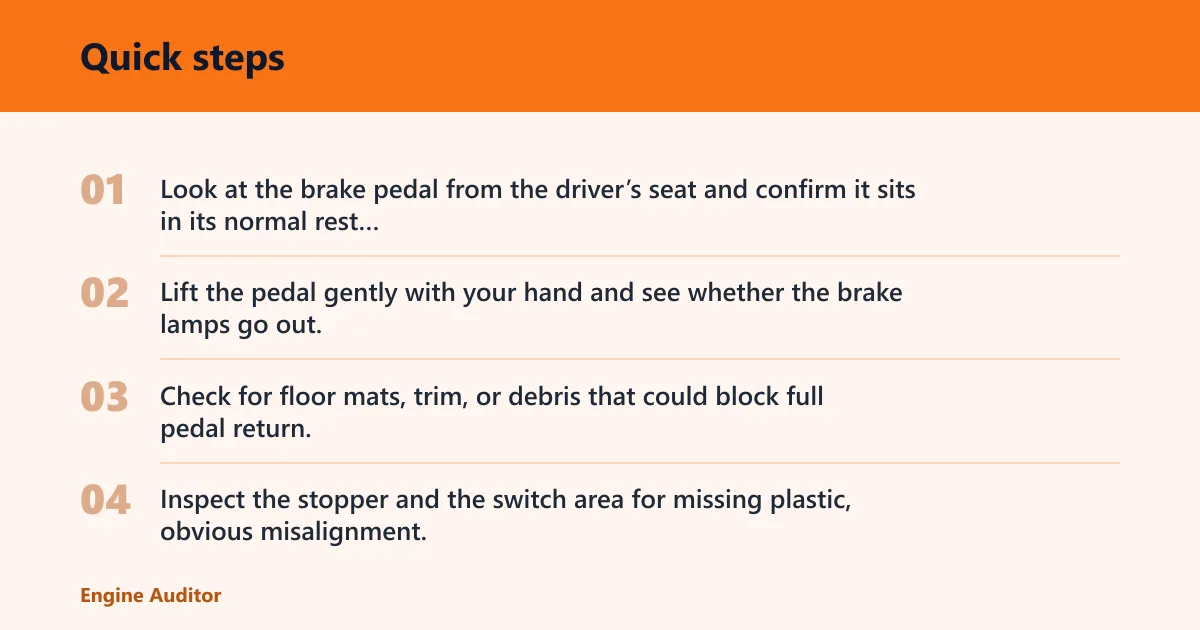
- Look at the brake pedal from the driver’s seat and confirm it sits in its normal rest position.
- Lift the pedal gently with your hand and see whether the brake lamps go out.
- Check for floor mats, trim, or debris that could block full pedal return.
- Inspect the stopper and the switch area for missing plastic, obvious misalignment, or a switch that looks pressed when the pedal is released.
Suppose the stop lamps go out when you tug the pedal upward by a small amount. That points strongly to pedal return, stopper, or switch alignment rather than a wiring fault farther downstream.
Brake light diagnosis matrix
This matrix separates the light type first, then points you to the most likely cause and the next check. Use the normal-delay column as a quick yes or no filter before replacing parts.
| Light type | Most likely cause | First no-tool check | Next test step | Normal delay possible? |
|---|---|---|---|---|
| Dome or interior light | Timed delay, door-jamb switch, or smart-key wake signal | Close every door and wait for the expected delay | Check whether the light reacts to each door and to the fob | Yes, often for a short period |
| Brake light | Brake light switch, pedal misalignment, return spring, or stopper fault | Lift the pedal slightly and watch the lamps | Check switch position at the pedal, then verify voltage at the circuit | No, not if it stays on continuously |
| Dashboard warning or backlight | Ignition switch wear, accessory-retained power, or BCM keep-alive logic | Cycle the key or shut down using the exact procedure in the manual | Check the fuse or relay output for remaining power | Sometimes, briefly |
| Parking light | Headlight switch position, relay fault, or wiring problem | Confirm the switch is fully off | Check the relay output and the fuse box for held power | Usually no |
| Accessory power | Ignition relay, ignition switch, smart-key wake, or BCM fault | Open and close the driver door, then retry shutdown | Use a multimeter at the fuse or relay output | Yes, for a short period on some models |
Why does my car seem like it is still on after I turn it off?
That feeling usually comes from power still flowing to one or more circuits. In key vehicles, a worn ignition switch can leave accessories inconsistent. An ignition relay can weld closed and keep power flowing after shutdown. Smart-key systems can also keep the vehicle awake if they keep seeing a fob, door, or driver-presence signal.
Ignition switch wear in key vehicles
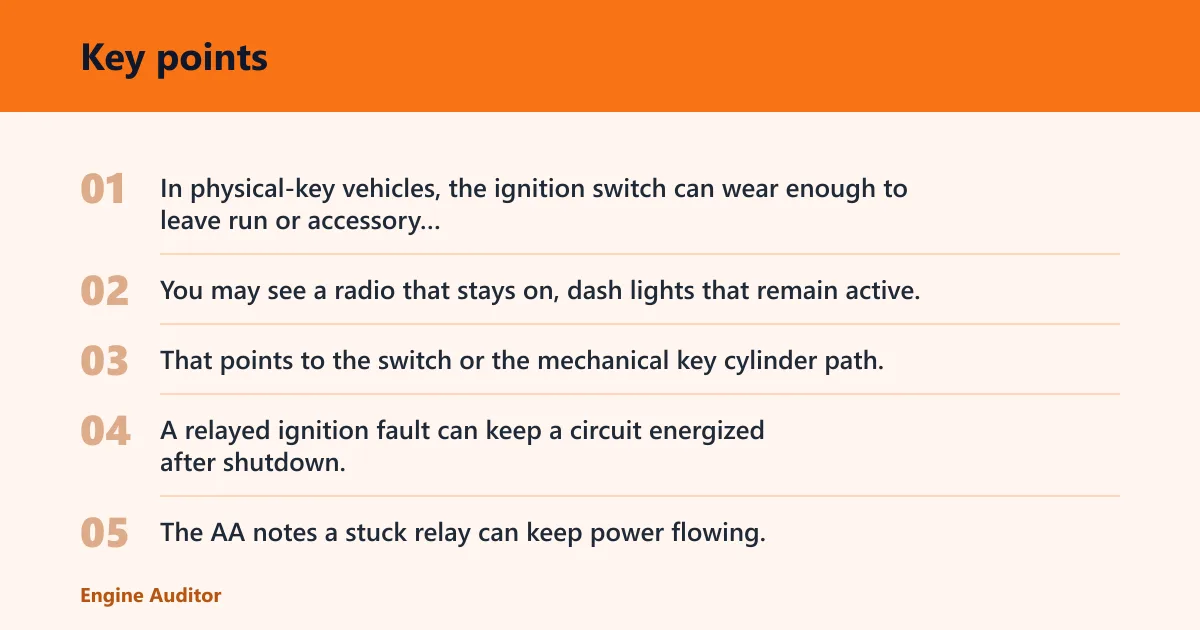
In physical-key vehicles, the ignition switch can wear enough to leave run or accessory behavior inconsistent. You may see a radio that stays on, dash lights that remain active, or a shutdown sequence that only works when the key is moved a certain way. That points to the switch or the mechanical key cylinder path.
Ignition relay stuck closed
A relayed ignition fault can keep a circuit energized after shutdown. The AA notes a stuck relay can keep power flowing. If the relay contacts weld closed, the load stays powered even when the control signal is gone. That is a direct shutdown problem, not a cosmetic one.
Smart key or key fob wake signals
Smart-key systems monitor the fob, doors, and driver-presence signals. A fob with a stuck button can send an unintended command. That can keep a vehicle awake, delay sleep mode, or confuse the shutdown logic so the cabin electronics stay alive longer than expected.
Body control module keep-alive logic
The body control module interprets door and presence signals and can keep accessory loads active while it waits for the car to sleep. If it misreads a wake input, it may not shut the circuit down. That is why door-jamb switches and fob inputs matter even when the problem looks electrical.
Picture a sedan with a push-button start where the radio, center screen, and one outlet stay on after the driver exits. If the owner’s manual says those loads should drop after a short delay, a lingering awake state points toward a wake signal, relay, or BCM issue rather than a normal feature.
Can a relay or wiring fault keep a car light on after shutdown?
Yes. A relay fault can hold power to a light or accessory circuit after the ignition is off, and damaged wiring can do the same. Corroded wires are listed as a cause of electrical faults. The right next step is to prove whether power is still present where it should have dropped out.
Fuse and relay box check
The fuse and relay box is the place to isolate the power path. It contains ignition-related relays, and output power should drop after shutdown. If a light stays on, look at the correct fuse or relay output for that circuit rather than guessing at the bulb or module first.
Multimeter test at the output
Use a multimeter to check whether power remains at a fuse or relay output after shutdown. If the output still has battery voltage when it should be off, the problem is upstream or inside the relay path. If the output drops correctly but the light stays on, the fault may be in the wiring to the load or in the load itself.
When should you stop driving?
Stop driving if the brake lights stay on at all times, if the symptom comes with other electrical oddities, or if the vehicle will not shut down normally. A steady brake lamp can drain the battery, mislead other drivers, and point to a switch or pedal fault that needs correction before road use.
Battery drain warning signs
If the light is bright enough to be seen in daylight, or if the car has already needed a jump start, treat it as a battery-drain risk. A light that stays on overnight can drain the battery even if the car otherwise seems to run normally.
When the brake lights stay on all the time
A brake lamp that never goes out is more than a nuisance. It can reduce bulb life, drain the battery, and confuse drivers behind you. Because the brake light switch and pedal linkage are part of the problem space, a quick inspection at the pedal area is the right first move.
When a shop is the better next step
If the pedal, stopper, and switch look correct but the circuit still stays powered, the diagnosis moves into relay, BCM, or wiring work. At that point, a shop is the better choice if you do not have the tools to trace power safely.
A common first-timer mistake is replacing a brake bulb or headlight switch before identifying the exact light. That wastes time. Separate the interior lamp from the brake lamp, then prove whether the circuit is staying powered or whether the switch is simply being held in the on position.
Frequently asked questions
Why does my car light stay on after I turn the engine off?
It usually means one of three things: the light is on a normal delay, a switch is stuck, or a control circuit is still awake. Start by identifying the exact light. A dome lamp, brake lamp, and accessory circuit have different causes and different checks.
Is it normal for interior lights to stay on for a few minutes after I shut the car off?
Yes, on many models. A short delay can be normal, and some vehicles also keep the radio, displays, or power outlets active briefly. If the light goes out within the expected delay in the owner’s manual, that behavior is usually normal.
Can a bad brake light switch keep the lights on all the time?
Yes. A faulty brake light switch can leave the lights on after shutdown, and a switch that fails stuck closed can keep the circuit energized. If moving the pedal changes the lamps, the switch or its adjustment is a prime suspect.
Could the brake pedal or spring cause the light to stay on?
Yes. Brake pedal misalignment can keep brake lights on, and a faulty brake pedal spring can prevent normal reset. If the pedal does not return all the way, the switch may never open fully, so the lights stay on even though the brake is not pressed.
Products related to this article
Sponsored / affiliate links. As an Amazon Associate I earn from qualifying purchases. I may earn additional commission from eligible campaigns.