Car interior lights: types, uses and common problems
Car interior lights often fall into a few common types, such as dome, map, footwell, vanity, and door- or puddle-style courtesy lights; if one fixture is out, check the bulb first, but if several fail together, inspect the fuse, switch, or dimmer. Ignoring them can leave you with a dead cabin, drained battery, or a failed inspection. This guide shows how to identify each light by location and symptom, then pinpoint the most likely fault before replacing parts.
What are the different types of car interior lights?
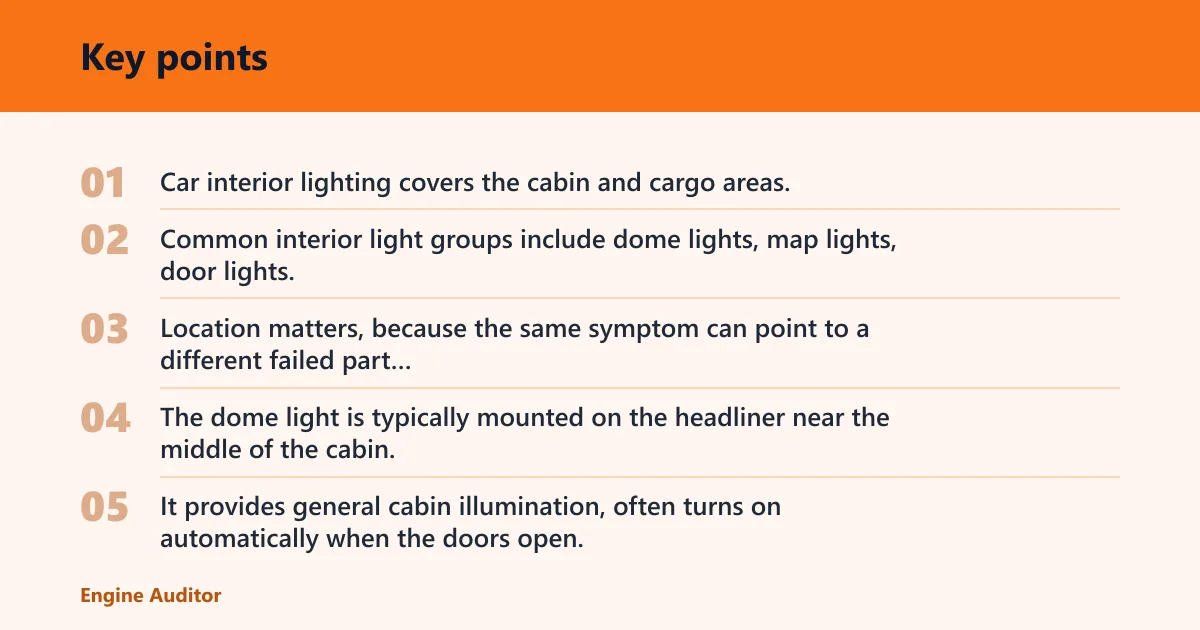


Car interior lighting covers the cabin and cargo areas. Common interior light groups include dome lights, map lights, door lights, footwell lights, trunk or boot lights, accent lighting, and instrument panel or dashboard backlighting. Location matters, because the same symptom can point to a different failed part depending on where the light sits.
Dome light
The dome light is typically mounted on the headliner near the middle of the cabin. It provides general cabin illumination, often turns on automatically when the doors open, and may stay on briefly after the doors close in a fade-out feature. Many units also have a manual switch position for constant on, off, or door-controlled operation.
Map light
Map lights are commonly attached to the roof and help illuminate objects while traveling at night. They are task lights, not cabin-wide lights. A map light usually gives a tighter beam for reading maps, books, or documents, and many vehicles let you switch the driver and passenger lamps separately.
Door light and footwell light
Door lights activate when the door opens and improve entry and exit visibility. They may sit inside the door panel or on the door edge, depending on the vehicle. Footwell lights are located on the car floor near the pedals and may also appear on the passenger side to help with night entry, exit, and finding dropped items.
Trunk or boot light, accent lighting, and instrument panel lights
Trunk lights illuminate the trunk when it is open, giving you cargo-area visibility for loading, unloading, or roadside checks. Accent lighting is mainly for ambience and may sit on the dashboard, under seats, or along trim. Dashboard and instrument panel lights often come on when headlights are turned on, since they backlight gauges and controls at night.
How do map lights and dome lights differ?
Map lights differ from dome lights mainly in beam focus, coverage, and control. A dome light spreads light across the cabin. A map light aims at one seat or object. If only one reading lamp fails, the problem often sits closer to that lamp, its socket, or its switch than to the whole cabin-light circuit.
Coverage and use
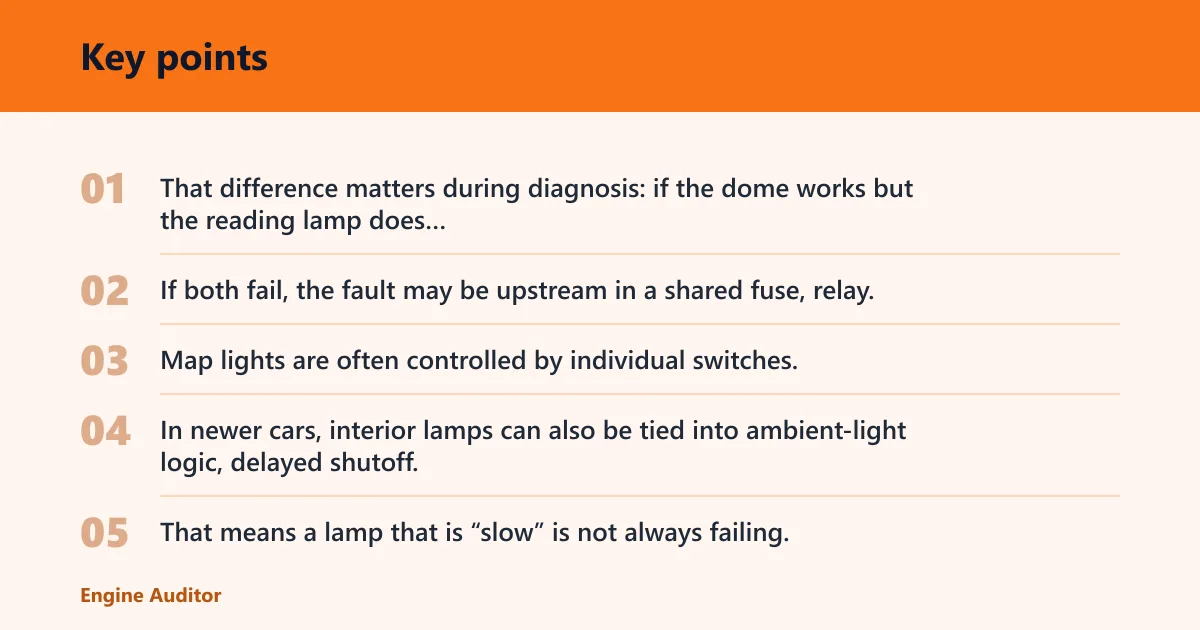
A dome light is for general illumination. A map light is for a task. That difference matters during diagnosis: if the dome works but the reading lamp does not, the battery and main interior-light feed may be fine. If both fail, the fault may be upstream in a shared fuse, relay, or body control module circuit where fitted.
Typical control behavior
Map lights are often controlled by individual switches, while dome lights may have a door-activated mode and a manual on/off setting. In newer cars, interior lamps can also be tied into ambient-light logic, delayed shutoff, or software-controlled dimming. That means a lamp that is “slow” is not always failing; it may be following a programmed fade.
When a map light points to a local fault
If a single map light is dead, flickers when tapped, or works only when the lens is pressed, look first at the bulb, socket tension, or switch contacts. A loose bulb base, heat-damaged socket, or worn rocker switch is more likely than a cabin-wide power issue. If both map lights fail together, check the shared supply path.
Where are footwell, trunk, and door lights located?
Footwell lights are usually mounted low on the driver and passenger sides, aimed at the floor near the pedals or under the dash. Trunk or boot lights sit inside the cargo area and turn on when the lid opens. Door lights are placed on the door edge or inside the door panel, where they improve visibility during entry and exit.
Finding each fixture fast
Picture a sedan with a dark cabin and one open rear door. The dome lamp may be on the headliner, but the door courtesy lamp is likely on the lower edge of that door or in the trim panel, while the footwell lamp will be low by the kick panel. That location mapping saves time when a single light fails.
What each location usually tells you
A trunk light that works only when the lid is at one angle often points to a hinge-area wire issue. A footwell light that flickers when the driver seat moves can point to a connector or harness rub. A door light that fails only on one door is often tied to that door’s switch, latch sensor, or local wiring rather than the main dome circuit.
Why are interior car lights dim or flickering?
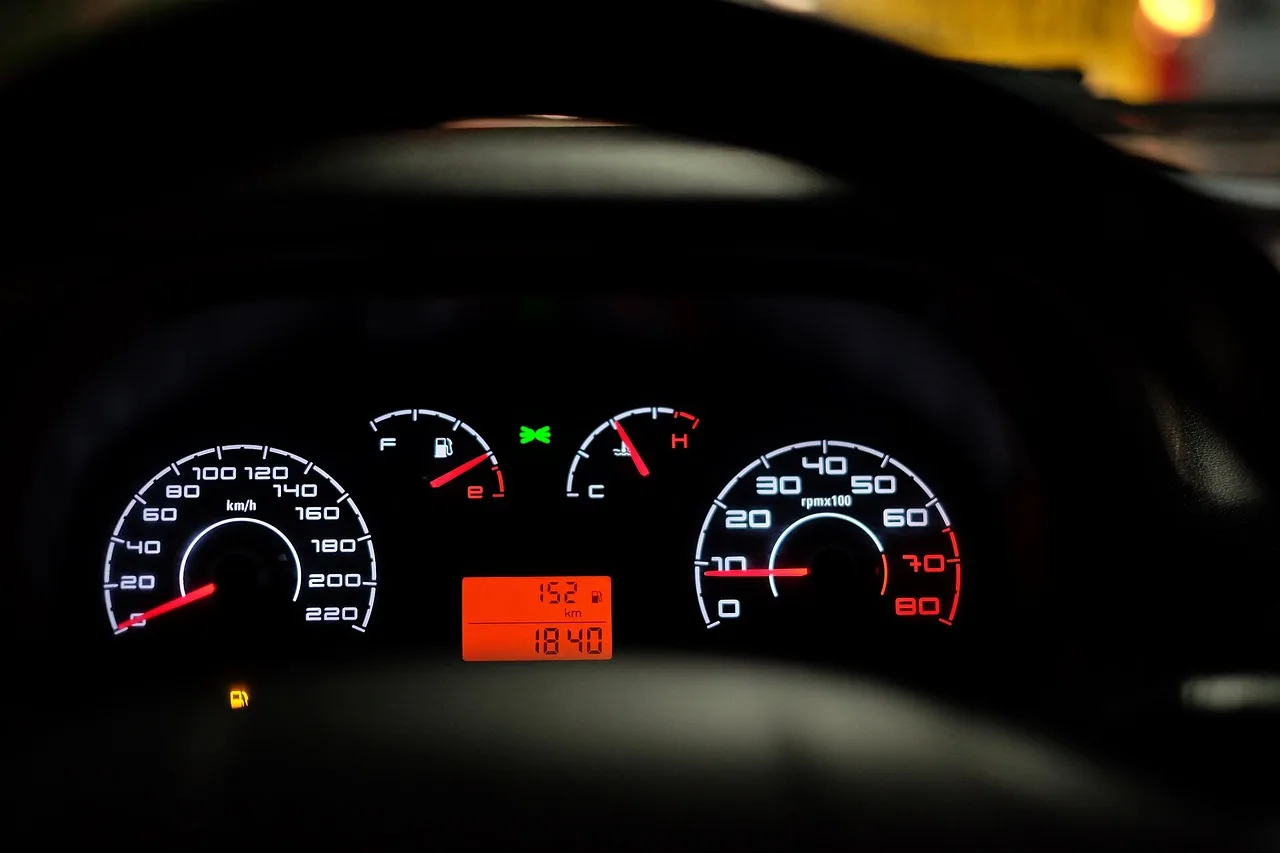
Dim or flickering interior lights usually point to bulb aging, poor connections, low system voltage, or control-related dimming. Do not treat “dim” and “dead” as the same problem. A light that still works but looks weak may have a tired bulb, corrosion in the socket, a bad ground, or a voltage drop somewhere in the circuit.
Bulb aging and LED driver faults
Incandescent bulbs lose output as filaments wear. LEDs can dim or flicker if the driver circuit is failing, if the supply voltage is unstable, or if the module expects a different load. If the lamp flickers only on one side, start with the bulb or LED unit before moving to wiring.
Loose sockets, corrosion, and poor grounds
A loose bulb socket can make a light work one moment and fail the next. Green corrosion, heat discoloration, or bent terminals can add resistance and reduce brightness. A weak ground can do the same thing, especially on lights near doors, trunks, or other areas exposed to moisture and vibration.
Low voltage and dimmer settings
A weak battery or charging issue can drag cabin lighting down, especially with several loads on at once. Some cars also reduce panel and ambient lighting through the dimmer control, so a low dashboard setting can make interior lights seem faulty when they are simply turned down. Always check the dimmer before replacing parts.
Why does my dome light stay on after I close the door?
A dome light that stays on after the door closes usually points to the manual switch position, a bad door-ajar switch or latch sensor, a delayed fade setting, or a control-module fault. Many vehicles keep the dome light on briefly by design. If the light stays on for minutes or never shuts off, treat it as a fault rather than normal fade behavior.
Manual switch position versus auto mode
Many dome lights have three basic positions: on, off, and door. If the switch is set to on, the light will ignore the door signal. Check this first. It is the simplest cause and the easiest to miss, especially when the lamp also has a fade feature that makes the shutdown timing less obvious.
Bad door-ajar switch or latch sensor
If the vehicle thinks a door is still open, the dome lamp may remain on, delay shutoff, or trigger warning chimes. The fault may be a failed door-ajar switch, a latch sensor inside the door mechanism, or damaged wiring in the door jamb. A stuck sensor is common when only one door seems to “read open.”
Fade timing, delayed shutoff, or module behavior
Some cars keep interior lighting on for a short period after closure, then fade it out. That is normal if the delay lasts only a brief time. If the fade never finishes, inspect the control path: switch, sensor, wiring, and, where fitted, the body control module. Newer cars may coordinate this with keyless entry or ambient-light timing.
When to inspect wiring or the switch circuit
Suppose the dome light stays on after all doors are closed, the manual switch is set to door, and the delay lasts far longer than normal. At that point, check the door switch signal, the latch area wiring, and the fuse feed. A stuck-on light can drain the car battery over time, so it is worth addressing promptly.
What causes a car interior light to stop working?
A dead interior light is often caused by a burned-out bulb, blown fuse, bad socket, failed switch, failed sensor, wiring damage, or, in some newer vehicles, a module fault. Start with the simplest checks first. If several interior lights fail together, the problem is more likely to be shared power, control, or ground than the bulb itself.
Bulb, fuse, and socket checks
Look for a failed filament, darkened bulb glass, or a melted connector. A blown fuse is more likely when multiple cabin lights stop at once. If the bulb is good, inspect the socket for loose terminals or heat damage. That small visual check can save you from replacing a working lamp assembly.
Switch, sensor, relay, and wiring faults
Interior lamps depend on switches, sensors, relays in some layouts, and wiring between the fixture and the power source. A broken wire in a moving door jamb can kill a door light or cause intermittent operation. A bad relay or control signal can make several lights fail together, which is why location and symptom both matter.
Module-controlled systems in newer cars
Newer vehicles may route interior-light commands through a body control module. That can change fade timing, auto-on behavior, and dimming based on lock state or ignition status. If a scan tool shows a wrong door status or a lamp command that does not match the switch position, the issue may be control-side rather than at the bulb.
Quick order before replacing parts
- Confirm the switch is in the correct position.
- Check whether one light or several are affected.
- Test the bulb or lamp unit.
- Inspect the fuse and socket.
- Check the related door, trunk, or dimmer control.
- Move to wiring, ground, or module diagnosis if the fault stays.
Can interior lights drain a car battery?
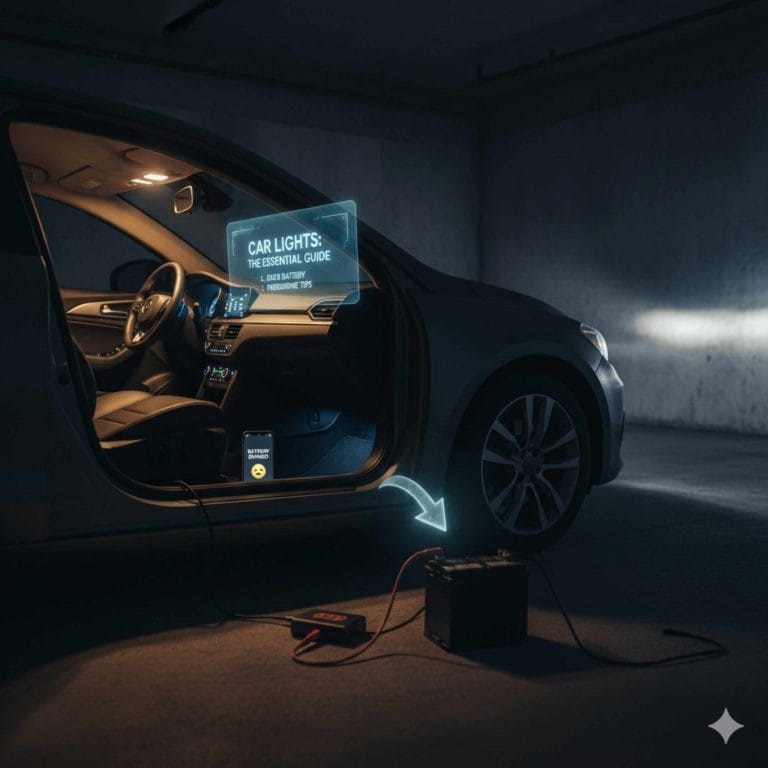
Yes. A light that stays on can drain a car battery, especially if the vehicle sits for hours with the dome lamp, trunk lamp, or courtesy lamp stuck on. Battery drain risk rises when the fault is not a bulb problem but a switch, sensor, or module that keeps commanding the light on after shutdown.
Why a stuck-on light matters
Interior lights draw power from the battery when the engine is off. One small lamp may not seem serious, but the combined draw from several lights, plus an awake control module, can be enough to leave the car slow to crank or completely dead the next morning. That is why “light stuck on” is a stop-and-check symptom.
When DIY ends
If the lamp only fails when a door moves, the wire may be broken inside the hinge area. If the dome light stays on despite correct switch settings and a known-good bulb, the fault may sit in the latch sensor, BCM, or wiring harness. At that point, inspect the circuit rather than replacing random parts.
Symptom-to-cause troubleshooting table
Use the symptom first, then match the most likely fault. This keeps you from replacing a bulb when the real issue is a switch, sensor, or wiring fault. The same light type can fail in different ways, so the test should fit the symptom, not just the fixture name.
| Light type | Likely fault | Quick test | When to stop DIY and inspect wiring or switches |
|---|---|---|---|
| Dome light | Manual switch left on, bad door-ajar switch, fade-time module issue | Move the switch through on/off/door and close each door one at a time | Stop if the lamp stays on with every switch position and every door closed |
| Map light | Worn bulb, loose socket, bad local switch | Swap sides if possible or test the lamp with a known-good bulb | Stop if both map lights fail together or the socket shows heat damage |
| Door light | Faulty door switch, broken jamb wiring, corrosion | Open and close the door slowly while watching for flicker | |
| Footwell light | Loose connector, poor ground, dimmer setting, LED driver fault | Adjust the dimmer and wiggle the harness gently with the car parked | Stop if brightness changes with seat movement or trim pressure |
| Trunk or boot light | Broken hinge-area wire, bad lid switch, blown bulb | Open the trunk fully and move the lid by hand while watching the lamp | Stop if the light cuts in and out at one lid position or the wire looks strained |
| Dashboard or instrument light | Dimmer setting, fuse, panel circuit fault, module control issue | Check the headlight switch and dimmer together | Stop if several panel lamps fail or brightness changes erratically with the control |
| Check whether the lighting is tied to ignition, drive mode, or ambient settings |
What does each interior light in a car do?
Each interior light has a location-specific job. Dome lights spread light across the cabin. Map lights aim at reading material. Door lights improve entry visibility. Footwell lights help you find pedals and dropped items. Trunk lights aid cargo handling. Accent lighting adds ambience. Dashboard lights backlight gauges and switches for night driving.
Frequently asked questions
Why are my interior car lights dim?
Dim lights often come from bulb aging, corrosion, poor grounds, low system voltage, or a dimmer that is turned down. LED lights can also dim if the driver circuit is failing. Separate “dim” from “off,” because the repair path is different and the voltage drop can point to the exact fault.
Britannica — How common are melanistic leopards and jaguars?
Melanistic leopards and jaguars are uncommon, and the trait is not present across most of their range. In plain terms, black panthers are a color form rather than a separate species. Their frequency varies by population, with melanism reported more often in some forested regions than in open habitats.
Products related to this article
Sponsored / affiliate links. As an Amazon Associate I earn from qualifying purchases. I may earn additional commission from eligible campaigns.