Transmission Control Module Coding After Replacement?
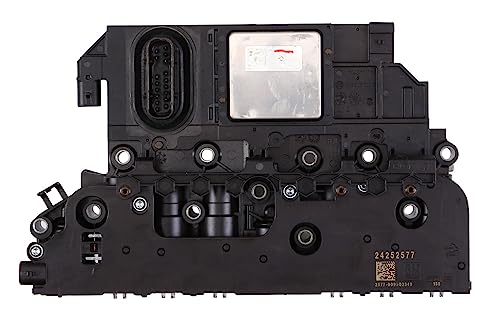
A replacement TCM often needs coding, programming, or both, though some units may only need adaptation or a relearn after installation. Skip the right setup, and the transmission may stay in limp mode, set faults, or send you after parts that do not solve the problem. This guide shows when coding is required, when programming or adaptation is the real step, and how to tell which setup your car needs.
What coding configures versus what it cannot repair


Usually yes, at least in some form. A replacement transmission control module, also called a TCU in some systems, needs to match the vehicle’s hardware and software expectations before it can control shift timing and hydraulic commands correctly. Coding sets the unit for the vehicle; programming may load software; adaptation or relearn may still be needed after that.
Coding does not repair a dead circuit, a corroded connector, or a failed pressure solenoid. If the transmission fault comes from low voltage, CAN communication trouble, bad power or ground, or a mechanical transmission problem, coding alone will not solve it. A scan code can point to a communication or control issue, but it does not prove the module is bad.
What coding can and cannot change
Coding configures a supported module for the vehicle’s installed options and control logic. It can change how the module identifies itself, which transmission variant it expects, and what data it uses for operation. It cannot fix damaged wiring, broken sensors, worn clutches, or a valve body fault.
That is why replacement should start with diagnosis, not part ordering. A scan tool should save the original fault data first, then verify power, ground, network communication, and part compatibility before any coding attempt.
Coding, programming, and adaptation explained
Coding, programming, and adaptation are related, but they are not the same job. Coding tells the control unit how to behave in a supported vehicle. Programming changes the software inside the control unit. Adaptation or relearn resets or relearns transmission-specific values after installation or repair.
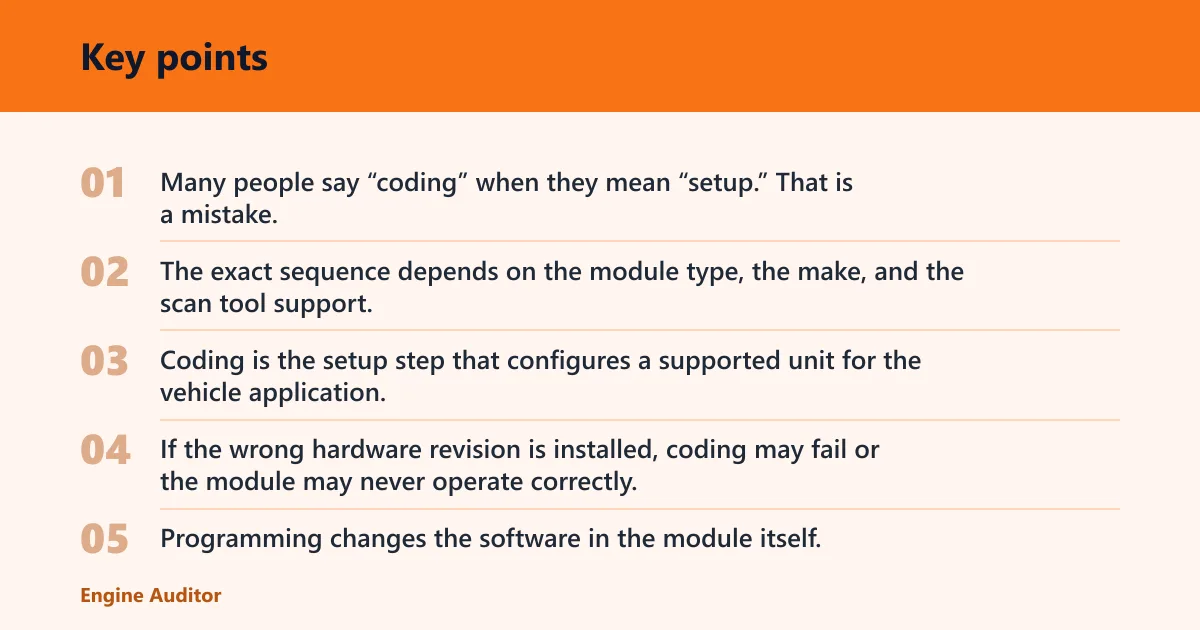
Many people say “coding” when they mean “setup.” That is a mistake. Some replacements need only coding, some need software programming, and some need a relearn even after the module is accepted by the car. The exact sequence depends on the module type, the make, and the scan tool support.
Coding
Coding is the setup step that configures a supported unit for the vehicle application. It is usually tied to equipment options, transmission version, and vehicle software expectations. If the wrong hardware revision is installed, coding may fail or the module may never operate correctly.
Programming
Programming changes the software in the module itself. A replacement unit may need this if it ships with blank, outdated, or wrong software. This step depends on tool support and controller support, and it often needs a stable battery and charging system voltage during the process.
Adaptation and relearn
Adaptation clears or relearns the values the transmission uses to manage shifts and hydraulic behavior. After a module swap, those values may not match the current transmission condition. Some vehicles require a drive cycle, some require a basic setting procedure, and some need a specific scan-tool function.
Suppose a car accepts the new module, the codes clear, and the transmission still shifts harshly at low speed. That can happen if the adaptation values were never reset, or if the module is still learning from old data. In that case, setup is incomplete even though the module is installed.
When each replacement module needs setup
The setup path depends on whether the module is new, used, remanufactured, or cloned. A vehicle-specific hardware and software match is required before any of those steps can work. Same-looking housings can be incompatible, and hardware revision changes can affect programming support.
New module
A new module often needs coding and sometimes programming before it can operate. It may still require adaptation or relearn after installation. If the unit is correct for the vehicle but arrives in a basic state, setup is normal and expected.
Used module
A used module is often less likely to be plug-and-play. It may carry vehicle-specific data from the donor car, and some systems will reject it until it is coded, programmed, or paired. Immobilizer pairing can also be required on some platforms, especially where security data is stored in the control network.
Remanufactured module
A remanufactured unit may arrive with repaired hardware, updated software, or cleaned internal data. That does not guarantee a no-setup install. It may still need coding, programming, adaptation, or pairing, depending on how thoroughly it was reset and what the car expects.
Cloned module
A cloned module copies data from the original unit so the replacement behaves like the old one. That can reduce or remove coding work when the clone is valid and complete. It does not solve a wiring fault, and it does not help if the original module was damaged in a way that cannot be copied cleanly.
TCM replacement decision matrix
Use this table to match the module type with the most likely setup needs. It is a decision aid, not a substitute for vehicle-specific service data. If the part number, hardware revision, or network behavior does not match, stop before forcing setup.
| Module type | Likely required steps | Common blockers | Most likely outcome if skipped |
|---|---|---|---|
| New | Coding, programming, adaptation/relearn | Part number mismatch, unsupported software, low voltage | No communication, wrong shift behavior, fault lights |
| Used | Coding, programming, adaptation/relearn, immobilizer pairing | Hardware revision mismatch, donor data conflict, CAN faults | Security lockout, limp mode, persistent transmission codes |
| Remanufactured | Coding, programming, adaptation/relearn | Software level mismatch, vehicle option mismatch, low battery | Partial function, shifting complaints, setup refusal |
| Cloned | Often adaptation/relearn; sometimes coding or pairing | Bad source data, unsupported clone, wiring or power issue | May act like the old unit, or may fail to initialize |
What to check before blaming the module?
Before you condemn the TCM, check battery supply, charging voltage, CAN communication, wiring, and part compatibility. Low voltage can create module communication issues. A bad ground, open network line, or wrong connector pinout can look like a dead controller. A scan code alone is not enough to separate those causes.
Battery and charging system condition
Stable voltage matters during diagnosis and during coding or programming. If the battery is weak or the charging system is unstable, the module can drop off the network or fail midway through setup. That can create new faults that were not present before the replacement attempt.
CAN communication and wiring?
Power, ground, and network circuits must be verified before setup. If the module cannot communicate cleanly over CAN, coding may be irrelevant because the car cannot complete the handshake. Check connectors, corrosion, broken terminals, and water intrusion before ordering another unit.
Part number and hardware revision
The part number and hardware revision must match the vehicle application. Two modules can look identical and still differ in software support, connector mapping, or transmission variant. If the revision is wrong, the replacement may never accept coding or may work only partially.
A common first-timer mistake is to clear codes right after installing a replacement module and assume the job is done. If the fault returns on the first ignition cycle, that usually means the root cause is still present: wrong part, bad supply, failed network, or a transmission fault that coding cannot cure.
Before you order a TCM
- Read all fault data. Save transmission, power, and network codes before clearing anything. That preserves the evidence needed to tell a wiring issue from a setup issue.
- Verify power supply. Check battery state, charging output, and the module’s power and ground feeds. A weak supply can mimic a failed controller.
- Match the part number. Confirm the exact part number and hardware revision against the vehicle application. Same housing does not mean same controller.
- Confirm setup access. Make sure your scan tool can do the required coding, programming, adaptation, or pairing. Some jobs need OEM-level access.
- Plan the relearn. If the transmission needs an adaptation or drive relearn, follow the correct procedure after the module accepts setup. Skipping this can leave shift quality poor.
Can a used TCM work without coding?
Sometimes, but “sometimes” is a narrow answer. A used module may work without coding only when it is truly the correct part, already compatible with the vehicle, and not locked by software or security data. Even then, adaptation or relearn is often still needed after installation.
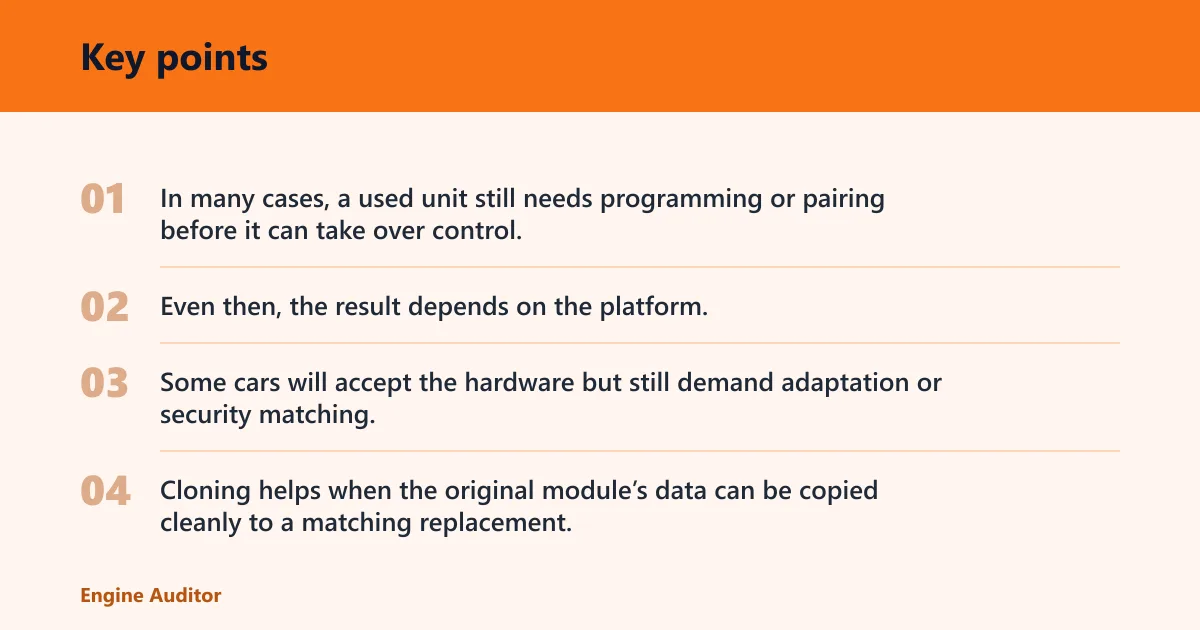
Used modules are not reliably plug-and-play. If the donor vehicle had different options, a different hardware revision, or a different transmission variant, the module may reject the car or behave incorrectly. In many cases, a used unit still needs programming or pairing before it can take over control.
When plug-and-play is realistic
Plug-and-play is most realistic when the replacement is a cloned unit, or when the used module is from the exact same application and the system tolerates it. Even then, the result depends on the platform. Some cars will accept the hardware but still demand adaptation or security matching.
When cloning helps
Cloning helps when the original module’s data can be copied cleanly to a matching replacement. That can reduce setup time and limit the need for coding. It is most useful when the original controller is dead but still readable, and when the donor unit is physically and electronically compatible.
When dealer access is still needed
Dealer-level or OEM-level access may still be required when the module needs software flashing, immobilizer pairing, or functions that a generic aftermarket scan tool cannot access. A professional scan tool can often read codes, run basic tests, and perform some relearns, but it may not complete every setup path.
Frequently asked questions
Is transmission control module coding required after replacement?
Usually yes, but not always in the same way. Some replacements need coding only, some need programming plus coding, and some also need adaptation or relearn. The deciding factors are module type, part number, hardware revision, and whether the vehicle expects security pairing or software flashing.
Can a replacement TCM work without programming?
Sometimes. If the module is already compatible, already flashed, and already matched to the vehicle’s setup, it may work with coding alone or even only with adaptation. If the software is wrong or missing, programming is required and a scan tool that cannot flash the module will not finish the job.
What’s the difference between coding, programming, and adaptation after TCM replacement?
Coding tells the module how to behave in the vehicle. Programming changes the software inside the module. Adaptation or relearn resets the transmission’s learned values so it can shift correctly with the new controller. They can all be needed on the same repair, but they solve different problems.
Do you need to relearn the transmission after installing a used module?
Often yes. A used module may carry old adaptation values or donor-car data that do not suit the current transmission. If the car allows it, a relearn or basic setting procedure can clear that mismatch. Without it, shift quality may stay rough even if the module communicates normally.
Will a new TCM fix shifting problems by itself?
No. A new TCM will not fix worn clutches, a valve body fault, bad sensors, wiring damage, or low voltage. It may correct a failed controller or a software mismatch, but the transmission still needs proper diagnosis first. Replacing the module without testing can waste money and time.
What happens if you install the wrong transmission control module?
The car may not communicate with it, may reject it during setup, or may enter limp mode. Wrong part numbers and hardware revisions can prevent coding or programming from completing. In some cases, the module may power up but never control shifts correctly, which leaves the original complaint unresolved.
Can a TCM be cloned instead of coded?
Sometimes. Cloning can copy usable data from the original module to a replacement, which may reduce coding work and speed installation. It only works when the source data is readable and the replacement hardware is compatible. A clone will not fix a bad power feed, CAN fault, or mechanical transmission issue.
Does the transmission control module need calibration after replacement?
Often yes, in the form of adaptation or relearn. Some manufacturers call this calibration, but the practical step is usually a transmission-specific reset or drive procedure. It is separate from coding and programming, and skipping it can leave the transmission shifting poorly even after a successful install.
For cost planning, diagnostic time, module setup, and relearn steps can add up quickly. MercGarage estimates initial diagnosis at AED 200–350, supported coding or programming at AED 300–750, and transmission controller work at AED 1,300–2,000. If a scan tool cannot complete the job, OEM-level access or a technician may be needed.
If you are buying a replacement, part compatibility and return terms matter too. Global Parts says it has sold over 5 million parts, lists over 150,000 parts, and mentions a 90-day warranty on selected parts. Those details do not prove a module will fit your car, but they do show why you should confirm the exact application before ordering.
Products related to this article
Sponsored / affiliate links. As an Amazon Associate I earn from qualifying purchases. I may earn additional commission from eligible campaigns.